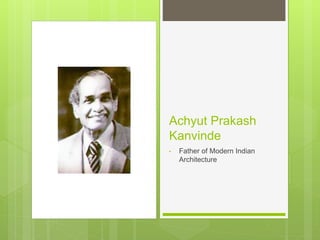
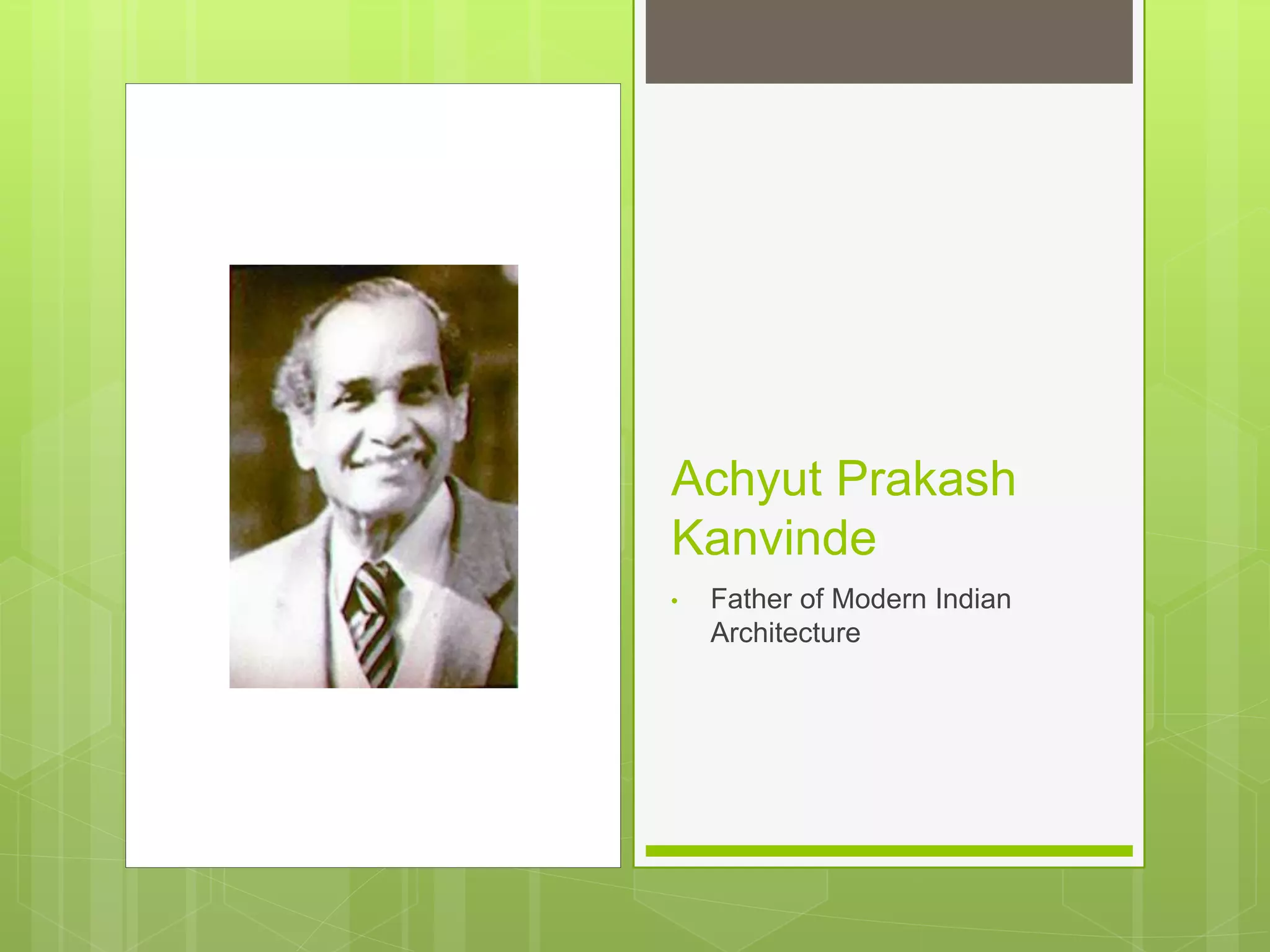
Achyut Prakash
Kanvinde
• Father of Modern Indian
Architecture
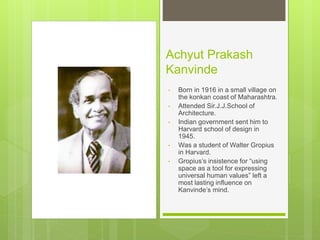
Achyut Prakash
Kanvinde
• Born in 1916 in a small village on
the konkan coast of Maharashtra.
• Attended Sir.J.J.School of
Architecture.
• Indian government sent him to
Harvard school of design in
1945.
• Was a student of Walter Gropius
in Harvard.
• Gropius’s insistence for “using
space as a tool for expressing
universal human values” left a
most lasting influence on
Kanvinde’s mind.
 Physical research
lab, Ahmedabad.
 Ahmedabad
textiles industries
research
association
building.
 Council of
scientific and
industrial research
center.
Prominent Works
From 1954 to 1964
 Harivallabdas House,
Ahmedabad.
 IIT Kanpur campus
 National dairy
development
board(Doodhsagar),
 Institute of rural
management
 Nehru science center
 Darpan dance academy
 National science center,
Delhi
 ISCKON temple, Delhi.
Prominent works
From 1964(Experiment period)
“In each of his buildings,
whether residential,
commercial, or government
complexes, one can see an
attempt to break away from
traditional architectural
design and yet design them
keeping in mind all the
aspects conducive to a
great building like, climate,
use of space, orientation
and aesthetics.”
- B.V. Doshi.
Achyut Kanvinde
Philosophy
 Functionalist Designs.
His buildings were always
conceived with first priority
given to its functions.
 Brutalism and
Regionalism.
An architectural expression
that reflected the ‘culture
and aspirations’ and clearly
reflected the rise of the
brutalist polemic (bold)
Architecture.
Achyut Kanvinde
Philosophy
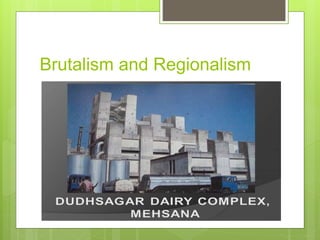
Brutalism and Regionalism
 His designs are slender,
balanced, proportionate,
neat and well balanced.
 He believed in
vernacular architecture.
 His buildings were
treated with the Indian
ancient philosophy of
Vaastu Sastra.
 Buildings were down to
Human scale.
 The building masses
were arranged such that
they were functional
from inside and elegant
from outside.
Achyut Kanvinde
Philosophy
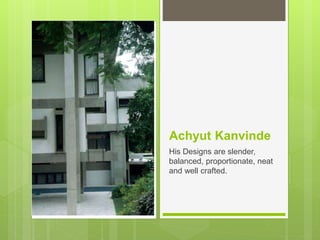
Achyut Kanvinde
His Designs are slender,
balanced, proportionate, neat
and well crafted.
 Functionalism was an
approach to architecture
associated with Bauhaus.
 Functionalist believed that the
shape and form of a building
should emerge out of the
logical arrangement of
space and not from any
predetermined idea like
symmetry.
 They believed that a building
should only have features that
were functionally necessary
and no non-functional
decoration.
 Buildings were
asymmetrical, pale, cuboid
forms with repetitive
arrangement of windows and
yet they were elegant.
Achyut Kanvinde
Functionalism and Kanvinde
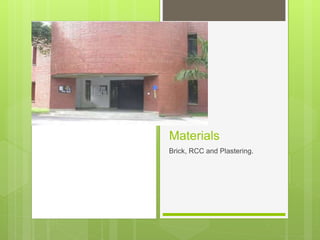
Materials
Brick, RCC and Plastering.
The local availability
of high quality brick
and the prevalent
Labour and
construction
practices made
Kanvinde go for
RCC for structural
frames and bricks as
infill.
Achyut Kanvinde
Materials
Kanvinde made an
aesthetic use of the
two materials.
Achyut Kanvinde
Materials
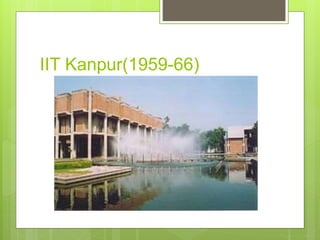
IIT Kanpur(1959-66)
IIT Kanpur
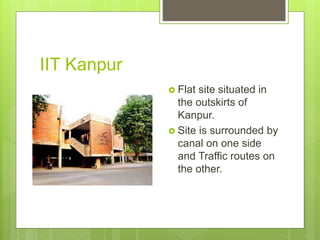
 Flat site situated in
the outskirts of
Kanpur.
 Site is surrounded by
canal on one side
and Traffic routes on
the other.
IIT Kanpur
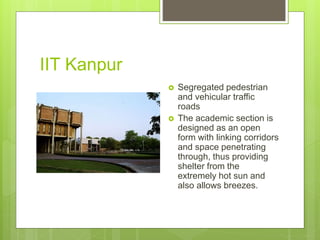
 Segregated pedestrian
and vehicular traffic
roads
 The academic section is
designed as an open
form with linking corridors
and space penetrating
through, thus providing
shelter from the
extremely hot sun and
also allows breezes.
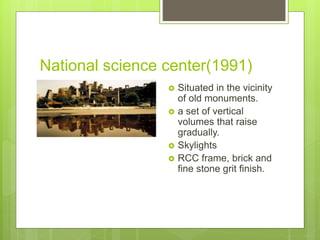
National science center(1991)
 Situated in the vicinity
of old monuments.
 a set of vertical
volumes that raise
gradually.
 Skylights
 RCC frame, brick and
fine stone grit finish.
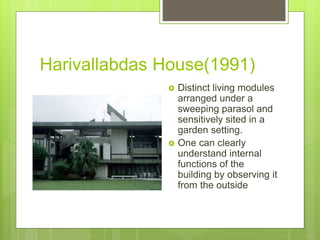
Harivallabdas House(1991)
 Distinct living modules
arranged under a
sweeping parasol and
sensitively sited in a
garden setting.
 One can clearly
understand internal
functions of the
building by observing it
from the outside
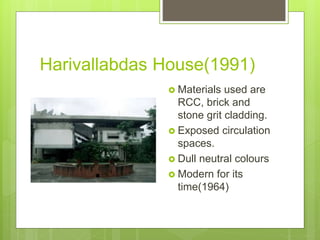
Harivallabdas House(1991)
 Materials used are
RCC, brick and
stone grit cladding.
 Exposed circulation
spaces.
 Dull neutral colours
 Modern for its
time(1964)
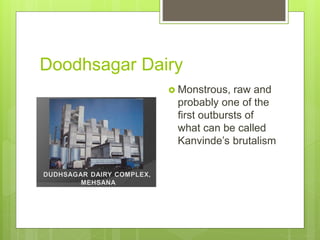
Doodhsagar Dairy
 Monstrous, raw and
probably one of the
first outbursts of
what can be called
Kanvinde’s brutalism
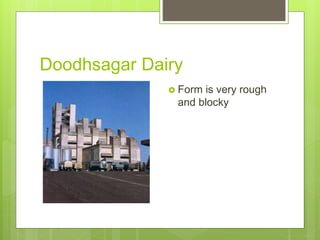
Doodhsagar Dairy
 Form is very rough
and blocky
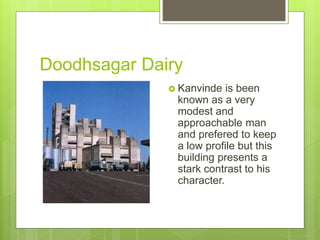
Doodhsagar Dairy
 Kanvinde is been
known as a very
modest and
approachable man
and prefered to keep
a low profile but this
building presents a
stark contrast to his
character.
Doodhsagar Dairy
“It was a time when everyday something new
was being created and India was just coming to
terms with its newly acquired independent
status. Kanvinde gave full rein to his innate
creativity in such a charged environment.”
- B.V.Doshi.
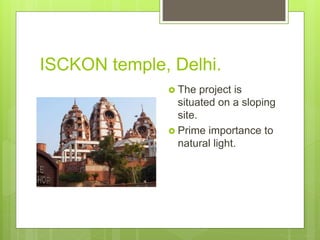
ISCKON temple, Delhi.
 The project is
situated on a sloping
site.
 Prime importance to
natural light.
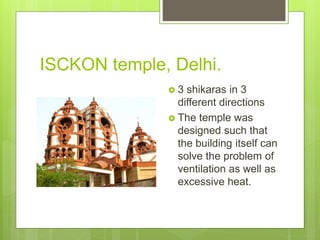
ISCKON temple, Delhi.
 3 shikaras in 3
different directions
 The temple was
designed such that
the building itself can
solve the problem of
ventilation as well as
excessive heat.
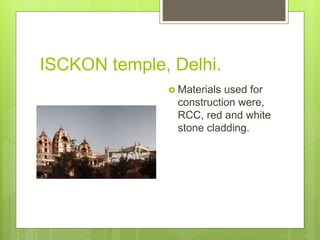
ISCKON temple, Delhi.
 Materials used for
construction were,
RCC, red and white
stone cladding.
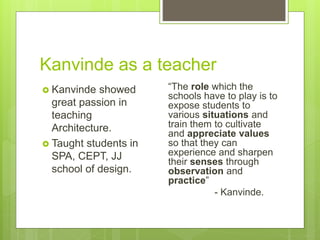
Kanvinde as a teacher
 Kanvinde showed
great passion in
teaching
Architecture.
 Taught students in
SPA, CEPT, JJ
school of design.
“The role which the
schools have to play is to
expose students to
various situations and
train them to cultivate
and appreciate values
so that they can
experience and sharpen
their senses through
observation and
practice”
- Kanvinde.

Achyut prakash kanvinde

  • 1.
    Achyut Prakash Kanvinde • Fatherof Modern Indian Architecture
  • 2.
    Achyut Prakash Kanvinde • Bornin 1916 in a small village on the konkan coast of Maharashtra. • Attended Sir.J.J.School of Architecture. • Indian government sent him to Harvard school of design in 1945. • Was a student of Walter Gropius in Harvard. • Gropius’s insistence for “using space as a tool for expressing universal human values” left a most lasting influence on Kanvinde’s mind.
  • 3.
     Physical research lab,Ahmedabad.  Ahmedabad textiles industries research association building.  Council of scientific and industrial research center. Prominent Works From 1954 to 1964
  • 4.
     Harivallabdas House, Ahmedabad. IIT Kanpur campus  National dairy development board(Doodhsagar),  Institute of rural management  Nehru science center  Darpan dance academy  National science center, Delhi  ISCKON temple, Delhi. Prominent works From 1964(Experiment period)
  • 5.
    “In each ofhis buildings, whether residential, commercial, or government complexes, one can see an attempt to break away from traditional architectural design and yet design them keeping in mind all the aspects conducive to a great building like, climate, use of space, orientation and aesthetics.” - B.V. Doshi. Achyut Kanvinde Philosophy
  • 6.
     Functionalist Designs. Hisbuildings were always conceived with first priority given to its functions.  Brutalism and Regionalism. An architectural expression that reflected the ‘culture and aspirations’ and clearly reflected the rise of the brutalist polemic (bold) Architecture. Achyut Kanvinde Philosophy
  • 7.
  • 8.
     His designsare slender, balanced, proportionate, neat and well balanced.  He believed in vernacular architecture.  His buildings were treated with the Indian ancient philosophy of Vaastu Sastra.  Buildings were down to Human scale.  The building masses were arranged such that they were functional from inside and elegant from outside. Achyut Kanvinde Philosophy
  • 9.
    Achyut Kanvinde His Designsare slender, balanced, proportionate, neat and well crafted.
  • 10.
     Functionalism wasan approach to architecture associated with Bauhaus.  Functionalist believed that the shape and form of a building should emerge out of the logical arrangement of space and not from any predetermined idea like symmetry.  They believed that a building should only have features that were functionally necessary and no non-functional decoration.  Buildings were asymmetrical, pale, cuboid forms with repetitive arrangement of windows and yet they were elegant. Achyut Kanvinde Functionalism and Kanvinde
  • 11.
  • 12.
    The local availability ofhigh quality brick and the prevalent Labour and construction practices made Kanvinde go for RCC for structural frames and bricks as infill. Achyut Kanvinde Materials
  • 13.
    Kanvinde made an aestheticuse of the two materials. Achyut Kanvinde Materials
  • 14.
  • 15.
    IIT Kanpur  Flatsite situated in the outskirts of Kanpur.  Site is surrounded by canal on one side and Traffic routes on the other.
  • 16.
    IIT Kanpur  Segregatedpedestrian and vehicular traffic roads  The academic section is designed as an open form with linking corridors and space penetrating through, thus providing shelter from the extremely hot sun and also allows breezes.
  • 17.
    National science center(1991) Situated in the vicinity of old monuments.  a set of vertical volumes that raise gradually.  Skylights  RCC frame, brick and fine stone grit finish.
  • 18.
    Harivallabdas House(1991)  Distinctliving modules arranged under a sweeping parasol and sensitively sited in a garden setting.  One can clearly understand internal functions of the building by observing it from the outside
  • 19.
    Harivallabdas House(1991)  Materialsused are RCC, brick and stone grit cladding.  Exposed circulation spaces.  Dull neutral colours  Modern for its time(1964)
  • 20.
    Doodhsagar Dairy  Monstrous,raw and probably one of the first outbursts of what can be called Kanvinde’s brutalism
  • 21.
    Doodhsagar Dairy  Formis very rough and blocky
  • 22.
    Doodhsagar Dairy  Kanvindeis been known as a very modest and approachable man and prefered to keep a low profile but this building presents a stark contrast to his character.
  • 23.
    Doodhsagar Dairy “It wasa time when everyday something new was being created and India was just coming to terms with its newly acquired independent status. Kanvinde gave full rein to his innate creativity in such a charged environment.” - B.V.Doshi.
  • 24.
    ISCKON temple, Delhi. The project is situated on a sloping site.  Prime importance to natural light.
  • 25.
    ISCKON temple, Delhi. 3 shikaras in 3 different directions  The temple was designed such that the building itself can solve the problem of ventilation as well as excessive heat.
  • 26.
    ISCKON temple, Delhi. Materials used for construction were, RCC, red and white stone cladding.
  • 27.
    Kanvinde as ateacher  Kanvinde showed great passion in teaching Architecture.  Taught students in SPA, CEPT, JJ school of design. “The role which the schools have to play is to expose students to various situations and train them to cultivate and appreciate values so that they can experience and sharpen their senses through observation and practice” - Kanvinde.