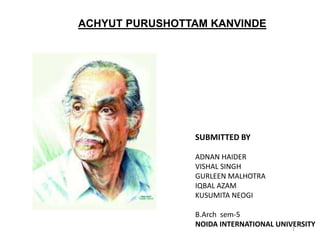
ACHYUT PURUSHOTTAM KANVINDE
SUBMITTED BY
ADNAN HAIDER
VISHAL SINGH
GURLEEN MALHOTRA
IQBAL AZAM
KUSUMITA NEOGI
B.Arch sem-5
NOIDA INTERNATIONAL UNIVERSITY
1
2
ARCHITECTURAL PRINCIPLES
• His buildings were simple and he used to tell the students
“ARCHITECTURE IS NOT A MUSEUM OF MATERIAL”
• The various principles reflected in most of Kanvinde’s work would be:
Logic of light
Functionalism
Asymmetry
Blocky
Cubic shapes
Smooth, flat, plain, Undecorated surfaces
Flat roofs
Adoption of steel framed or reinforced concrete post and slab.
CONCEPTS
•Kanvinde believed that a grid of columns forming a matrix giving structural
and spatial aspect would turn a design to more sophisticated.
• He treated his building with ‘VASTUSHASTRA’.
• He also used maximum principles of vernacular architecture
BORN :1916
DIED : 28TH DECEMBER 2002
EDUCATION
He was graduted from sir J.J. school of arts, Mumbai in 1941 and attended Harvard
university under Walter Gropius.
ACHIEVEMENTS
• Recipient of Padmashree – National Honour from
Govt. of India 1975
• Recipient of Gold Medal of the Indian Institute of
Architects 1985
• National Award for Institution of Engineers for
Architectural Engineering 1990
• Great Master National Award by J.K. Industries Ltd
in 1993
• Outstanding Konkan Award in 2003
3
4
5
• Constructed during 1960-1965
CONTEXT
• Total area 1000 acres
•Its located centrally at the free from traffic
noise
• Academic buildings
• Library
• Computer Centres faculty offices
• laboratories and administrative buildings
• 10 boys hostel and 2 girls hostel
• Sports complex
• Housing for faculty
• No of buildings 108
The BAUHAUS influence is visible in IITK
• Cubic shapes
• Smooth, flat surfaces
• Flat roof
6
N
7
MATERIALS
•High quality brick
•Reinforced concrete
8
9
P.K. KELEKAR
LIBRARY is important
part of the complex
Four storied structure
Builtup area: 5730
sq.m.
Exposed brick work:
reduces the maintaince
costs and enhances
aesthetic appeal
Framed structure based on grids
Built in R.C.C with brick façade
10
11
Built in 1973.
STYLE OF ARCHITECTURE : BRUTALISM
One of the largest Milk processing unit in Gujarat.
FEATURES
• Monstrous and raw
• The form is very rough and
blocky
• Cold character
• One of the first outburts of
kanvinde’s brutalism
12
1. Milk receiving
2. Truck deck
3. Elevated deck
4. Tank
5. Powder filling packing
6. Goods lift
7. Vent shaft
8. Canopy
9. Spray dryer
10. Shaft
PLAN
13
• Ventilation points are expressed as large shafts that rise above the
roof level
• They evacuate the hot air by natural convection eliminating the need
for mechanical exhaust system
•The natural slope of the site utilized to
advantage of a multi processing system
•Milk receiving is doe at the roof.
•Processing is done at the second level
•The third and the lower most level
accommodate the worker’s amenities.
CONTEXT
14
3. NATIONAL SCIENCE CENTER
• Location- Pargati Maidan, New Delhi.
• Site Area- 7000 sqm
• Material used- Rcc frame, Brick infill plastered in a
fine stone grit finish
15
THANK YOU
16

Ap kanvinde

  • 1.
    ACHYUT PURUSHOTTAM KANVINDE SUBMITTEDBY ADNAN HAIDER VISHAL SINGH GURLEEN MALHOTRA IQBAL AZAM KUSUMITA NEOGI B.Arch sem-5 NOIDA INTERNATIONAL UNIVERSITY 1
  • 2.
    2 ARCHITECTURAL PRINCIPLES • Hisbuildings were simple and he used to tell the students “ARCHITECTURE IS NOT A MUSEUM OF MATERIAL” • The various principles reflected in most of Kanvinde’s work would be: Logic of light Functionalism Asymmetry Blocky Cubic shapes Smooth, flat, plain, Undecorated surfaces Flat roofs Adoption of steel framed or reinforced concrete post and slab. CONCEPTS •Kanvinde believed that a grid of columns forming a matrix giving structural and spatial aspect would turn a design to more sophisticated. • He treated his building with ‘VASTUSHASTRA’. • He also used maximum principles of vernacular architecture BORN :1916 DIED : 28TH DECEMBER 2002 EDUCATION He was graduted from sir J.J. school of arts, Mumbai in 1941 and attended Harvard university under Walter Gropius.
  • 3.
    ACHIEVEMENTS • Recipient ofPadmashree – National Honour from Govt. of India 1975 • Recipient of Gold Medal of the Indian Institute of Architects 1985 • National Award for Institution of Engineers for Architectural Engineering 1990 • Great Master National Award by J.K. Industries Ltd in 1993 • Outstanding Konkan Award in 2003 3
  • 4.
  • 5.
    5 • Constructed during1960-1965 CONTEXT • Total area 1000 acres •Its located centrally at the free from traffic noise • Academic buildings • Library • Computer Centres faculty offices • laboratories and administrative buildings • 10 boys hostel and 2 girls hostel • Sports complex • Housing for faculty • No of buildings 108 The BAUHAUS influence is visible in IITK • Cubic shapes • Smooth, flat surfaces • Flat roof
  • 6.
  • 7.
  • 8.
  • 9.
    9 P.K. KELEKAR LIBRARY isimportant part of the complex Four storied structure Builtup area: 5730 sq.m. Exposed brick work: reduces the maintaince costs and enhances aesthetic appeal Framed structure based on grids Built in R.C.C with brick façade
  • 10.
  • 11.
    11 Built in 1973. STYLEOF ARCHITECTURE : BRUTALISM One of the largest Milk processing unit in Gujarat. FEATURES • Monstrous and raw • The form is very rough and blocky • Cold character • One of the first outburts of kanvinde’s brutalism
  • 12.
    12 1. Milk receiving 2.Truck deck 3. Elevated deck 4. Tank 5. Powder filling packing 6. Goods lift 7. Vent shaft 8. Canopy 9. Spray dryer 10. Shaft PLAN
  • 13.
    13 • Ventilation pointsare expressed as large shafts that rise above the roof level • They evacuate the hot air by natural convection eliminating the need for mechanical exhaust system •The natural slope of the site utilized to advantage of a multi processing system •Milk receiving is doe at the roof. •Processing is done at the second level •The third and the lower most level accommodate the worker’s amenities. CONTEXT
  • 14.
    14 3. NATIONAL SCIENCECENTER • Location- Pargati Maidan, New Delhi. • Site Area- 7000 sqm • Material used- Rcc frame, Brick infill plastered in a fine stone grit finish
  • 15.
  • 16.