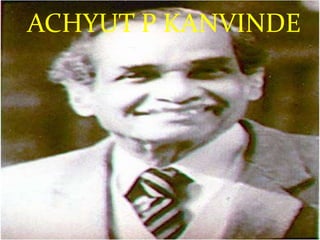
ACHYUT P KANVINDE
INTRODUCTION 
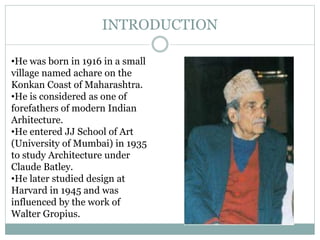
•He was born in 1916 in a small 
village named achare on the 
Konkan Coast of Maharashtra. 
•He is considered as one of 
forefathers of modern Indian 
Arhitecture. 
•He entered JJ School of Art 
(University of Mumbai) in 1935 
to study Architecture under 
Claude Batley. 
•He later studied design at 
Harvard in 1945 and was 
influenced by the work of 
Walter Gropius.
WORKS 
•Physical Research 
laboratory,Ahmedabad 
•Ahmedabad textiles Industries 
research association 
•Harivallabdas 
house,Ahmedabad 
•Gandhi krishi Vigyan Kendra, 
Bangalore 
•PK Kelkar library, IIT Kanpur, 
•Dudhsagar diary,Mehsna ( 
national diary development 
board) 
•Institute of rural management, 
Anand 
•Nehru Science Center, Mumbai 
•National Science Center, New 
Delhi 
•National insurance academy, 
Pune 
•ISKCON temple, East of 
Kailash, Delhi 
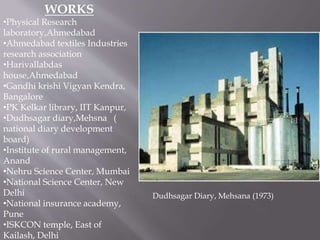
Dudhsagar Diary, Mehsana (1973)
LIFETIME 
ACHIEVEMENTS 
•Awarded Padma Shree in1976 
•President IIA 
•Co-Authored book “Campus 
Design in India” 
•IIA’s Babu Rao Mhatre Gold 
Medal for life time achievement in 
1985 
•Great Masters Award from JK 
Industries Ltd. in 1993. 
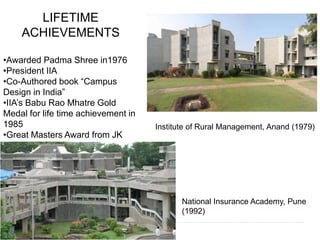
Institute of Rural Management, Anand (1979) 
National Insurance Academy, Pune 
(1992)
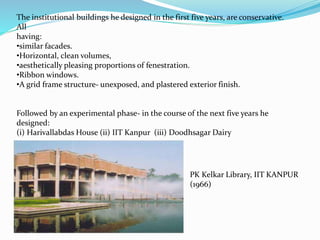
The institutional buildings he designed in the first five years, are conservative. 
All 
having: 
•similar facades. 
•Horizontal, clean volumes, 
•aesthetically pleasing proportions of fenestration. 
•Ribbon windows. 
•A grid frame structure- unexposed, and plastered exterior finish. 
Followed by an experimental phase- in the course of the next five years he 
designed: 
(i) Harivallabdas House (ii) IIT Kanpur (iii) Doodhsagar Dairy 
PK Kelkar Library, IIT KANPUR 
(1966)
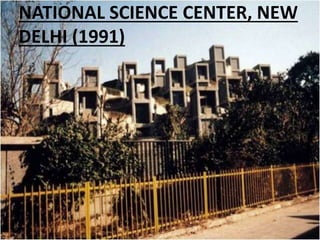
NATIONAL SCIENCE CENTER, NEW 
DELHI (1991)
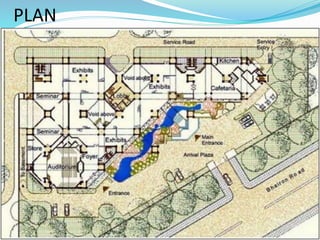
PLAN
•Situated in the vicinity of old monuments of Delhi providing a new fabric to 
the city and at the same time feeling of the ancient building. 
•A set of vertical volumes that rise gradually- this buildings is visually 
appealing, and unimposing. It has a large grand flight of steps on its 
entrance. 
• The skylights- which are the dominant highlight of the design are a 
common repeating element in many of his works- such as the Doodhsagar 
Dairy, and the Nehru Science Center, Mumbai. 
•The building seems to have a simple & efficiently designed structural 
system, and a functional approach in its layout 
•The building accommodates a complex of workshops, library, lecture halls 
and observatory. 
• Site Location- Bhairon Road, Adjacent Pragati Maidan, New Delhi. 
•Site Area- 7000m2 
• Materials Used: RCC frame, brick infill plastered in a fine stone grit finish.
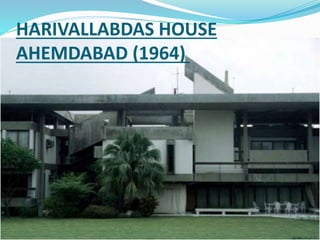
HARIVALLABDAS HOUSE 
AHEMDABAD (1964)
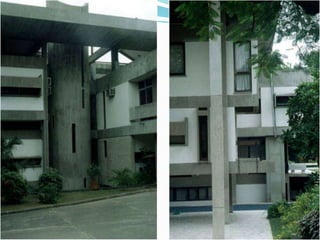
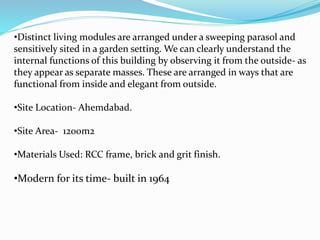
•Distinct living modules are arranged under a sweeping parasol and 
sensitively sited in a garden setting. We can clearly understand the 
internal functions of this building by observing it from the outside- as 
they appear as separate masses. These are arranged in ways that are 
functional from inside and elegant from outside. 
•Site Location- Ahemdabad. 
•Site Area- 1200m2 
•Materials Used: RCC frame, brick and grit finish. 
•Modern for its time- built in 1964
CONCLUSION 
•Kanvinde’s career spanned a period of about 50 years. 
•It was a prolific career in that the scale and number of projects he worked on 
from the beginning are incomparable. 
•There are infinite number of concerns, influences and traditions that have shaped 
Kanvinde’s works. 
• A much deep-probing understanding of his life and his work responsive to his 
larger interests and concerns seems important to clarify the important phase of 
the political and social process in the creation in the new country which he shaped 
and guided. 
•Humility and reticence are acclaimed hallmarks of his persona, which is probably 
one of the reasons his works have not been as widely known as they could have 
been.
Achyut p kanvinde
Achyut p kanvinde

Achyut p kanvinde

  • 1.
  • 2.
    INTRODUCTION •He wasborn in 1916 in a small village named achare on the Konkan Coast of Maharashtra. •He is considered as one of forefathers of modern Indian Arhitecture. •He entered JJ School of Art (University of Mumbai) in 1935 to study Architecture under Claude Batley. •He later studied design at Harvard in 1945 and was influenced by the work of Walter Gropius.
  • 3.
    WORKS •Physical Research laboratory,Ahmedabad •Ahmedabad textiles Industries research association •Harivallabdas house,Ahmedabad •Gandhi krishi Vigyan Kendra, Bangalore •PK Kelkar library, IIT Kanpur, •Dudhsagar diary,Mehsna ( national diary development board) •Institute of rural management, Anand •Nehru Science Center, Mumbai •National Science Center, New Delhi •National insurance academy, Pune •ISKCON temple, East of Kailash, Delhi Dudhsagar Diary, Mehsana (1973)
  • 4.
    LIFETIME ACHIEVEMENTS •AwardedPadma Shree in1976 •President IIA •Co-Authored book “Campus Design in India” •IIA’s Babu Rao Mhatre Gold Medal for life time achievement in 1985 •Great Masters Award from JK Industries Ltd. in 1993. Institute of Rural Management, Anand (1979) National Insurance Academy, Pune (1992)
  • 5.
    The institutional buildingshe designed in the first five years, are conservative. All having: •similar facades. •Horizontal, clean volumes, •aesthetically pleasing proportions of fenestration. •Ribbon windows. •A grid frame structure- unexposed, and plastered exterior finish. Followed by an experimental phase- in the course of the next five years he designed: (i) Harivallabdas House (ii) IIT Kanpur (iii) Doodhsagar Dairy PK Kelkar Library, IIT KANPUR (1966)
  • 6.
    NATIONAL SCIENCE CENTER,NEW DELHI (1991)
  • 7.
  • 8.
    •Situated in thevicinity of old monuments of Delhi providing a new fabric to the city and at the same time feeling of the ancient building. •A set of vertical volumes that rise gradually- this buildings is visually appealing, and unimposing. It has a large grand flight of steps on its entrance. • The skylights- which are the dominant highlight of the design are a common repeating element in many of his works- such as the Doodhsagar Dairy, and the Nehru Science Center, Mumbai. •The building seems to have a simple & efficiently designed structural system, and a functional approach in its layout •The building accommodates a complex of workshops, library, lecture halls and observatory. • Site Location- Bhairon Road, Adjacent Pragati Maidan, New Delhi. •Site Area- 7000m2 • Materials Used: RCC frame, brick infill plastered in a fine stone grit finish.
  • 9.
  • 11.
    •Distinct living modulesare arranged under a sweeping parasol and sensitively sited in a garden setting. We can clearly understand the internal functions of this building by observing it from the outside- as they appear as separate masses. These are arranged in ways that are functional from inside and elegant from outside. •Site Location- Ahemdabad. •Site Area- 1200m2 •Materials Used: RCC frame, brick and grit finish. •Modern for its time- built in 1964
  • 12.
    CONCLUSION •Kanvinde’s careerspanned a period of about 50 years. •It was a prolific career in that the scale and number of projects he worked on from the beginning are incomparable. •There are infinite number of concerns, influences and traditions that have shaped Kanvinde’s works. • A much deep-probing understanding of his life and his work responsive to his larger interests and concerns seems important to clarify the important phase of the political and social process in the creation in the new country which he shaped and guided. •Humility and reticence are acclaimed hallmarks of his persona, which is probably one of the reasons his works have not been as widely known as they could have been.