Chapter Nine Political Parties
Political Parties A party is a group that seeks to elect candidates to public office by supplying them with a label (party identification), by which they are known to the electorate United States parties have become weaker as labels, sets of leaders, and organizations
Parties in the US and Europe European parties are disciplined gatekeepers, to which voters are very loyal, though this has been declining recently The federal system decentralizes power in U.S. Parties are closely regulated by state and federal laws, which weaken them Candidates are now chosen through primaries, not by party leaders
The Rise and Decline of Parties The founders disliked parties, viewing them as factions During the Jacksonian era political participation became a mass phenomenon From the Civil War until the 1930s most states were dominated by one party Progressives pushed measures to curtail parties’ power and influence
The Results of Reform The worst forms of political corruption were reduced All political parties were weakened; parties became less able to hold officeholders accountable or to coordinate across the branches of government
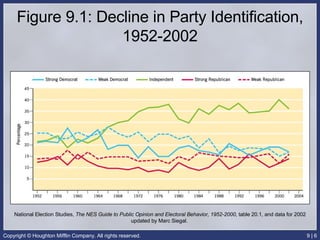
Figure 9.1: Decline in Party Identification, 1952-2002 National Election Studies,  The NES Guide to Public Opinion and Electoral Behavior, 1952-2000 , table 20.1, and data for 2002 updated by Marc Siegal.
Party Realignment Critical or realigning periods : periods when a sharp, lasting shift occurs in the popular coalition supporting one or both parties Two kinds of realignments A major party is defeated so badly that it disappears and a new party emerges Two existing parties continue but voters shift their loyalty from one to another
Realignments 1860: slavery issue fixed new loyalties in the popular mind 1896: economic issues shifted loyalties to East/West, city/farm split 1932: economic depression triggered new coalition for Democrats 1980: Could not have been a traditional realignment, because Congress was left in the hands of the Democrats
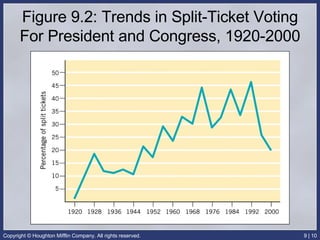
Party Decline Evidence that parties are declining, not realigning Proportion of people identifying with a party declined between 1960 and 1980 Proportion of those voting a split ticket increased
Figure 9.2: Trends in Split-Ticket Voting For President and Congress, 1920-2000
Party Structure Parties are similar on paper  RNC effectively created a national firm of political consultants Democrats moved to factionalized structure and redistributed power By the 1990s, DNC had learned from the RNC: adopted the same techniques, with some success
Nominating a President Primary : an election in which voters select the candidate who will run on each party’s ticket Caucus : a meeting of party followers at which delegates are picked
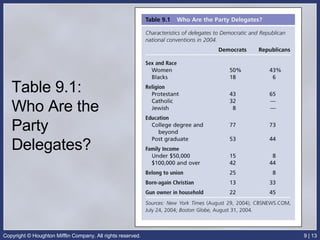
Table 9.1: Who Are the Party Delegates?
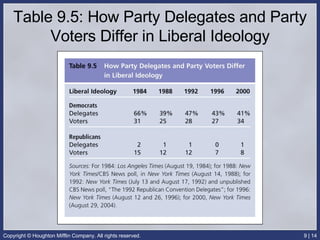
Table 9.5: How Party Delegates and Party Voters Differ in Liberal Ideology
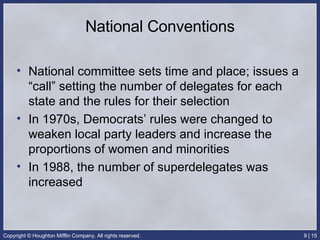
National Conventions National committee sets time and place; issues a “call” setting the number of delegates for each state and the rules for their selection In 1970s, Democrats’ rules were changed to weaken local party leaders and increase the proportions of women and minorities In 1988, the number of superdelegates was increased
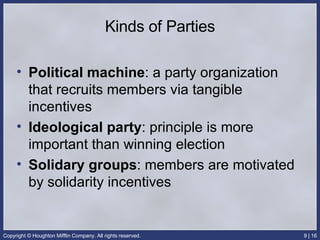
Kinds of Parties Political machine : a party organization that recruits members via tangible incentives  Ideological party : principle is more important than winning election Solidary groups : members are motivated by solidarity incentives
Kinds of Parties Sponsored parties : created or sustained by another organization Personal following : requires an appealing personality, an extensive network, name recognition, and money
Reasons for the Two Party System Electoral system—winner-take-all and plurality system limit the number of parties Opinions of voters—two broad coalitions work, although there may be times of bitter dissent State laws have made it very difficult for third parties to get on the ballot
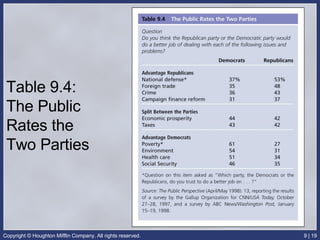
Table 9.4: The Public Rates the Two Parties
Minor Parties Ideological parties : comprehensive, radical view; most enduring One-issue parties : address one concern, avoid others Economic protest parties : regional, protest economic conditions Factional parties : from split in a major party, usually over the party’s presidential nominee
Impact of Minor Parties Conventional wisdom holds that minor parties develop ideas that the major parties adopt Factional parties have had probably the greatest influence on public policy

ap gov chap 9

  • 1.
  • 2.
    Political Parties Aparty is a group that seeks to elect candidates to public office by supplying them with a label (party identification), by which they are known to the electorate United States parties have become weaker as labels, sets of leaders, and organizations
  • 3.
    Parties in theUS and Europe European parties are disciplined gatekeepers, to which voters are very loyal, though this has been declining recently The federal system decentralizes power in U.S. Parties are closely regulated by state and federal laws, which weaken them Candidates are now chosen through primaries, not by party leaders
  • 4.
    The Rise andDecline of Parties The founders disliked parties, viewing them as factions During the Jacksonian era political participation became a mass phenomenon From the Civil War until the 1930s most states were dominated by one party Progressives pushed measures to curtail parties’ power and influence
  • 5.
    The Results ofReform The worst forms of political corruption were reduced All political parties were weakened; parties became less able to hold officeholders accountable or to coordinate across the branches of government
  • 6.
    Figure 9.1: Declinein Party Identification, 1952-2002 National Election Studies, The NES Guide to Public Opinion and Electoral Behavior, 1952-2000 , table 20.1, and data for 2002 updated by Marc Siegal.
  • 7.
    Party Realignment Criticalor realigning periods : periods when a sharp, lasting shift occurs in the popular coalition supporting one or both parties Two kinds of realignments A major party is defeated so badly that it disappears and a new party emerges Two existing parties continue but voters shift their loyalty from one to another
  • 8.
    Realignments 1860: slaveryissue fixed new loyalties in the popular mind 1896: economic issues shifted loyalties to East/West, city/farm split 1932: economic depression triggered new coalition for Democrats 1980: Could not have been a traditional realignment, because Congress was left in the hands of the Democrats
  • 9.
    Party Decline Evidencethat parties are declining, not realigning Proportion of people identifying with a party declined between 1960 and 1980 Proportion of those voting a split ticket increased
  • 10.
    Figure 9.2: Trendsin Split-Ticket Voting For President and Congress, 1920-2000
  • 11.
    Party Structure Partiesare similar on paper RNC effectively created a national firm of political consultants Democrats moved to factionalized structure and redistributed power By the 1990s, DNC had learned from the RNC: adopted the same techniques, with some success
  • 12.
    Nominating a PresidentPrimary : an election in which voters select the candidate who will run on each party’s ticket Caucus : a meeting of party followers at which delegates are picked
  • 13.
    Table 9.1: WhoAre the Party Delegates?
  • 14.
    Table 9.5: HowParty Delegates and Party Voters Differ in Liberal Ideology
  • 15.
    National Conventions Nationalcommittee sets time and place; issues a “call” setting the number of delegates for each state and the rules for their selection In 1970s, Democrats’ rules were changed to weaken local party leaders and increase the proportions of women and minorities In 1988, the number of superdelegates was increased
  • 16.
    Kinds of PartiesPolitical machine : a party organization that recruits members via tangible incentives Ideological party : principle is more important than winning election Solidary groups : members are motivated by solidarity incentives
  • 17.
    Kinds of PartiesSponsored parties : created or sustained by another organization Personal following : requires an appealing personality, an extensive network, name recognition, and money
  • 18.
    Reasons for theTwo Party System Electoral system—winner-take-all and plurality system limit the number of parties Opinions of voters—two broad coalitions work, although there may be times of bitter dissent State laws have made it very difficult for third parties to get on the ballot
  • 19.
    Table 9.4: ThePublic Rates the Two Parties
  • 20.
    Minor Parties Ideologicalparties : comprehensive, radical view; most enduring One-issue parties : address one concern, avoid others Economic protest parties : regional, protest economic conditions Factional parties : from split in a major party, usually over the party’s presidential nominee
  • 21.
    Impact of MinorParties Conventional wisdom holds that minor parties develop ideas that the major parties adopt Factional parties have had probably the greatest influence on public policy