American Government C H A P T E R  10 Congress © 2001 by Prentice Hall, Inc.
Two Houses of Congress Historical:  The British Parliament consisted of two houses since the 1300s, and many colonial assemblies were similar in form. Practical:  A bicameral legislature was necessary to compromise the Virginia and New Jersey plans of representation.  Theoretical:  The Framers favored a bicameral Congress in order that one house might act as a check on the other. The Constitution creates a  bicameral  (two house) legislature for three reasons: Chapter 10, Section 1 2 3 4
Terms A  term   is the length of time that officials serve after an election, as in a two- or six-year term. Chapter 10, Section 1 2 3 4 The date for the start of each new term has been set by the Twentieth Amendment (1933) as “noon of the 3d day of January” of every odd-numbered year.
Sessions of Congress Chapter 10, Section 1 A  session  is the regular period of time during which Congress conducts business. 2 3 4 Each Congress last  two years .  This two-year term is broken into  two  one-year congressional sessions running from January to December. Congress  adjourns ,   or suspends until the next session, each regular session as it sees fit. Only the President may call Congress into a  special session —a meeting to deal with some emergency situation that has occurred after adjournment.
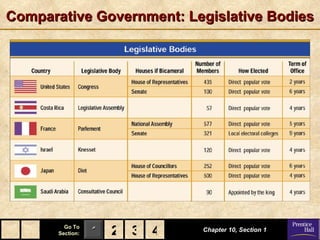
Comparative Government: Legislative Bodies Chapter 10, Section 1 2 3 4
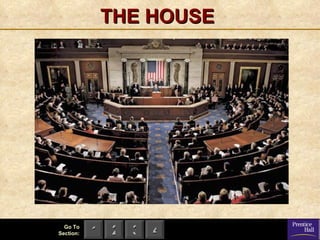
THE HOUSE
Size and Terms The exact size of the House of Representatives, currently at 435 members, is determined by Congress. The Constitution provides that the total number of seats in the House shall be  apportioned  (distributed) among the States on the basis of their respective populations. Chapter 10, Section 2 3 4 1 Members of the House of Representatives serve two-year terms. Although there have been recent movements to limit terms, there are no limits set on the number of terms a representative may serve.
Qualifications for House Members The Constitution says that a member of the House   (1) must be at least 25 years of age,   (2) must have been a citizen of the United States for at least seven years, and (3) must have been an inhabitant of the State from which he or she is elected. The realities of politics also require some informal qualifications, such as party identification, name familiarity, gender, ethnic characteristics, and political experience. Chapter 10, Section 2 3 4 1
Congressional Elections Congressional elections are held on the Tuesday following the first Monday in November of each even-numbered year. Off-year elections  are those congressional elections held between presidential elections. Chapter 10, Section 2 3 4 1
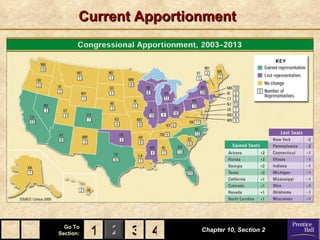
Reapportionment Article I of the Constitution directs Congress to  reapportion —redistribute—the seats in the House after each decennial census.  (Every 10 years) Chapter 10, Section 2 3 4 1 As the United States grew in population, the number of representatives in the House also grew. The Reapportionment Act of 1929 set the “permanent” size of the House at 435 members, and provided for “automatic reapportionment.”
Current Apportionment Chapter 10, Section 2 3 4 1
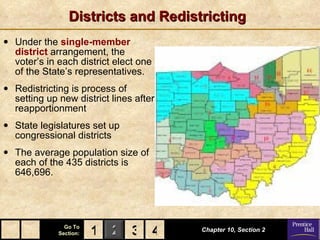
Districts and Redistricting Under the  single-member district   arrangement, the voter’s in each district elect one of the State’s representatives.  Redistricting is process of setting up new district lines after reapportionment State legislatures set up congressional districts The average population size of each of the 435 districts is 646,696.  Chapter 10, Section 2 3 4 1
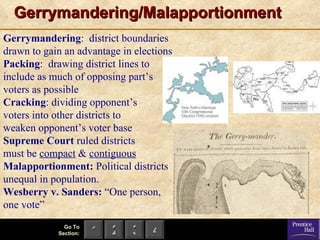
Gerrymandering/Malapportionment Gerrymandering :  district boundaries drawn to gain an advantage in elections Packing :  drawing district lines to include as much of opposing part’s voters as possible Cracking : dividing opponent’s  voters into other districts to weaken opponent’s voter base Supreme Court  ruled districts must be  compact  &  contiguous Malapportionment:  Political districts unequal in population. Wesberry v. Sanders:  “One person, one vote”
The Senate
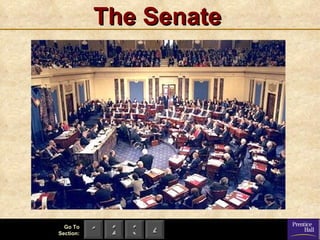
Size, Election, and Terms The Constitution says that the Senate “shall be composed of two Senators from each State.” Today’s Senate consists of 100 Senators. Originally, the Constitution provided that senators were chosen by the State legislatures.  In 1912 the  Seventeenth Amendment  was passed and called for the popular election of senators. Senators serve for six-year terms. The Senate is a  continuous body ,  meaning that all of its seats are never up for election at the same time.  1/3 are up for reelection every two years.  Chapter 10, Section 3 2 4 1
Qualifications for Senators The requirements for the U.S. Senate are higher than for the House of Representatives. The Constitution says that a Senator   (1) must be at least 30 years of age,   (2) must have been a citizen of the United States for at least nine years, and (3) must be an inhabitant of the State from which he or she is elected. Chapter 10, Section 3 2 4 1 5
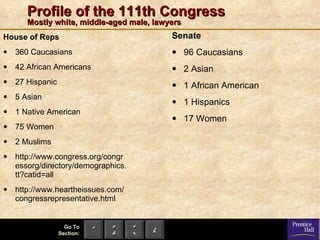
Profile of the 111th Congress   Mostly   white, middle-aged male, lawyers House of Reps 360 Caucasians 42 African Americans 27 Hispanic 5 Asian 1 Native American 75 Women  2 Muslims http://www.congress.org/congressorg/directory/demographics.tt?catid=all http://www.heartheissues.com/congressrepresentative.html Senate 96 Caucasians 2 Asian 1 African American 1 Hispanics 17 Women
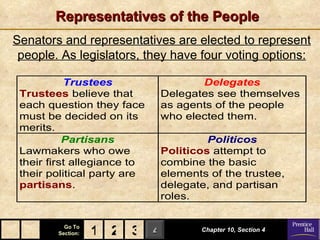
Representatives of the People Chapter 10, Section 4 2 3 1 Senators and representatives are elected to represent people. As legislators, they have four voting options:
Committee Membership and Public Servants As committee members, senators and representatives screen proposed laws before they are voted on. Another vital part of their committee work involves the  oversight function . Oversight is the the process by which Congress, through its committees, checks to see that the agencies of the executive branch are working effectively. Members of the House and the Senate also act as servants of their constituents. Requests from voters vary widely, and members of Congress take heed to many of them. Ignoring their constituencies would not bode well in the next election. Chapter 10, Section 4 2 3 1
Compensation Today, senators and representatives are paid a salary of $169,300 a year. Certain members, such as the Speaker of the House and the Senate’s president  pro tem , are paid more. The  franking privilege  allows members of Congress to mail letters and other materials postage-free by substituting their facsimile signature (frank) for the postage. The Constitution says that Congress fixes its own “compensation.” Therefore, the only real limits to congressional pay are the President’s veto and fear of voter backlash against a pay increase. The  27th Amendment  did place a small check on congressional pay increases. Chapter 10, Section 4 2 3 1

Chapter 10

  • 1.
    American Government CH A P T E R 10 Congress © 2001 by Prentice Hall, Inc.
  • 2.
    Two Houses ofCongress Historical: The British Parliament consisted of two houses since the 1300s, and many colonial assemblies were similar in form. Practical: A bicameral legislature was necessary to compromise the Virginia and New Jersey plans of representation. Theoretical: The Framers favored a bicameral Congress in order that one house might act as a check on the other. The Constitution creates a bicameral (two house) legislature for three reasons: Chapter 10, Section 1 2 3 4
  • 3.
    Terms A term is the length of time that officials serve after an election, as in a two- or six-year term. Chapter 10, Section 1 2 3 4 The date for the start of each new term has been set by the Twentieth Amendment (1933) as “noon of the 3d day of January” of every odd-numbered year.
  • 4.
    Sessions of CongressChapter 10, Section 1 A session is the regular period of time during which Congress conducts business. 2 3 4 Each Congress last two years . This two-year term is broken into two one-year congressional sessions running from January to December. Congress adjourns , or suspends until the next session, each regular session as it sees fit. Only the President may call Congress into a special session —a meeting to deal with some emergency situation that has occurred after adjournment.
  • 5.
    Comparative Government: LegislativeBodies Chapter 10, Section 1 2 3 4
  • 6.
  • 7.
    Size and TermsThe exact size of the House of Representatives, currently at 435 members, is determined by Congress. The Constitution provides that the total number of seats in the House shall be apportioned (distributed) among the States on the basis of their respective populations. Chapter 10, Section 2 3 4 1 Members of the House of Representatives serve two-year terms. Although there have been recent movements to limit terms, there are no limits set on the number of terms a representative may serve.
  • 8.
    Qualifications for HouseMembers The Constitution says that a member of the House (1) must be at least 25 years of age, (2) must have been a citizen of the United States for at least seven years, and (3) must have been an inhabitant of the State from which he or she is elected. The realities of politics also require some informal qualifications, such as party identification, name familiarity, gender, ethnic characteristics, and political experience. Chapter 10, Section 2 3 4 1
  • 9.
    Congressional Elections Congressionalelections are held on the Tuesday following the first Monday in November of each even-numbered year. Off-year elections are those congressional elections held between presidential elections. Chapter 10, Section 2 3 4 1
  • 10.
    Reapportionment Article Iof the Constitution directs Congress to reapportion —redistribute—the seats in the House after each decennial census. (Every 10 years) Chapter 10, Section 2 3 4 1 As the United States grew in population, the number of representatives in the House also grew. The Reapportionment Act of 1929 set the “permanent” size of the House at 435 members, and provided for “automatic reapportionment.”
  • 11.
    Current Apportionment Chapter10, Section 2 3 4 1
  • 12.
    Districts and RedistrictingUnder the single-member district arrangement, the voter’s in each district elect one of the State’s representatives. Redistricting is process of setting up new district lines after reapportionment State legislatures set up congressional districts The average population size of each of the 435 districts is 646,696. Chapter 10, Section 2 3 4 1
  • 13.
    Gerrymandering/Malapportionment Gerrymandering : district boundaries drawn to gain an advantage in elections Packing : drawing district lines to include as much of opposing part’s voters as possible Cracking : dividing opponent’s voters into other districts to weaken opponent’s voter base Supreme Court ruled districts must be compact & contiguous Malapportionment: Political districts unequal in population. Wesberry v. Sanders: “One person, one vote”
  • 14.
  • 15.
    Size, Election, andTerms The Constitution says that the Senate “shall be composed of two Senators from each State.” Today’s Senate consists of 100 Senators. Originally, the Constitution provided that senators were chosen by the State legislatures. In 1912 the Seventeenth Amendment was passed and called for the popular election of senators. Senators serve for six-year terms. The Senate is a continuous body , meaning that all of its seats are never up for election at the same time. 1/3 are up for reelection every two years. Chapter 10, Section 3 2 4 1
  • 16.
    Qualifications for SenatorsThe requirements for the U.S. Senate are higher than for the House of Representatives. The Constitution says that a Senator (1) must be at least 30 years of age, (2) must have been a citizen of the United States for at least nine years, and (3) must be an inhabitant of the State from which he or she is elected. Chapter 10, Section 3 2 4 1 5
  • 17.
    Profile of the111th Congress Mostly white, middle-aged male, lawyers House of Reps 360 Caucasians 42 African Americans 27 Hispanic 5 Asian 1 Native American 75 Women 2 Muslims http://www.congress.org/congressorg/directory/demographics.tt?catid=all http://www.heartheissues.com/congressrepresentative.html Senate 96 Caucasians 2 Asian 1 African American 1 Hispanics 17 Women
  • 18.
    Representatives of thePeople Chapter 10, Section 4 2 3 1 Senators and representatives are elected to represent people. As legislators, they have four voting options:
  • 19.
    Committee Membership andPublic Servants As committee members, senators and representatives screen proposed laws before they are voted on. Another vital part of their committee work involves the oversight function . Oversight is the the process by which Congress, through its committees, checks to see that the agencies of the executive branch are working effectively. Members of the House and the Senate also act as servants of their constituents. Requests from voters vary widely, and members of Congress take heed to many of them. Ignoring their constituencies would not bode well in the next election. Chapter 10, Section 4 2 3 1
  • 20.
    Compensation Today, senatorsand representatives are paid a salary of $169,300 a year. Certain members, such as the Speaker of the House and the Senate’s president pro tem , are paid more. The franking privilege allows members of Congress to mail letters and other materials postage-free by substituting their facsimile signature (frank) for the postage. The Constitution says that Congress fixes its own “compensation.” Therefore, the only real limits to congressional pay are the President’s veto and fear of voter backlash against a pay increase. The 27th Amendment did place a small check on congressional pay increases. Chapter 10, Section 4 2 3 1