
Chapter 9: Political Parties
What Is a Political Party?

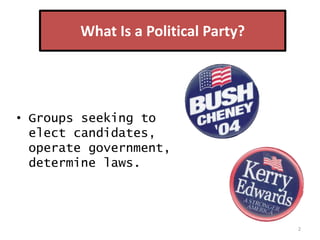
• Groups seeking to
elect candidates,
operate government,
determine laws.

2
How are parties different from
interest groups?

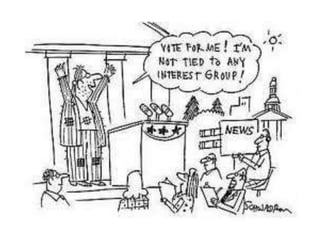
IG‟s do not operate government,
just influence it.
Don‟t select political candidates,
but support them.
Focus on single issues.
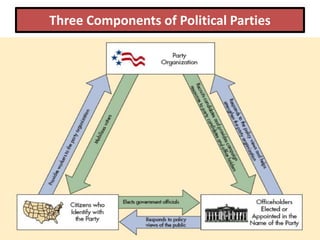
Three Components of Political Parties
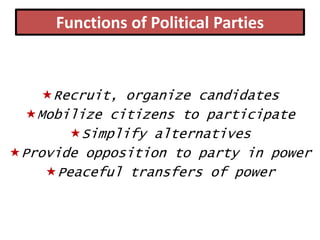
Functions of Political Parties

Recruit, organize candidates
Mobilize citizens to participate
Simplify alternatives
Provide opposition to party in power
Peaceful transfers of power
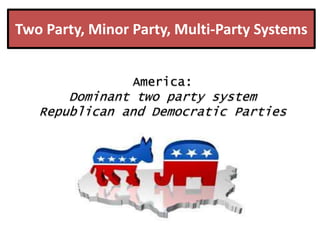
Two Party, Minor Party, Multi-Party Systems
America:

Dominant two party system
Republican and Democratic Parties
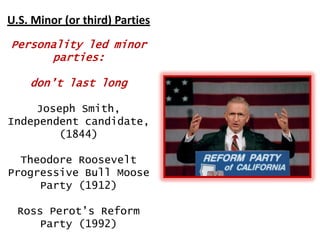
U.S. Minor (or third) Parties
Personality led minor
parties:

don‟t last long
Joseph Smith,
Independent candidate,
(1844)
Theodore Roosevelt
Progressive Bull Moose
Party (1912)
Ross Perot‟s Reform
Party (1992)
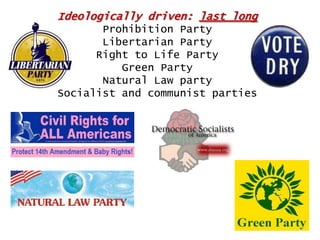
Ideologically driven: last long
Prohibition Party
Libertarian Party
Right to Life Party
Green Party
Natural Law party
Socialist and communist parties
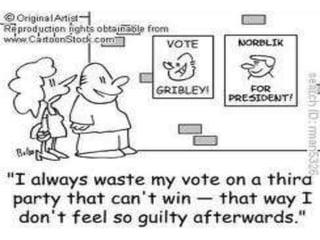
Third Party Influence
 Never won presidency
 Won: handful of congressional seats

Two governorships Jesse Ventura, Reform Party, MN
Lowell Weicker, Independent Party, CT
 Senator Lieberman‟s Connecticut for

Lieberman Party (2008)
Influence On Other Candidates
 Perot, H.W. Bush, Clinton (1992)
Perot won 20% of popular vote
(19 million votes)
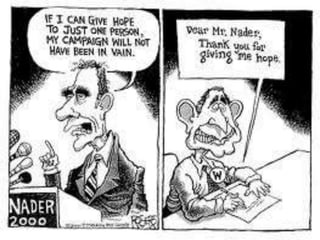
2000 Presidential Race
Ralph Nader (Green Party)
George Bush (Republican)
Al Gore (Democrat)

Gore lost FL by few
hundred votes
Thousands vote for Nader
Third parties think
Republicans and Democrats
barely different
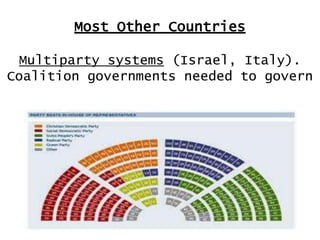
Most Other Countries
Multiparty systems (Israel, Italy).
Coalition governments needed to govern
The Voters
How Did You Choose?
PARTY IDENTIFICATION
Usually determined from childhood
Your party affiliation?
Who influenced that decision?
PARTISAN REALIGNMENT AND DEALIGNMENT
Realignment
“New and stable pattern of partisan loyalties”

Caused by Critical elections
Last Electoral Realignment
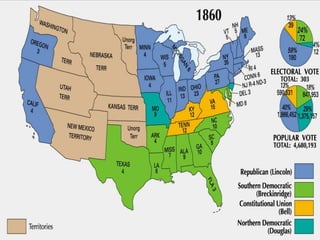
o Great Depression (1932)
o Republicans mishandled crisis
o Non-traditional coalitions form for Democrats:
· Black Americans
· Organized labor
· Southern Democrats
· Working class, Catholic voters
Possible Realignment?

1980s Reagan Wins Two Terms
1994 Republican Takeover of
Congress
Bush Wins Two Terms

Was this a realignment?
Two kinds of realignments
Major party defeated, disappears,
new one emerges
Both parties continue, voters shift
loyalty

De-alignment
Rejection of both parties; rise of
independents
Parties In Government
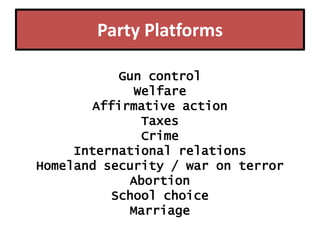
Party Platforms
Gun control
Welfare
Affirmative action
Taxes
Crime
International relations
Homeland security / war on terror
Abortion
School choice
Marriage
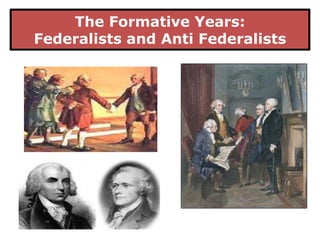
The Formative Years:
Federalists and Anti Federalists
 Parties not in new Constitution

 Non-existent in GW‟s first election
Formed between GW‟s 2nd and TJ‟s 1st term

 Hamilton: Federalists,
Jefferson Democratic-Republicans
 America‟s First two-party system
 Both wanted control of presidency,
congress, states
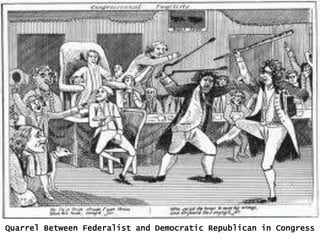
Quarrel Between Federalist and Democratic Republican in Congress
Washington vs. Scholars
 President Washington:
Upset at party formation
Farewell address:
“nation would suffer by
„…effects of party‟”
 Scholars:
Founding parties stabilized
democracy
Parties necessary

institution

Who is right?
Creation of Republican Party
Federalist Party collapses (1816)
Era of Good Feelings (1816-1830)
Only Democratic-Republicans existed
Competition between individuals, not
parties.
Period of national purpose… desired unity
Lull in partisan disputes
James Monroe worked to eliminate parties
altogether
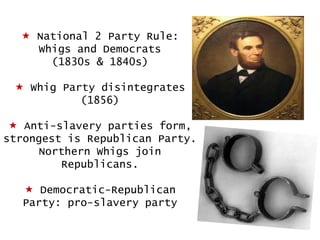
 National 2 Party Rule:
Whigs and Democrats
(1830s & 1840s)
 Whig Party disintegrates
(1856)
 Anti-slavery parties form,
strongest is Republican Party.
Northern Whigs join
Republicans.
 Democratic-Republican
Party: pro-slavery party
National Conventions

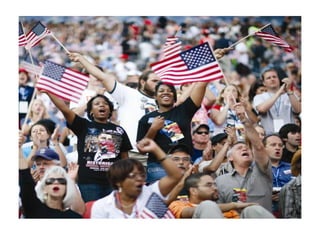
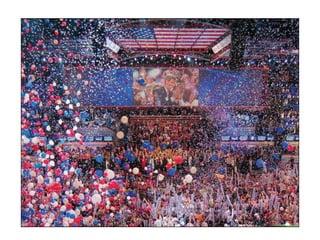
2008 Democratic National Convention, Denver;
2008 Republican National Convention,
Minneapolis.
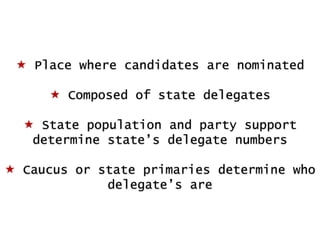
 Place where candidates are nominated

 Composed of state delegates
 State population and party support
determine state‟s delegate numbers
 Caucus or state primaries determine who
delegate‟s are
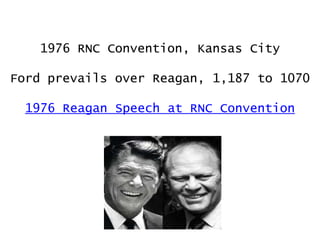
1976 RNC Convention, Kansas City

Ford prevails over Reagan, 1,187 to 1070
1976 Reagan Speech at RNC Convention
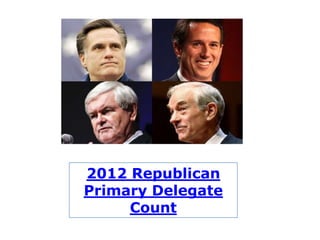
2012 Republican
Primary Delegate
Count
Modern Changes
Primary Contests
Primary contests select most delegates

Candidate known before convention
Lack of suspense -- declining viewership
Coverage by major networks reduced
Suggestions to do away with convention
Television
Made conventions tightly scripted
Each party presents best possible light

Demonstrate united front
Parties now avoid hashing out differences
Conventions Still Fulfill Important
Functions
Draft Party Platform
Parties mature and grow
Caucuses, receptions, breakfasts, etc…

Energize activists
Ticket emerges with poll bounce
2008 DNC and RNC National
Conventions
RNC 2008
Convention
DNC 2008
Convention
Manipulating the Votes of
Voters: Gerrymandering
Mapping districts for advantages

Named for Elbridge Gerry, former MA governor…
Designed district coincidently shaped like
salamander
Every 10 years states redistrict
Party in power controls process
Districts must be equal in population
Divided Government
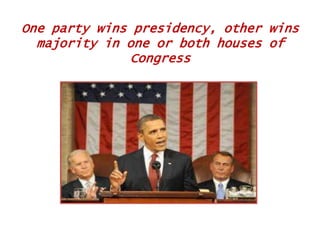
One party wins presidency, other wins
majority in one or both houses of
Congress
Benefits
Government works better

Reason:
Each party has opportunity to block most
divisive measures proposed by other party
Evidence:
Four Points
Rate of growth of federal spending
usually lower
 Probability that major reform will last
usually higher
Liberties more insulated
Prospect of major war is less
Probability that major reform
will last:
Reagan‟s tax laws largely
survived
Exception:
Great Society programs (1960s)
Four wars in 20th
century initiated by
Democratic President and
Congress


 Iraq War initiated by

Republican President and
Republican Congress
Only long period of unusual
fiscal expansion:
Kennedy/Johnson Administration
One party control in D.C.
Brought Great Society & Vietnam
War
Questions
 What does it mean: Parties are a
necessary evil?
 Are teachers biased toward political
parties?
"We are slow to change our minds about
things that matter to us or shift our
loyalties." Do we ever?

9 political parties 2 classes

  • 1.
  • 2.
    What Is aPolitical Party? • Groups seeking to elect candidates, operate government, determine laws. 2
  • 3.
    How are partiesdifferent from interest groups? IG‟s do not operate government, just influence it. Don‟t select political candidates, but support them. Focus on single issues.
  • 5.
    Three Components ofPolitical Parties
  • 6.
    Functions of PoliticalParties Recruit, organize candidates Mobilize citizens to participate Simplify alternatives Provide opposition to party in power Peaceful transfers of power
  • 7.
    Two Party, MinorParty, Multi-Party Systems America: Dominant two party system Republican and Democratic Parties
  • 8.
    U.S. Minor (orthird) Parties Personality led minor parties: don‟t last long Joseph Smith, Independent candidate, (1844) Theodore Roosevelt Progressive Bull Moose Party (1912) Ross Perot‟s Reform Party (1992)
  • 9.
    Ideologically driven: lastlong Prohibition Party Libertarian Party Right to Life Party Green Party Natural Law party Socialist and communist parties
  • 10.
    Third Party Influence Never won presidency  Won: handful of congressional seats Two governorships Jesse Ventura, Reform Party, MN Lowell Weicker, Independent Party, CT  Senator Lieberman‟s Connecticut for Lieberman Party (2008)
  • 12.
    Influence On OtherCandidates  Perot, H.W. Bush, Clinton (1992) Perot won 20% of popular vote (19 million votes)
  • 13.
    2000 Presidential Race RalphNader (Green Party) George Bush (Republican) Al Gore (Democrat) Gore lost FL by few hundred votes Thousands vote for Nader
  • 15.
    Third parties think Republicansand Democrats barely different
  • 16.
    Most Other Countries Multipartysystems (Israel, Italy). Coalition governments needed to govern
  • 17.
  • 18.
    How Did YouChoose? PARTY IDENTIFICATION Usually determined from childhood Your party affiliation? Who influenced that decision?
  • 19.
    PARTISAN REALIGNMENT ANDDEALIGNMENT Realignment “New and stable pattern of partisan loyalties” Caused by Critical elections Last Electoral Realignment o Great Depression (1932) o Republicans mishandled crisis o Non-traditional coalitions form for Democrats: · Black Americans · Organized labor · Southern Democrats · Working class, Catholic voters
  • 20.
    Possible Realignment? 1980s ReaganWins Two Terms 1994 Republican Takeover of Congress Bush Wins Two Terms Was this a realignment?
  • 21.
    Two kinds ofrealignments Major party defeated, disappears, new one emerges Both parties continue, voters shift loyalty De-alignment Rejection of both parties; rise of independents
  • 22.
  • 23.
    Party Platforms Gun control Welfare Affirmativeaction Taxes Crime International relations Homeland security / war on terror Abortion School choice Marriage
  • 28.
  • 29.
     Parties notin new Constitution  Non-existent in GW‟s first election Formed between GW‟s 2nd and TJ‟s 1st term  Hamilton: Federalists, Jefferson Democratic-Republicans  America‟s First two-party system  Both wanted control of presidency, congress, states
  • 30.
    Quarrel Between Federalistand Democratic Republican in Congress
  • 31.
    Washington vs. Scholars President Washington: Upset at party formation Farewell address: “nation would suffer by „…effects of party‟”  Scholars: Founding parties stabilized democracy Parties necessary institution Who is right?
  • 32.
    Creation of RepublicanParty Federalist Party collapses (1816) Era of Good Feelings (1816-1830) Only Democratic-Republicans existed Competition between individuals, not parties.
  • 33.
    Period of nationalpurpose… desired unity Lull in partisan disputes James Monroe worked to eliminate parties altogether
  • 34.
     National 2Party Rule: Whigs and Democrats (1830s & 1840s)  Whig Party disintegrates (1856)  Anti-slavery parties form, strongest is Republican Party. Northern Whigs join Republicans.  Democratic-Republican Party: pro-slavery party
  • 38.
    National Conventions 2008 DemocraticNational Convention, Denver; 2008 Republican National Convention, Minneapolis.
  • 41.
     Place wherecandidates are nominated  Composed of state delegates  State population and party support determine state‟s delegate numbers  Caucus or state primaries determine who delegate‟s are
  • 42.
    1976 RNC Convention,Kansas City Ford prevails over Reagan, 1,187 to 1070 1976 Reagan Speech at RNC Convention
  • 43.
  • 44.
    Modern Changes Primary Contests Primarycontests select most delegates Candidate known before convention Lack of suspense -- declining viewership Coverage by major networks reduced Suggestions to do away with convention
  • 45.
    Television Made conventions tightlyscripted Each party presents best possible light Demonstrate united front Parties now avoid hashing out differences
  • 46.
    Conventions Still FulfillImportant Functions Draft Party Platform Parties mature and grow Caucuses, receptions, breakfasts, etc… Energize activists Ticket emerges with poll bounce
  • 47.
    2008 DNC andRNC National Conventions RNC 2008 Convention DNC 2008 Convention
  • 48.
    Manipulating the Votesof Voters: Gerrymandering Mapping districts for advantages Named for Elbridge Gerry, former MA governor… Designed district coincidently shaped like salamander Every 10 years states redistrict Party in power controls process Districts must be equal in population
  • 49.
  • 50.
    One party winspresidency, other wins majority in one or both houses of Congress
  • 51.
    Benefits Government works better Reason: Eachparty has opportunity to block most divisive measures proposed by other party Evidence: Four Points
  • 52.
    Rate of growthof federal spending usually lower  Probability that major reform will last usually higher Liberties more insulated Prospect of major war is less
  • 53.
    Probability that majorreform will last: Reagan‟s tax laws largely survived Exception: Great Society programs (1960s)
  • 54.
    Four wars in20th century initiated by Democratic President and Congress   Iraq War initiated by Republican President and Republican Congress
  • 55.
    Only long periodof unusual fiscal expansion: Kennedy/Johnson Administration One party control in D.C. Brought Great Society & Vietnam War
  • 56.
    Questions  What doesit mean: Parties are a necessary evil?  Are teachers biased toward political parties? "We are slow to change our minds about things that matter to us or shift our loyalties." Do we ever?