Chapter Eleven Interest Groups
Why Interest Groups are Common Interest group : any organization that seeks to influence public policy Many kinds of cleavages in the country mean that there are many different interests
Why Interest Groups are Common The Constitution provides many access points to government Political parties are weak so interests work directly on government
Kinds of Organizations Institutional Interests : individuals or organizations representing other organizations Membership Interests : Americans join some groups more frequently than citizens in other nations
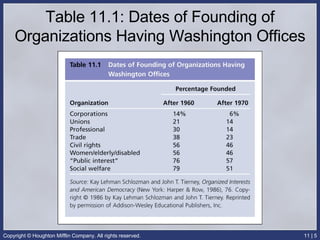
Table 11.1: Dates of Founding of Organizations Having Washington Offices
Incentives to Join Solidary incentives—pleasure, companionship Material incentives—money, things, services  Purposive incentives—goal/purpose of the organization itself
Social Movements Social movement : a widely shared demand for change in the social or political order, either liberal or conservative Examples include the environmental and feminist movements Unions continued activism after their social movement died, but sustaining membership is difficult
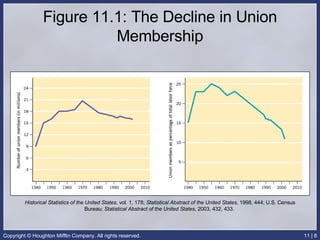
Figure 11.1: The Decline in Union Membership Historical Statistics of the United States , vol. 1, 178;  Statistical Abstract of the United States , 1998, 444; U.S. Census Bureau;  Statistical Abstract of the United States , 2003, 432, 433.
Funds for Interest Groups Foundation grants One study found that 1/3 of public interest lobbying groups received more than half of all their funds from foundation grants Federal grants and contracts Expansion of federal grants in 1960s and 1970s benefited interest groups; cutbacks in 1980s hurt them
Funds for Interest Groups Direct mail: through the use of computers, mail is sent directly to a specialized audience But this approach is also expensive—it must generate checks from at least 2 percent of the people contacted
The Problem of Bias Those who are more affluent are more likely to join and be active Business/professional groups are more numerous and better financed than those representing minorities, consumers, or the disadvantaged
Limits on Elite Influence Elites have input in the political system but do not control who eventually wins or loses on particular issues Business groups are often divided among themselves
Activities of Interest Groups Supplying credible information is the single most important tactic of interest groups Insider strategy: face-to-face contact between lobbyist and member or Hill staff Outsider strategy: grassroots mobilization of the public
Activities of Interest Groups Lobbyists’ key targets: the undecided legislator or bureaucrat Some groups attack their likely allies to embarrass them Some groups try for grassroots support
Money and PACs PAC : a committee set up to raise and spend money on campaigns and candidates Money is the least effective way to influence politicians The campaign finance reform law of 1973 restricted donations The rapid growth in PACs has probably not led to vote buying
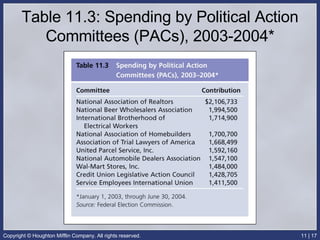
Money and PACs Ideological PACs raise more money, but raising the money also consumes it, so less is available to give to campaigns and candidates In 2003-2004, unions and business or professional organizations gave the most Incumbents get the most PAC money
Table 11.3: Spending by Political Action Committees (PACs), 2003-2004*
Money and Influence There is no systematic evidence that PAC money influences votes in Congress Most members vote in line with their ideology and with their constituents
Money and Influence When an issue is of little concern to voters and ideology provides little guidance, there is a slight correlation between PAC contributions and votes PAC money may influence politics in other ways, like access or committee actions
The “Revolving Door” Federal government workers leave to take more lucrative positions in private industry (lobbying, consulting, executive positions) This may give private interests a way to improperly influence government decisions
Regulating Interest Groups A 1995 act provided a broader definition of lobbying and tightened reporting requirements Tax code; nonprofits lose tax-exempt status if a “substantial part” of their activities involve lobbying Campaign-finance laws limit donations by individual PACs

ap gov chap 11

  • 1.
  • 2.
    Why Interest Groupsare Common Interest group : any organization that seeks to influence public policy Many kinds of cleavages in the country mean that there are many different interests
  • 3.
    Why Interest Groupsare Common The Constitution provides many access points to government Political parties are weak so interests work directly on government
  • 4.
    Kinds of OrganizationsInstitutional Interests : individuals or organizations representing other organizations Membership Interests : Americans join some groups more frequently than citizens in other nations
  • 5.
    Table 11.1: Datesof Founding of Organizations Having Washington Offices
  • 6.
    Incentives to JoinSolidary incentives—pleasure, companionship Material incentives—money, things, services Purposive incentives—goal/purpose of the organization itself
  • 7.
    Social Movements Socialmovement : a widely shared demand for change in the social or political order, either liberal or conservative Examples include the environmental and feminist movements Unions continued activism after their social movement died, but sustaining membership is difficult
  • 8.
    Figure 11.1: TheDecline in Union Membership Historical Statistics of the United States , vol. 1, 178; Statistical Abstract of the United States , 1998, 444; U.S. Census Bureau; Statistical Abstract of the United States , 2003, 432, 433.
  • 9.
    Funds for InterestGroups Foundation grants One study found that 1/3 of public interest lobbying groups received more than half of all their funds from foundation grants Federal grants and contracts Expansion of federal grants in 1960s and 1970s benefited interest groups; cutbacks in 1980s hurt them
  • 10.
    Funds for InterestGroups Direct mail: through the use of computers, mail is sent directly to a specialized audience But this approach is also expensive—it must generate checks from at least 2 percent of the people contacted
  • 11.
    The Problem ofBias Those who are more affluent are more likely to join and be active Business/professional groups are more numerous and better financed than those representing minorities, consumers, or the disadvantaged
  • 12.
    Limits on EliteInfluence Elites have input in the political system but do not control who eventually wins or loses on particular issues Business groups are often divided among themselves
  • 13.
    Activities of InterestGroups Supplying credible information is the single most important tactic of interest groups Insider strategy: face-to-face contact between lobbyist and member or Hill staff Outsider strategy: grassroots mobilization of the public
  • 14.
    Activities of InterestGroups Lobbyists’ key targets: the undecided legislator or bureaucrat Some groups attack their likely allies to embarrass them Some groups try for grassroots support
  • 15.
    Money and PACsPAC : a committee set up to raise and spend money on campaigns and candidates Money is the least effective way to influence politicians The campaign finance reform law of 1973 restricted donations The rapid growth in PACs has probably not led to vote buying
  • 16.
    Money and PACsIdeological PACs raise more money, but raising the money also consumes it, so less is available to give to campaigns and candidates In 2003-2004, unions and business or professional organizations gave the most Incumbents get the most PAC money
  • 17.
    Table 11.3: Spendingby Political Action Committees (PACs), 2003-2004*
  • 18.
    Money and InfluenceThere is no systematic evidence that PAC money influences votes in Congress Most members vote in line with their ideology and with their constituents
  • 19.
    Money and InfluenceWhen an issue is of little concern to voters and ideology provides little guidance, there is a slight correlation between PAC contributions and votes PAC money may influence politics in other ways, like access or committee actions
  • 20.
    The “Revolving Door”Federal government workers leave to take more lucrative positions in private industry (lobbying, consulting, executive positions) This may give private interests a way to improperly influence government decisions
  • 21.
    Regulating Interest GroupsA 1995 act provided a broader definition of lobbying and tightened reporting requirements Tax code; nonprofits lose tax-exempt status if a “substantial part” of their activities involve lobbying Campaign-finance laws limit donations by individual PACs