Political Parties What is the difference between the Republicans and the Democrats? Why are political parties important in a democracy? Why does the US only have two viable parties?
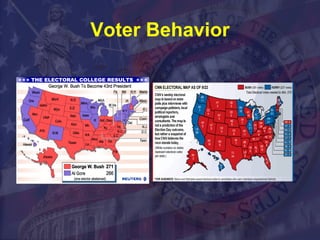
Voter Behavior
Political Socialization Source of political beliefs and attitudes Family and the Social Environment Education Peers Leaders’ Influence Media  Political events  Example: The Great Depression  60’s and the Vietnam War Era
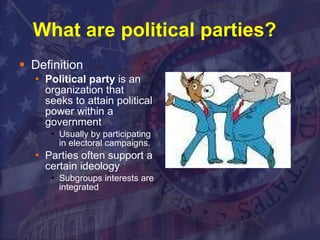
What are political parties?  Definition Political party  is an organization that seeks to attain political power within a government Usually by participating in electoral campaigns. Parties often support a certain ideology Subgroups interests are integrated
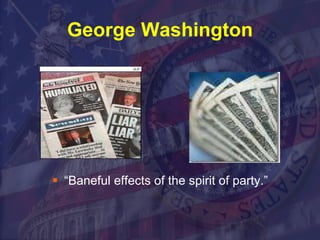
George Washington “ Baneful effects of the spirit of party.”
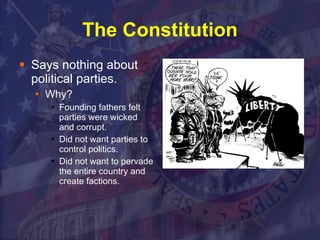
The Constitution Says nothing about political parties. Why? Founding fathers felt parties were wicked and corrupt. Did not want parties to control politics. Did not want to pervade the entire country and create factions.
Institutional Constraints on Political Parties Structure and Strength of Parties:  Majoritarian or Proportional Representation  History Presidential or Parliamentary System Laws and Constitution
Theory: Lipset and Rokkan Theory on Political Cleavages Parties that were formed in the aftermath of political, religious, and economic revolutions are frozen. State vs. Church Worker vs. Owner Land vs. Industry Center vs. Periphery (Fed vs. State) These have and will continue to exist in the political arena despite new issues and challenges.
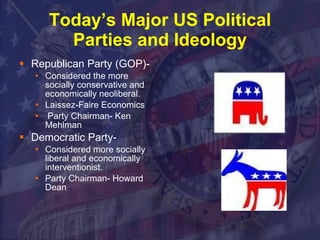
Today’s Major US Political Parties and Ideology Republican Party (GOP)-  Considered the more socially conservative and economically neoliberal.  Laissez-Faire Economics Party Chairman- Ken Mehlman Democratic Party- Considered more socially liberal and economically interventionist. Party Chairman- Howard Dean
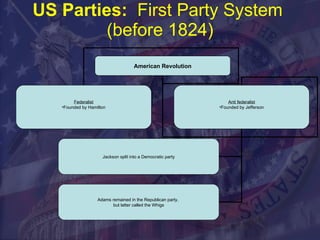
US Parties:  First Party System  (before 1824) American Revolution Federalist Founded by Hamilton Anti federalist Founded by Jefferson Jackson split into a Democratic party Adams remained in the Republican party,  but latter called the Whigs
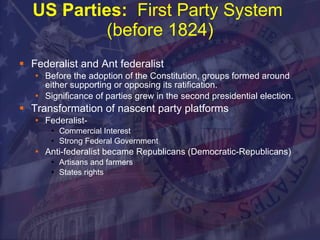
US Parties:  First Party System  (before 1824) Federalist and Ant federalist Before the adoption of the Constitution, groups formed around either supporting or opposing its ratification. Significance of parties grew in the second presidential election. Transformation of nascent party platforms Federalist- Commercial Interest Strong Federal Government Anti-federalist became Republicans (Democratic-Republicans) Artisans and farmers States rights
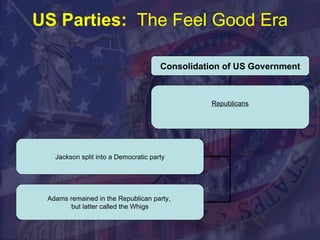
US Parties:  The Feel Good Era Consolidation of US Government Republicans Jackson split into a Democratic party Adams remained in the Republican party,  but latter called the Whigs
The Era of Feel Good Transformation of two party system Most people votes Republican. Virtual collapse of the Federalist party by 1816 No opposition party, so internal fighting. Republican Platform Still opposed federalist ideas of big central govt, but the US govt acquired Lo. And Fl. Established national bank
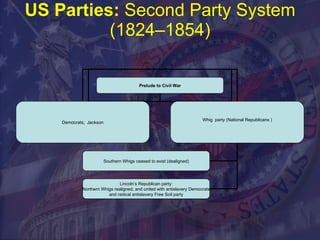
US Parties:  Second Party System (1824–1854) Prelude to Civil War Democrats :   Jackson Whig  party (National Republicans ) Southern Whigs ceased to exist (dealigned) Lincoln’s Republican party: Northern Whigs realigned, and united with antislavery Democrats and radical antislavery Free Soil party
Parties:  Second Party System (1824–1854) Republican Split The “era of personal politics” created faction in Republican party, Adams altered the name to National Republicans. Later became the Whigs. Jackson formed the Democratic Party Platforms Whigs Federal spending on infrastructure Democrats Personal Liberty Opportunity for the common man (only white man)
US Parties:  Third Party System: Civil War and Post Civil War  (1854–1896) Slavery split parties Whigs split Realignment- Northern industrialist merged with antislavery democrats and Free Soil party to form the Modern Republican Party (anti-slavery party) Dealignment- Southern Planters felt that a strong federal govt could also free slaves, so party cease to exist
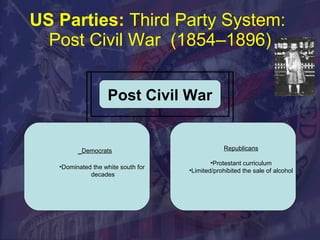
US Parties:  Third Party System:  Post Civil War  (1854–1896) Post Civil War Democrats Dominated the white south for  decades Republicans Protestant curriculum Limited/prohibited the sale of alcohol
US Parties:  Third Party System:  Post Civil War  (1854–1896) Stronger Republicans  Strong federal government to promote  business and economic growth. Impose evangelical Protestant morals on society. Republican merged urban dwellers Southern Democrats  After Civil War, white southern feared that strong Republicans will make them treats blacks fairly. Democrats merge Populist party
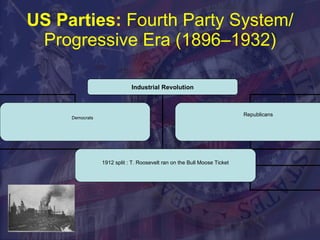
US Parties:  Fourth Party System/ Progressive Era (1896–1932) Industrial Revolution Democrats  Republicans 1912 split : T. Roosevelt ran on the Bull Moose Ticket
US Parties:  Fourth Party System/ Progressive Era (1896–1932) Republican split Teddy Roosevelt created splinter party (Bull Moose Party) Split the Republican Vote, so Wilson was able to win Wilson’s Democrats  Radical Change Govt. manipulation of the economy Progressive philosophy except for African Americans.
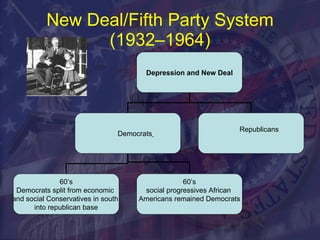
New Deal/Fifth Party System (1932–1964) Depression and New Deal Democrats   Republicans 60’s Democrats split from economic  and social Conservatives in south  into republican base 60’s social progressives African  Americans remained Democrats
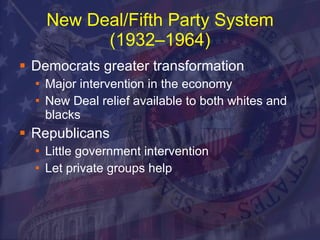
New Deal/Fifth Party System (1932–1964) Democrats greater transformation Major intervention in the economy New Deal relief available to both whites and blacks Republicans Little government intervention Let private groups help
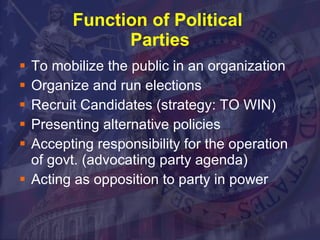
Function of Political  Parties To mobilize the public in an organization Organize and run elections Recruit Candidates (strategy: TO WIN) Presenting alternative policies Accepting responsibility for the operation of govt. (advocating party agenda) Acting as opposition to party in power
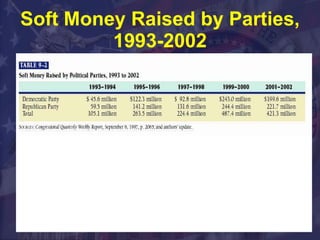
Soft Money Raised by Parties, 1993-2002
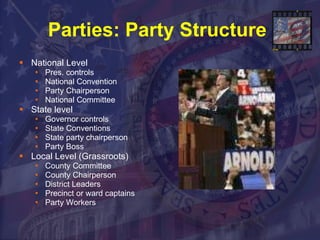
Parties: Party Structure  National Level Pres. controls  National Convention Party Chairperson National Committee State level Governor controls State Conventions State party chairperson Party Boss Local Level (Grassroots) County Committee County Chairperson District Leaders Precinct or ward captains Party Workers
Primary Elections Candidates official nomination process All parties will select their candidate for the general election Presidential, Gubernatorial, Congressional, Senate candidates Any contested seat within party Front-Loading: State determines the date for its primary (NH) or caucus (IW) Early primaries are more influential States compete to schedule their primaries as early as possible
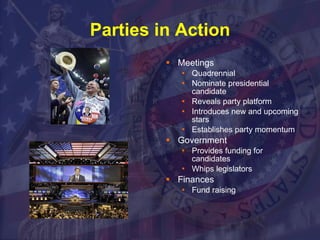
Parties in Action Meetings Quadrennial Nominate presidential candidate Reveals party platform Introduces new and upcoming stars Establishes party momentum Government Provides funding for candidates Whips legislators  Finances Fund raising
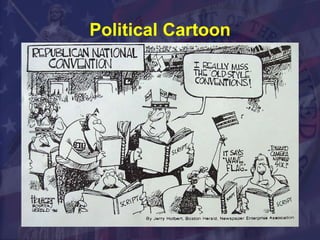
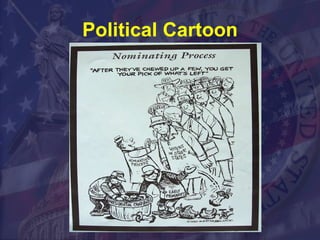
Political Cartoon
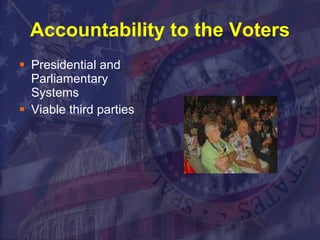
Accountability to the Voters Presidential and Parliamentary Systems Viable third parties
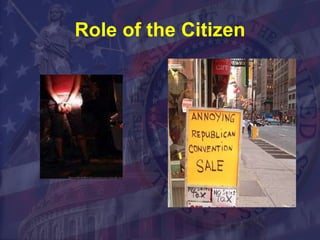
Role of the Citizen
Quiz How did Josh keep party members in line with the party’s platform and agenda?
Quiz Why are political parties essential to Democracy?  And what tools do parties use to satisfy their members?
Political Cartoon

Political Parties Iii

  • 1.
    Political Parties Whatis the difference between the Republicans and the Democrats? Why are political parties important in a democracy? Why does the US only have two viable parties?
  • 2.
  • 3.
    Political Socialization Sourceof political beliefs and attitudes Family and the Social Environment Education Peers Leaders’ Influence Media Political events Example: The Great Depression 60’s and the Vietnam War Era
  • 4.
    What are politicalparties? Definition Political party is an organization that seeks to attain political power within a government Usually by participating in electoral campaigns. Parties often support a certain ideology Subgroups interests are integrated
  • 5.
    George Washington “Baneful effects of the spirit of party.”
  • 6.
    The Constitution Saysnothing about political parties. Why? Founding fathers felt parties were wicked and corrupt. Did not want parties to control politics. Did not want to pervade the entire country and create factions.
  • 7.
    Institutional Constraints onPolitical Parties Structure and Strength of Parties: Majoritarian or Proportional Representation History Presidential or Parliamentary System Laws and Constitution
  • 8.
    Theory: Lipset andRokkan Theory on Political Cleavages Parties that were formed in the aftermath of political, religious, and economic revolutions are frozen. State vs. Church Worker vs. Owner Land vs. Industry Center vs. Periphery (Fed vs. State) These have and will continue to exist in the political arena despite new issues and challenges.
  • 9.
    Today’s Major USPolitical Parties and Ideology Republican Party (GOP)- Considered the more socially conservative and economically neoliberal. Laissez-Faire Economics Party Chairman- Ken Mehlman Democratic Party- Considered more socially liberal and economically interventionist. Party Chairman- Howard Dean
  • 10.
    US Parties: First Party System (before 1824) American Revolution Federalist Founded by Hamilton Anti federalist Founded by Jefferson Jackson split into a Democratic party Adams remained in the Republican party, but latter called the Whigs
  • 11.
    US Parties: First Party System (before 1824) Federalist and Ant federalist Before the adoption of the Constitution, groups formed around either supporting or opposing its ratification. Significance of parties grew in the second presidential election. Transformation of nascent party platforms Federalist- Commercial Interest Strong Federal Government Anti-federalist became Republicans (Democratic-Republicans) Artisans and farmers States rights
  • 12.
    US Parties: The Feel Good Era Consolidation of US Government Republicans Jackson split into a Democratic party Adams remained in the Republican party, but latter called the Whigs
  • 13.
    The Era ofFeel Good Transformation of two party system Most people votes Republican. Virtual collapse of the Federalist party by 1816 No opposition party, so internal fighting. Republican Platform Still opposed federalist ideas of big central govt, but the US govt acquired Lo. And Fl. Established national bank
  • 14.
    US Parties: Second Party System (1824–1854) Prelude to Civil War Democrats : Jackson Whig party (National Republicans ) Southern Whigs ceased to exist (dealigned) Lincoln’s Republican party: Northern Whigs realigned, and united with antislavery Democrats and radical antislavery Free Soil party
  • 15.
    Parties: SecondParty System (1824–1854) Republican Split The “era of personal politics” created faction in Republican party, Adams altered the name to National Republicans. Later became the Whigs. Jackson formed the Democratic Party Platforms Whigs Federal spending on infrastructure Democrats Personal Liberty Opportunity for the common man (only white man)
  • 16.
    US Parties: Third Party System: Civil War and Post Civil War (1854–1896) Slavery split parties Whigs split Realignment- Northern industrialist merged with antislavery democrats and Free Soil party to form the Modern Republican Party (anti-slavery party) Dealignment- Southern Planters felt that a strong federal govt could also free slaves, so party cease to exist
  • 17.
    US Parties: Third Party System: Post Civil War (1854–1896) Post Civil War Democrats Dominated the white south for decades Republicans Protestant curriculum Limited/prohibited the sale of alcohol
  • 18.
    US Parties: Third Party System: Post Civil War (1854–1896) Stronger Republicans Strong federal government to promote business and economic growth. Impose evangelical Protestant morals on society. Republican merged urban dwellers Southern Democrats After Civil War, white southern feared that strong Republicans will make them treats blacks fairly. Democrats merge Populist party
  • 19.
    US Parties: Fourth Party System/ Progressive Era (1896–1932) Industrial Revolution Democrats Republicans 1912 split : T. Roosevelt ran on the Bull Moose Ticket
  • 20.
    US Parties: Fourth Party System/ Progressive Era (1896–1932) Republican split Teddy Roosevelt created splinter party (Bull Moose Party) Split the Republican Vote, so Wilson was able to win Wilson’s Democrats Radical Change Govt. manipulation of the economy Progressive philosophy except for African Americans.
  • 21.
    New Deal/Fifth PartySystem (1932–1964) Depression and New Deal Democrats Republicans 60’s Democrats split from economic and social Conservatives in south into republican base 60’s social progressives African Americans remained Democrats
  • 22.
    New Deal/Fifth PartySystem (1932–1964) Democrats greater transformation Major intervention in the economy New Deal relief available to both whites and blacks Republicans Little government intervention Let private groups help
  • 23.
    Function of Political Parties To mobilize the public in an organization Organize and run elections Recruit Candidates (strategy: TO WIN) Presenting alternative policies Accepting responsibility for the operation of govt. (advocating party agenda) Acting as opposition to party in power
  • 24.
    Soft Money Raisedby Parties, 1993-2002
  • 25.
    Parties: Party Structure National Level Pres. controls National Convention Party Chairperson National Committee State level Governor controls State Conventions State party chairperson Party Boss Local Level (Grassroots) County Committee County Chairperson District Leaders Precinct or ward captains Party Workers
  • 26.
    Primary Elections Candidatesofficial nomination process All parties will select their candidate for the general election Presidential, Gubernatorial, Congressional, Senate candidates Any contested seat within party Front-Loading: State determines the date for its primary (NH) or caucus (IW) Early primaries are more influential States compete to schedule their primaries as early as possible
  • 27.
    Parties in ActionMeetings Quadrennial Nominate presidential candidate Reveals party platform Introduces new and upcoming stars Establishes party momentum Government Provides funding for candidates Whips legislators Finances Fund raising
  • 28.
  • 29.
    Accountability to theVoters Presidential and Parliamentary Systems Viable third parties
  • 30.
    Role of theCitizen
  • 31.
    Quiz How didJosh keep party members in line with the party’s platform and agenda?
  • 32.
    Quiz Why arepolitical parties essential to Democracy? And what tools do parties use to satisfy their members?
  • 33.