
6
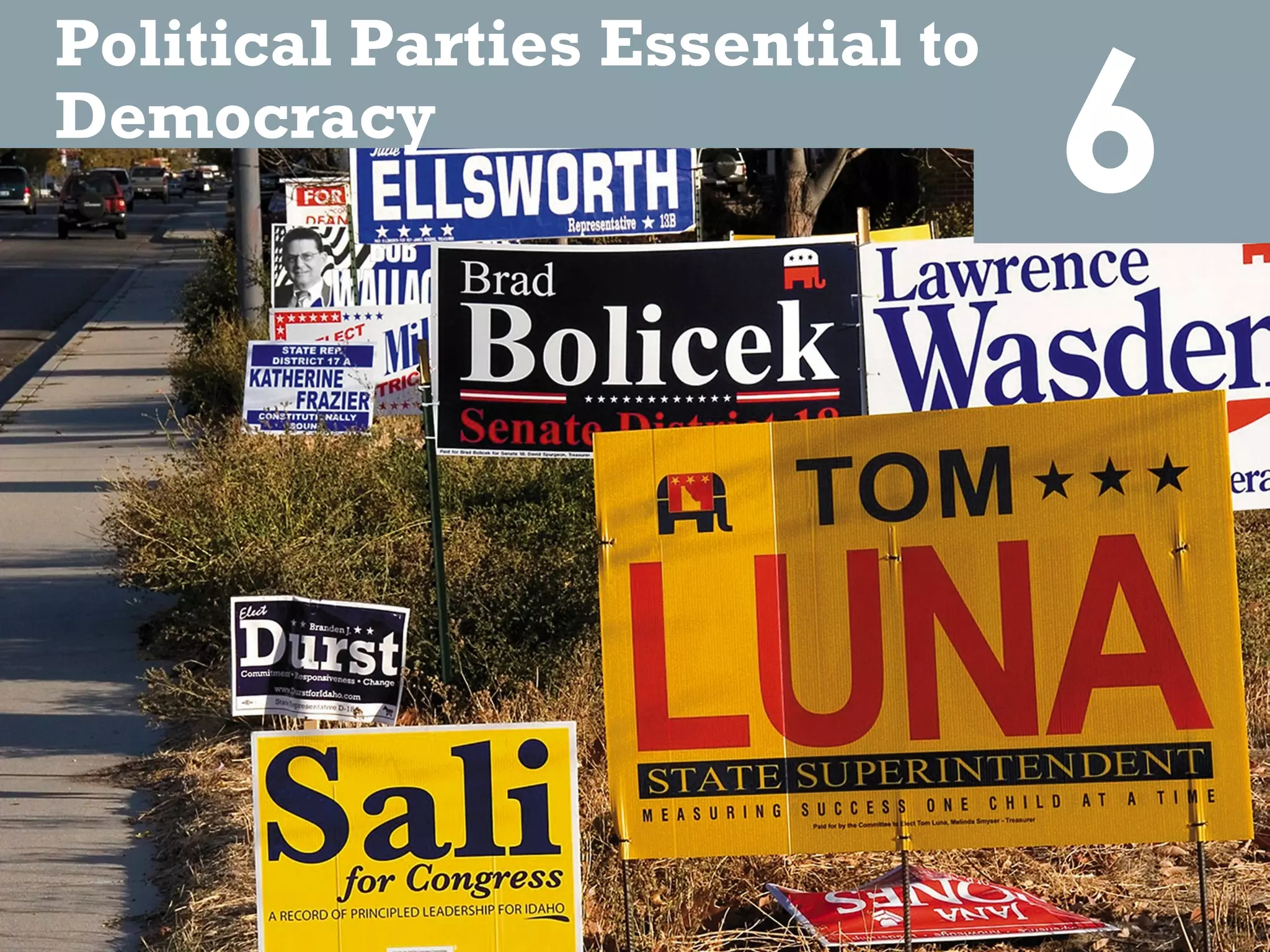
Political Parties Essential to
Democracy
Copyright © 2015 by Pearson Education, Inc. All rights reserved.
Learning Objectives
6
6.1
6.2
Identify the primary functions of
parties in democracies and distinguish
the U.S. party system from those in
European democracies
Describe changes in American political
parties and identify four realigning
elections
Copyright © 2015 by Pearson Education, Inc. All rights reserved.
Learning Objectives
6
6.3
6.4
Evaluate the functions of parties as
institutions, parties in government,
and parties in the electorate
Explain party fund-raising and
expenditures, and assess their
regulation
Copyright © 2015 by Pearson Education, Inc. All rights reserved.
Learning Objectives
2.2
6
6.5
Assess the effects of recent party
reforms and the long-term prospects
for the current party system
Copyright © 2015 by Pearson Education, Inc. All rights reserved.
What Parties Do for
Democracy
 Party Functions
 The Nomination of Candidates
 Party Systems
 Minor Parties: Persistence and Frustration
6.1
Copyright © 2015 by Pearson Education, Inc. All rights reserved.
Party Functions
 Organize the competition
Parties nominate candidates, and then support them by raising money,
providing training, and mobilizing voters to volunteer and vote for them.
 Unify the electorate - must present a unified front even
during internal conflicts
 Organize the government - In Congress, the majority
party selects the committee chairs and has a majority in each committee.
This is clearly important when it comes to passing legislation.
 Make policy - Elected party members must support party policies
 Provide loyal opposition
6.1
Copyright © 2015 by Pearson Education, Inc. All rights reserved.
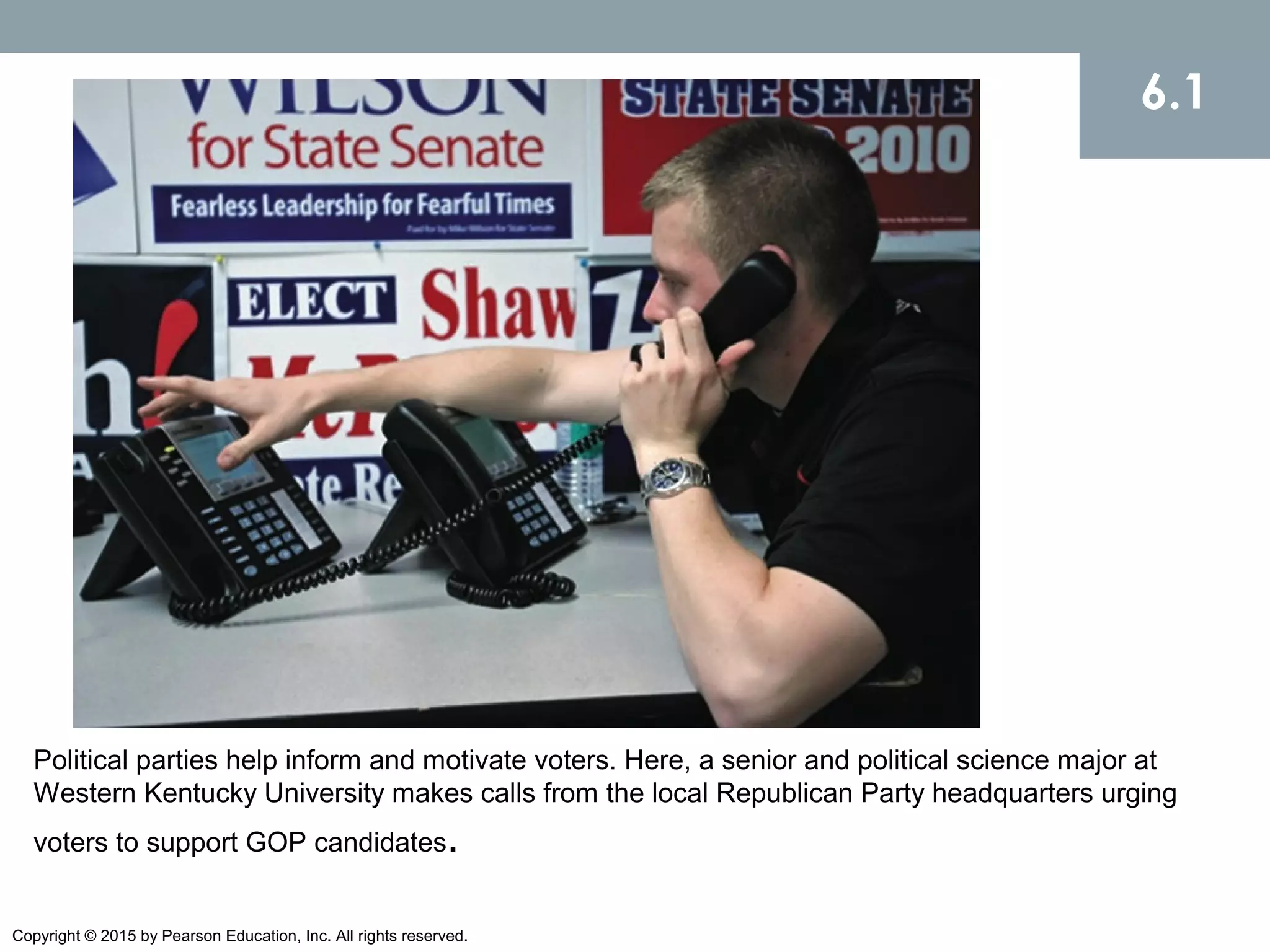
Political parties help inform and motivate voters. Here, a senior and political science major at
Western Kentucky University makes calls from the local Republican Party headquarters urging
voters to support GOP candidates.
6.1
Copyright © 2015 by Pearson Education, Inc. All rights reserved.
The Nomination of Candidates
 Early caucus gave way to convention
 Direct primary
 Open primaries - voters can vote for candidates from any party.
 Closed primaries - only voters registered for a party can vote and
they must vote for party candidate.
 Local caucuses
 Choose delegates who choose delegates to state and
national conventions
6.1
Copyright © 2015 by Pearson Education, Inc. All rights reserved.
Iowa Caucus 6.1
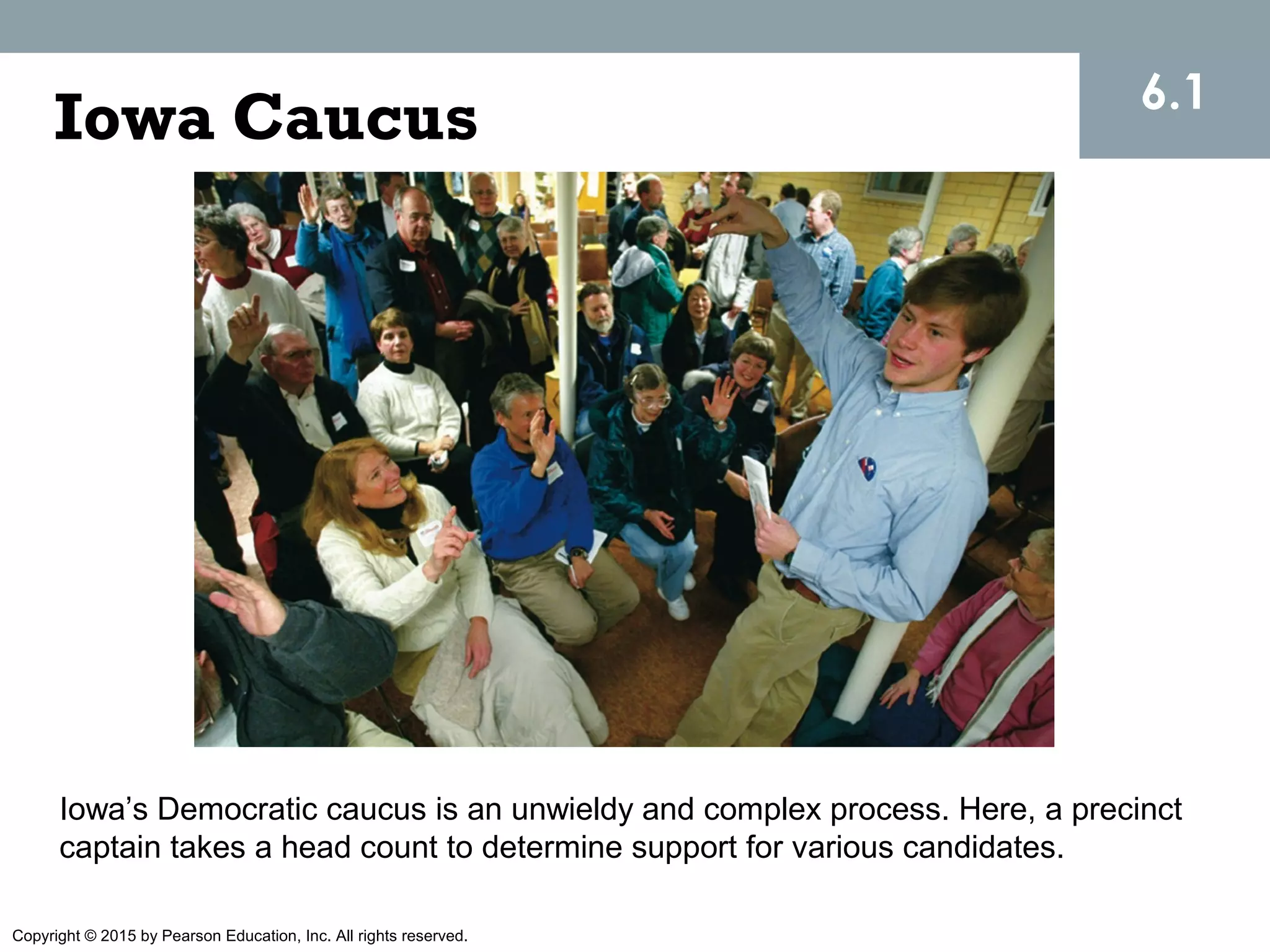
Iowa’s Democratic caucus is an unwieldy and complex process. Here, a precinct
captain takes a head count to determine support for various candidates.
Copyright © 2015 by Pearson Education, Inc. All rights reserved.
Party Systems
 Presidential vs. Parliamentary government
• US has 2 main parties and some minor ones
• Parliamentary governments are often multiparty systems. Winners are
determined through proportional representation.
 Proportional representation - seats are apportioned in
the legislature based on the percentage of the vote won by each party.
In such a system, even small parties can gain seats and perhaps a
place in the governing coalition.
6.1
Copyright © 2015 by Pearson Education, Inc. All rights reserved.
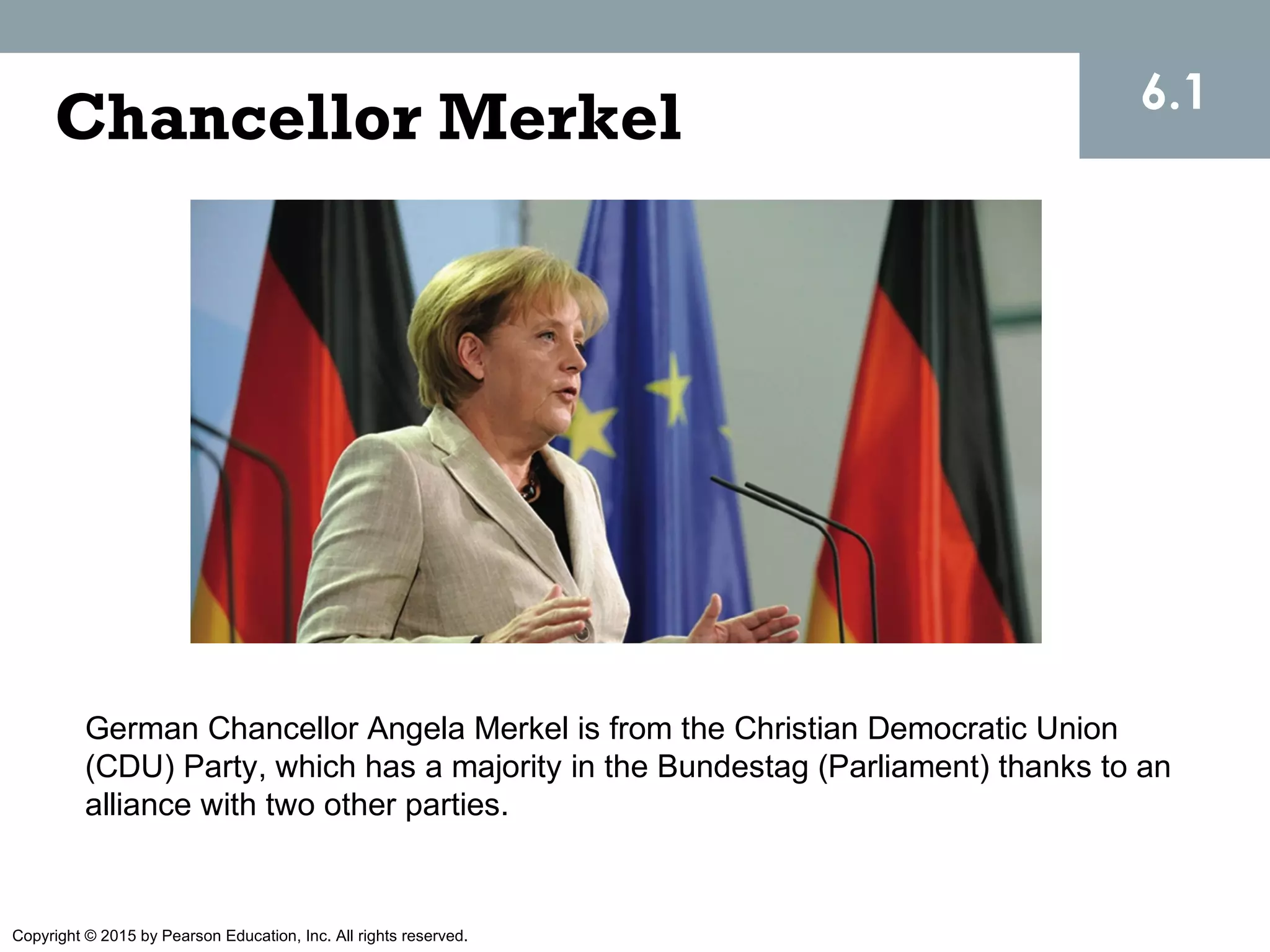
Chancellor Merkel 6.1
German Chancellor Angela Merkel is from the Christian Democratic Union
(CDU) Party, which has a majority in the Bundestag (Parliament) thanks to an
alliance with two other parties.
Copyright © 2015 by Pearson Education, Inc. All rights reserved.
Party Systems
 “Winner-take-all” system - The candidate who
receives a plurality of the vote—not necessarily a majority—gets
the seat. There is no advantage to coming in second.
 Lack of incentive for small parties -
Candidates for small parties are unlikely to win and it’s hard to
convince people that a vote for them is not a wasted vote.
6.1
Copyright © 2015 by Pearson Education, Inc. All rights reserved.
Minor Parties: Persistence
and Frustration
 Candidate-based parties - usually last only as
long as the candidate
 Ideology-based parties - tend to last longer.
Examples are Libertarian and Green Parties
 Limited success and influence - minor parties have
never won more than a handful of congressional seats and their
influence on national policy and on the platforms of the two major
parties has been limited.
6.1
Copyright © 2015 by Pearson Education, Inc. All rights reserved.
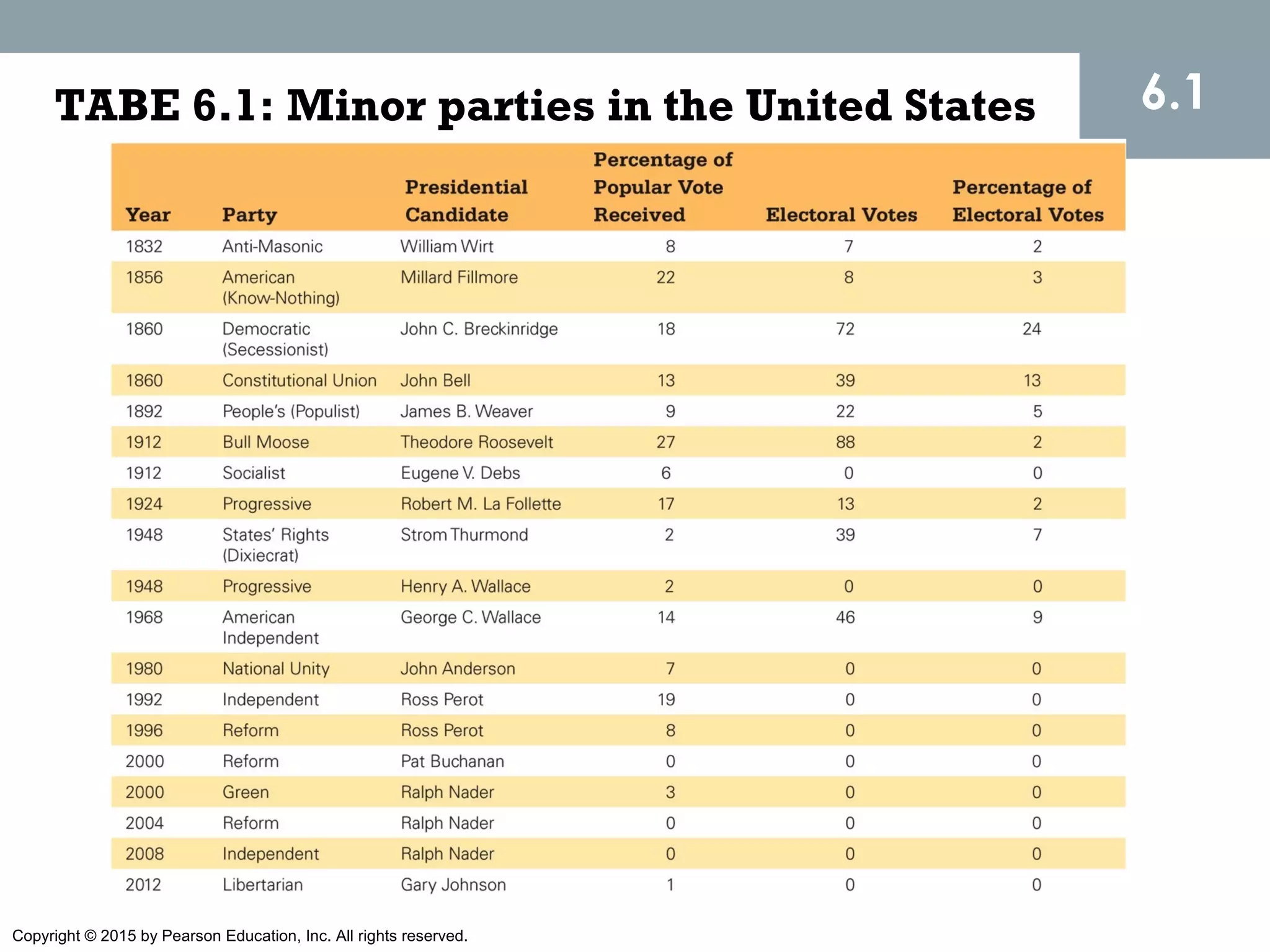
TABE 6.1: Minor parties in the United States 6.1
Copyright © 2015 by Pearson Education, Inc. All rights reserved.
6.1 What is a meeting of local party
members to choose candidates for
public office and to decide the platform called?
a. Open primary
b. Direct primary
c. Convention
d. Caucus
6.1
Copyright © 2015 by Pearson Education, Inc. All rights reserved.
6.1 What is a meeting of local party
members to choose candidates for
public office and to decide the platform called?
6.1
a. Open primary
b. Direct primary
c. Convention
d. Caucus
Copyright © 2015 by Pearson Education, Inc. All rights reserved.
A Brief History of American
Political Parties
 The Nation’s First Parties
 Realigning Elections
 The Last Half Century
6.2
Copyright © 2015 by Pearson Education, Inc. All rights reserved.
The Nation’s First Parties
 Constitution Ratification debate - caused the
first parties to form
 Hamilton and the Federalists - In order to usher
measures through the first Congress, the Washington
administration, under the leadership of Alexander Hamilton, formed
a coalition of factions and legislators called the Federalist party.
 Jefferson and the Democratic-Republicans
In response, those politically opposed, led by Thomas Jefferson,
formed a counter-coalition, known as Republicans, then as
Democratic-Republicans, and finally as Democrats.
6.2
Copyright © 2015 by Pearson Education, Inc. All rights reserved.
Realigning Elections
 1824: Andrew Jackson and the Democrats
 1860: The Civil War and the rise of the
Republicans
 1896: A party in transition
 1932: Franklin Roosevelt and the New
Deal alignment
6.2
The two-party system has remained constant but about every 32
years, realigning elections involve more voters and change the
relationships of power within the broader political community.
Copyright © 2015 by Pearson Education, Inc. All rights reserved.
Realigning Elections
 1932: Franklin Roosevelt and the New
Deal alignment
• the dividing line between Republicans and Democrats became the
role of government in the economy.
6.2
Copyright © 2015 by Pearson Education, Inc. All rights reserved.
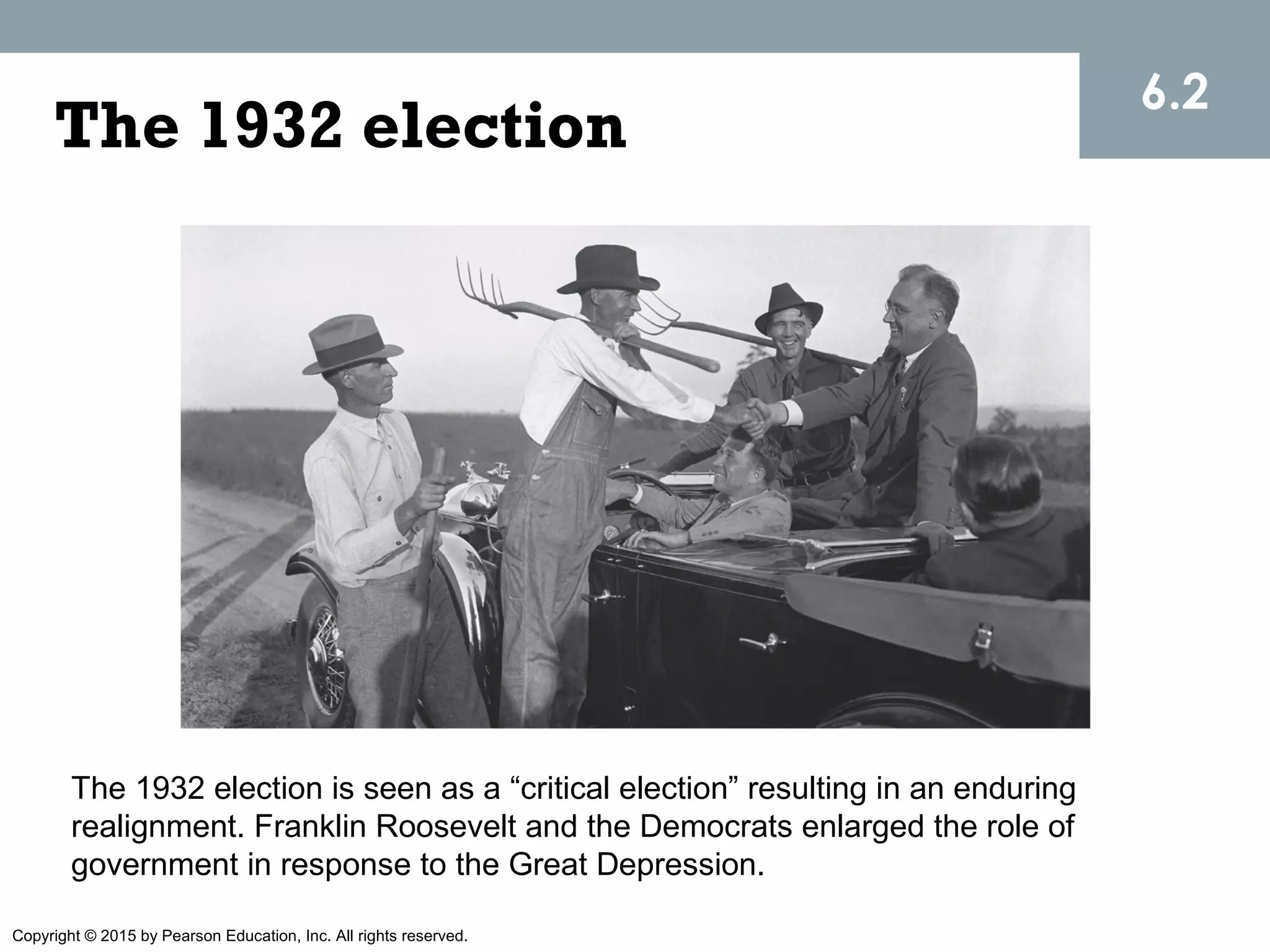
The 1932 election is seen as a “critical election” resulting in an enduring
realignment. Franklin Roosevelt and the Democrats enlarged the role of
government in response to the Great Depression.
The 1932 election
6.2
Copyright © 2015 by Pearson Education, Inc. All rights reserved.
The Last Half Century
 Party demographic shift -Major shifts in party demographics
have occurred in recent decades, most notably in the South.
 “Solid South”/Republican South - Once controlled by
Democrats, many white Democrats left the party when leaders passed civil
rights legislation. The exodus continued as Democrats supported more
liberal stands on abortion and social issues and the Republican South
reinforced the shift to conservatism.
 2008 election and the Tea Party - The 2008 election
saw an increase in voter turnout. It also produced the Tea Party
Movement. Tea Party activists are conservatives and predominately
Republicans, who helped the GOP gain a majority in the House of
Representatives.
6.2
Copyright © 2015 by Pearson Education, Inc. All rights reserved.
6.2 Which of these is not a
characteristic of realigning elections?
a. Weak voter involvement
b. Disruptions of traditional voting patterns
c. Changes in relationships of power within the
broader political community
d. The formation of new and durable electoral
groupings
6.2
Copyright © 2015 by Pearson Education, Inc. All rights reserved.
6.2 Which of these is not a
characteristic of realigning elections?
6.2
a. Weak voter involvement
b. Disruptions of traditional voting patterns
c. Changes in relationships of power within the
broader political community
d. The formation of new and durable electoral
groupings
Copyright © 2015 by Pearson Education, Inc. All rights reserved.
American Parties Today
 Parties as Institutions
 Parties in Government
 Parties in the Electorate
 Party Identification
 Partisan Dealignment?
6.3
Copyright © 2015 by Pearson Education, Inc. All rights reserved.
Parties as Institutions
 National party leadership
 National party conventions - meet every four years at a
national party convention to nominate a presidential and vice
presidential candidate and ratify the party platform.
 National committee and chair draft the party’s platform
 Party platform - details the issues and where the party
stands on them
 Parties at the state and local levels - Each
state has a state committee headed by a state chair, and below
the state committees are county committees, which vary widely in
function and power.
6.3
Copyright © 2015 by Pearson Education, Inc. All rights reserved.
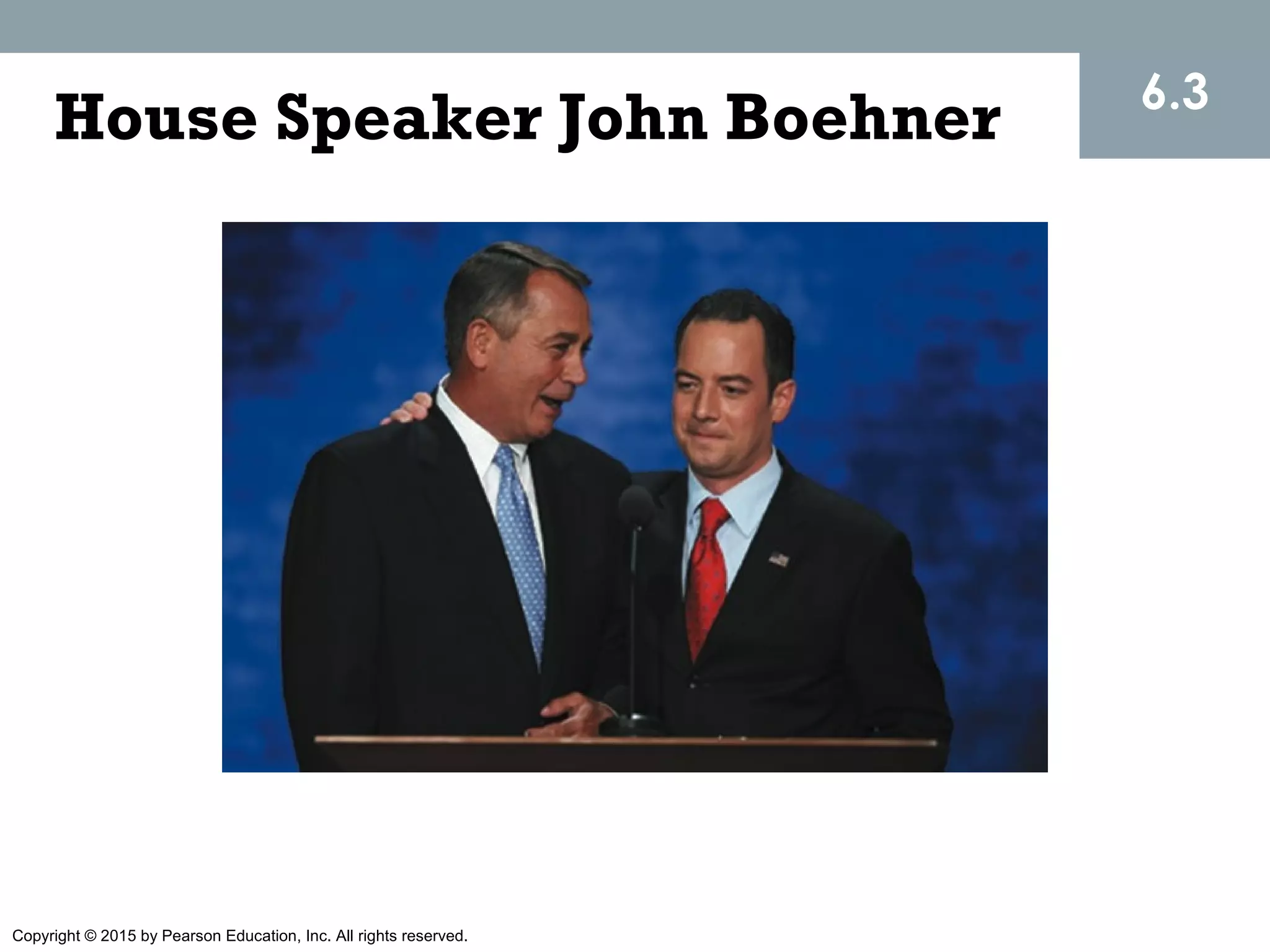
House Speaker John Boehner 6.3
Copyright © 2015 by Pearson Education, Inc. All rights reserved.
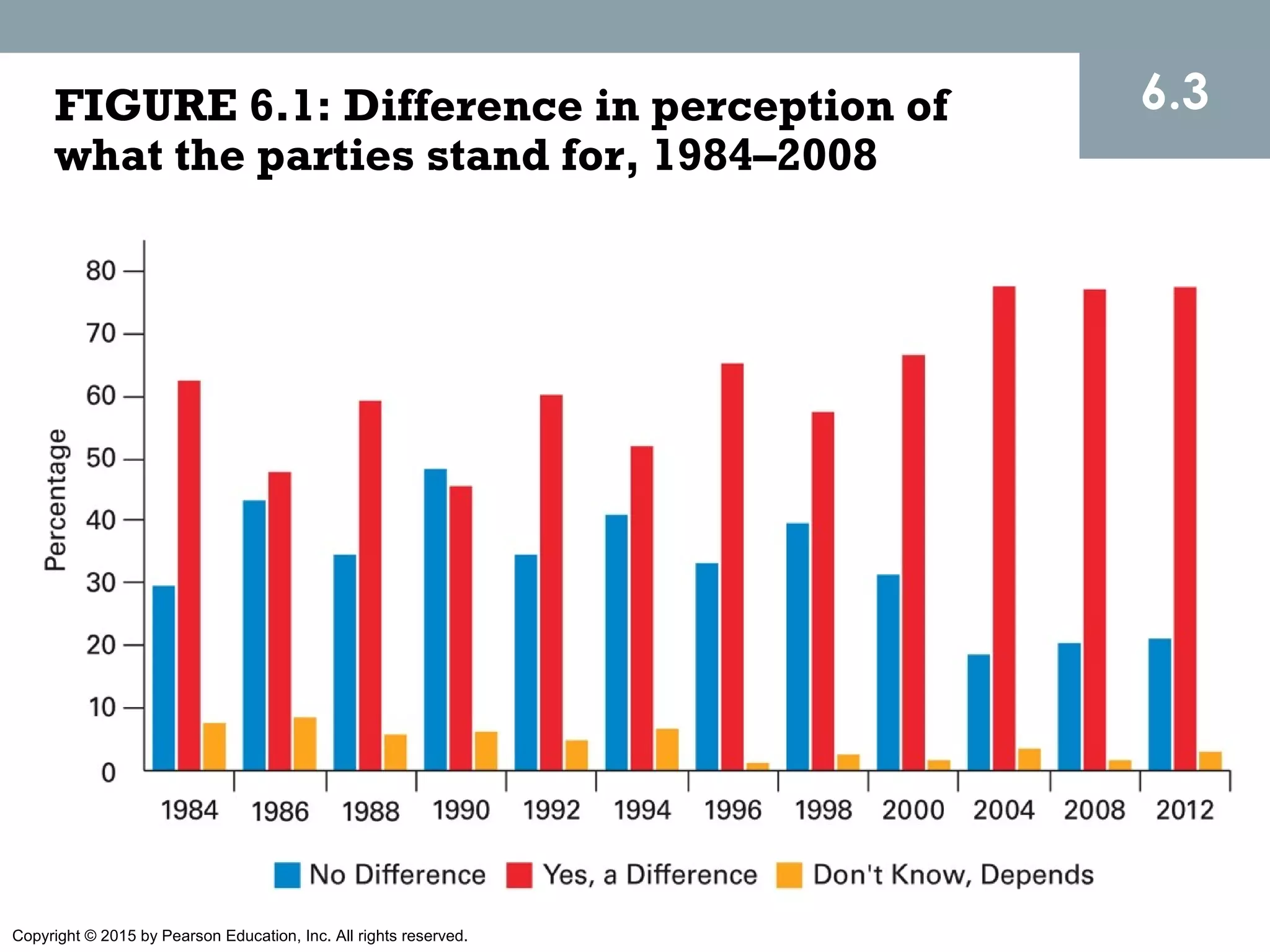
FIGURE 6.1: Difference in perception of
what the parties stand for, 1984–2008
6.3
Copyright © 2015 by Pearson Education, Inc. All rights reserved.
Parties in Government
 In the legislative branch
 Members have more power and influence when their party is
control of the House or Senate. Committee chairs belong to
majority party
 In the executive branch
 Presidential appointments based on partisanship -
nearly all senior White House staff and members of the Cabinet.
 In the judicial branch
 Partisan appointment process
 Importance of parties varies at the state
and local levels
6.3
Copyright © 2015 by Pearson Education, Inc. All rights reserved.
Parties in the Electorate
 Party registration - the purpose is to limit the
participants in primary elections to members of that party and
to make it easier for parties to contact its potential voters.
 Party activists fall into 3 categories
 Party regulars
 Candidate activists
 Issue activists
6.3
Copyright © 2015 by Pearson Education, Inc. All rights reserved.
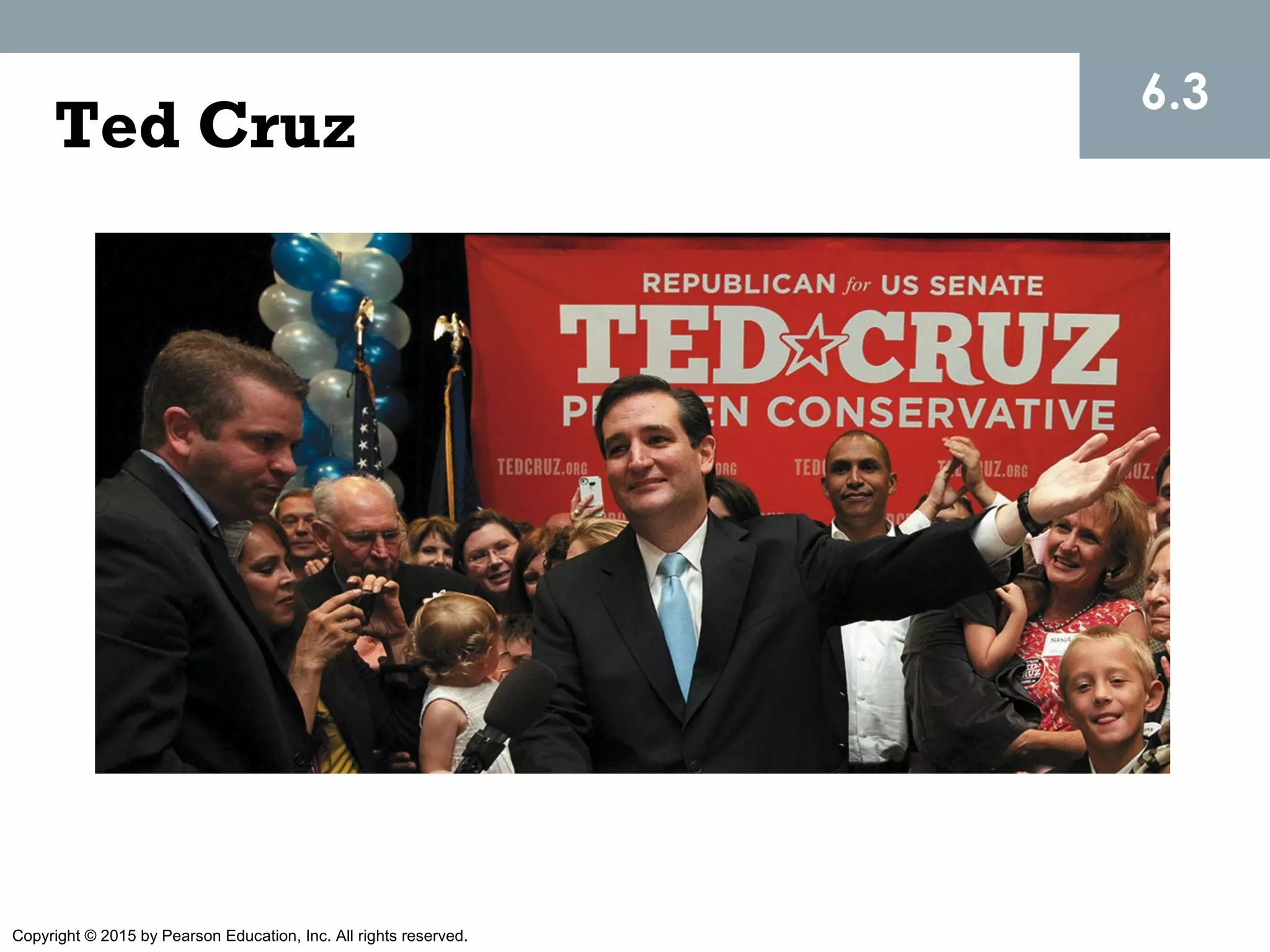
Ted Cruz
6.3
Copyright © 2015 by Pearson Education, Inc. All rights reserved.
Party Identification
 Party identification is acquired during
childhood
 Party identification is relatively stable
over time
 Party identification is the single best
predictor of how people will vote
6.3
Copyright © 2015 by Pearson Education, Inc. All rights reserved.
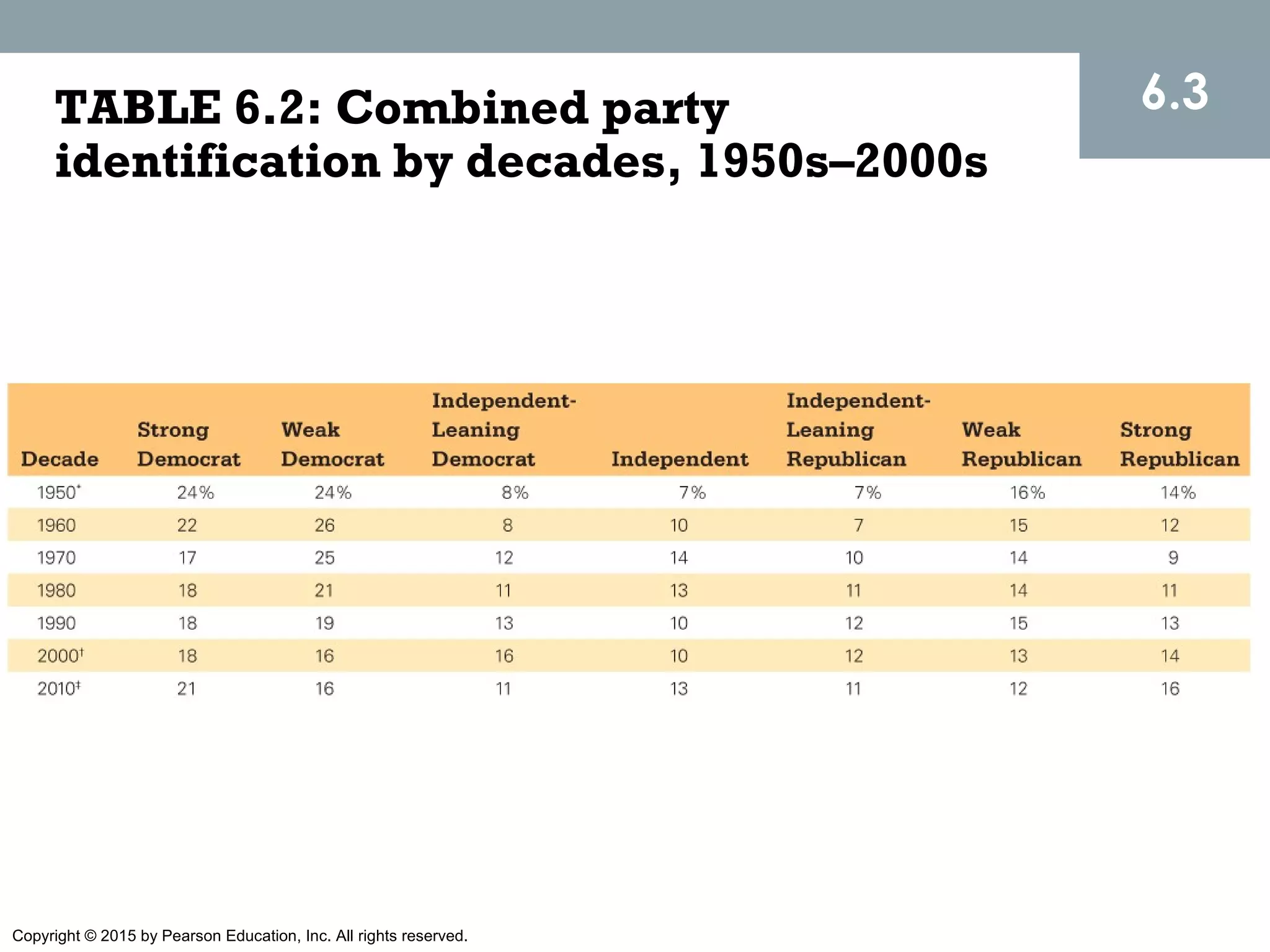
TABLE 6.2: Combined party
identification by decades, 1950s–2000s
6.3
Copyright © 2015 by Pearson Education, Inc. All rights reserved.
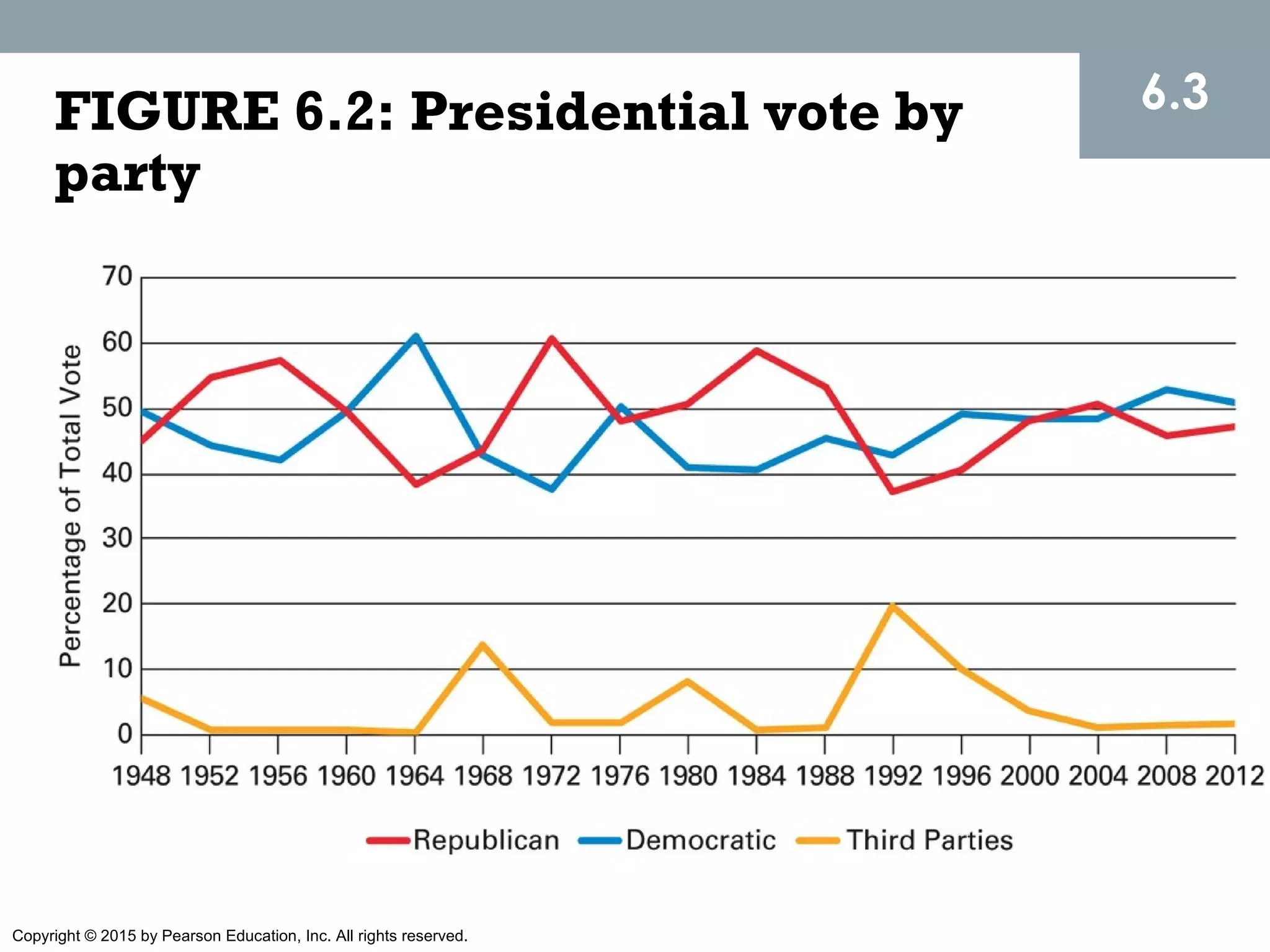
FIGURE 6.2: Presidential vote by
party
6.3
Copyright © 2015 by Pearson Education, Inc. All rights reserved.
 Increasing number of Independents
 Most self-identified Independents vote
along partisan lines
 Pure Independents make up same
proportion as 1956
6.3
Partisan Dealignment?
Copyright © 2015 by Pearson Education, Inc. All rights reserved.
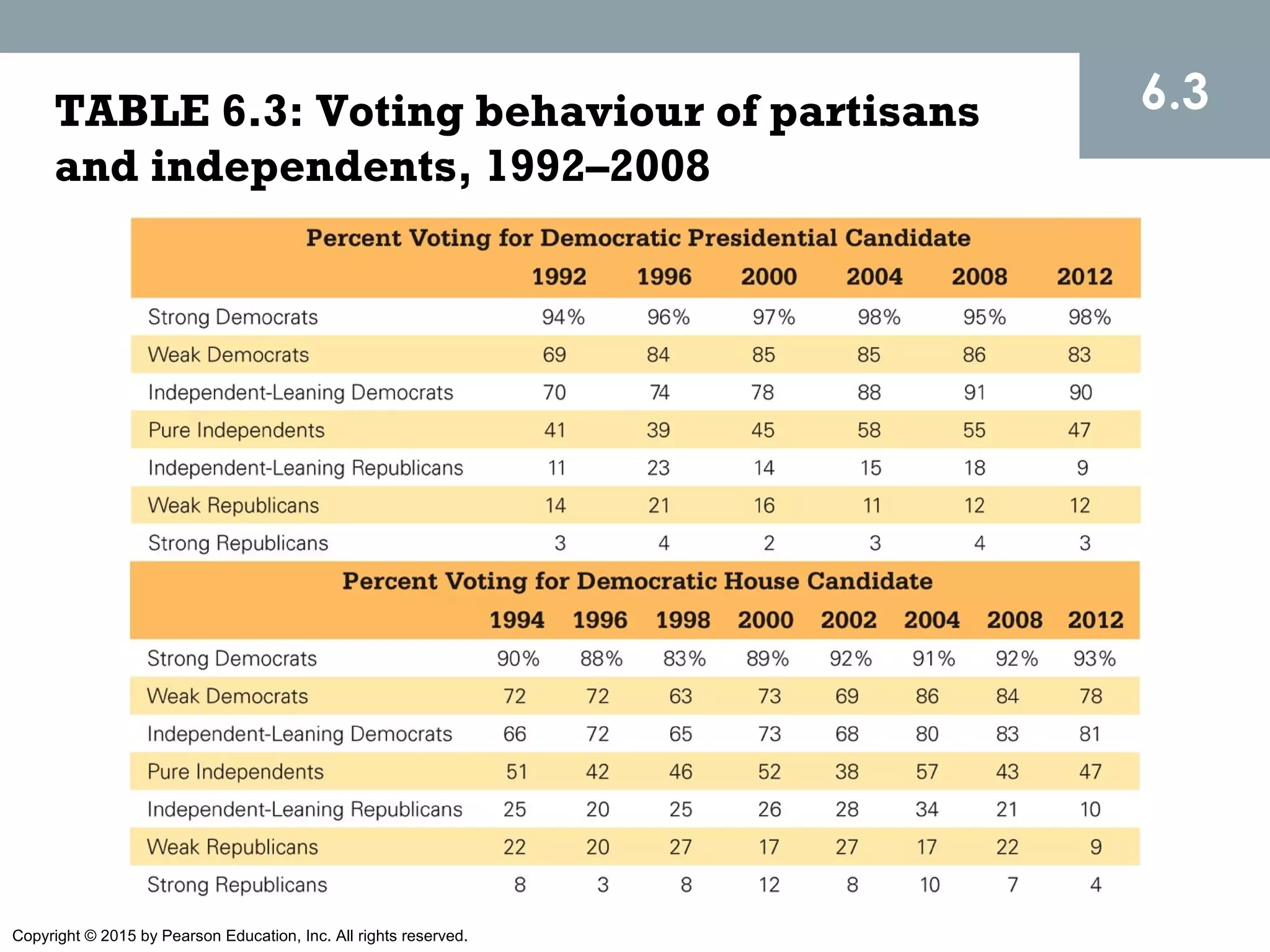
TABLE 6.3: Voting behaviour of partisans
and independents, 1992–2008
6.3
Copyright © 2015 by Pearson Education, Inc. All rights reserved.
6.3 Which of the following is the
best predictor of voting behavior?
a. Party identification
b. Interest in single issue
c. Ideology
d. Choice of candidate
6.3
Copyright © 2015 by Pearson Education, Inc. All rights reserved.
6.3 Which of the following is the
best predictor of voting behavior?
a. Party identification
b. Interest in single issue
c. Ideology
d. Choice of candidate
6.3
Copyright © 2015 by Pearson Education, Inc. All rights reserved.
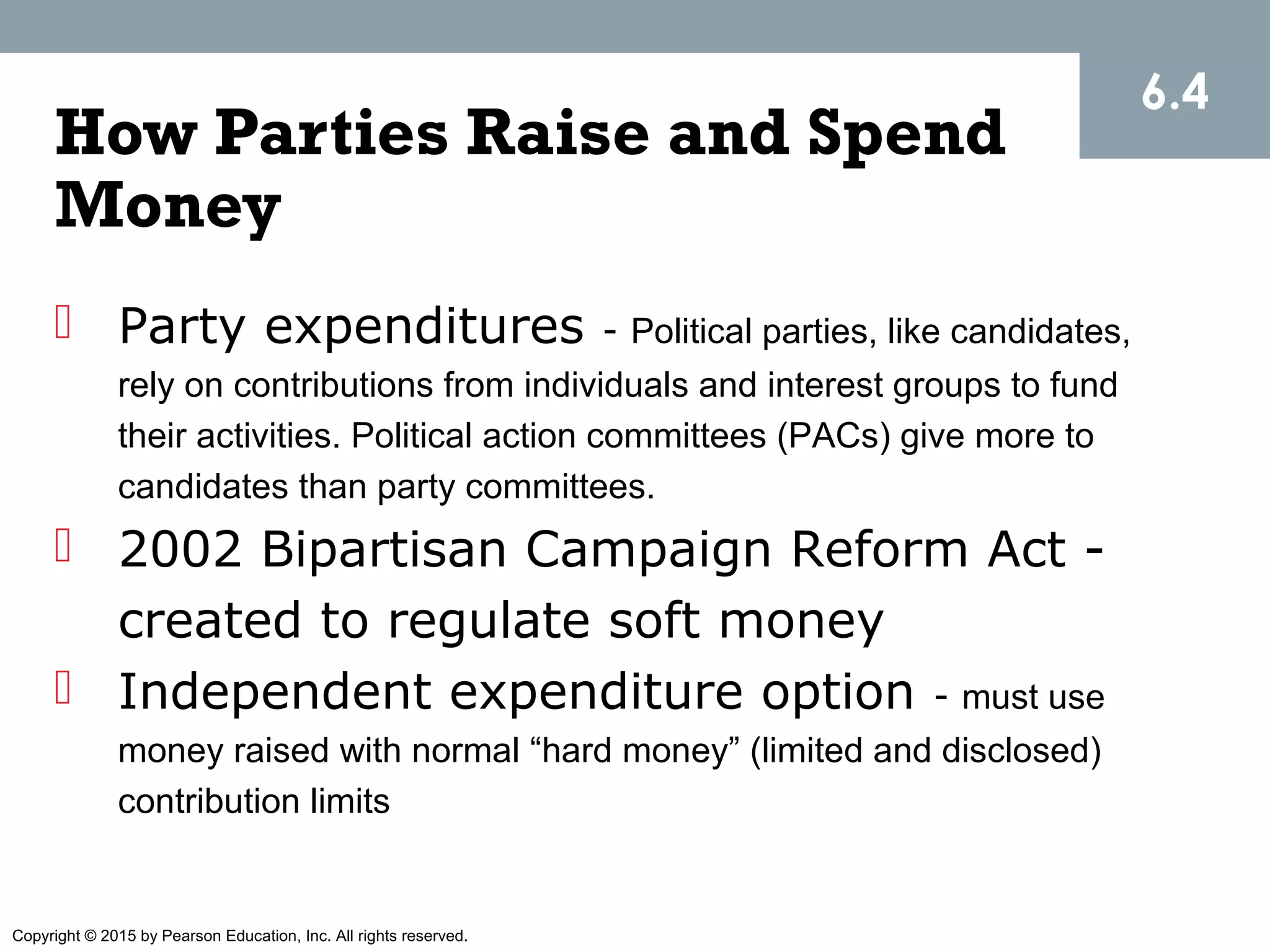
How Parties Raise and Spend
Money
 Party expenditures - Political parties, like candidates,
rely on contributions from individuals and interest groups to fund
their activities. Political action committees (PACs) give more to
candidates than party committees.
 2002 Bipartisan Campaign Reform Act -
created to regulate soft money
 Independent expenditure option - must use
money raised with normal “hard money” (limited and disclosed)
contribution limits
6.4
Copyright © 2015 by Pearson Education, Inc. All rights reserved.
6.4 What happened after the passage
of Bipartisan Campaign Reform Act?
6.4
a. Political parties were weakened by limits
on funding
b. Political parties were strengthened by a
surge in contributions
c. There was no change in contributions
d. Contributions at first weakened but then
had modest increases
Copyright © 2015 by Pearson Education, Inc. All rights reserved.
6.4 What happened after the passage
of Bipartisan Campaign Reform Act?
6.4
a. Political parties were weakened by limits
on funding
b. Political parties were strengthened by a
surge in contributions
c. There was no change in contributions
d. Contributions at first weakened but then
had modest increases
Copyright © 2015 by Pearson Education, Inc. All rights reserved.
Are the Political Parties Dying?
 Reform Among the Democrats
 Reform Among the Republicans
 Continued Importance of Parties
6.5
Copyright © 2015 by Pearson Education, Inc. All rights reserved.
Reform Among the Democrats
 Use of direct primaries
 Proportional voting
 Nominees won delegates based on votes they received
 Super delegates
 Party leaders who do not have to run for election as
delegates
6.5
Copyright © 2015 by Pearson Education, Inc. All rights reserved.
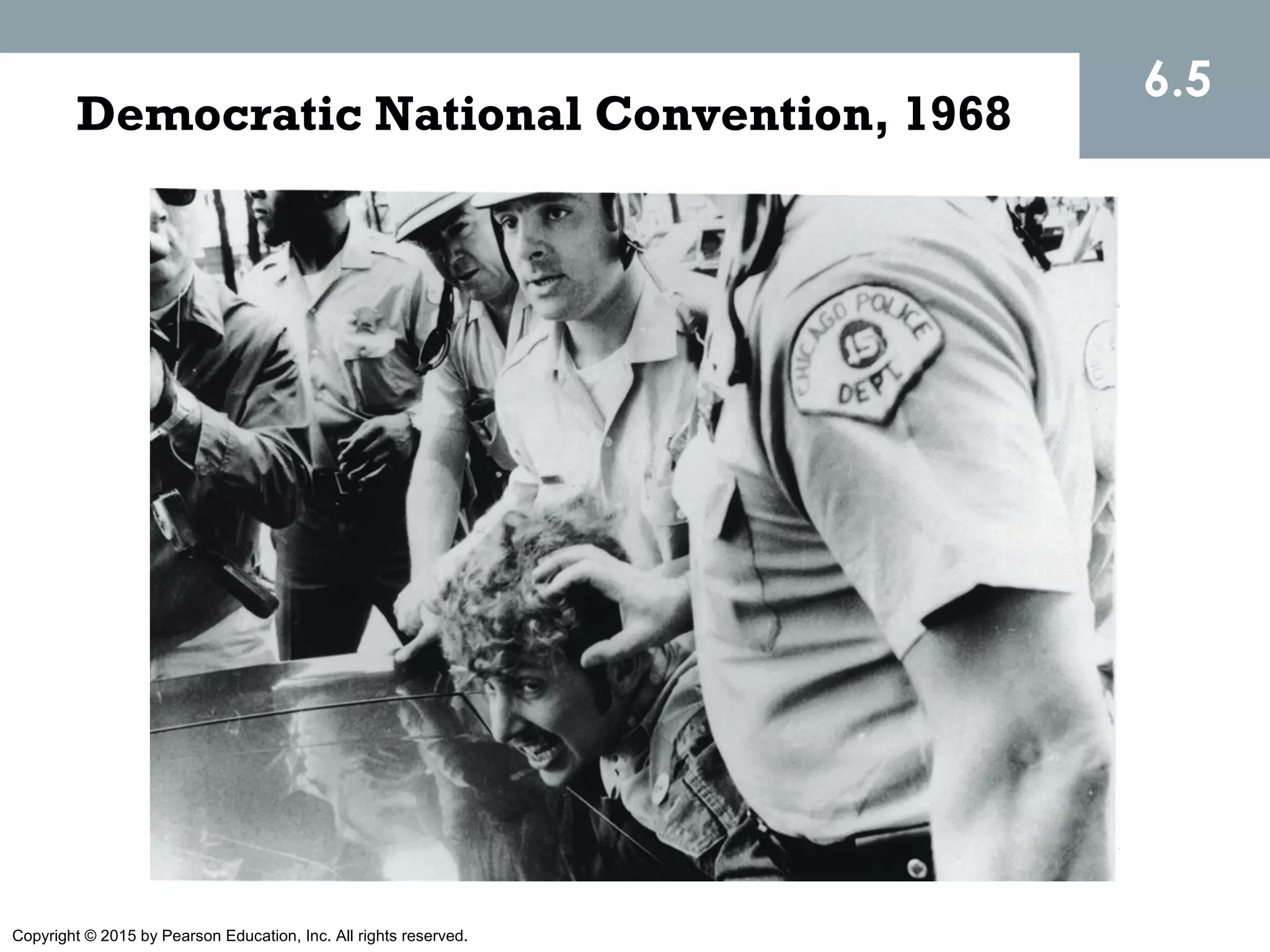
Democratic National Convention, 1968
6.5
Copyright © 2015 by Pearson Education, Inc. All rights reserved.
 Grassroots campaigns - seminars and training workshops for
young party professionals.
 More membership recruitment - women, minorities,
youth, and the poor.
• Donor base - Until 2004, Republicans had cultivated a larger
donor base and were less reliant on soft money contributions that
became so controversial in recent elections.
• In the 2010 election cycle, the Democratic Party committees all raised
and spent more than the Republican Party committees. However,
both sides raised substantial contributions, much of it from small
donors.
6.5Reform Among the
Republicans
Copyright © 2015 by Pearson Education, Inc. All rights reserved.
Continued Importance of
Parties
 Parties fill democratic functions
 Parties help organize government
 Through parties, citizens influence
government
6.5
Copyright © 2015 by Pearson Education, Inc. All rights reserved.
6.5 How did the Republican Party
become better organized in the 1970s?
a. By using grassroots methods
b. By training young professionals
c. By increasing membership among different groups
d. All of the above
6.5
Copyright © 2015 by Pearson Education, Inc. All rights reserved.
6.5 How did the Republican Party
become better organized in the 1970s?
a. By using grassroots methods
b. By training young professionals
c. By increasing membership among different groups
d. All of the above
6.5
Copyright © 2015 by Pearson Education, Inc. All rights reserved.
Discussion Question
Are you a member of a major or minor
political party? Why? How would you
classify your level of partisanship?
6

Magleby chapter6 ppt

  • 2.
  • 3.
    Copyright © 2015by Pearson Education, Inc. All rights reserved. Learning Objectives 6 6.1 6.2 Identify the primary functions of parties in democracies and distinguish the U.S. party system from those in European democracies Describe changes in American political parties and identify four realigning elections
  • 4.
    Copyright © 2015by Pearson Education, Inc. All rights reserved. Learning Objectives 6 6.3 6.4 Evaluate the functions of parties as institutions, parties in government, and parties in the electorate Explain party fund-raising and expenditures, and assess their regulation
  • 5.
    Copyright © 2015by Pearson Education, Inc. All rights reserved. Learning Objectives 2.2 6 6.5 Assess the effects of recent party reforms and the long-term prospects for the current party system
  • 6.
    Copyright © 2015by Pearson Education, Inc. All rights reserved. What Parties Do for Democracy  Party Functions  The Nomination of Candidates  Party Systems  Minor Parties: Persistence and Frustration 6.1
  • 7.
    Copyright © 2015by Pearson Education, Inc. All rights reserved. Party Functions  Organize the competition Parties nominate candidates, and then support them by raising money, providing training, and mobilizing voters to volunteer and vote for them.  Unify the electorate - must present a unified front even during internal conflicts  Organize the government - In Congress, the majority party selects the committee chairs and has a majority in each committee. This is clearly important when it comes to passing legislation.  Make policy - Elected party members must support party policies  Provide loyal opposition 6.1
  • 8.
    Copyright © 2015by Pearson Education, Inc. All rights reserved. Political parties help inform and motivate voters. Here, a senior and political science major at Western Kentucky University makes calls from the local Republican Party headquarters urging voters to support GOP candidates. 6.1
  • 9.
    Copyright © 2015by Pearson Education, Inc. All rights reserved. The Nomination of Candidates  Early caucus gave way to convention  Direct primary  Open primaries - voters can vote for candidates from any party.  Closed primaries - only voters registered for a party can vote and they must vote for party candidate.  Local caucuses  Choose delegates who choose delegates to state and national conventions 6.1
  • 10.
    Copyright © 2015by Pearson Education, Inc. All rights reserved. Iowa Caucus 6.1 Iowa’s Democratic caucus is an unwieldy and complex process. Here, a precinct captain takes a head count to determine support for various candidates.
  • 11.
    Copyright © 2015by Pearson Education, Inc. All rights reserved. Party Systems  Presidential vs. Parliamentary government • US has 2 main parties and some minor ones • Parliamentary governments are often multiparty systems. Winners are determined through proportional representation.  Proportional representation - seats are apportioned in the legislature based on the percentage of the vote won by each party. In such a system, even small parties can gain seats and perhaps a place in the governing coalition. 6.1
  • 12.
    Copyright © 2015by Pearson Education, Inc. All rights reserved. Chancellor Merkel 6.1 German Chancellor Angela Merkel is from the Christian Democratic Union (CDU) Party, which has a majority in the Bundestag (Parliament) thanks to an alliance with two other parties.
  • 13.
    Copyright © 2015by Pearson Education, Inc. All rights reserved. Party Systems  “Winner-take-all” system - The candidate who receives a plurality of the vote—not necessarily a majority—gets the seat. There is no advantage to coming in second.  Lack of incentive for small parties - Candidates for small parties are unlikely to win and it’s hard to convince people that a vote for them is not a wasted vote. 6.1
  • 14.
    Copyright © 2015by Pearson Education, Inc. All rights reserved. Minor Parties: Persistence and Frustration  Candidate-based parties - usually last only as long as the candidate  Ideology-based parties - tend to last longer. Examples are Libertarian and Green Parties  Limited success and influence - minor parties have never won more than a handful of congressional seats and their influence on national policy and on the platforms of the two major parties has been limited. 6.1
  • 15.
    Copyright © 2015by Pearson Education, Inc. All rights reserved. TABE 6.1: Minor parties in the United States 6.1
  • 16.
    Copyright © 2015by Pearson Education, Inc. All rights reserved. 6.1 What is a meeting of local party members to choose candidates for public office and to decide the platform called? a. Open primary b. Direct primary c. Convention d. Caucus 6.1
  • 17.
    Copyright © 2015by Pearson Education, Inc. All rights reserved. 6.1 What is a meeting of local party members to choose candidates for public office and to decide the platform called? 6.1 a. Open primary b. Direct primary c. Convention d. Caucus
  • 18.
    Copyright © 2015by Pearson Education, Inc. All rights reserved. A Brief History of American Political Parties  The Nation’s First Parties  Realigning Elections  The Last Half Century 6.2
  • 19.
    Copyright © 2015by Pearson Education, Inc. All rights reserved. The Nation’s First Parties  Constitution Ratification debate - caused the first parties to form  Hamilton and the Federalists - In order to usher measures through the first Congress, the Washington administration, under the leadership of Alexander Hamilton, formed a coalition of factions and legislators called the Federalist party.  Jefferson and the Democratic-Republicans In response, those politically opposed, led by Thomas Jefferson, formed a counter-coalition, known as Republicans, then as Democratic-Republicans, and finally as Democrats. 6.2
  • 20.
    Copyright © 2015by Pearson Education, Inc. All rights reserved. Realigning Elections  1824: Andrew Jackson and the Democrats  1860: The Civil War and the rise of the Republicans  1896: A party in transition  1932: Franklin Roosevelt and the New Deal alignment 6.2 The two-party system has remained constant but about every 32 years, realigning elections involve more voters and change the relationships of power within the broader political community.
  • 21.
    Copyright © 2015by Pearson Education, Inc. All rights reserved. Realigning Elections  1932: Franklin Roosevelt and the New Deal alignment • the dividing line between Republicans and Democrats became the role of government in the economy. 6.2
  • 22.
    Copyright © 2015by Pearson Education, Inc. All rights reserved. The 1932 election is seen as a “critical election” resulting in an enduring realignment. Franklin Roosevelt and the Democrats enlarged the role of government in response to the Great Depression. The 1932 election 6.2
  • 23.
    Copyright © 2015by Pearson Education, Inc. All rights reserved. The Last Half Century  Party demographic shift -Major shifts in party demographics have occurred in recent decades, most notably in the South.  “Solid South”/Republican South - Once controlled by Democrats, many white Democrats left the party when leaders passed civil rights legislation. The exodus continued as Democrats supported more liberal stands on abortion and social issues and the Republican South reinforced the shift to conservatism.  2008 election and the Tea Party - The 2008 election saw an increase in voter turnout. It also produced the Tea Party Movement. Tea Party activists are conservatives and predominately Republicans, who helped the GOP gain a majority in the House of Representatives. 6.2
  • 24.
    Copyright © 2015by Pearson Education, Inc. All rights reserved. 6.2 Which of these is not a characteristic of realigning elections? a. Weak voter involvement b. Disruptions of traditional voting patterns c. Changes in relationships of power within the broader political community d. The formation of new and durable electoral groupings 6.2
  • 25.
    Copyright © 2015by Pearson Education, Inc. All rights reserved. 6.2 Which of these is not a characteristic of realigning elections? 6.2 a. Weak voter involvement b. Disruptions of traditional voting patterns c. Changes in relationships of power within the broader political community d. The formation of new and durable electoral groupings
  • 26.
    Copyright © 2015by Pearson Education, Inc. All rights reserved. American Parties Today  Parties as Institutions  Parties in Government  Parties in the Electorate  Party Identification  Partisan Dealignment? 6.3
  • 27.
    Copyright © 2015by Pearson Education, Inc. All rights reserved. Parties as Institutions  National party leadership  National party conventions - meet every four years at a national party convention to nominate a presidential and vice presidential candidate and ratify the party platform.  National committee and chair draft the party’s platform  Party platform - details the issues and where the party stands on them  Parties at the state and local levels - Each state has a state committee headed by a state chair, and below the state committees are county committees, which vary widely in function and power. 6.3
  • 28.
    Copyright © 2015by Pearson Education, Inc. All rights reserved. House Speaker John Boehner 6.3
  • 29.
    Copyright © 2015by Pearson Education, Inc. All rights reserved. FIGURE 6.1: Difference in perception of what the parties stand for, 1984–2008 6.3
  • 30.
    Copyright © 2015by Pearson Education, Inc. All rights reserved. Parties in Government  In the legislative branch  Members have more power and influence when their party is control of the House or Senate. Committee chairs belong to majority party  In the executive branch  Presidential appointments based on partisanship - nearly all senior White House staff and members of the Cabinet.  In the judicial branch  Partisan appointment process  Importance of parties varies at the state and local levels 6.3
  • 31.
    Copyright © 2015by Pearson Education, Inc. All rights reserved. Parties in the Electorate  Party registration - the purpose is to limit the participants in primary elections to members of that party and to make it easier for parties to contact its potential voters.  Party activists fall into 3 categories  Party regulars  Candidate activists  Issue activists 6.3
  • 32.
    Copyright © 2015by Pearson Education, Inc. All rights reserved. Ted Cruz 6.3
  • 33.
    Copyright © 2015by Pearson Education, Inc. All rights reserved. Party Identification  Party identification is acquired during childhood  Party identification is relatively stable over time  Party identification is the single best predictor of how people will vote 6.3
  • 34.
    Copyright © 2015by Pearson Education, Inc. All rights reserved. TABLE 6.2: Combined party identification by decades, 1950s–2000s 6.3
  • 35.
    Copyright © 2015by Pearson Education, Inc. All rights reserved. FIGURE 6.2: Presidential vote by party 6.3
  • 36.
    Copyright © 2015by Pearson Education, Inc. All rights reserved.  Increasing number of Independents  Most self-identified Independents vote along partisan lines  Pure Independents make up same proportion as 1956 6.3 Partisan Dealignment?
  • 37.
    Copyright © 2015by Pearson Education, Inc. All rights reserved. TABLE 6.3: Voting behaviour of partisans and independents, 1992–2008 6.3
  • 38.
    Copyright © 2015by Pearson Education, Inc. All rights reserved. 6.3 Which of the following is the best predictor of voting behavior? a. Party identification b. Interest in single issue c. Ideology d. Choice of candidate 6.3
  • 39.
    Copyright © 2015by Pearson Education, Inc. All rights reserved. 6.3 Which of the following is the best predictor of voting behavior? a. Party identification b. Interest in single issue c. Ideology d. Choice of candidate 6.3
  • 40.
    Copyright © 2015by Pearson Education, Inc. All rights reserved. How Parties Raise and Spend Money  Party expenditures - Political parties, like candidates, rely on contributions from individuals and interest groups to fund their activities. Political action committees (PACs) give more to candidates than party committees.  2002 Bipartisan Campaign Reform Act - created to regulate soft money  Independent expenditure option - must use money raised with normal “hard money” (limited and disclosed) contribution limits 6.4
  • 41.
    Copyright © 2015by Pearson Education, Inc. All rights reserved. 6.4 What happened after the passage of Bipartisan Campaign Reform Act? 6.4 a. Political parties were weakened by limits on funding b. Political parties were strengthened by a surge in contributions c. There was no change in contributions d. Contributions at first weakened but then had modest increases
  • 42.
    Copyright © 2015by Pearson Education, Inc. All rights reserved. 6.4 What happened after the passage of Bipartisan Campaign Reform Act? 6.4 a. Political parties were weakened by limits on funding b. Political parties were strengthened by a surge in contributions c. There was no change in contributions d. Contributions at first weakened but then had modest increases
  • 43.
    Copyright © 2015by Pearson Education, Inc. All rights reserved. Are the Political Parties Dying?  Reform Among the Democrats  Reform Among the Republicans  Continued Importance of Parties 6.5
  • 44.
    Copyright © 2015by Pearson Education, Inc. All rights reserved. Reform Among the Democrats  Use of direct primaries  Proportional voting  Nominees won delegates based on votes they received  Super delegates  Party leaders who do not have to run for election as delegates 6.5
  • 45.
    Copyright © 2015by Pearson Education, Inc. All rights reserved. Democratic National Convention, 1968 6.5
  • 46.
    Copyright © 2015by Pearson Education, Inc. All rights reserved.  Grassroots campaigns - seminars and training workshops for young party professionals.  More membership recruitment - women, minorities, youth, and the poor. • Donor base - Until 2004, Republicans had cultivated a larger donor base and were less reliant on soft money contributions that became so controversial in recent elections. • In the 2010 election cycle, the Democratic Party committees all raised and spent more than the Republican Party committees. However, both sides raised substantial contributions, much of it from small donors. 6.5Reform Among the Republicans
  • 47.
    Copyright © 2015by Pearson Education, Inc. All rights reserved. Continued Importance of Parties  Parties fill democratic functions  Parties help organize government  Through parties, citizens influence government 6.5
  • 48.
    Copyright © 2015by Pearson Education, Inc. All rights reserved. 6.5 How did the Republican Party become better organized in the 1970s? a. By using grassroots methods b. By training young professionals c. By increasing membership among different groups d. All of the above 6.5
  • 49.
    Copyright © 2015by Pearson Education, Inc. All rights reserved. 6.5 How did the Republican Party become better organized in the 1970s? a. By using grassroots methods b. By training young professionals c. By increasing membership among different groups d. All of the above 6.5
  • 50.
    Copyright © 2015by Pearson Education, Inc. All rights reserved. Discussion Question Are you a member of a major or minor political party? Why? How would you classify your level of partisanship? 6

Editor's Notes

  • #3 Republican presidential candidate Mitt Romney, right, and his vice presidential running mate Representative Paul Ryan, R-Wis., left, campaigning down to the wire on Sunday, Oct. 28, 2012, in hard-fought Ohio. Political parties play an important role in facilitating voting by organizing elections and simplifying choices. They are both a consequence of democracy and an instrument of it.
  • #4 This chapter begins by examining why parties are so vital to the functioning of democracy and then discusses their evolution. We will assess how parties have furthered democracy as institutions, in government, and in the electorate, and explore the prospect for party reform and renewal.
  • #7 Political parties seek political power. They try to elect people to office who will help party positions and philosophy become public policy. The U.S. has a two-party system, Democrats and Republicans, although there are also some third parties that are built around ideologies such as communism. Political parties serve a number of functions in democracies. American political parties function both as an ideological organization and a catalyst of policy, to greater and lesser degrees of success.
  • #8 Parties nominate candidates, and then support them by raising money, providing training, and mobilizing voters to volunteer and vote for them. Political parties may have internal conflicts but they work to present a unified front to voters. Parties are often identified with single issues, like gun control. However, they generally avoid this identification in order to appeal to more voters both within and outside their party. Congress and state legislatures are organized along party lines. In Congress, the majority party selects the committee chairs and has a majority in each committee. This is clearly important when when it comes to passing legislation. In addition, majority parties can select people to serve in government jobs. We will talk about this patronage, also known as the spoils system, later in this chapter. Elected party members must support party policies but in general they have limited success in setting the course of national policy. Their best chance is during the honeymoon period after an election, before the media and opposition party begin to criticize the party in control.
  • #9 Political parties help inform and motivate voters. Here, a senior and political science major at Western Kentucky University makes calls from the local Republican Party headquarters urging voters to support GOP candidates.
  • #10 Candidates for public office are selected by parties in various ways. In a caucus, local party members meet to choose both party officials and candidates, and decide the platform. They played an important part in pre- and post-Revolutionary politics until giving way to more representative party conventions. Today, voters vote for party nominees in the direct primary. In open primaries, voters can vote for candidates from any party. In closed primaries, only voters registered for a party can vote and they must vote for party candidate. Local caucuses choose delegates to attend regional meetings, which in turn select delegates to state and national conventions where they nominate party candidates for offices.
  • #11 Iowa’s Democratic caucus is an unwieldy and complex process. Here, a precinct captain takes a head count to determine support for various candidates.
  • #12 Party systems differ in countries with different governmental structures. The American presidential system has two main parties, Democrats and Republicans, and some minor parties. Parliamentary governments are often multiparty systems. Winners are determined through proportional representation. The parties receive a proportion of the legislators corresponding to their share of the vote. That is, seats are apportioned in the legislature based on the percentage of the vote won by each party. In such a system, even small parties can gain seats and perhaps a place in the governing coalition. In multiparty systems, parties at the extremes are likely to have more influence than in our two-party system. Thus, legislatures more accurately reflect the full range of the views of the electorate. However, multiparty parliamentary systems are often unstable. Coalitions can form and collapse, leading to dramatic swings in policy when party control changes.
  • #13 German Chancellor Angela Merkel is from the Christian Democratic Union (CDU) Party, which has a majority in the Bundestag (Parliament) thanks to an alliance with two other parties. Merkel has been under pressure domestically not to go too far in assisting the European Union's struggling economies and under international pressure to be as supportive of them as possible.
  • #14 The United States has a single-member district, winner-take-all system. The candidate who receives a plurality of the vote—not necessarily a majority—gets the seat. There is no advantage to coming in second. Candidates for small parties are unlikely to win and it’s hard to convince people that a vote for them is not a wasted vote. Two-party systems produce governments that tend to be stable and centrist, and as a result, policy changes occur incrementally.
  • #15 Let’s take a closer look now at these smaller, third parties. The United States has minor parties, or third parties, which have been centered around both candidates and ideologies. Candidate-based parties usually last only as long as the candidate. However, minor parties that are organized around an ideology have more staying power. Communist, Libertarian, and Green Parties are of the ideological type. Although often visible, minor parties have never won more than a handful of congressional seats and their influence on national policy and on the platforms of the two major parties has been limited.
  • #16 How does the percentage of popular vote received compare to the electoral votes received? How can you explain the difference in these numbers? Activity: Discuss how the structural “rules of the game” in American politics include single, plurality, winner-take-all district elections; encourage a two-party system; and make it almost impossible for a minor or third party to win. Have the class discuss whether proportional representation electoral rules (at least in the House of Representatives and state legislatures), which would create a multiparty system, would improve politics and democracy in the United States.
  • #17 We began this section with a look at how candidates are chosen to run for office. Can you answer this question now?
  • #18 Caucuses are a more complicated process than direct primaries.
  • #19 The Founders did not set up the American two-party system, and in fact were concerned that factions might create too much conflict. In this section, we will learn the history of American political parties and how they have evolved over the past 230-plus years. This evolution and development of political ideas and organizations has been highlighted by key individuals, events, and elections.
  • #20 Parties began to form as citizens debated the ratification of the Constitution. People realized that in order to get laws passed laws in Congress, officeholders had to have similar views. In order to usher measures through the first Congress, the Washington administration, under the leadership of Alexander Hamilton, formed a coalition of factions and legislators called the Federalist party. In response, those politically opposed, led by Thomas Jefferson, formed a counter-coalition, known as Republicans, then as Democratic-Republicans, and finally as Democrats.
  • #21 The two-party system has remained constant but about every 32 years, realigning elections involve more voters and change the relationships of power within the broader political community. In 1828, Andrew Jackson, aided by Martin Van Buren, knitted together a combination of regions, groups, and political doctrines to win the presidency. By 1837, the Democrats had become a large movement with national and state leadership, a clear party doctrine, and a grassroots organization. The 1860 election was won by the fledgling Republican Party with Abraham Lincoln as its candidate and the support not only of financiers, industrialists, and merchants but also of many workers and farmers. Republicans dominated the White House until the early twentieth century. In 1896 , the Republican Party realignment evolved and advanced its industrial-progressive view and reinforced its majority status.
  • #22 The 1932 election swept Democrats and Franklin Roosevelt into office in a landslide in response to the Great Depression. The New Deal fundamentally altered the relationship between government and society; the dividing line between Republicans and Democrats became the role of government in the economy.
  • #23 The 1932 election is seen as a “critical election” resulting in an enduring realignment. Franklin Roosevelt and the Democrats enlarged the role of government in response to the Great Depression. Roosevelt is seen here greeting farmers in Georgia in October 1932 as he campaigned for the presidency.
  • #24 Major shifts in party demographics have occurred in recent decades, most notably in the South. Once controlled by Democrats, many white Democrats left the party when leaders passed civil rights legislation. The exodus continued as Democrats supported more liberal stands on abortion and social issues and the Republican South reinforced the shift to conservatism. Since 1953, there has been divided government, where one party controls Congress and another the White House, more than there has been united government. Unified party control of government, when it has occurred, has been more volatile than earlier realignments. The 2008 election saw an increase in voter turnout. It also produced the Tea Party Movement. Tea Party activists are conservatives and predominately Republicans, who helped the GOP gain a majority in the House of Representatives.
  • #25 Let’s test your understanding of realignments with this question.
  • #26 Realigning elections feature intense voter involvement; without this, the elections would have little impact on political power and the formation of new groupings.
  • #27 Most voters think of themselves as Democrats or Republicans and typically vote for candidates from their party. Collectively they contribute millions of dollars to the two major parties. Both national parties and most state parties are moderate in their policies and leadership, appealing to a majority of the voters from their own constituency.
  • #28 Both major parties meet every four years at a national party convention to nominate a presidential and vice presidential candidate and ratify the party platform. The national committee and chair draft the party’s platform, which details the issues and where the party stands on them. The typical party platform is often a vague and ponderous document, the result of many meetings and compromises between groups and individuals. The platform-drafting process gives partisans an opportunity to express their views. The two major parties are decentralized. There are organizations for national, state, and local levels of government that prepare for elections at each level. The state and local levels are structured much like the national level. Each state has a state committee headed by a state chair, and below the state committees are county committees, which vary widely in function and power.
  • #29 Here we see Republican National Committee Chair Reince Priebus at the 2012 GOP Convention with Republican House Speaker John Boehner.
  • #30 A National Election survey tracks responses to the question, “Do you think there are any important differences in what the Republicans and Democrats stand for?” Why would people be more likely to see differences between parties in presidential election years than in midterm election years? Activity: For an interesting class discussion, first ask students whether there’s any difference between Republicans and Democrats. Then repeat the question, focusing on specific political issues—for example, abortion, obscenity, environment, and tax policy—and which social groups identify with each party.
  • #31 Congress takes its parties seriously. Members have more power and influence when their party is control of the House or Senate. The chairs of all standing committees are from the majority party. Partisanship is also important in presidential appointments to the highest levels of the federal workforce, including nearly all senior White House staff and members of the Cabinet. The judicial branch of the national government is designed to operate in an expressly nonpartisan manner; however, appointment process for judges has always been partisan, and today, party identification remains an important consideration when nominating federal judges. The importance of party in the operation of local government varies among states and localities.
  • #32 People choose party affiliations for a number of reasons. Factors include: • their stand on the issues • personal or party history • religious, racial, or social peer grouping • and the appeal of their candidates. The purpose of party registration is to limit the participants in primary elections to members of that party and to make it easier for parties to contact people who might vote for their party. Party activists invest time and effort in political parties. They tend to fall into three broad categories: party regulars, candidate activists, and issue activists. Party regulars place the party first, while candidate activists are followers of a specific candidate and see the party as the means to elect their candidate. Issue activists want to push the parties in a particular direction on a single issue or a narrow range of issues.
  • #33 We see in this photo Texas Republican U.S. Senate candidate Ted Cruz in 2012 on the night of his primary election victory, when he defeated a more established candidate. A favorite of the Tea Party and the son of a Cuban immigrant, Cruz went on to win the general election.
  • #34 Most people begin to identify with a political party in childhood. Peers and early political experiences reinforce party identification as part of the political socialization process. Party identification ranges from strong Democrat to strong Republican, with pure Independents as the median. Strong Republicans and strong Democrats participate more actively in politics than any other group. They are generally better informed about political issues, and most predictably partisan in their voting behavior. Although new voters have been added to the electorate, partisan preferences of the public as a whole have remained remarkably stable during the last fifty years. Party identification is the single best predictor of how people will vote.
  • #35 As we can see in this table, Independents typically lean toward one party. The stronger the identification, the greater the political interest and participation.
  • #36 Based on this graph, what share of the vote do third parties generally get? How many elections since 1952 have been exceptions to this?
  • #37 Some experts argue that Independents are increasing in number, suggesting that the party system may be in a period of dealignment, in which partisan preferences are weakening. However, two-thirds of all self-identified Independents are really partisans in their voting behavior and attitudes. Despite the reported growth in numbers, pure Independents make up approximately the same proportion of voters today as in 1956.
  • #38 In years that were good for Democrats in congressional elections, like 2004 and 2008, what support did they have that they didn’t in weaker elections, like 1994 and 1998?
  • #39 We’ve discussed at length factors that affect how voters vote. Can you answer this question now?
  • #40 People tend to vote according to their party affiliation, which is generally acquired in childhood.
  • #41 Political parties, like candidates, rely on contributions from individuals and interest groups to fund their activities. Political action committees (PACs) give more to candidates than party committees. Political parties had been allowed to raise unlimited amounts of money, called soft money, for party-building purposes. However, parties spent this money to elect or defeat candidates. Finally, in 2002, Congress passed the Bipartisan Campaign Reform Act to regulate this unrestricted soft money. Party committees can contribute a limited amount of money to support candidates and for coordinated expenditures in competitive elections. They can also spend unlimited amounts for and against candidates as long as the expenditures are independent of the candidate or a party committee. Party-independent expenditures must use money raised with normal “hard money” (limited and disclosed) contribution limits. The surge in individual contributions following the 2002 soft-money ban has demonstrated that the Democrat and Republican parties could find alternatives to unregulated money.
  • #42 Now that we’ve discussed how parties raise and spend money, can you answer this question?
  • #43 When parties were limited in the use of soft money, they compensated by increasing their donor base of individual contributions.
  • #44 Political parties have been criticized for not taking meaningful positions on issues. Some claim that that party membership is essentially meaningless and that because parties try to appeal to middle of the ideological spectrum, they are incapable of progress. Even worse, extremes have captured both parties’ agend. As a result, there is political gridlock throughout the government. Other analysts point out the long-term adverse impact that allowing Independents to vote in primaries had on parties. The increase in national, state, and local elections has made it harder for parties to influence the election process. Further, the rise of television and electronic technology and the parallel increase in campaign, media, and direct-mail consultants have made parties less relevant in educating, mobilizing, and organizing the electorate. Is there a future for political parties?
  • #45 In 1968, there were riots outside the the Democratic National Convention. The party responded to disputes about the fairness of delegate selection procedures and agreed to a number of reforms. Reforms included greater use of direct primaries. More women, minorities, and younger people were elected as delegates. Another reform was the abolition of the winner-take-all rule and its replacement by a system of vote proportionality. This meant that candidates won delegates based on the proportion of votes they received. To keep the party leadership onboard as delegates, without having to first be elected, the party created superdelegate positions.
  • #46 Chicago police officers push a protestor's head against the hood of a car as they restrain him after he climbed onto a wooden barricade near the headquarters of the 1968 Democratic National Convention and waved a Vietcong flag during anti-Vietnam War demonstrations, August 1968.
  • #47 Throughout the 1970s, Republicans emphasized grassroots organization and membership recruitment. They held seminars and training workshops for young party professionals. State parties were encouraged to increase the participation of women, minorities, youth, and the poor. Until 2004, Republicans had cultivated a larger donor base and were less reliant on soft money contributions that became so controversial in recent elections. In the 2010 election cycle, the Democratic Party committees all raised and spent more than the Republican Party committees. However, both sides raised substantial contributions, much of it from small donors.
  • #48 Political parties remain vital to the functioning of democracy by organizing electoral competition and unifying large portions of the electorate. They simplify democracy for voters, and create policy. Similarly, parties are just as important in organizing the government. Because parties are the means by which politicians secure office, they also provide an important way for citizens to influence American government.
  • #49 Let’s recap what we’ve just discussed with this question.
  • #50 Along with the Democratic Party, in the 1970s the Republican Party made some reforms. They used grassroots organization and increased its membership recruitment in the 1970s. They organized seminars on how to give speeches and held conferences to train young party professionals.