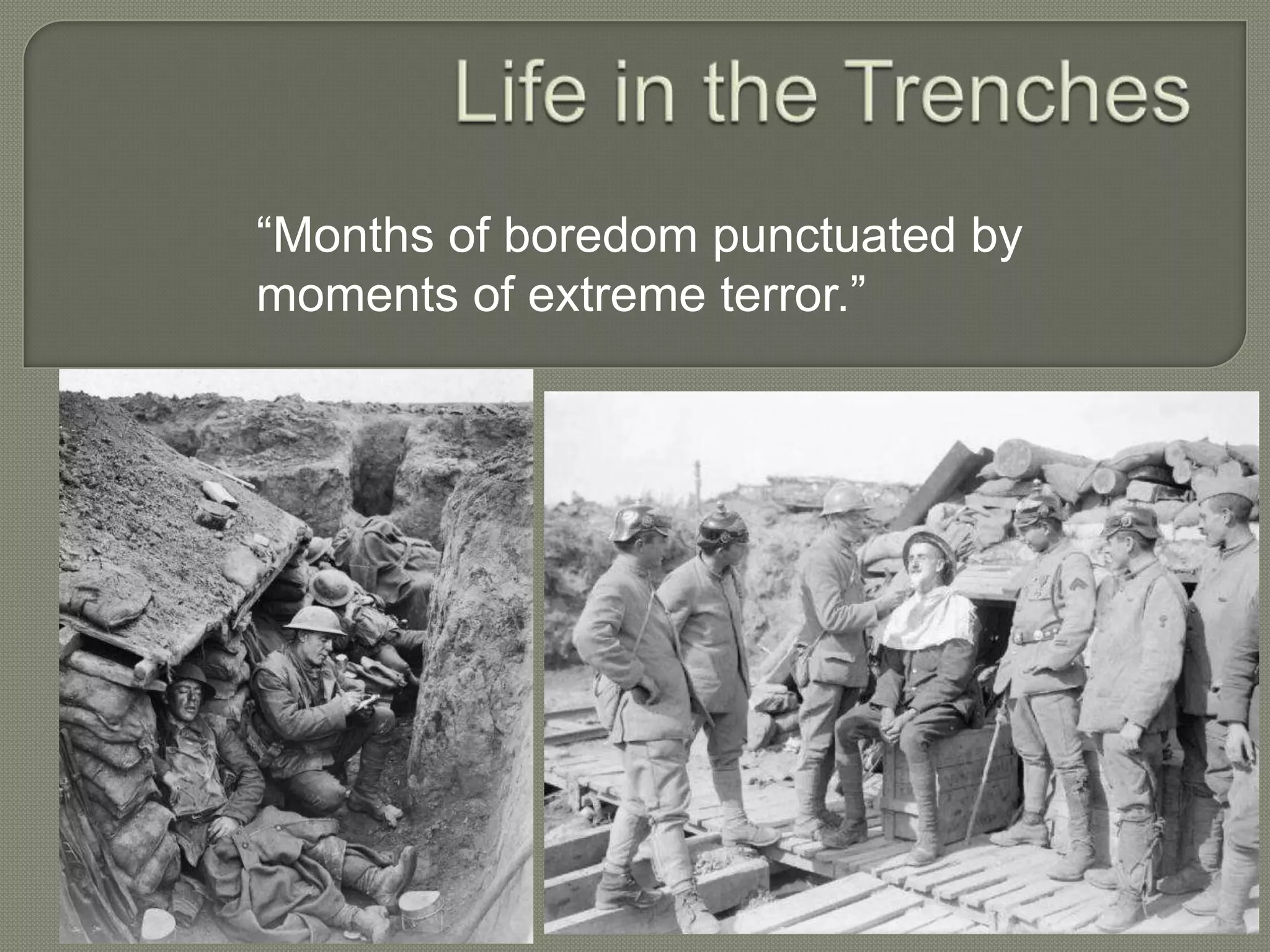
“Months of boredom punctuated by
moments of extreme terror.”
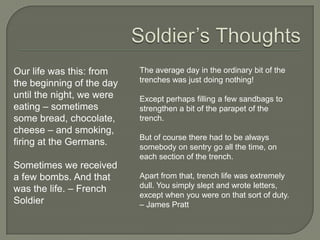
The average day in the ordinary bit of the
trenches was just doing nothing!
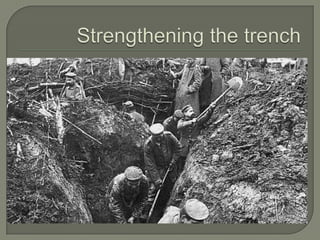
Except perhaps filling a few sandbags to
strengthen a bit of the parapet of the
trench.
But of course there had to be always
somebody on sentry go all the time, on
each section of the trench.
Apart from that, trench life was extremely
dull. You simply slept and wrote letters,
except when you were on that sort of duty.
– James Pratt
Our life was this: from
the beginning of the day
until the night, we were
eating – sometimes
some bread, chocolate,
cheese – and smoking,
firing at the Germans.
Sometimes we received
a few bombs. And that
was the life. – French
Soldier
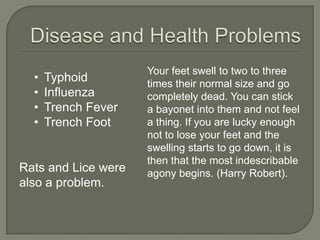
Your feet swell to two to three
times their normal size and go
completely dead. You can stick
a bayonet into them and not feel
a thing. If you are lucky enough
not to lose your feet and the
swelling starts to go down, it is
then that the most indescribable
agony begins. (Harry Robert).Rats and Lice were
also a problem.
• Typhoid
• Influenza
• Trench Fever
• Trench Foot
 Often mistaken for cowardice.
 Soldiers would be shot for not going over the top.
 Shell Shock was unfamiliar to many doctors.
Well I just thought it was a failure of life itself, the failure of
the mind to take the enormous depression that it had got. If
you are standing under a bombardment for so long and
you‟re seeing fellows going up in the air and you‟ve got to
stick it for a couple or three days it isn‟t funny.
I don‟t think they were cowards at all; any man that went up
there if he was a coward he wouldn‟t have gone, he‟d have
done anything not to go up there. – British Private
https://www.youtube.com/watch?v=hAA9Z
VgZauA
 Trench Slang
 “Gone West” – A term for a soldier who had died.
 “Brass Hat” – Enlisted men‟s term for an officer.
 “Belly Flopping” – To hit the ground quickly during an
attack.
 “Elephant” – Small dug-out with sheets of corrugated
iron.
 “Gunfire” – Strong tea, usually laced with rum.
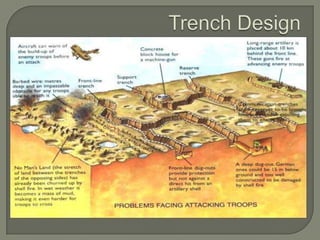
Usually took place at night.
A line of soldiers would dig about 10 feet
deep.
If the water levels were too high they
would make above ground trenches using
sandbags.
Soldiers would decorate sandbags to look
like soldiers.
https://www.youtube.com/watch?v=Ciq9ts0
2ci4
Machine guns and artillery devastated the
enemy.
Brutal hand to hand combat in the
trenches.
There were more trenches to take after the
first one.
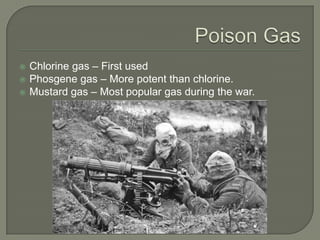
 Chlorine gas – First used
 Phosgene gas – More potent than chlorine.
 Mustard gas – Most popular gas during the war.
https://www.youtube.com/watch?v=_gOU_
GCkwMo
 https://www.youtube.com/watch?v=NOz9SpWc_yE
We were in the front line; we were about
300 yards from the Germans. On
Christmas Eve, we‟d been singing
carols and this that and the other, and
the Germans had been doing the same.
And we‟d been shouting to each
other, sometimes rude remarks more
often just joking remarks.
Anyway, eventually a German
said, „Tomorrow you no shoot, we no
shoot.‟
And the morning came and we didn‟t
shoot and they didn‟t shoot. – British
Private
• Christmas trees
were set up.
• Gifts were
exchanged.
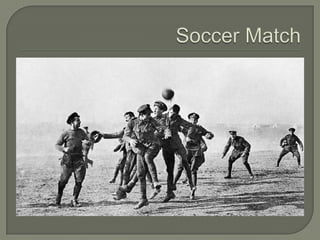
• A few troops
even played
soccer together.
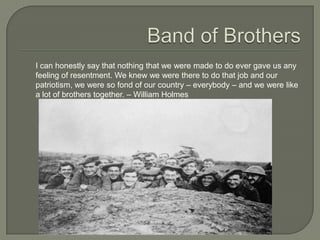
I can honestly say that nothing that we were made to do ever gave us any
feeling of resentment. We knew we were there to do that job and our
patriotism, we were so fond of our country – everybody – and we were like
a lot of brothers together. – William Holmes
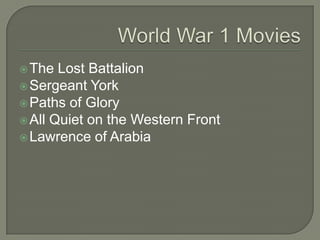
The Lost Battalion
Sergeant York
Paths of Glory
All Quiet on the Western Front
Lawrence of Arabia

World War 1 Trench Life/Warfare

  • 1.
    “Months of boredompunctuated by moments of extreme terror.”
  • 2.
    The average dayin the ordinary bit of the trenches was just doing nothing! Except perhaps filling a few sandbags to strengthen a bit of the parapet of the trench. But of course there had to be always somebody on sentry go all the time, on each section of the trench. Apart from that, trench life was extremely dull. You simply slept and wrote letters, except when you were on that sort of duty. – James Pratt Our life was this: from the beginning of the day until the night, we were eating – sometimes some bread, chocolate, cheese – and smoking, firing at the Germans. Sometimes we received a few bombs. And that was the life. – French Soldier
  • 3.
    Your feet swellto two to three times their normal size and go completely dead. You can stick a bayonet into them and not feel a thing. If you are lucky enough not to lose your feet and the swelling starts to go down, it is then that the most indescribable agony begins. (Harry Robert).Rats and Lice were also a problem. • Typhoid • Influenza • Trench Fever • Trench Foot
  • 4.
     Often mistakenfor cowardice.  Soldiers would be shot for not going over the top.  Shell Shock was unfamiliar to many doctors. Well I just thought it was a failure of life itself, the failure of the mind to take the enormous depression that it had got. If you are standing under a bombardment for so long and you‟re seeing fellows going up in the air and you‟ve got to stick it for a couple or three days it isn‟t funny. I don‟t think they were cowards at all; any man that went up there if he was a coward he wouldn‟t have gone, he‟d have done anything not to go up there. – British Private
  • 5.
    https://www.youtube.com/watch?v=hAA9Z VgZauA  Trench Slang “Gone West” – A term for a soldier who had died.  “Brass Hat” – Enlisted men‟s term for an officer.  “Belly Flopping” – To hit the ground quickly during an attack.  “Elephant” – Small dug-out with sheets of corrugated iron.  “Gunfire” – Strong tea, usually laced with rum.
  • 7.
    Usually took placeat night. A line of soldiers would dig about 10 feet deep. If the water levels were too high they would make above ground trenches using sandbags. Soldiers would decorate sandbags to look like soldiers.
  • 10.
    https://www.youtube.com/watch?v=Ciq9ts0 2ci4 Machine guns andartillery devastated the enemy. Brutal hand to hand combat in the trenches. There were more trenches to take after the first one.
  • 11.
     Chlorine gas– First used  Phosgene gas – More potent than chlorine.  Mustard gas – Most popular gas during the war.
  • 12.
  • 13.
     https://www.youtube.com/watch?v=NOz9SpWc_yE We werein the front line; we were about 300 yards from the Germans. On Christmas Eve, we‟d been singing carols and this that and the other, and the Germans had been doing the same. And we‟d been shouting to each other, sometimes rude remarks more often just joking remarks. Anyway, eventually a German said, „Tomorrow you no shoot, we no shoot.‟ And the morning came and we didn‟t shoot and they didn‟t shoot. – British Private • Christmas trees were set up. • Gifts were exchanged. • A few troops even played soccer together.
  • 15.
    I can honestlysay that nothing that we were made to do ever gave us any feeling of resentment. We knew we were there to do that job and our patriotism, we were so fond of our country – everybody – and we were like a lot of brothers together. – William Holmes
  • 16.
    The Lost Battalion SergeantYork Paths of Glory All Quiet on the Western Front Lawrence of Arabia