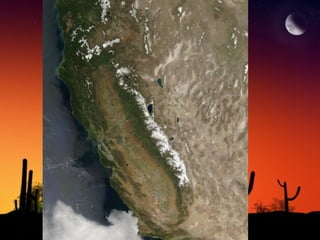
Warm up question
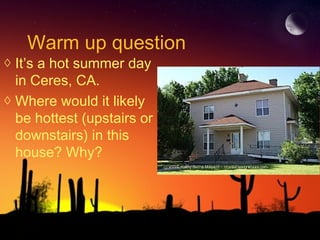
◊ It’s a hot summer day
in Ceres, CA.
◊ Where would it likely
be hottest (upstairs or
downstairs) in this
house? Why?
Climate & Terrestrial
Biodiversity
Ch. 7
Ch.7FocusQuestions
1.What factors influence
climate?2.How does climate affect
the nature and locations
of biomes?3.How have we affected
the world’s terrestrial
ecosystems?
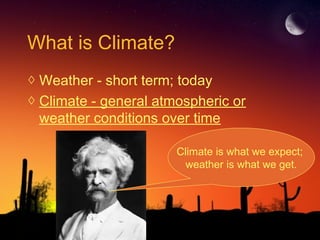
What is Climate?
◊ Weather - short term; today
◊ Climate - general atmospheric or
weather conditions over time
Climate is what we expect;
weather is what we get.
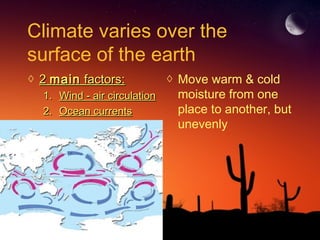
Climate varies over the
surface of the earth
◊ 22 mainmain factors:factors:
1.1. Wind - air circulationWind - air circulation
2.2. Ocean currentsOcean currents
◊ Move warm & cold
moisture from one
place to another, but
unevenly
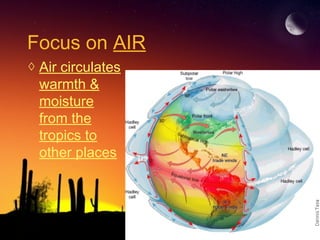
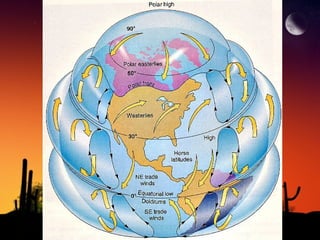
Focus on AIR
◊ Air circulates
warmth &
moisture
from the
tropics to
other places
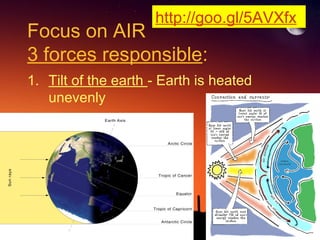
Focus on AIR
3 forces responsible:
1. Tilt of the earth - Earth is heated
unevenly
http://goo.gl/5AVXfx​
Focus on AIR
3 forces
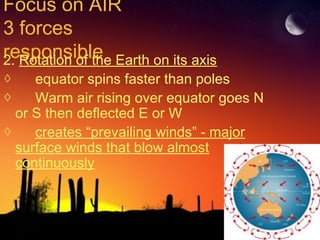
responsible2. Rotation of the Earth on its axis
◊ equator spins faster than poles
◊ Warm air rising over equator goes N
or S then deflected E or W
◊ creates “prevailing winds” - major
surface winds that blow almost
continuously
Quick Demo
◊ What happened to the line as you rotated the
whiteboard?
◊ What happens to the line as you get further
toward the edge?
Focus on AIR
3 forces responsible
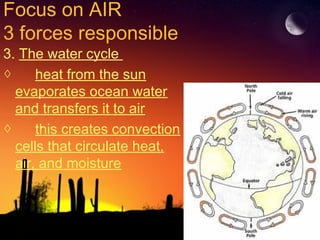
3. The water cycle
◊ heat from the sun
evaporates ocean water
and transfers it to air
◊ this creates convection
cells that circulate heat,
air, and moisture
Quick Write
◊ In 1 sentence – DESCRIBE how AIR
affects the climate of an area
Focus on OCEAN
CURRENTS
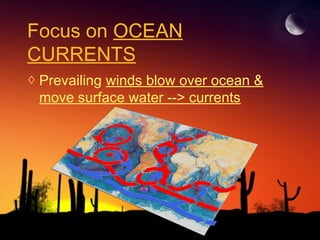
◊ Prevailing winds blow over ocean &
move surface water --> currents
Focus on OCEAN
CURRENTS
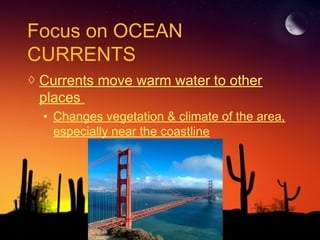
◊ Currents move warm water to other
places
• Changes vegetation & climate of the area,
especially near the coastline
Focus on OCEAN
CURRENTS
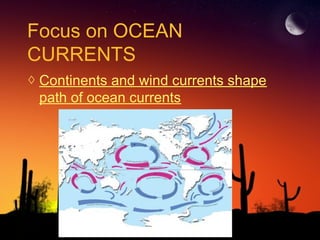
◊ Continents and wind currents shape
path of ocean currents
Focus on OCEAN
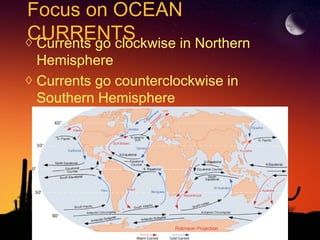
CURRENTS◊ Currents go clockwise in Northern
Hemisphere
◊ Currents go counterclockwise in
Southern Hemisphere
Focus on OCEAN
CURRENTS
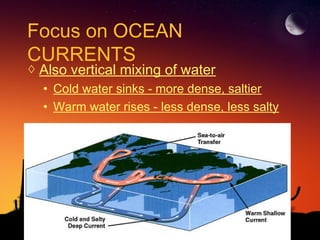
◊ Also vertical mixing of water
• Cold water sinks - more dense, saltier
• Warm water rises - less dense, less salty
Quick Write
◊ In 2 sentences – EXPLAIN how OCEAN
CURRENTS affect the climate of an
area
OCEAN CURRENTS + AIR
CURRENTS 4EVER
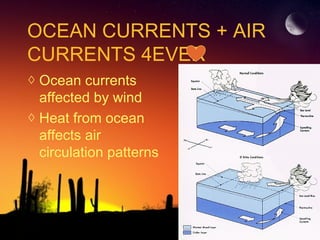
◊ Ocean currents
affected by wind
◊ Heat from ocean
affects air
circulation patterns
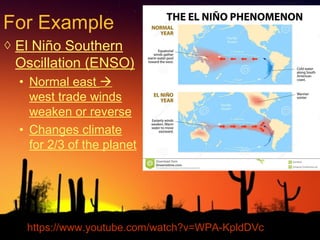
For Example
◊ El Niño Southern
Oscillation (ENSO)
• Normal east 
west trade winds
weaken or reverse
• Changes climate
for 2/3 of the planet
https://www.youtube.com/watch?v=WPA-KpldDVc
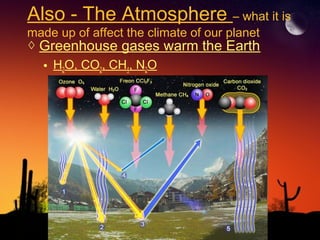
Also - The Atmosphere – what it is
made up of affect the climate of our planet
◊ Greenhouse gases warm the Earth
• H2O, CO2, CH4, N2O
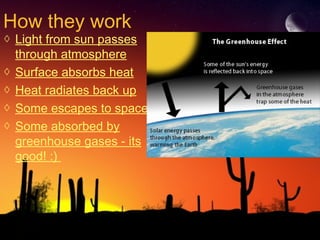
How they work
◊ Light from sun passes
through atmosphere
◊ Surface absorbs heat
◊ Heat radiates back up
◊ Some escapes to space
◊ Some absorbed by
greenhouse gases - its
good! :)
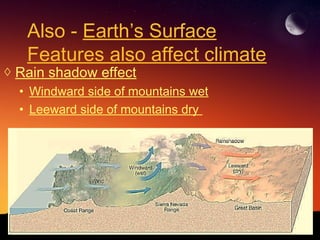
Also - Earth’s Surface
Features also affect climate
◊ Rain shadow effect
• Windward side of mountains wet
• Leeward side of mountains dry
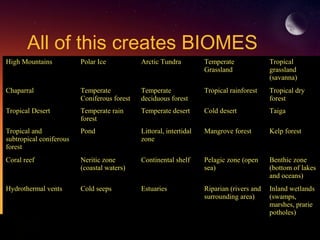
All of this creates BIOMES
High Mountains Polar Ice Arctic Tundra Temperate
Grassland
Tropical
grassland
(savanna)
Chaparral Temperate
Coniferous forest
Temperate
deciduous forest
Tropical rainforest Tropical dry
forest
Tropical Desert Temperate rain
forest
Temperate desert Cold desert Taiga
Tropical and
subtropical coniferous
forest
Pond Littoral, intertidal
zone
Mangrove forest Kelp forest
Coral reef Neritic zone
(coastal waters)
Continental shelf Pelagic zone (open
sea)
Benthic zone
(bottom of lakes
and oceans)
Hydrothermal vents Cold seeps Estuaries Riparian (rivers and
surrounding area)
Inland wetlands
(swamps,
marshes, prarie
potholes)
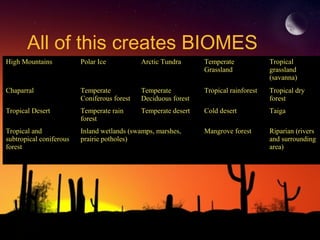
All of this creates BIOMES
High Mountains Polar Ice Arctic Tundra Temperate
Grassland
Tropical
grassland
(savanna)
Chaparral Temperate
Coniferous forest
Temperate
Deciduous forest
Tropical rainforest Tropical dry
forest
Tropical Desert Temperate rain
forest
Temperate desert Cold desert Taiga
Tropical and
subtropical coniferous
forest
Inland wetlands (swamps, marshes,
prairie potholes)
Mangrove forest Riparian (rivers
and surrounding
area)
Quick Write
◊ So…What factors influence the climate
of an area?
◊ Make a list of all the things you can
think of
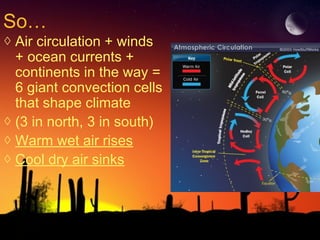
So…
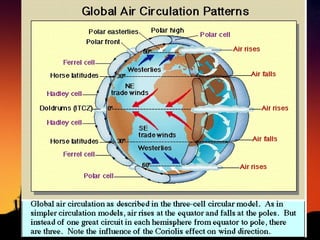
◊ Air circulation + winds
+ ocean currents +
continents in the way =
6 giant convection cells
that shape climate
◊ (3 in north, 3 in south)
◊ Warm wet air rises
◊ Cool dry air sinks
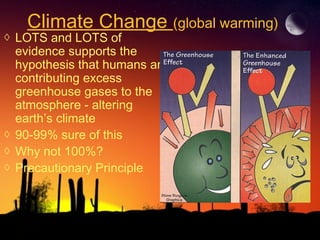
Climate Change (global warming)
◊ LOTS and LOTS of
evidence supports the
hypothesis that humans are
contributing excess
greenhouse gases to the
atmosphere - altering
earth’s climate
◊ 90-99% sure of this
◊ Why not 100%?
◊ Precautionary Principle

AP Environmental Science Ch. 7

  • 1.
    Warm up question ◊It’s a hot summer day in Ceres, CA. ◊ Where would it likely be hottest (upstairs or downstairs) in this house? Why?
  • 2.
  • 3.
    Ch.7FocusQuestions 1.What factors influence climate?2.Howdoes climate affect the nature and locations of biomes?3.How have we affected the world’s terrestrial ecosystems?
  • 4.
    What is Climate? ◊Weather - short term; today ◊ Climate - general atmospheric or weather conditions over time Climate is what we expect; weather is what we get.
  • 5.
    Climate varies overthe surface of the earth ◊ 22 mainmain factors:factors: 1.1. Wind - air circulationWind - air circulation 2.2. Ocean currentsOcean currents ◊ Move warm & cold moisture from one place to another, but unevenly
  • 6.
    Focus on AIR ◊Air circulates warmth & moisture from the tropics to other places
  • 7.
    Focus on AIR 3forces responsible: 1. Tilt of the earth - Earth is heated unevenly http://goo.gl/5AVXfx​
  • 8.
    Focus on AIR 3forces responsible2. Rotation of the Earth on its axis ◊ equator spins faster than poles ◊ Warm air rising over equator goes N or S then deflected E or W ◊ creates “prevailing winds” - major surface winds that blow almost continuously
  • 9.
    Quick Demo ◊ Whathappened to the line as you rotated the whiteboard? ◊ What happens to the line as you get further toward the edge?
  • 13.
    Focus on AIR 3forces responsible 3. The water cycle ◊ heat from the sun evaporates ocean water and transfers it to air ◊ this creates convection cells that circulate heat, air, and moisture
  • 14.
    Quick Write ◊ In1 sentence – DESCRIBE how AIR affects the climate of an area
  • 15.
    Focus on OCEAN CURRENTS ◊Prevailing winds blow over ocean & move surface water --> currents
  • 16.
    Focus on OCEAN CURRENTS ◊Currents move warm water to other places • Changes vegetation & climate of the area, especially near the coastline
  • 17.
    Focus on OCEAN CURRENTS ◊Continents and wind currents shape path of ocean currents
  • 18.
    Focus on OCEAN CURRENTS◊Currents go clockwise in Northern Hemisphere ◊ Currents go counterclockwise in Southern Hemisphere
  • 19.
    Focus on OCEAN CURRENTS ◊Also vertical mixing of water • Cold water sinks - more dense, saltier • Warm water rises - less dense, less salty
  • 20.
    Quick Write ◊ In2 sentences – EXPLAIN how OCEAN CURRENTS affect the climate of an area
  • 21.
    OCEAN CURRENTS +AIR CURRENTS 4EVER ◊ Ocean currents affected by wind ◊ Heat from ocean affects air circulation patterns
  • 22.
    For Example ◊ ElNiño Southern Oscillation (ENSO) • Normal east  west trade winds weaken or reverse • Changes climate for 2/3 of the planet https://www.youtube.com/watch?v=WPA-KpldDVc
  • 23.
    Also - TheAtmosphere – what it is made up of affect the climate of our planet ◊ Greenhouse gases warm the Earth • H2O, CO2, CH4, N2O
  • 24.
    How they work ◊Light from sun passes through atmosphere ◊ Surface absorbs heat ◊ Heat radiates back up ◊ Some escapes to space ◊ Some absorbed by greenhouse gases - its good! :)
  • 25.
    Also - Earth’sSurface Features also affect climate ◊ Rain shadow effect • Windward side of mountains wet • Leeward side of mountains dry
  • 27.
    All of thiscreates BIOMES High Mountains Polar Ice Arctic Tundra Temperate Grassland Tropical grassland (savanna) Chaparral Temperate Coniferous forest Temperate deciduous forest Tropical rainforest Tropical dry forest Tropical Desert Temperate rain forest Temperate desert Cold desert Taiga Tropical and subtropical coniferous forest Pond Littoral, intertidal zone Mangrove forest Kelp forest Coral reef Neritic zone (coastal waters) Continental shelf Pelagic zone (open sea) Benthic zone (bottom of lakes and oceans) Hydrothermal vents Cold seeps Estuaries Riparian (rivers and surrounding area) Inland wetlands (swamps, marshes, prarie potholes)
  • 28.
    All of thiscreates BIOMES High Mountains Polar Ice Arctic Tundra Temperate Grassland Tropical grassland (savanna) Chaparral Temperate Coniferous forest Temperate Deciduous forest Tropical rainforest Tropical dry forest Tropical Desert Temperate rain forest Temperate desert Cold desert Taiga Tropical and subtropical coniferous forest Inland wetlands (swamps, marshes, prairie potholes) Mangrove forest Riparian (rivers and surrounding area)
  • 29.
    Quick Write ◊ So…Whatfactors influence the climate of an area? ◊ Make a list of all the things you can think of
  • 30.
    So… ◊ Air circulation+ winds + ocean currents + continents in the way = 6 giant convection cells that shape climate ◊ (3 in north, 3 in south) ◊ Warm wet air rises ◊ Cool dry air sinks
  • 31.
    Climate Change (globalwarming) ◊ LOTS and LOTS of evidence supports the hypothesis that humans are contributing excess greenhouse gases to the atmosphere - altering earth’s climate ◊ 90-99% sure of this ◊ Why not 100%? ◊ Precautionary Principle