Possible Effects of aPossible Effects of a
Warmer PlanetWarmer Planet
Ch. 19,
part 2
Gaby, I
need to
talk to you
What do I need to know about
climate change?
 What evidence do we have?
1. What are some of the potential and realized
consequences of a changing climate?
2. What are the challenges to addressing climate
change? (why is it so hard?)
3. What are some of the ways we can combat
climate change (i.e. halt it and/or reverse it)
4. What have we already done? Did it work?
Consequences
Realized
 Drought
 Melting ice
 Sea level rise
 7 consequences
 Permafrost melt
Potential?
 Altered thermohaline
circulation
 Extreme weather
 Extinctions
 Coral bleaching
 Altered migratory patterns
 More pests
 Shifting ag
 Threats to human health
Which first? The good news or
the bad news?
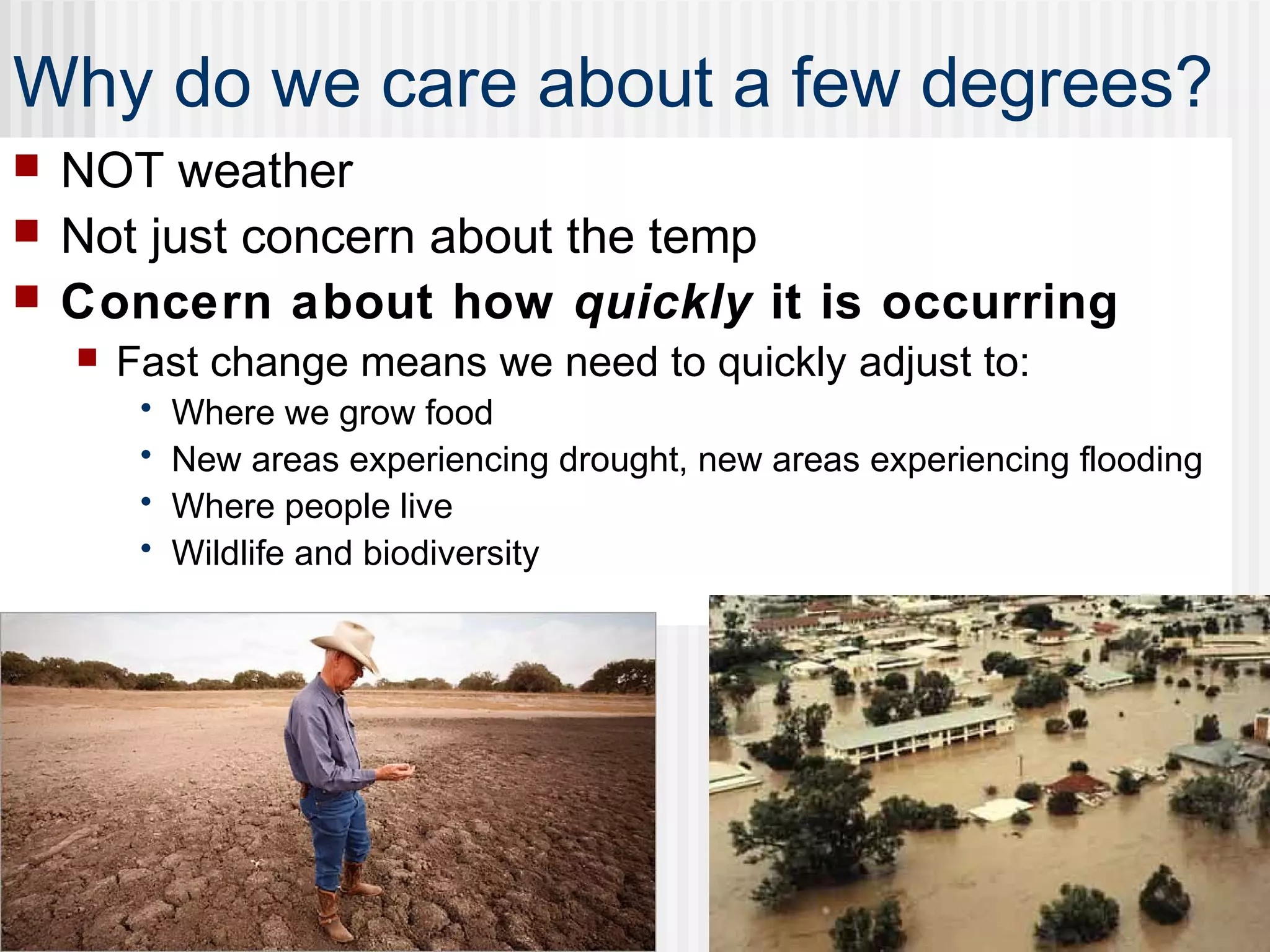
Why do we care about a few degrees?
 NOT weather
 Not just concern about the temp
 Concern about how quickly it is occurring
 Fast change means we need to quickly adjust to:
• Where we grow food
• New areas experiencing drought, new areas experiencing flooding
• Where people live
• Wildlife and biodiversity
What the experts are saying
Global warming and the resulting
climate change must be viewed
as a serious threat to global
stability and should be elevated to a U.S.
national security concern
Peter Schwartz,
Doug Randall, US
DOD
What the experts are saying
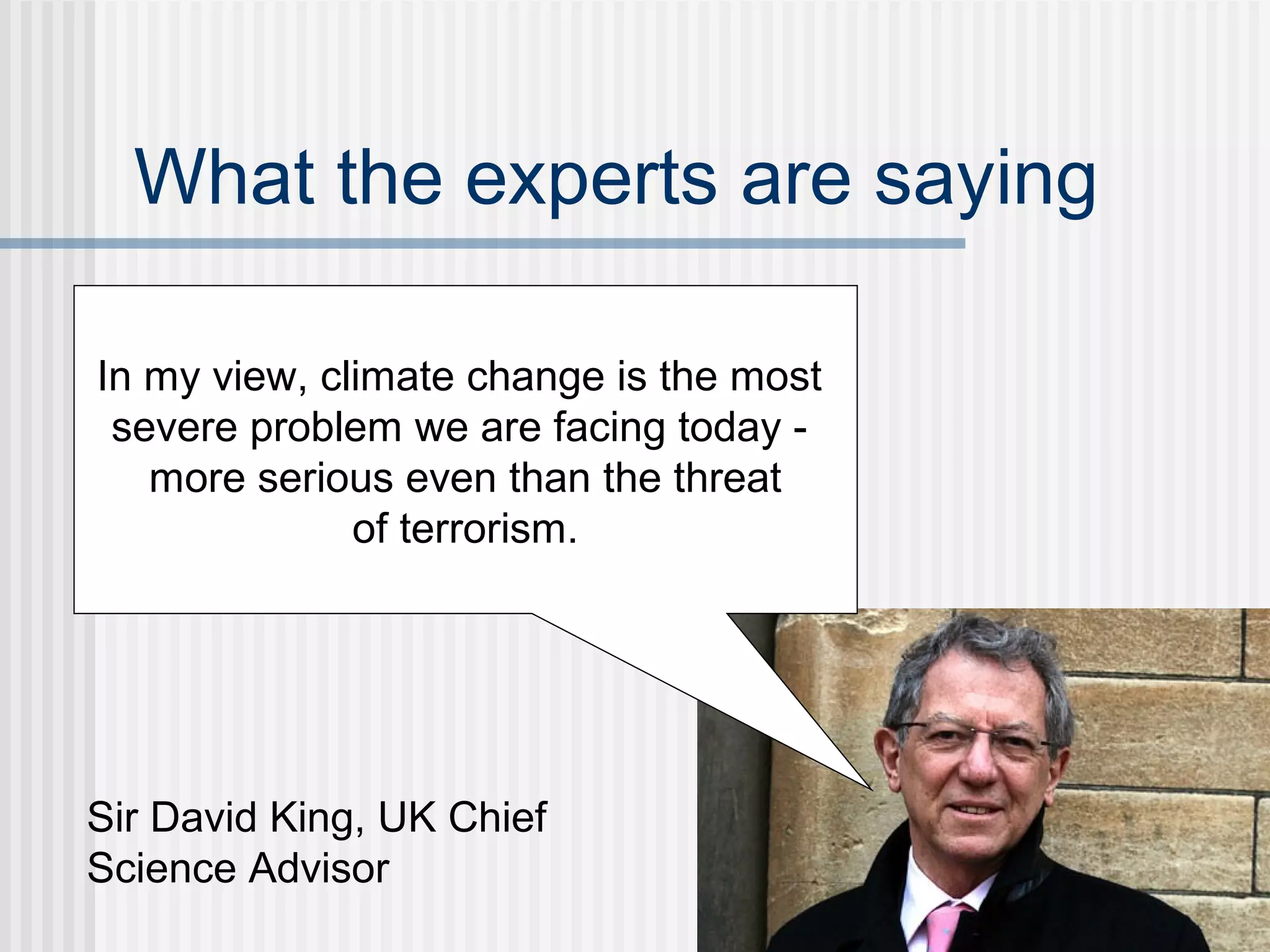
In my view, climate change is the most
severe problem we are facing today -
more serious even than the threat
of terrorism.
Sir David King, UK Chief
Science Advisor
What the experts are saying
The effects will be catastrophic -
on the level of nuclear war
International
Institute for
Strategic Studies
- works with
military on
security issues
What the experts are saying
A 2°C warming is inevitable -
we have waited too long to
prevent it and ignored the warnings
from prestigious committees
of climate scientists for more than
25 years
Realized Consequences
it‘s already happening…
The Tipping Point
 The point at which a
series of small
ineffective changes
acquires enough
pressure or
importance to cause
a larger, more
significant change
Bad News: Severe Drought is
Increasing
 Drought - evaporation from high
temps exceeds precipitation
 Less soil moisture
 Less surface water
 Less photosynthesis so less CO2
out of air
 More fires  more CO2
 Water tables drop
 1-3 billion people face water
shortages
 Decrease in biodiversity
Bad News: Ice and
Snow are Melting
 Ice reflects light back
 As ice melts - exposes more
dark soil
 Dark absorbs heat --> warmer -->
melts more ice
 Many people rely on snow melt
for freshwater
 Loss of mountain glaciers means
loss of freshwater
• Alps, Ganges River, Yangtze and
Yellow River in China, Glacier
National Park
Bad News: Sea Levels are
Rising
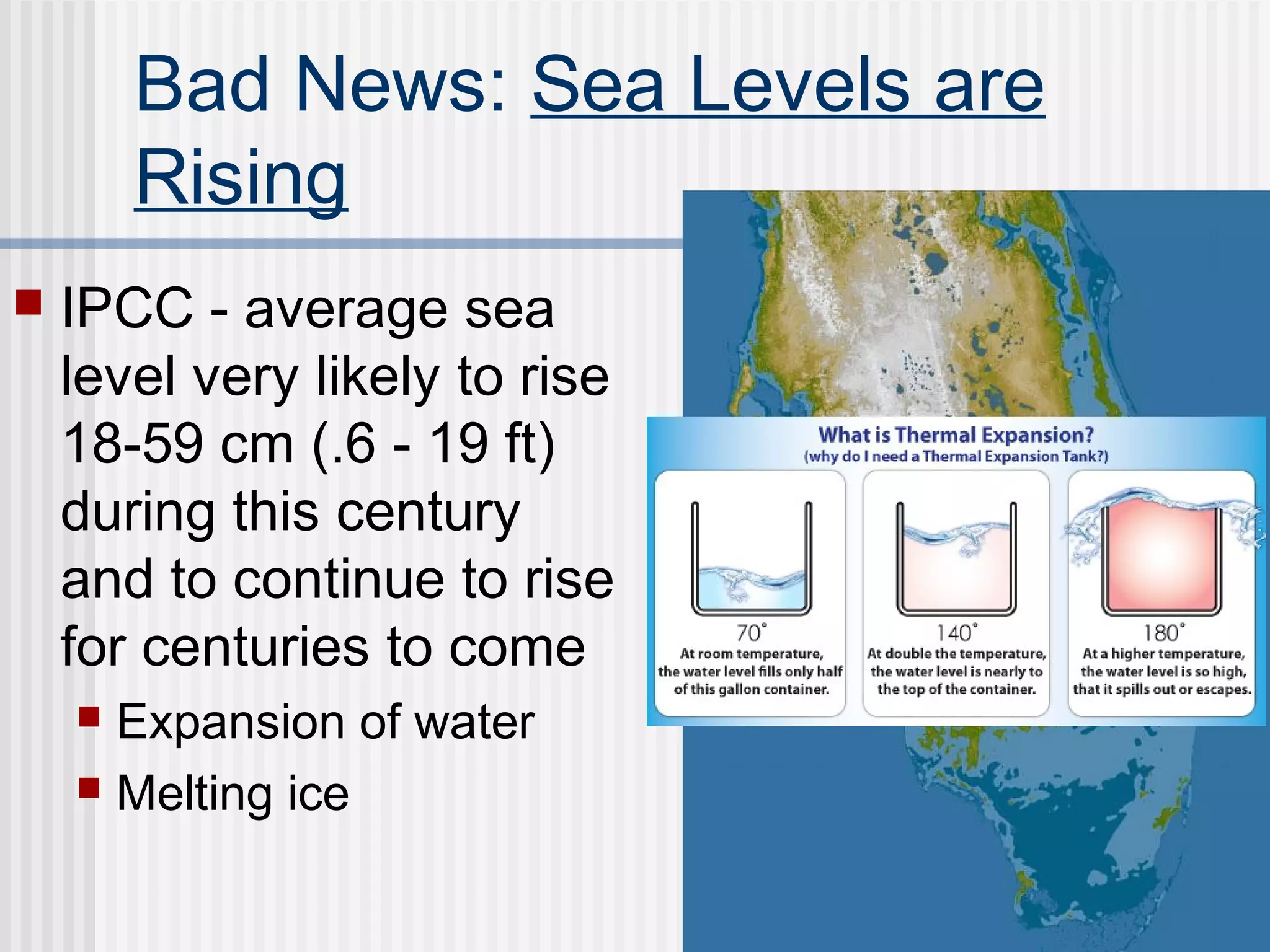
 IPCC - average sea
level very likely to rise
18-59 cm (.6 - 19 ft)
during this century
and to continue to rise
for centuries to come
 Expansion of water
 Melting ice
What effect: rising sea levels?
 Degrade or destroy ~1/3 of the world’s
coastal, estuary, coral reefs
What effect: rising sea levels?
 Disrupt
marine
fisheries
 Changes
where
fish are
What effect: rising sea levels?
 Flood and loss of low lying barrier islands
What effect: rising sea levels?
 Flooding of ag land where most of the rice
is grown
What effect: rising sea levels?
 Contamination of freshwater coastal
aquifers with saltwater & less
groundwater for irrigation, drinking,
cooling power plants
What effect: rising sea levels?
 Submergence of low lying islands - home
to 5% of the world’s people (350 million
people)
What effect: rising sea levels?
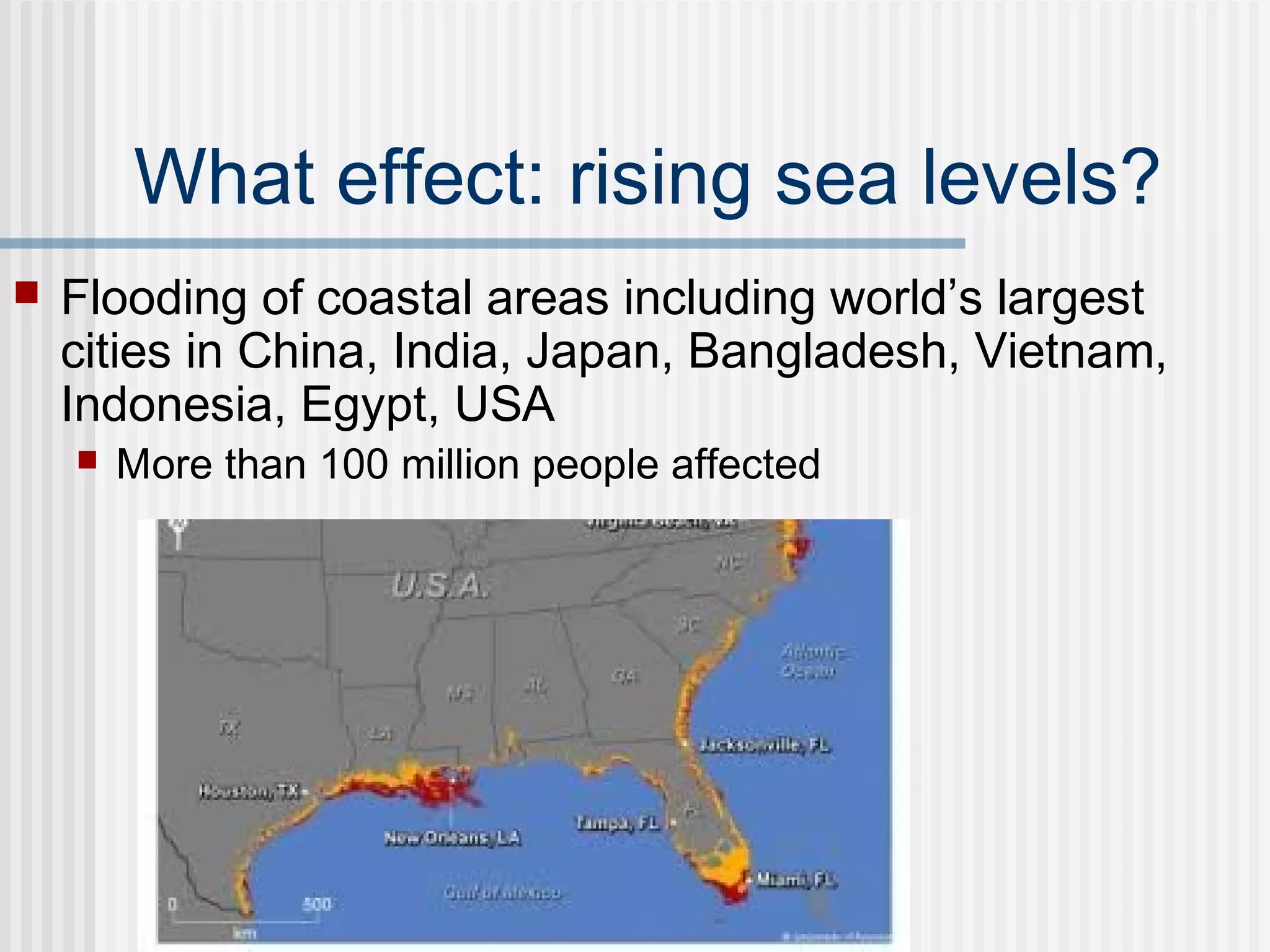
 Flooding of coastal areas including world’s largest
cities in China, India, Japan, Bangladesh, Vietnam,
Indonesia, Egypt, USA
 More than 100 million people affected
Bad News: Permafrost is
melting
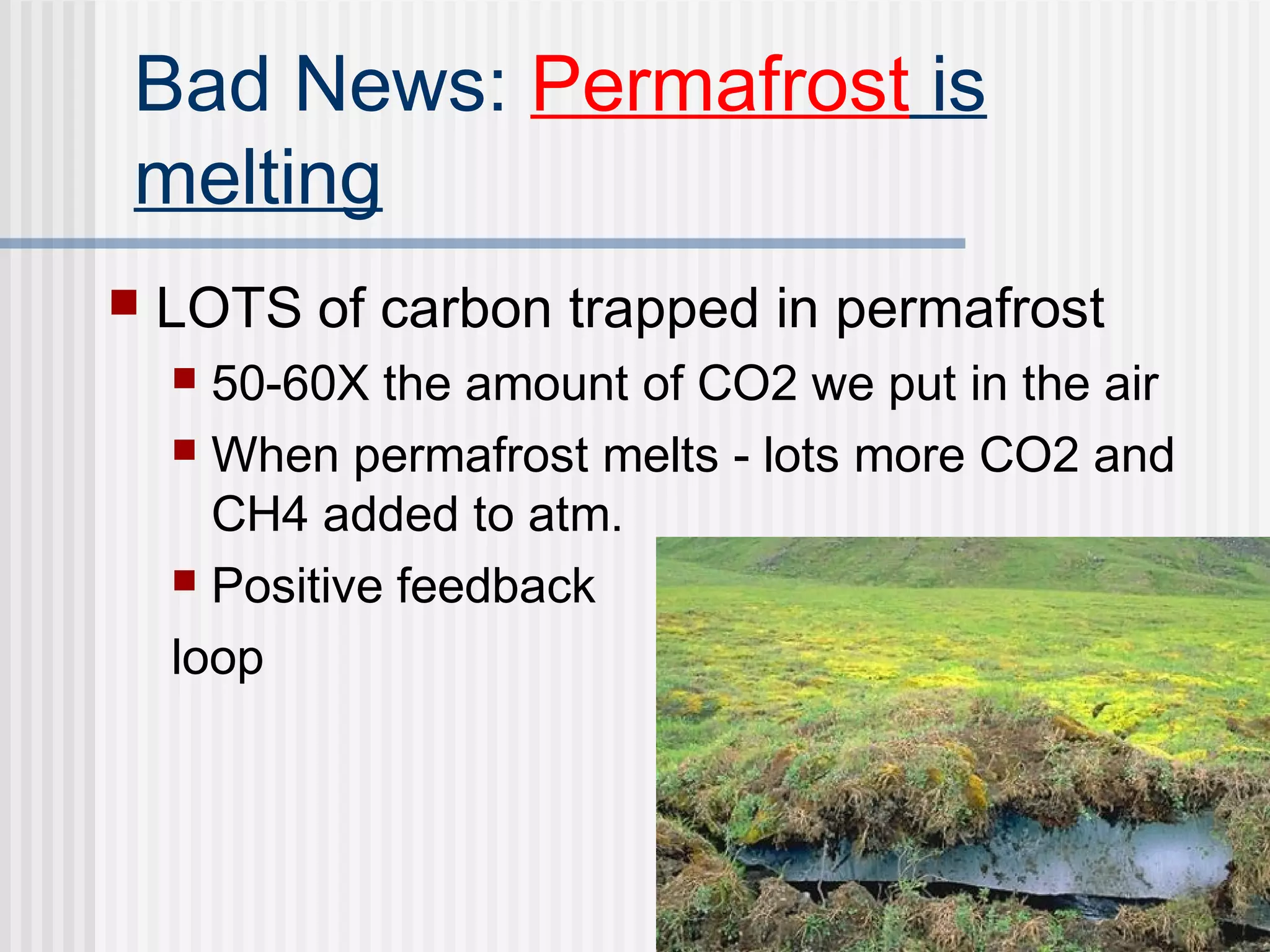
 LOTS of carbon trapped in permafrost
 50-60X the amount of CO2 we put in the air
 When permafrost melts - lots more CO2 and
CH4 added to atm.
 Positive feedback
loop
Potential Consequences
Some experts say we
are already
experiencing these…
but scientists still
saying maybe
Bad News- Ocean Currents are
Changing…
 Threat Unknown
 Less O2 delivered to ocean bottom
 Changing climates worldwide
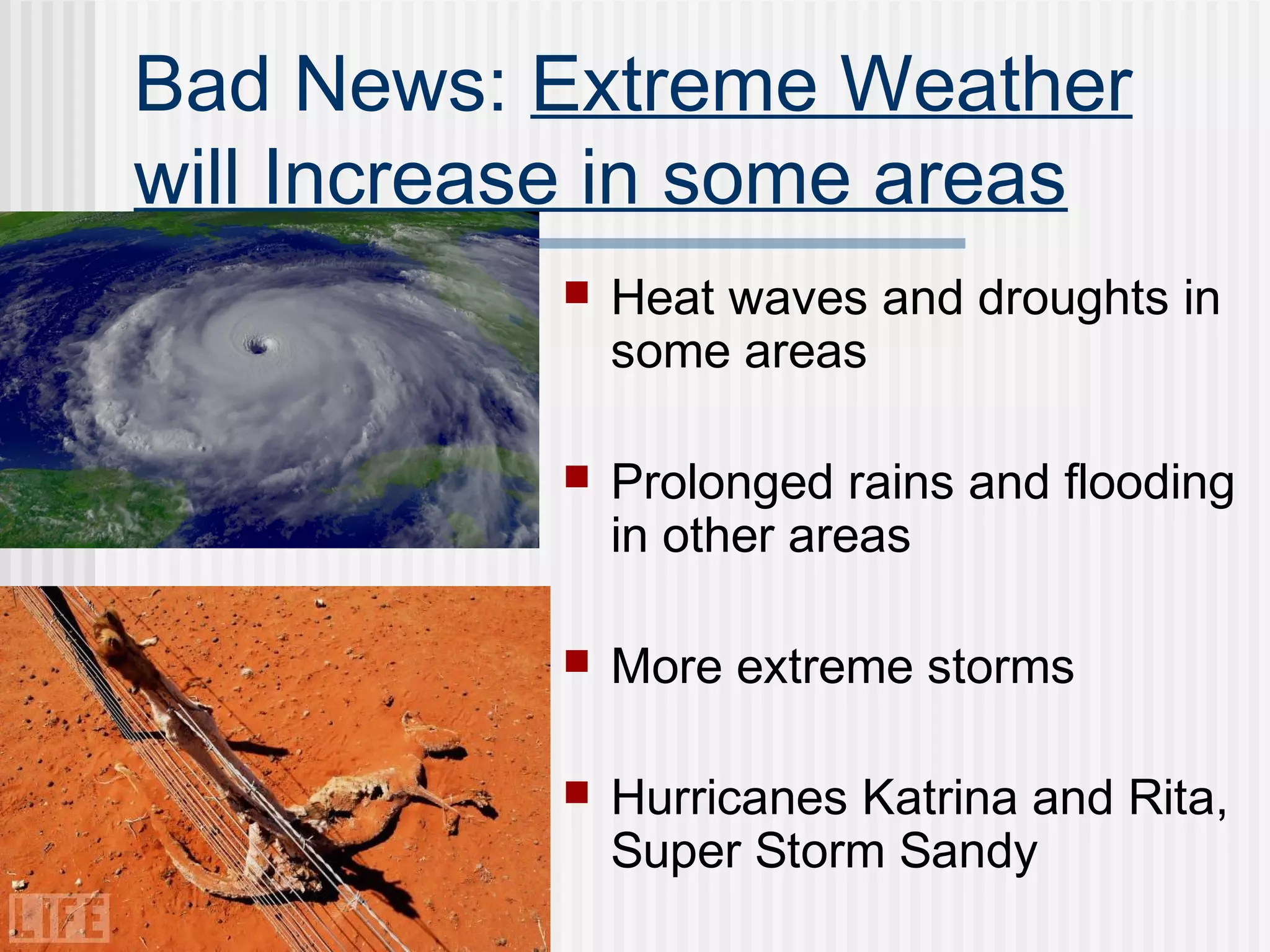
Bad News: Extreme Weather
will Increase in some areas
 Heat waves and droughts in
some areas
 Prolonged rains and flooding
in other areas
 More extreme storms
 Hurricanes Katrina and Rita,
Super Storm Sandy
Bad News: Global Warming is a
Major Threat to Biodiversity :’(
 Most susceptible ecosystems
 Coral reefs
 Polar seas
 Coastal wetland
 High-elevation mountaintops
 Alpine and arctic tundra
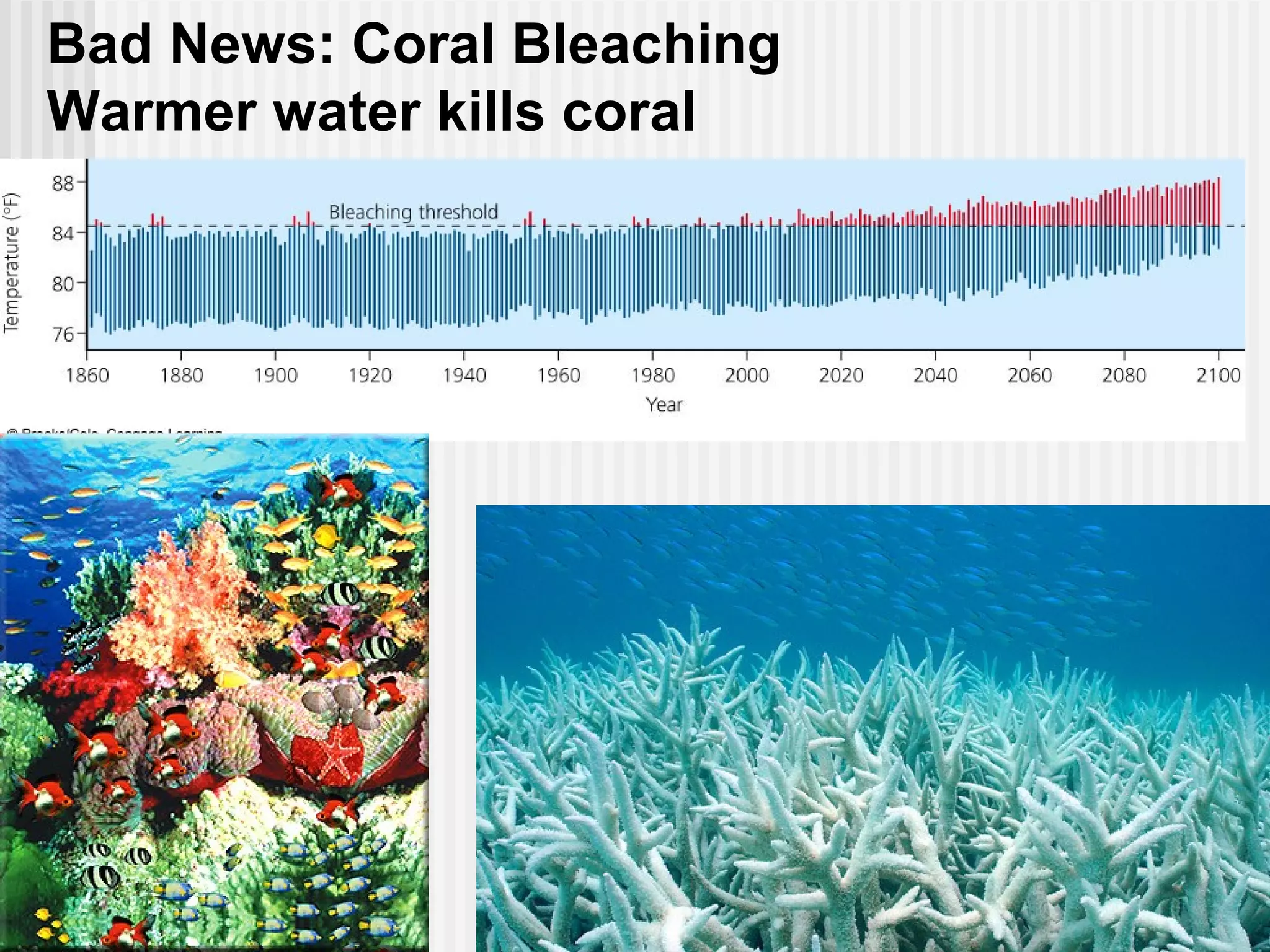
Bad News: Coral Bleaching
Warmer water kills coral
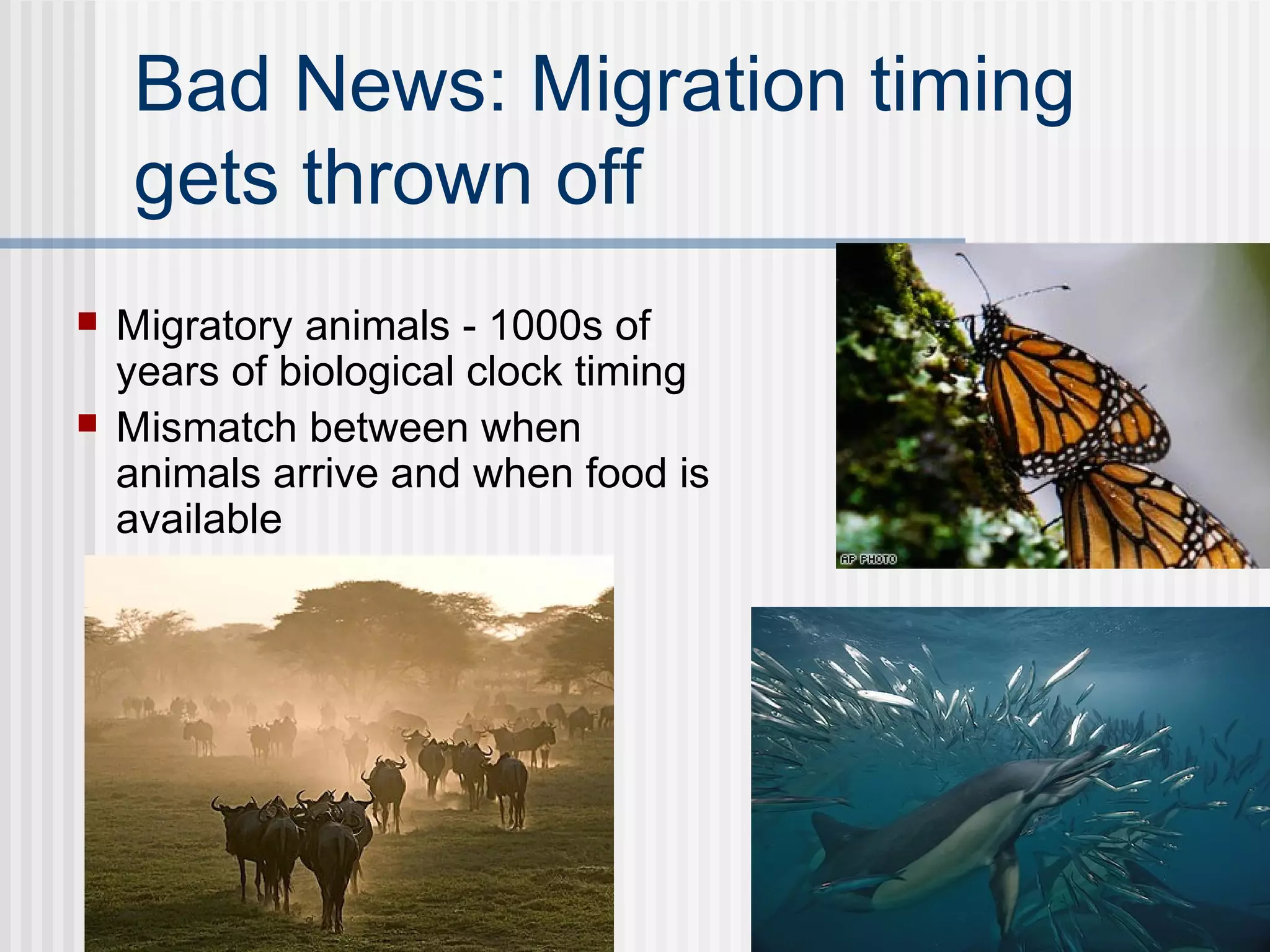
Bad News: Migration timing
gets thrown off
 Migratory animals - 1000s of
years of biological clock timing
 Mismatch between when
animals arrive and when food is
available
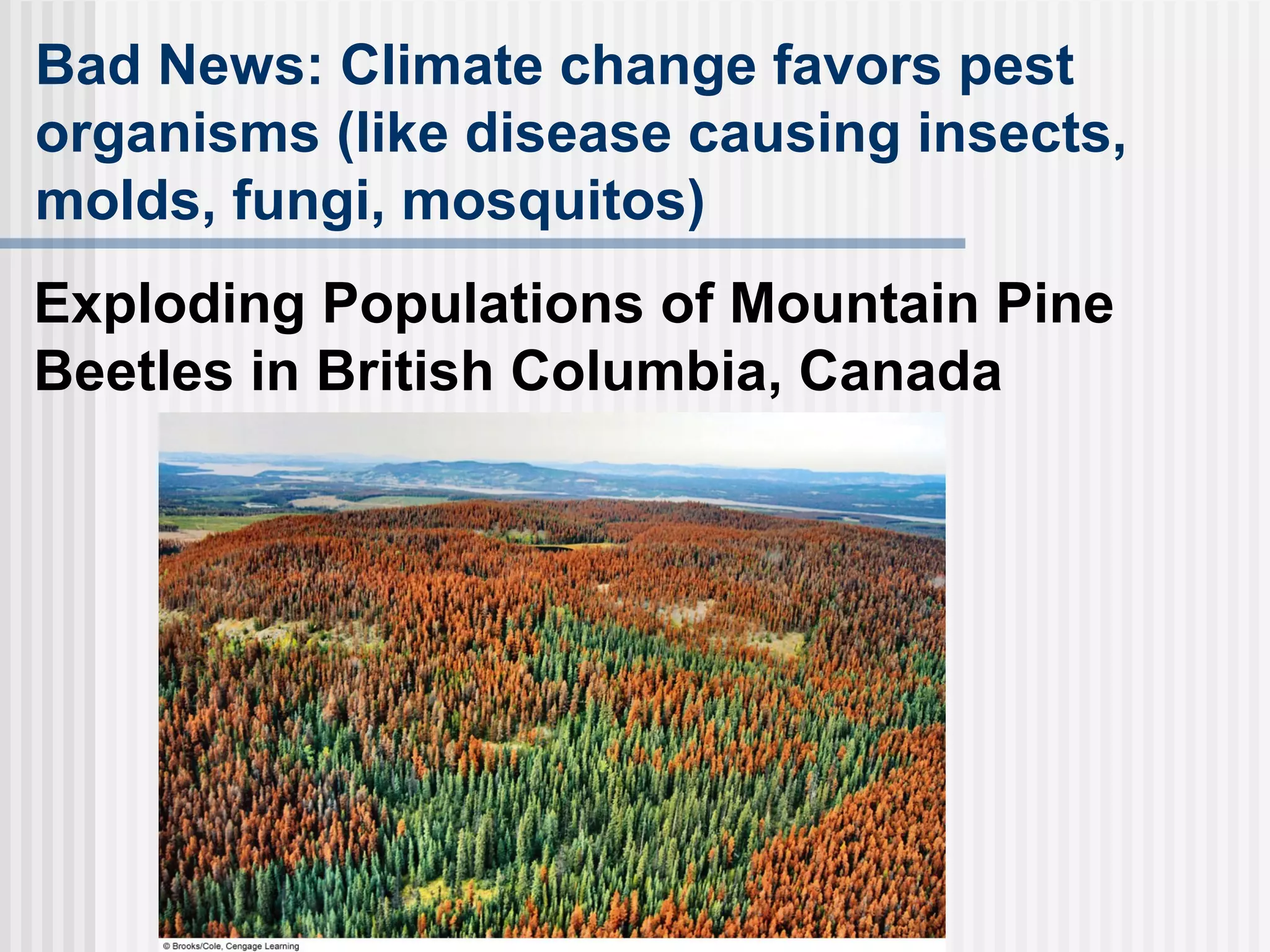
Exploding Populations of Mountain Pine
Beetles in British Columbia, Canada
Bad News: Climate change favors pest
organisms (like disease causing insects,
molds, fungi, mosquitos)
Bad News: Climate Change will Shift
Areas where crops can be grown
 Farming depends on a stable
climate
 Regions of farming may shift
 Decrease in tropical and
subtropical areas - poor areas
already
 Increase in northern latitudes
• Less productivity; soil not as fertile
 For awhile, food productivity will
increase due to longer growing
season
 Genetically engineered crops
Bad News: Climate Change will
threaten human health
 Deaths from heat waves will
increase
 2003 - 52,000 people died from
heat wave in Europe
 Deaths from cold weather will
decrease
 Higher temperatures can cause
 Increased flooding
 Increase in some forms of air
pollution, more O3
 More insects, microbes, toxic
molds, pollen, and fungi

AP Environmental Science Ch. 19, part 2

  • 1.
    Possible Effects ofaPossible Effects of a Warmer PlanetWarmer Planet Ch. 19, part 2 Gaby, I need to talk to you
  • 2.
    What do Ineed to know about climate change?  What evidence do we have? 1. What are some of the potential and realized consequences of a changing climate? 2. What are the challenges to addressing climate change? (why is it so hard?) 3. What are some of the ways we can combat climate change (i.e. halt it and/or reverse it) 4. What have we already done? Did it work?
  • 3.
    Consequences Realized  Drought  Meltingice  Sea level rise  7 consequences  Permafrost melt Potential?  Altered thermohaline circulation  Extreme weather  Extinctions  Coral bleaching  Altered migratory patterns  More pests  Shifting ag  Threats to human health
  • 5.
    Which first? Thegood news or the bad news?
  • 6.
    Why do wecare about a few degrees?  NOT weather  Not just concern about the temp  Concern about how quickly it is occurring  Fast change means we need to quickly adjust to: • Where we grow food • New areas experiencing drought, new areas experiencing flooding • Where people live • Wildlife and biodiversity
  • 7.
    What the expertsare saying Global warming and the resulting climate change must be viewed as a serious threat to global stability and should be elevated to a U.S. national security concern Peter Schwartz, Doug Randall, US DOD
  • 8.
    What the expertsare saying In my view, climate change is the most severe problem we are facing today - more serious even than the threat of terrorism. Sir David King, UK Chief Science Advisor
  • 9.
    What the expertsare saying The effects will be catastrophic - on the level of nuclear war International Institute for Strategic Studies - works with military on security issues
  • 10.
    What the expertsare saying A 2°C warming is inevitable - we have waited too long to prevent it and ignored the warnings from prestigious committees of climate scientists for more than 25 years
  • 11.
  • 12.
    The Tipping Point The point at which a series of small ineffective changes acquires enough pressure or importance to cause a larger, more significant change
  • 13.
    Bad News: SevereDrought is Increasing  Drought - evaporation from high temps exceeds precipitation  Less soil moisture  Less surface water  Less photosynthesis so less CO2 out of air  More fires  more CO2  Water tables drop  1-3 billion people face water shortages  Decrease in biodiversity
  • 14.
    Bad News: Iceand Snow are Melting  Ice reflects light back  As ice melts - exposes more dark soil  Dark absorbs heat --> warmer --> melts more ice  Many people rely on snow melt for freshwater  Loss of mountain glaciers means loss of freshwater • Alps, Ganges River, Yangtze and Yellow River in China, Glacier National Park
  • 16.
    Bad News: SeaLevels are Rising  IPCC - average sea level very likely to rise 18-59 cm (.6 - 19 ft) during this century and to continue to rise for centuries to come  Expansion of water  Melting ice
  • 17.
    What effect: risingsea levels?  Degrade or destroy ~1/3 of the world’s coastal, estuary, coral reefs
  • 18.
    What effect: risingsea levels?  Disrupt marine fisheries  Changes where fish are
  • 19.
    What effect: risingsea levels?  Flood and loss of low lying barrier islands
  • 20.
    What effect: risingsea levels?  Flooding of ag land where most of the rice is grown
  • 21.
    What effect: risingsea levels?  Contamination of freshwater coastal aquifers with saltwater & less groundwater for irrigation, drinking, cooling power plants
  • 22.
    What effect: risingsea levels?  Submergence of low lying islands - home to 5% of the world’s people (350 million people)
  • 23.
    What effect: risingsea levels?  Flooding of coastal areas including world’s largest cities in China, India, Japan, Bangladesh, Vietnam, Indonesia, Egypt, USA  More than 100 million people affected
  • 24.
    Bad News: Permafrostis melting  LOTS of carbon trapped in permafrost  50-60X the amount of CO2 we put in the air  When permafrost melts - lots more CO2 and CH4 added to atm.  Positive feedback loop
  • 25.
    Potential Consequences Some expertssay we are already experiencing these… but scientists still saying maybe
  • 26.
    Bad News- OceanCurrents are Changing…  Threat Unknown  Less O2 delivered to ocean bottom  Changing climates worldwide
  • 27.
    Bad News: ExtremeWeather will Increase in some areas  Heat waves and droughts in some areas  Prolonged rains and flooding in other areas  More extreme storms  Hurricanes Katrina and Rita, Super Storm Sandy
  • 28.
    Bad News: GlobalWarming is a Major Threat to Biodiversity :’(  Most susceptible ecosystems  Coral reefs  Polar seas  Coastal wetland  High-elevation mountaintops  Alpine and arctic tundra
  • 29.
    Bad News: CoralBleaching Warmer water kills coral
  • 30.
    Bad News: Migrationtiming gets thrown off  Migratory animals - 1000s of years of biological clock timing  Mismatch between when animals arrive and when food is available
  • 31.
    Exploding Populations ofMountain Pine Beetles in British Columbia, Canada Bad News: Climate change favors pest organisms (like disease causing insects, molds, fungi, mosquitos)
  • 32.
    Bad News: ClimateChange will Shift Areas where crops can be grown  Farming depends on a stable climate  Regions of farming may shift  Decrease in tropical and subtropical areas - poor areas already  Increase in northern latitudes • Less productivity; soil not as fertile  For awhile, food productivity will increase due to longer growing season  Genetically engineered crops
  • 33.
    Bad News: ClimateChange will threaten human health  Deaths from heat waves will increase  2003 - 52,000 people died from heat wave in Europe  Deaths from cold weather will decrease  Higher temperatures can cause  Increased flooding  Increase in some forms of air pollution, more O3  More insects, microbes, toxic molds, pollen, and fungi