CLIMATE CHΔNGE
A primer for business
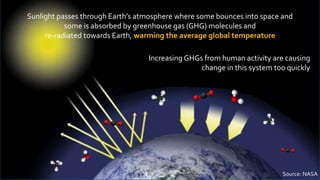
Sunlight passes through Earth’s atmosphere where some bounces into space and
some is absorbed by greenhouse gas (GHG) molecules and
re-radiated towards Earth, warming the average global temperature
Increasing GHGs from human activity are causing
change in this system too quickly
Source: NASA
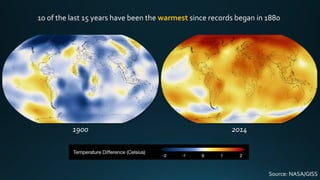
1900 2014
10 of the last 15 years have been the warmest since records began in 1880
Source: NASA/GISS
Source: IPCC/PNAS/NASA/GISS
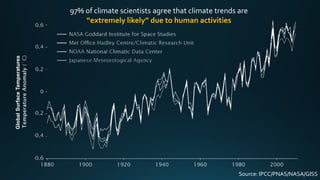
97% of climate scientists agree that climate trends are
“extremely likely” due to human activitiesGlobalSurfaceTemperatures
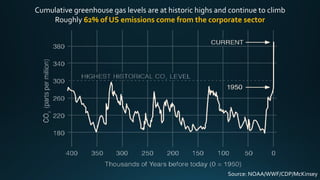
Cumulative greenhouse gas levels are at historic highs and continue to climb
Roughly 62% of US emissions come from the corporate sector
Source: NOAA/WWF/CDP/McKinsey
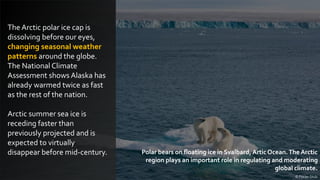
The Arctic polar ice cap is
dissolving before our eyes,
changing seasonal weather
patterns around the globe.
The National Climate
Assessment shows Alaska has
already warmed twice as fast
as the rest of the nation.
Arctic summer sea ice is
receding faster than
previously projected and is
expected to virtually
disappear before mid-century.
© Florian Shulz
Polar bears on floating ice in Svalbard, Artic Ocean.The Arctic
region plays an important role in regulating and moderating
global climate.
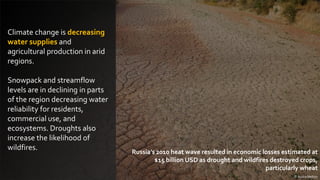
Climate change is decreasing
water supplies and
agricultural production in arid
regions.
Snowpack and streamflow
levels are in declining in parts
of the region decreasing water
reliability for residents,
commercial use, and
ecosystems. Droughts also
increase the likelihood of
wildfires.
© Audra Melton
Russia’s 2010 heat wave resulted in economic losses estimated at
$15 billion USD as drought and wildfires destroyed crops,
particularly wheat
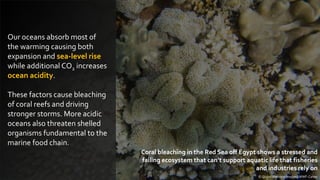
Our oceans absorb most of
the warming causing both
expansion and sea-level rise
while additional CO2 increases
ocean acidity.
These factors cause bleaching
of coral reefs and driving
stronger storms. More acidic
oceans also threaten shelled
organisms fundamental to the
marine food chain.
© Global Warming Images / WWF-Canon
Coral bleaching in the Red Sea off Egypt shows a stressed and
failing ecosystem that can’t support aquatic life that fisheries
and industries rely on
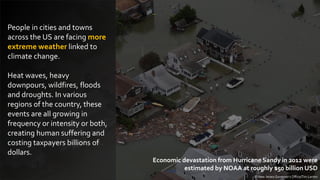
People in cities and towns
across the US are facing more
extreme weather linked to
climate change.
Heat waves, heavy
downpours, wildfires, floods
and droughts. In various
regions of the country, these
events are all growing in
frequency or intensity or both,
creating human suffering and
costing taxpayers billions of
dollars.
© New Jersey Governor's Office/Tim Larsen
Economic devastation from Hurricane Sandy in 2012 were
estimated by NOAA at roughly $50 billion USD
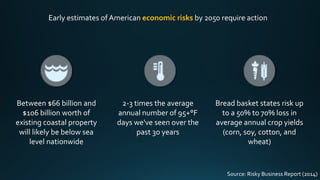
Between $66 billion and
$106 billion worth of
existing coastal property
will likely be below sea
level nationwide
2-3 times the average
annual number of 95+°F
days we've seen over the
past 30 years
Bread basket states risk up
to a 50% to 70% loss in
average annual crop yields
(corn, soy, cotton, and
wheat)
Early estimates of American economic risks by 2050 require action
Source: Risky Business Report (2014)
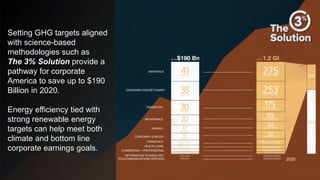
Setting GHG targets aligned
with science-based
methodologies such as
The 3% Solution provide a
pathway for corporate
America to save up to $190
Billion in 2020.
Energy efficiency tied with
strong renewable energy
targets can help meet both
climate and bottom line
corporate earnings goals.
2020
MATERIALS
CONSUMER DISCRETIONARY
TRANSPORT
INDUSTRIALS
ENERGY
CONSUMER STAPLES
FINANCIALS
HEALTH CARE
COMMERCIAL + PROFESSIONAL
INFORMATION TECHNOLOGY
TELECOMMUNICATIONS SERVICES

Climate Change 101

  • 1.
  • 2.
    Sunlight passes throughEarth’s atmosphere where some bounces into space and some is absorbed by greenhouse gas (GHG) molecules and re-radiated towards Earth, warming the average global temperature Increasing GHGs from human activity are causing change in this system too quickly Source: NASA
  • 3.
    1900 2014 10 ofthe last 15 years have been the warmest since records began in 1880 Source: NASA/GISS
  • 4.
    Source: IPCC/PNAS/NASA/GISS 97% ofclimate scientists agree that climate trends are “extremely likely” due to human activitiesGlobalSurfaceTemperatures
  • 5.
    Cumulative greenhouse gaslevels are at historic highs and continue to climb Roughly 62% of US emissions come from the corporate sector Source: NOAA/WWF/CDP/McKinsey
  • 6.
    The Arctic polarice cap is dissolving before our eyes, changing seasonal weather patterns around the globe. The National Climate Assessment shows Alaska has already warmed twice as fast as the rest of the nation. Arctic summer sea ice is receding faster than previously projected and is expected to virtually disappear before mid-century. © Florian Shulz Polar bears on floating ice in Svalbard, Artic Ocean.The Arctic region plays an important role in regulating and moderating global climate.
  • 7.
    Climate change isdecreasing water supplies and agricultural production in arid regions. Snowpack and streamflow levels are in declining in parts of the region decreasing water reliability for residents, commercial use, and ecosystems. Droughts also increase the likelihood of wildfires. © Audra Melton Russia’s 2010 heat wave resulted in economic losses estimated at $15 billion USD as drought and wildfires destroyed crops, particularly wheat
  • 8.
    Our oceans absorbmost of the warming causing both expansion and sea-level rise while additional CO2 increases ocean acidity. These factors cause bleaching of coral reefs and driving stronger storms. More acidic oceans also threaten shelled organisms fundamental to the marine food chain. © Global Warming Images / WWF-Canon Coral bleaching in the Red Sea off Egypt shows a stressed and failing ecosystem that can’t support aquatic life that fisheries and industries rely on
  • 9.
    People in citiesand towns across the US are facing more extreme weather linked to climate change. Heat waves, heavy downpours, wildfires, floods and droughts. In various regions of the country, these events are all growing in frequency or intensity or both, creating human suffering and costing taxpayers billions of dollars. © New Jersey Governor's Office/Tim Larsen Economic devastation from Hurricane Sandy in 2012 were estimated by NOAA at roughly $50 billion USD
  • 10.
    Between $66 billionand $106 billion worth of existing coastal property will likely be below sea level nationwide 2-3 times the average annual number of 95+°F days we've seen over the past 30 years Bread basket states risk up to a 50% to 70% loss in average annual crop yields (corn, soy, cotton, and wheat) Early estimates of American economic risks by 2050 require action Source: Risky Business Report (2014)
  • 11.
    Setting GHG targetsaligned with science-based methodologies such as The 3% Solution provide a pathway for corporate America to save up to $190 Billion in 2020. Energy efficiency tied with strong renewable energy targets can help meet both climate and bottom line corporate earnings goals. 2020 MATERIALS CONSUMER DISCRETIONARY TRANSPORT INDUSTRIALS ENERGY CONSUMER STAPLES FINANCIALS HEALTH CARE COMMERCIAL + PROFESSIONAL INFORMATION TECHNOLOGY TELECOMMUNICATIONS SERVICES

Editor's Notes

  • #3 A layer of greenhouse gases – primarily water vapor, and including much smaller amounts of carbon dioxide, methane and nitrous oxide – acts as a thermal blanket for the Earth, absorbing heat and warming the surface to a life-supporting average of 59 degrees Fahrenheit (15 degrees Celsius). Certain gases in the atmosphere block heat from escaping. Long-lived gases that remain semi-permanently in the atmosphere and do not respond physically or chemically to changes in temperature are described as "forcing" climate change. Gases, such as water vapor, which respond physically or chemically to changes in temperature are seen as "feedbacks.“ Gases that contribute to the greenhouse effect include: Water vapor. The most abundant greenhouse gas, but importantly, it acts as a feedback to the climate. Water vapor increases as the Earth's atmosphere warms, but so does the possibility of clouds and precipitation, making these some of the most important feedback mechanisms to the greenhouse effect. Carbon dioxide (CO2). A minor but very important component of the atmosphere, carbon dioxide is released through natural processes such as respiration and volcano eruptions and through human activities such as deforestation, land use changes, and burning fossil fuels. Humans have increased atmospheric CO2 concentration by a third since the Industrial Revolution began. This is the most important long-lived "forcing" of climate change. Methane. A hydrocarbon gas produced both through natural sources and human activities, including the decomposition of wastes in landfills, agriculture, and especially rice cultivation, as well as ruminant digestion and manure management associated with domestic livestock. On a molecule-for-molecule basis, methane is a far more active greenhouse gas than carbon dioxide, but also one which is much less abundant in the atmosphere. Nitrous oxide. A powerful greenhouse gas produced by soil cultivation practices, especially the use of commercial and organic fertilizers, fossil fuel combustion, nitric acid production, and biomass burning. Chlorofluorocarbons (CFCs). Synthetic compounds entirely of industrial origin used in a number of applications, but now largely regulated in production and release to the atmosphere by international agreement for their ability to contribute to destruction of the ozone layer. They are also greenhouse gases. Other trace gases such as HFCs, PFCs, and SF6 Source: NASA (2015). Available at: http://climate.nasa.gov/causes/
  • #4 The images show five-year average variations of global surface temperatures of 1900 and 2014. Dark blue indicates areas cooler than average. Dark red indicates areas warmer than average. Source: NASA/GISS (2014). Available at: http://climate.nasa.gov/vital-signs/global-temperature/
  • #5 Ninety-seven percent of climate scientists agree that climate-warming trends over the past century are very likely due to human activities, and most of the leading scientific organizations worldwide have issued public statements endorsing this position. (IPCC AR5) Source: IPCC/PNAS/NASA/GISS (2014). Available at: http://climate.nasa.gov/scientific-consensus/
  • #6 Carbon dioxide (CO2) is an important heat-trapping (greenhouse) gas, which is released through human activities such as deforestation and burning fossil fuels, as well as natural processes such as respiration and volcanic eruptions. The chart shows CO2 levels during the last three glacial cycles, as reconstructed from ice cores. Sources: WWF, CDP, McKinsey, The 3% Solution (2013). Available at: www.the3percentsolution.org NOAA/NASA (2015). Available at: http://climate.nasa.gov/vital-signs/carbon-dioxide/
  • #8  Source: PWC (2012). Available at http://www.pwc.com/gx/en/governance-risk-compliance-consulting-services/resilience/publications/business-not-as-usual.jhtml
  • #10  Source: NOAA (2012). Available at: http://www.nhc.noaa.gov/data/tcr/AL182012_Sandy.pdf
  • #11 Source: Risky Business Report (2014). Available at: www.riskybusiness.org/uploads/files/RiskyBusiness_Report_WEB_09_08_14.pdf
  • #12  Sources: WWF, CDP, McKinsey, The 3% Solution (2013). Available at: www.the3percentsolution.org