Earth’s Climate
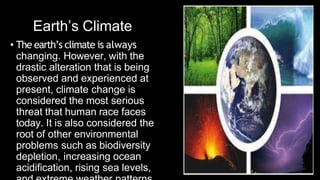
• The earth’s climate is always
changing. However, with the
drastic alteration that is being
observed and experienced at
present, climate change is
considered the most serious
threat that human race faces
today. It is also considered the
root of other environmental
problems such as biodiversity
depletion, increasing ocean
acidification, rising sea levels,
Climate
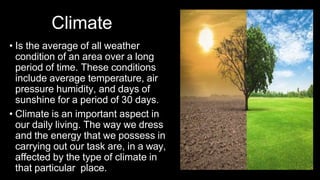
• Is the average of all weather
condition of an area over a long
period of time. These conditions
include average temperature, air
pressure humidity, and days of
sunshine for a period of 30 days.
• Climate is an important aspect in
our daily living. The way we dress
and the energy that we possess in
carrying out our task are, in a way,
affected by the type of climate in
that particular place.
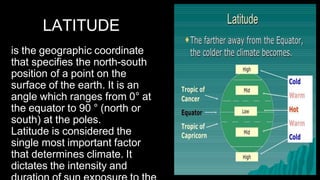
LATITUDE
is the geographic coordinate
that specifies the north-south
position of a point on the
surface of the earth. It is an
angle which ranges from 0° at
the equator to 90 ° (north or
south) at the poles.
Latitude is considered the
single most important factor
that determines climate. It
dictates the intensity and
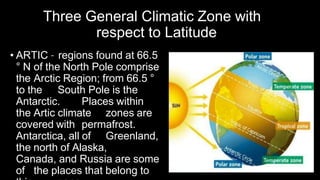
Three General Climatic Zone with
respect to Latitude
• ARTIC – regions found at 66.5
° N of the North Pole comprise
the Arctic Region; from 66.5 °
to the South Pole is the
Antarctic. Places within
the Artic climate zones are
covered with permafrost.
Antarctica, all of Greenland,
the north of Alaska,
Canada, and Russia are some
of the places that belong to
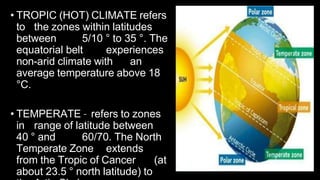
• TROPIC (HOT) CLIMATE refers
to the zones within latitudes
between 5/10 ° to 35 °. The
equatorial belt experiences
non-arid climate with an
average temperature above 18
°C.
• TEMPERATE – refers to zones
in range of latitude between
40 ° and 60/70. The North
Temperate Zone extends
from the Tropic of Cancer (at
about 23.5 ° north latitude) to
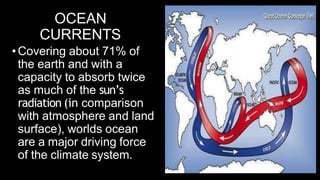
OCEAN
CURRENTS
•Covering about 71% of
the earth and with a
capacity to absorb twice
as much of the sun’s
radiation (in comparison
with atmosphere and land
surface), worlds ocean
are a major driving force
of the climate system.
Two Types of Ocean Current
1. WIND-DRIVEN CIRCULATION – which is forced
by wind stress on the sea surface including a
momentum exchange. It dominates in the upper
hundred meters from the sea surface.
2. THERMOHALINE CIRCULATION – which is an
“overturning” circulation in which warm water flows
poleward near the surface and is subsequently
converted into cold water that sinks and flows
equatorward in the interior.
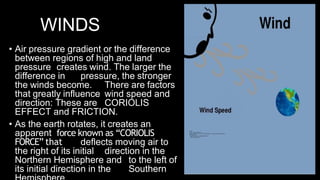
WINDS
• Air pressure gradient or the difference
between regions of high and land
pressure creates wind. The larger the
difference in pressure, the stronger
the winds become. There are factors
that greatly influence wind speed and
direction: These are CORIOLIS
EFFECT and FRICTION.
• As the earth rotates, it creates an
apparent force known as “CORIOLIS
FORCE” that deflects moving air to
the right of its initial direction in the
Northern Hemisphere and to the left of
its initial direction in the Southern
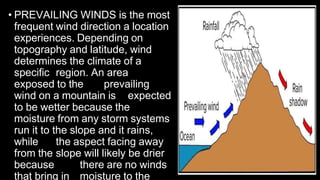
• PREVAILING WINDS is the most
frequent wind direction a location
experiences. Depending on
topography and latitude, wind
determines the climate of a
specific region. An area
exposed to the prevailing
wind on a mountain is expected
to be wetter because the
moisture from any storm systems
run it to the slope and it rains,
while the aspect facing away
from the slope will likely be drier
because there are no winds
that bring in moisture to the
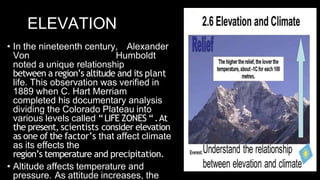
ELEVATION
• In the nineteenth century, Alexander
Von Humboldt
noted a unique relationship
between a region’s altitude and its plant
life. This observation was verified in
1889 when C. Hart Merriam
completed his documentary analysis
dividing the Colorado Plateau into
various levels called “LIFE ZONES “.At
the present, scientists consider elevation
as one of the factor’s that affect climate
as its effects the
region’s temperature and precipitation.
• Altitude affects temperature and
pressure. As attitude increases, the
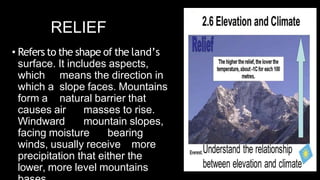
RELIEF
• Refers to the shape of the land’s
surface. It includes aspects,
which means the direction in
which a slope faces. Mountains
form a natural barrier that
causes air masses to rise.
Windward mountain slopes,
facing moisture bearing
winds, usually receive more
precipitation that either the
lower, more level mountains
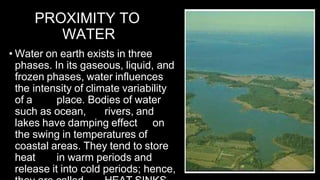
PROXIMITY TO
WATER
• Water on earth exists in three
phases. In its gaseous, liquid, and
frozen phases, water influences
the intensity of climate variability
of a place. Bodies of water
such as ocean, rivers, and
lakes have damping effect on
the swing in temperatures of
coastal areas. They tend to store
heat in warm periods and
release it into cold periods; hence,
• THERMAL INERTIA
refers to the tendency of
heat to transfer more
slowly to some
material bodies than
others, which creates an
apparent lag between
temperature change
between tow materials
bodies.
Global Climate
Change
Phenomenon
• The climate is changing; the earth needs an antibiotic! As
frequently quoted, “WE ONLY HAVE ONE EARTH”, hence, we
should sustain its health not only for our sake, but more
importantly for the generation to come.
• Just in the last 650,000 years, records showed that there
been seven cycles of glacial advance and retreat with the
abrupt end of the last Ice Age about 7000 years ago. This
phenomenon marks the beginning of the modern climate era
and of human civilization. Previously, climate changes are
attributed to very
small variations in Earth’s orbit that alters the amount of solar
energy our planet receives. However, at present, climate
change is considered a major environmental, social, and
political concern that prevails as a result of human activities.
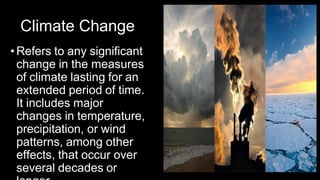
Climate Change
•Refers to any significant
change in the measures
of climate lasting for an
extended period of time.
It includes major
changes in temperature,
precipitation, or wind
patterns, among other
effects, that occur over
several decades or
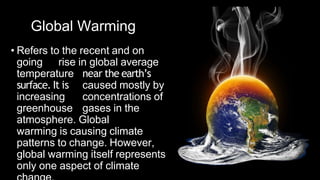
Global Warming
• Refers to the recent and on
going rise in global average
temperature near the earth’s
surface. It is caused mostly by
increasing concentrations of
greenhouse gases in the
atmosphere. Global
warming is causing climate
patterns to change. However,
global warming itself represents
only one aspect of climate
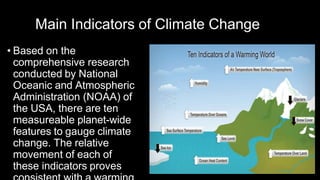
Main Indicators of Climate Change
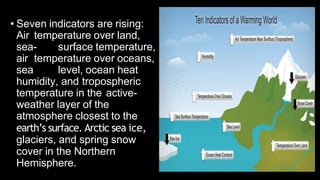
• Based on the
comprehensive research
conducted by National
Oceanic and Atmospheric
Administration (NOAA) of
the USA, there are ten
measureable planet-wide
features to gauge climate
change. The relative
movement of each of
these indicators proves
• Seven indicators are rising:
Air temperature over land,
sea- surface temperature,
air temperature over oceans,
sea level, ocean heat
humidity, and tropospheric
temperature in the active-
weather layer of the
atmosphere closest to the
earth’s surface. Arctic sea ice,
glaciers, and spring snow
cover in the Northern
Hemisphere.
Causes of Climate Change
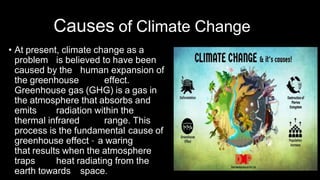
• At present, climate change as a
problem is believed to have been
caused by the human expansion of
the greenhouse effect.
Greenhouse gas (GHG) is a gas in
the atmosphere that absorbs and
emits radiation within the
thermal infrared range. This
process is the fundamental cause of
greenhouse effect – a waring
that results when the atmosphere
traps heat radiating from the
earth towards space.
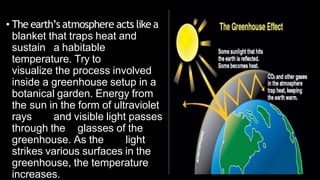
• The earth’s atmosphere acts like a
blanket that traps heat and
sustain a habitable
temperature. Try to
visualize the process involved
inside a greenhouse setup in a
botanical garden. Energy from
the sun in the form of ultraviolet
rays and visible light passes
through the glasses of the
greenhouse. As the light
strikes various surfaces in the
greenhouse, the temperature
increases.
Five Gases Responsible for
Greenhouse Effect
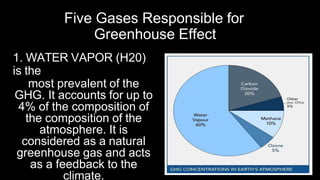
1. WATER VAPOR (H20)
is the
most prevalent of the
GHG. It accounts for up to
4% of the composition of
the composition of the
atmosphere. It is
considered as a natural
greenhouse gas and acts
as a feedback to the
climate.
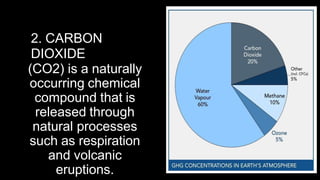
2. CARBON
DIOXIDE
(CO2) is a naturally
occurring chemical
compound that is
released through
natural processes
such as respiration
and volcanic
eruptions.
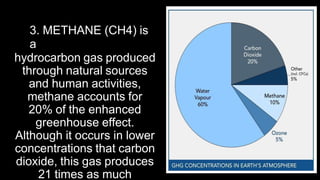
3. METHANE (CH4) is
a
hydrocarbon gas produced
through natural sources
and human activities,
methane accounts for
20% of the enhanced
greenhouse effect.
Although it occurs in lower
concentrations that carbon
dioxide, this gas produces
21 times as much
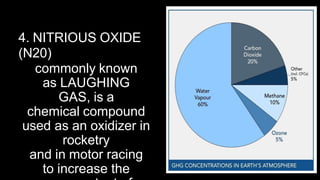
4. NITRIOUS OXIDE
(N20)
commonly known
as LAUGHING
GAS, is a
chemical compound
used as an oxidizer in
rocketry
and in motor racing
to increase the
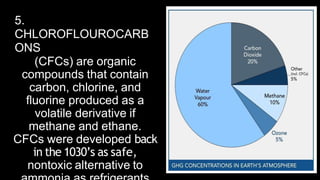
5.
CHLOROFLOUROCARB
ONS
(CFCs) are organic
compounds that contain
carbon, chlorine, and
fluorine produced as a
volatile derivative if
methane and ethane.
CFCs were developed back
in the 1030’s as safe,
nontoxic alternative to
Climate Change in Focus: Impacts
and Threats
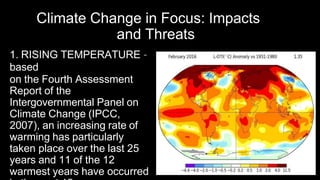
1. RISING TEMPERATURE –
based
on the Fourth Assessment
Report of the
Intergovernmental Panel on
Climate Change (IPCC,
2007), an increasing rate of
warming has particularly
taken place over the last 25
years and 11 of the 12
warmest years have occurred
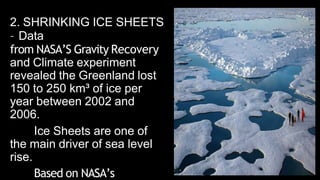
2. SHRINKING ICE SHEETS
– Data
from NASA’S Gravity Recovery
and Climate experiment
revealed the Greenland lost
150 to 250 km³ of ice per
year between 2002 and
2006.
Ice Sheets are one of
the main driver of sea level
rise.
Based on NASA’s
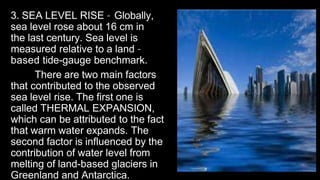
3. SEA LEVEL RISE – Globally,
sea level rose about 16 cm in
the last century. Sea level is
measured relative to a land –
based tide-gauge benchmark.
There are two main factors
that contributed to the observed
sea level rise. The first one is
called THERMAL EXPANSION,
which can be attributed to the fact
that warm water expands. The
second factor is influenced by the
contribution of water level from
melting of land-based glaciers in
Greenland and Antarctica.
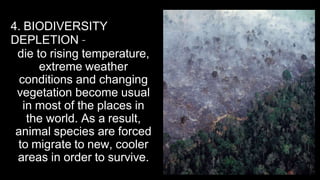
4. BIODIVERSITY
DEPLETION –
die to rising temperature,
extreme weather
conditions and changing
vegetation become usual
in most of the places in
the world. As a result,
animal species are forced
to migrate to new, cooler
areas in order to survive.
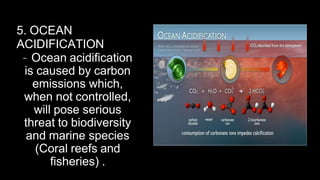
5. OCEAN
ACIDIFICATION
– Ocean acidification
is caused by carbon
emissions which,
when not controlled,
will pose serious
threat to biodiversity
and marine species
(Coral reefs and
fisheries) .
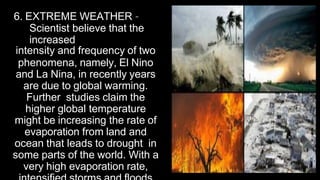
6. EXTREME WEATHER –
Scientist believe that the
increased
intensity and frequency of two
phenomena, namely, El Nino
and La Nina, in recently years
are due to global warming.
Further studies claim the
higher global temperature
might be increasing the rate of
evaporation from land and
ocean that leads to drought in
some parts of the world. With a
very high evaporation rate,
Ways to Mitigate the Effects of
Climate Change
• CLIMATE CHANGE MITIGATION refers to any action
focused to reduce the intensity of radiative forcing so as
to lessen the effects of global warming. On the other
hand, adaptation to global warming involves acting to
tolerate the effects of global warming.
• CLIMATE CHANGE is a universal issue; hence, a universal
effort is deemed necessary to combat the problem. Various
action, treaties, or agreement were conducted and several
policies are being drafted for implementation in global and
local levels.
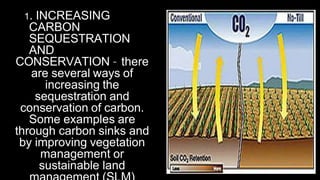
1. INCREASING
CARBON
SEQUESTRATION
AND
CONSERVATION – there
are several ways of
increasing the
sequestration and
conservation of carbon.
Some examples are
through carbon sinks and
by improving vegetation
management or
sustainable land
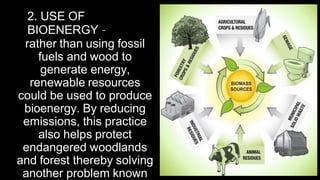
2. USE OF
BIOENERGY –
rather than using fossil
fuels and wood to
generate energy,
renewable resources
could be used to produce
bioenergy. By reducing
emissions, this practice
also helps protect
endangered woodlands
and forest thereby solving
another problem known
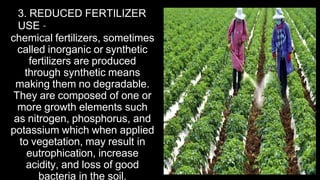
3. REDUCED FERTILIZER
USE –
chemical fertilizers, sometimes
called inorganic or synthetic
fertilizers are produced
through synthetic means
making them no degradable.
They are composed of one or
more growth elements such
as nitrogen, phosphorus, and
potassium which when applied
to vegetation, may result in
eutrophication, increase
acidity, and loss of good
bacteria in the soil.
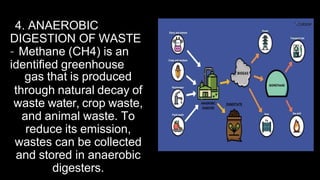
4. ANAEROBIC
DIGESTION OF WASTE
– Methane (CH4) is an
identified greenhouse
gas that is produced
through natural decay of
waste water, crop waste,
and animal waste. To
reduce its emission,
wastes can be collected
and stored in anaerobic
digesters.
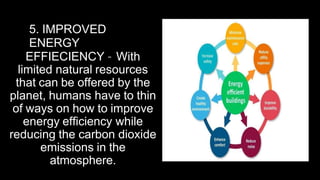
5. IMPROVED
ENERGY
EFFIECIENCY – With
limited natural resources
that can be offered by the
planet, humans have to thin
of ways on how to improve
energy efficiency while
reducing the carbon dioxide
emissions in the
atmosphere.

grade9differentfactorsaffectingclimate-240116020951-e81c6748.pptx

  • 2.
    Earth’s Climate • Theearth’s climate is always changing. However, with the drastic alteration that is being observed and experienced at present, climate change is considered the most serious threat that human race faces today. It is also considered the root of other environmental problems such as biodiversity depletion, increasing ocean acidification, rising sea levels,
  • 3.
    Climate • Is theaverage of all weather condition of an area over a long period of time. These conditions include average temperature, air pressure humidity, and days of sunshine for a period of 30 days. • Climate is an important aspect in our daily living. The way we dress and the energy that we possess in carrying out our task are, in a way, affected by the type of climate in that particular place.
  • 5.
    LATITUDE is the geographiccoordinate that specifies the north-south position of a point on the surface of the earth. It is an angle which ranges from 0° at the equator to 90 ° (north or south) at the poles. Latitude is considered the single most important factor that determines climate. It dictates the intensity and
  • 6.
    Three General ClimaticZone with respect to Latitude • ARTIC – regions found at 66.5 ° N of the North Pole comprise the Arctic Region; from 66.5 ° to the South Pole is the Antarctic. Places within the Artic climate zones are covered with permafrost. Antarctica, all of Greenland, the north of Alaska, Canada, and Russia are some of the places that belong to
  • 7.
    • TROPIC (HOT)CLIMATE refers to the zones within latitudes between 5/10 ° to 35 °. The equatorial belt experiences non-arid climate with an average temperature above 18 °C. • TEMPERATE – refers to zones in range of latitude between 40 ° and 60/70. The North Temperate Zone extends from the Tropic of Cancer (at about 23.5 ° north latitude) to
  • 8.
    OCEAN CURRENTS •Covering about 71%of the earth and with a capacity to absorb twice as much of the sun’s radiation (in comparison with atmosphere and land surface), worlds ocean are a major driving force of the climate system.
  • 9.
    Two Types ofOcean Current 1. WIND-DRIVEN CIRCULATION – which is forced by wind stress on the sea surface including a momentum exchange. It dominates in the upper hundred meters from the sea surface. 2. THERMOHALINE CIRCULATION – which is an “overturning” circulation in which warm water flows poleward near the surface and is subsequently converted into cold water that sinks and flows equatorward in the interior.
  • 10.
    WINDS • Air pressuregradient or the difference between regions of high and land pressure creates wind. The larger the difference in pressure, the stronger the winds become. There are factors that greatly influence wind speed and direction: These are CORIOLIS EFFECT and FRICTION. • As the earth rotates, it creates an apparent force known as “CORIOLIS FORCE” that deflects moving air to the right of its initial direction in the Northern Hemisphere and to the left of its initial direction in the Southern
  • 11.
    • PREVAILING WINDSis the most frequent wind direction a location experiences. Depending on topography and latitude, wind determines the climate of a specific region. An area exposed to the prevailing wind on a mountain is expected to be wetter because the moisture from any storm systems run it to the slope and it rains, while the aspect facing away from the slope will likely be drier because there are no winds that bring in moisture to the
  • 12.
    ELEVATION • In thenineteenth century, Alexander Von Humboldt noted a unique relationship between a region’s altitude and its plant life. This observation was verified in 1889 when C. Hart Merriam completed his documentary analysis dividing the Colorado Plateau into various levels called “LIFE ZONES “.At the present, scientists consider elevation as one of the factor’s that affect climate as its effects the region’s temperature and precipitation. • Altitude affects temperature and pressure. As attitude increases, the
  • 13.
    RELIEF • Refers tothe shape of the land’s surface. It includes aspects, which means the direction in which a slope faces. Mountains form a natural barrier that causes air masses to rise. Windward mountain slopes, facing moisture bearing winds, usually receive more precipitation that either the lower, more level mountains
  • 14.
    PROXIMITY TO WATER • Wateron earth exists in three phases. In its gaseous, liquid, and frozen phases, water influences the intensity of climate variability of a place. Bodies of water such as ocean, rivers, and lakes have damping effect on the swing in temperatures of coastal areas. They tend to store heat in warm periods and release it into cold periods; hence,
  • 15.
    • THERMAL INERTIA refersto the tendency of heat to transfer more slowly to some material bodies than others, which creates an apparent lag between temperature change between tow materials bodies.
  • 17.
  • 18.
    • The climateis changing; the earth needs an antibiotic! As frequently quoted, “WE ONLY HAVE ONE EARTH”, hence, we should sustain its health not only for our sake, but more importantly for the generation to come. • Just in the last 650,000 years, records showed that there been seven cycles of glacial advance and retreat with the abrupt end of the last Ice Age about 7000 years ago. This phenomenon marks the beginning of the modern climate era and of human civilization. Previously, climate changes are attributed to very small variations in Earth’s orbit that alters the amount of solar energy our planet receives. However, at present, climate change is considered a major environmental, social, and political concern that prevails as a result of human activities.
  • 19.
    Climate Change •Refers toany significant change in the measures of climate lasting for an extended period of time. It includes major changes in temperature, precipitation, or wind patterns, among other effects, that occur over several decades or
  • 20.
    Global Warming • Refersto the recent and on going rise in global average temperature near the earth’s surface. It is caused mostly by increasing concentrations of greenhouse gases in the atmosphere. Global warming is causing climate patterns to change. However, global warming itself represents only one aspect of climate
  • 21.
    Main Indicators ofClimate Change • Based on the comprehensive research conducted by National Oceanic and Atmospheric Administration (NOAA) of the USA, there are ten measureable planet-wide features to gauge climate change. The relative movement of each of these indicators proves
  • 22.
    • Seven indicatorsare rising: Air temperature over land, sea- surface temperature, air temperature over oceans, sea level, ocean heat humidity, and tropospheric temperature in the active- weather layer of the atmosphere closest to the earth’s surface. Arctic sea ice, glaciers, and spring snow cover in the Northern Hemisphere.
  • 23.
    Causes of ClimateChange • At present, climate change as a problem is believed to have been caused by the human expansion of the greenhouse effect. Greenhouse gas (GHG) is a gas in the atmosphere that absorbs and emits radiation within the thermal infrared range. This process is the fundamental cause of greenhouse effect – a waring that results when the atmosphere traps heat radiating from the earth towards space.
  • 24.
    • The earth’satmosphere acts like a blanket that traps heat and sustain a habitable temperature. Try to visualize the process involved inside a greenhouse setup in a botanical garden. Energy from the sun in the form of ultraviolet rays and visible light passes through the glasses of the greenhouse. As the light strikes various surfaces in the greenhouse, the temperature increases.
  • 25.
    Five Gases Responsiblefor Greenhouse Effect 1. WATER VAPOR (H20) is the most prevalent of the GHG. It accounts for up to 4% of the composition of the composition of the atmosphere. It is considered as a natural greenhouse gas and acts as a feedback to the climate.
  • 26.
    2. CARBON DIOXIDE (CO2) isa naturally occurring chemical compound that is released through natural processes such as respiration and volcanic eruptions.
  • 27.
    3. METHANE (CH4)is a hydrocarbon gas produced through natural sources and human activities, methane accounts for 20% of the enhanced greenhouse effect. Although it occurs in lower concentrations that carbon dioxide, this gas produces 21 times as much
  • 28.
    4. NITRIOUS OXIDE (N20) commonlyknown as LAUGHING GAS, is a chemical compound used as an oxidizer in rocketry and in motor racing to increase the
  • 29.
    5. CHLOROFLOUROCARB ONS (CFCs) are organic compoundsthat contain carbon, chlorine, and fluorine produced as a volatile derivative if methane and ethane. CFCs were developed back in the 1030’s as safe, nontoxic alternative to
  • 30.
    Climate Change inFocus: Impacts and Threats 1. RISING TEMPERATURE – based on the Fourth Assessment Report of the Intergovernmental Panel on Climate Change (IPCC, 2007), an increasing rate of warming has particularly taken place over the last 25 years and 11 of the 12 warmest years have occurred
  • 31.
    2. SHRINKING ICESHEETS – Data from NASA’S Gravity Recovery and Climate experiment revealed the Greenland lost 150 to 250 km³ of ice per year between 2002 and 2006. Ice Sheets are one of the main driver of sea level rise. Based on NASA’s
  • 32.
    3. SEA LEVELRISE – Globally, sea level rose about 16 cm in the last century. Sea level is measured relative to a land – based tide-gauge benchmark. There are two main factors that contributed to the observed sea level rise. The first one is called THERMAL EXPANSION, which can be attributed to the fact that warm water expands. The second factor is influenced by the contribution of water level from melting of land-based glaciers in Greenland and Antarctica.
  • 33.
    4. BIODIVERSITY DEPLETION – dieto rising temperature, extreme weather conditions and changing vegetation become usual in most of the places in the world. As a result, animal species are forced to migrate to new, cooler areas in order to survive.
  • 34.
    5. OCEAN ACIDIFICATION – Oceanacidification is caused by carbon emissions which, when not controlled, will pose serious threat to biodiversity and marine species (Coral reefs and fisheries) .
  • 35.
    6. EXTREME WEATHER– Scientist believe that the increased intensity and frequency of two phenomena, namely, El Nino and La Nina, in recently years are due to global warming. Further studies claim the higher global temperature might be increasing the rate of evaporation from land and ocean that leads to drought in some parts of the world. With a very high evaporation rate,
  • 36.
    Ways to Mitigatethe Effects of Climate Change • CLIMATE CHANGE MITIGATION refers to any action focused to reduce the intensity of radiative forcing so as to lessen the effects of global warming. On the other hand, adaptation to global warming involves acting to tolerate the effects of global warming. • CLIMATE CHANGE is a universal issue; hence, a universal effort is deemed necessary to combat the problem. Various action, treaties, or agreement were conducted and several policies are being drafted for implementation in global and local levels.
  • 37.
    1. INCREASING CARBON SEQUESTRATION AND CONSERVATION –there are several ways of increasing the sequestration and conservation of carbon. Some examples are through carbon sinks and by improving vegetation management or sustainable land
  • 38.
    2. USE OF BIOENERGY– rather than using fossil fuels and wood to generate energy, renewable resources could be used to produce bioenergy. By reducing emissions, this practice also helps protect endangered woodlands and forest thereby solving another problem known
  • 39.
    3. REDUCED FERTILIZER USE– chemical fertilizers, sometimes called inorganic or synthetic fertilizers are produced through synthetic means making them no degradable. They are composed of one or more growth elements such as nitrogen, phosphorus, and potassium which when applied to vegetation, may result in eutrophication, increase acidity, and loss of good bacteria in the soil.
  • 40.
    4. ANAEROBIC DIGESTION OFWASTE – Methane (CH4) is an identified greenhouse gas that is produced through natural decay of waste water, crop waste, and animal waste. To reduce its emission, wastes can be collected and stored in anaerobic digesters.
  • 41.
    5. IMPROVED ENERGY EFFIECIENCY –With limited natural resources that can be offered by the planet, humans have to thin of ways on how to improve energy efficiency while reducing the carbon dioxide emissions in the atmosphere.