Long Term & Short Term Effects of Climate ChangeBy: Sarah Ramanathan Keiran AlamChantal LiuManal Rahim
For the past millions of years, our climate has had many significant changes. Changes in Earth's climate are triggered by changes in Earth's energy balance. Long term changes:- continental drift- changes in Earth's orbitShort term changes:- Volcanic eruptions- Air and Ocean Currents 
Long Term Changes in climate(millions of years- hundreds of thousands of years)Chantal & Manal
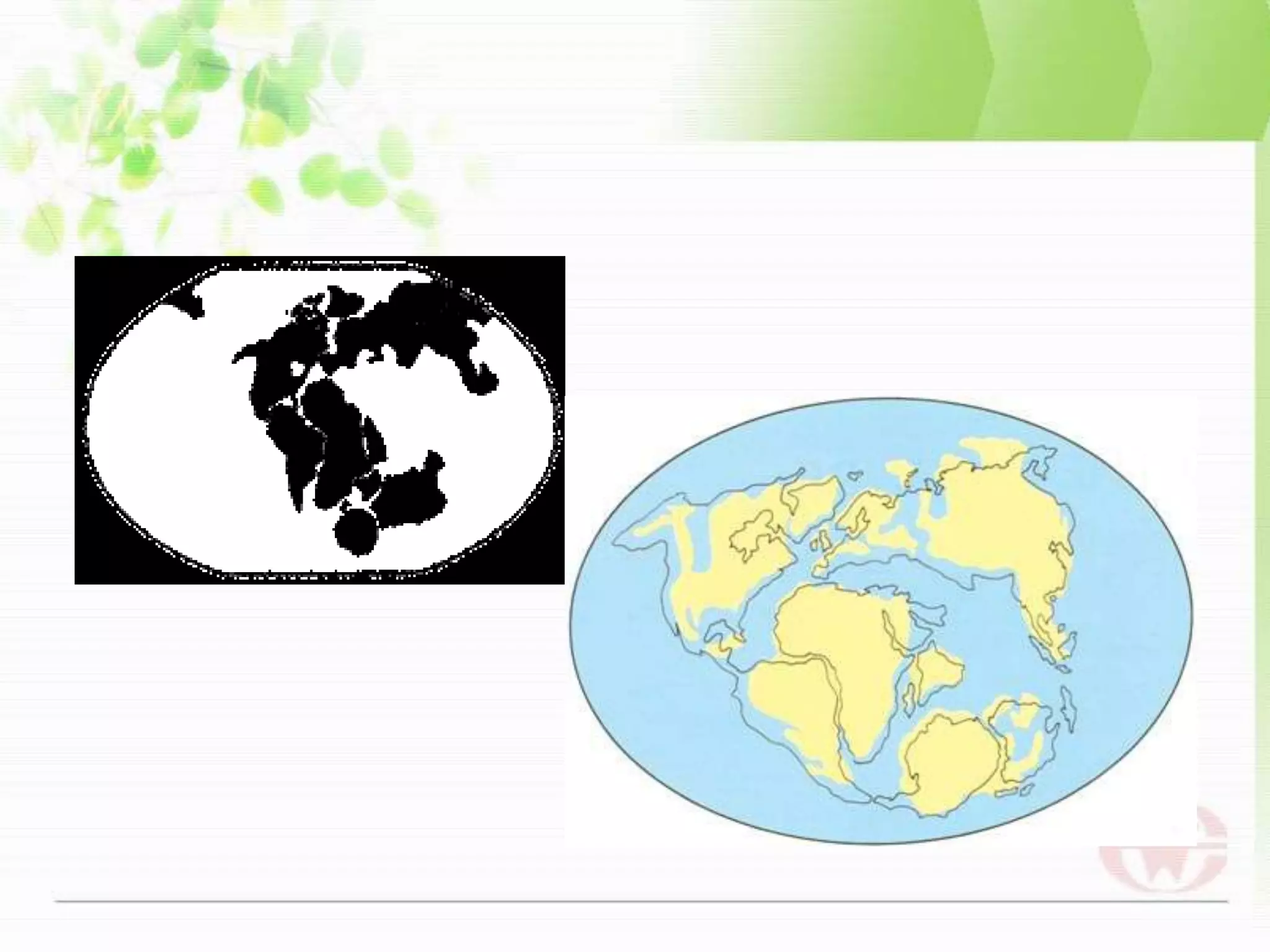
Plate Tectonics = Theory of explaining slow movement of large plates of Earth's crustContinental Drift - Theory that Earth's continents used to be one supercontinent named Pangaea.225 Million years ago: Pangaea (Permian period)Changes Due to Continental Drift
200 Million years ago: Laragia and Gondwanaland (Triassic period)135 Million years ago: Jurassic period65 Million years ago: Creations period.
Continents move = ocean currents and wind patterns change	- Affects heat transferAffects distribution of land mass	- Nothern Hemisphere (includes Canada) has most land mass.
	- Fewer large bodies of water = coldest winters & warmest summers	- More large bodies of water in Southern hemisphere = more moderate climate	- Temperatures weren't like this in Permian period
More mountains (caused by movement of Earth's plates) affects Local & regional climatesWearing of mountains over time can also cause regional climate change	- These changes have occurred in Canada because we have new and old mountain 	regions such as the Rockies and Appalachians.
Scientists have found that over time the energy the Sun produces over time can also changeChanges of area cause complications in production of CO2	- CO2 porduced in volcanoes & mid-ocean trenches.		-> Lost by slowly being absorbed into oceans		-> Areas w/ high overall temperature most likely had greenhouse warming due to 		volcanic CO2
Long-Term Cycles in Climate20 000 years ago, Earth had last ice age.	- Temp was 10 degrees lower than today	- Canada covered in ice sheet 3 km thick	- Sea levels dropped as oceans froze over		-> Land under oceans were exposed, revealing hidden bridges to continents
		-> Animals crossed over to new habitatsMajor changes in temp happen in regular cycles (page 349 of textbook)	-warm interglacial periods occur every 100 000 yearsInterglacial Period - Time between ice ages when Earth warms up
Changes That Occur Over Hundreds Of Thousands Of Years: The Recurrence of Interglacial Periods and Ice Agesevery 100,000 years, interglacial periods and ice ages occurIce age (glacial period): long term reduction of Earth’s temperature = glaciers and ice sheets covering Earth
Interglacial periods: period of warmer temperature that separates periods of time in an ice ageInterglacial periods involve movements of glaciersCauses temperatures to keep rising and falling depending on whether glaciers are advancing or retreating
Why these Interglacial Periods &Ice Ages Keep Happening? Engineer/astronomer Milutin Milankovitch developed theory on reason for these climate changes Earth’s orbit around sun changes on three main ways/cycles:Eccentricity (changing shape) of Earth’s orbitEarth’s  TiltDirection (wobble) of tilt
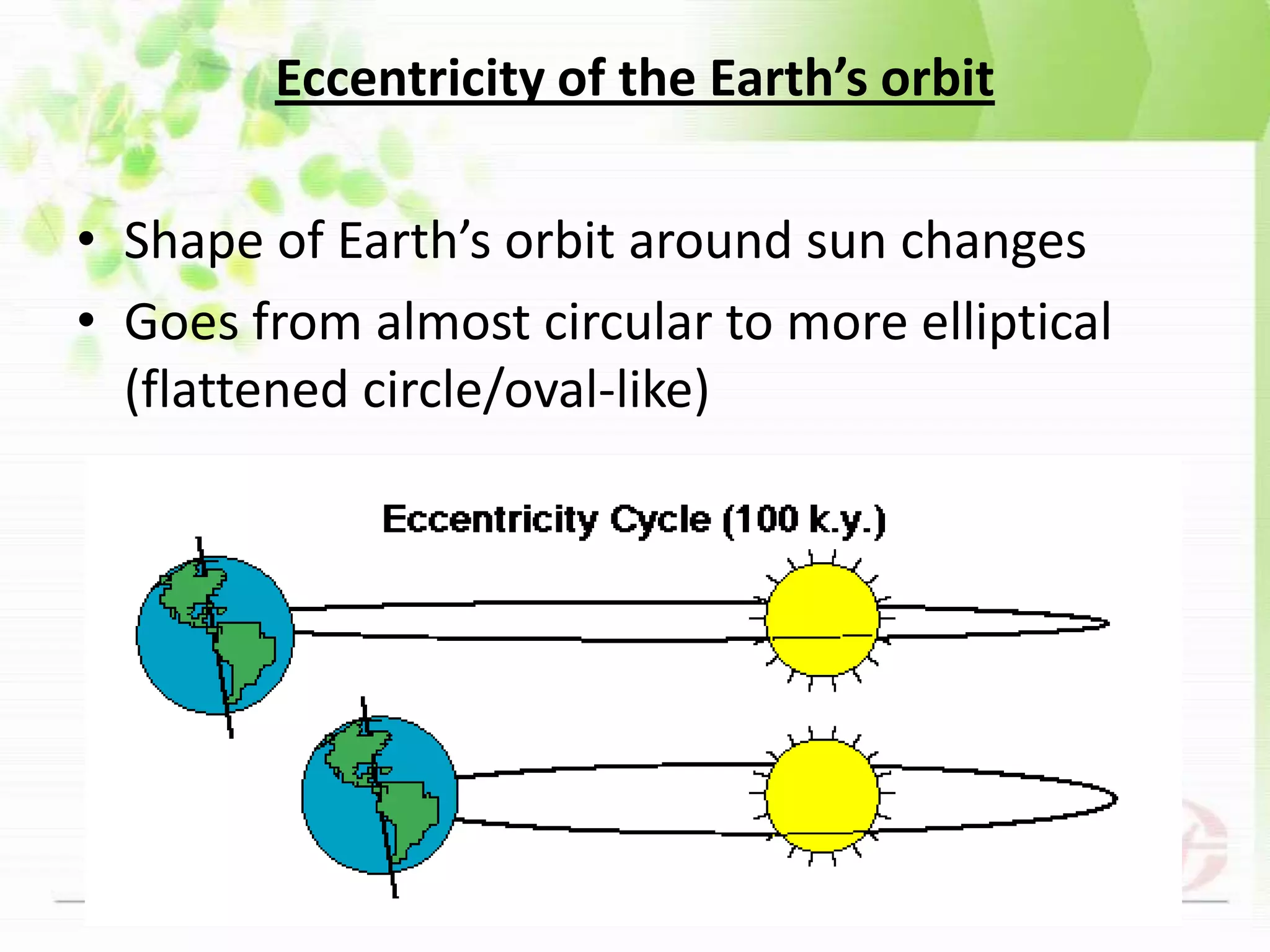
Eccentricity of the Earth’s orbitShape of Earth’s orbit around sun changes Goes from almost circular to more elliptical (flattened circle/oval-like)
Caused by Jupiter and Saturn’s gravitiesOccurs approximately every 100,000 yearsEarth’s current cycle is more elliptical (oval-like)
Earth’s TiltEarth’s current tilt = 23.5 degreesEarth’s tilt is responsible for its changes in seasons
Scientists believe that changes in Earth’s tilt are cause for glacial cycles occurringWhen Earth’s tilt is larger (closer to its 24.5 degrees max):Glaciations endCauses warmer summersEarth’s tilt currently decreasing
In a cycle close to 42,000 years, Earth tilts back and forth on its axis from 22.1 degrees to 24.5 degrees
Direction (wobble) of tilt (Axial Precession)In order to grasp the idea, think of a spinning top
As it spins, it wobbles around/changes direction while spinning on same pointEarth’s tilt is similarAs Earth’s spins on its axis, it slowly wobblesThe angle of its tilt remains approximately the same but its directions changesCycle of roughly 26,000 years
Short Term Changes in climate (decades-thousands of years)Sarah & Keiran
Volcanic EruptionsVolcanic eruptions can cause Earth’s climate to change temporarilyrocks, dust, and gases are sent out high into atmosphere.
Suns energy reflects back out to space (from sulfur dioxide particles) Earth’s surface shaded.Amount of cooling depends on amount of dust put in air, and time of cooling-on size of particles.
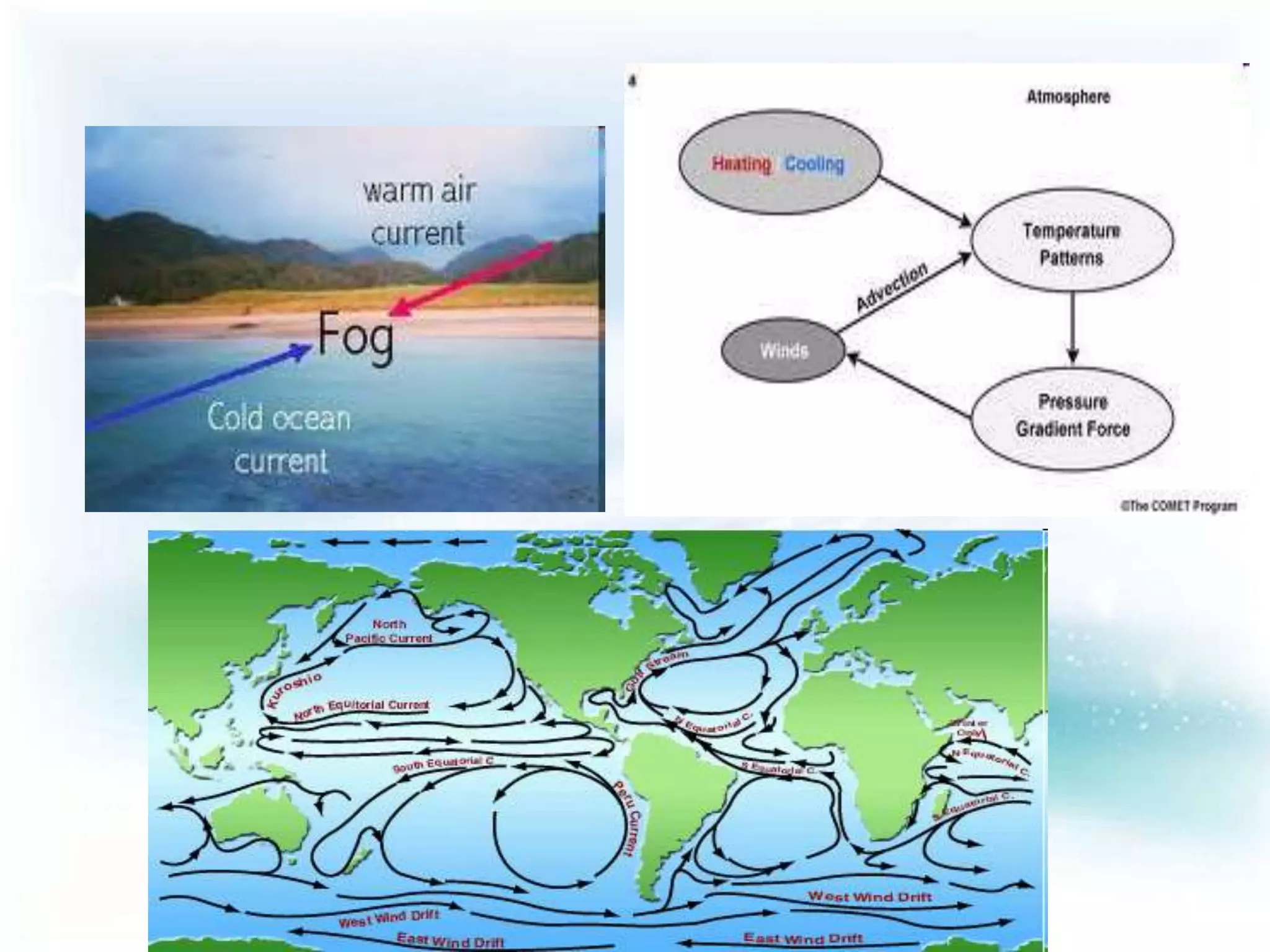
Ocean CurrentsUneven heating of Earth causes convection currents that create prevailing winds and ocean currents. Ocean currents have a strong effect on climates of nearby landOcean currents can be caused by windsCold ocean currents cool air above Warm ocean currents heat air above
The global conveyor belt begins around the North Pole and then works its way down, traveling through all of the oceans before circling backOcean currents can have a major effect on the weather
Air CurrentsAir on Earth's surface is in constant motion called air currentsAir currents affect air quality and ocean currents, and weather conditionsAir currents caused by three main processes: temperature change
Impurities
pressure.
Changes in Sun’s Radiationsuns radiation amount drops, Earth gets less energy(less heat =Earth cools down)suns radiation higher=more energyNo scientific reason yet why radiation    and     over shorter time scales.
Thank You
BibliographyNelson Science Perspectives 10Nelson Education Ltd.2010Pages 348-353<http://ircamera.as.arizona.edu/NatSci102/NatSci102/lectures/climate.htm>.Windows to the Universe2010 National Earth Science Teachers Association 200-2011http://www.windows2universe.org/earth/climate/cli_seasons.htmlWoods Hole Oceanographic InstitutionShelley DawickiMarch 28, 2005http://www.whoi.edu/page.do?pid=9779&tid=282&cid=3638&ct=162Long term climatehypertext   G. H. Riekehttp://ircamera.as.arizona.edu/NatSci102/NatSci102/lectures/climate.htm

Long term & short term effects of climate

  • 1.
    Long Term &Short Term Effects of Climate ChangeBy: Sarah Ramanathan Keiran AlamChantal LiuManal Rahim
  • 2.
    For the pastmillions of years, our climate has had many significant changes. Changes in Earth's climate are triggered by changes in Earth's energy balance. Long term changes:- continental drift- changes in Earth's orbitShort term changes:- Volcanic eruptions- Air and Ocean Currents 
  • 3.
    Long Term Changesin climate(millions of years- hundreds of thousands of years)Chantal & Manal
  • 4.
    Plate Tectonics =Theory of explaining slow movement of large plates of Earth's crustContinental Drift - Theory that Earth's continents used to be one supercontinent named Pangaea.225 Million years ago: Pangaea (Permian period)Changes Due to Continental Drift
  • 5.
    200 Million yearsago: Laragia and Gondwanaland (Triassic period)135 Million years ago: Jurassic period65 Million years ago: Creations period.
  • 8.
    Continents move =ocean currents and wind patterns change - Affects heat transferAffects distribution of land mass - Nothern Hemisphere (includes Canada) has most land mass.
  • 9.
    - Fewer largebodies of water = coldest winters & warmest summers - More large bodies of water in Southern hemisphere = more moderate climate - Temperatures weren't like this in Permian period
  • 10.
    More mountains (causedby movement of Earth's plates) affects Local & regional climatesWearing of mountains over time can also cause regional climate change - These changes have occurred in Canada because we have new and old mountain regions such as the Rockies and Appalachians.
  • 11.
    Scientists have foundthat over time the energy the Sun produces over time can also changeChanges of area cause complications in production of CO2 - CO2 porduced in volcanoes & mid-ocean trenches. -> Lost by slowly being absorbed into oceans -> Areas w/ high overall temperature most likely had greenhouse warming due to volcanic CO2
  • 12.
    Long-Term Cycles inClimate20 000 years ago, Earth had last ice age. - Temp was 10 degrees lower than today - Canada covered in ice sheet 3 km thick - Sea levels dropped as oceans froze over -> Land under oceans were exposed, revealing hidden bridges to continents
  • 13.
    -> Animals crossedover to new habitatsMajor changes in temp happen in regular cycles (page 349 of textbook) -warm interglacial periods occur every 100 000 yearsInterglacial Period - Time between ice ages when Earth warms up
  • 14.
    Changes That OccurOver Hundreds Of Thousands Of Years: The Recurrence of Interglacial Periods and Ice Agesevery 100,000 years, interglacial periods and ice ages occurIce age (glacial period): long term reduction of Earth’s temperature = glaciers and ice sheets covering Earth
  • 15.
    Interglacial periods: periodof warmer temperature that separates periods of time in an ice ageInterglacial periods involve movements of glaciersCauses temperatures to keep rising and falling depending on whether glaciers are advancing or retreating
  • 17.
    Why these InterglacialPeriods &Ice Ages Keep Happening? Engineer/astronomer Milutin Milankovitch developed theory on reason for these climate changes Earth’s orbit around sun changes on three main ways/cycles:Eccentricity (changing shape) of Earth’s orbitEarth’s TiltDirection (wobble) of tilt
  • 18.
    Eccentricity of theEarth’s orbitShape of Earth’s orbit around sun changes Goes from almost circular to more elliptical (flattened circle/oval-like)
  • 19.
    Caused by Jupiterand Saturn’s gravitiesOccurs approximately every 100,000 yearsEarth’s current cycle is more elliptical (oval-like)
  • 20.
    Earth’s TiltEarth’s currenttilt = 23.5 degreesEarth’s tilt is responsible for its changes in seasons
  • 21.
    Scientists believe thatchanges in Earth’s tilt are cause for glacial cycles occurringWhen Earth’s tilt is larger (closer to its 24.5 degrees max):Glaciations endCauses warmer summersEarth’s tilt currently decreasing
  • 22.
    In a cycleclose to 42,000 years, Earth tilts back and forth on its axis from 22.1 degrees to 24.5 degrees
  • 23.
    Direction (wobble) oftilt (Axial Precession)In order to grasp the idea, think of a spinning top
  • 24.
    As it spins,it wobbles around/changes direction while spinning on same pointEarth’s tilt is similarAs Earth’s spins on its axis, it slowly wobblesThe angle of its tilt remains approximately the same but its directions changesCycle of roughly 26,000 years
  • 26.
    Short Term Changesin climate (decades-thousands of years)Sarah & Keiran
  • 27.
    Volcanic EruptionsVolcanic eruptionscan cause Earth’s climate to change temporarilyrocks, dust, and gases are sent out high into atmosphere.
  • 30.
    Suns energy reflectsback out to space (from sulfur dioxide particles) Earth’s surface shaded.Amount of cooling depends on amount of dust put in air, and time of cooling-on size of particles.
  • 31.
    Ocean CurrentsUneven heatingof Earth causes convection currents that create prevailing winds and ocean currents. Ocean currents have a strong effect on climates of nearby landOcean currents can be caused by windsCold ocean currents cool air above Warm ocean currents heat air above
  • 32.
    The global conveyorbelt begins around the North Pole and then works its way down, traveling through all of the oceans before circling backOcean currents can have a major effect on the weather
  • 33.
    Air CurrentsAir onEarth's surface is in constant motion called air currentsAir currents affect air quality and ocean currents, and weather conditionsAir currents caused by three main processes: temperature change
  • 34.
  • 35.
  • 36.
    Changes in Sun’sRadiationsuns radiation amount drops, Earth gets less energy(less heat =Earth cools down)suns radiation higher=more energyNo scientific reason yet why radiation and over shorter time scales.
  • 37.
  • 38.
    BibliographyNelson Science Perspectives10Nelson Education Ltd.2010Pages 348-353<http://ircamera.as.arizona.edu/NatSci102/NatSci102/lectures/climate.htm>.Windows to the Universe2010 National Earth Science Teachers Association 200-2011http://www.windows2universe.org/earth/climate/cli_seasons.htmlWoods Hole Oceanographic InstitutionShelley DawickiMarch 28, 2005http://www.whoi.edu/page.do?pid=9779&tid=282&cid=3638&ct=162Long term climatehypertext   G. H. Riekehttp://ircamera.as.arizona.edu/NatSci102/NatSci102/lectures/climate.htm
  • 39.
    Pictures:Long term climatehypertext  G. H. Riekehttp://ircamera.as.arizona.edu/NatSci102/NatSi102/lectures/climate.htmhttp://www.phy6.org/stargcc/Sconcat2.htmhttp://room106vjh2.blogspot.com/2010_09_01_archive.htmlBlack, Ken. "How does Ocean Temperature affect Air Temperature?" WiseGeek. Web. 10 Jan 2011. Capital Regional District. "Global Ocean Currents.". Web. 10 Jan 2011. Hayhoe, Christy, Douglas and Katharine. Energy Transfer within the Climate System: Air and Ocean Circulation. Perspectives 10. Canada: Nelson Eduacation Ltd, 2010. 344-348. Print.Exploring the environmentWheeling Jesuit University/NASA-supported Classroom of the FutureSeptember 30, 2010http://www.cotf.edu/ete/modules/volcanoes/vclimate.html