Chapter 8
Varieties of American Nationalism
Era of Good Feelings?
During this time (1813-1824) both
Nationalism and Sectionalism existed
at the same time and in the same
place.
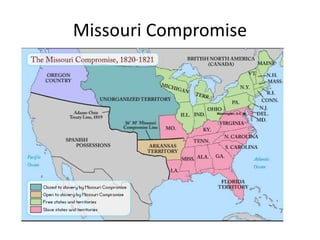
Missouri Compromise
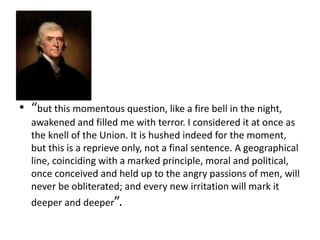
• “but this momentous question, like a fire bell in the night,
awakened and filled me with terror. I considered it at once as
the knell of the Union. It is hushed indeed for the moment,
but this is a reprieve only, not a final sentence. A geographical
line, coinciding with a marked principle, moral and political,
once conceived and held up to the angry passions of men, will
never be obliterated; and every new irritation will mark it
deeper and deeper”.
A Growing Economy
• At the same time of nationalism there was the
political movement to support the growth of
the nation’s economy—Henry Clay’s American
System
• --internal improvements-building roads and
canals
• Protecting budding industries from European
competition-tariffs
• Second Bank of the US
• Internal improvements—Presidents Madison
and Monroe objected that the Constitution
did not explicitly provide for the spending of
federal money on roads and canals—vetoed
many bills thus leaving the states with the
burden of internal improvements.
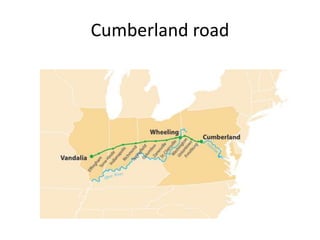
• National Road—a federally funded road from
Cumberland, Maryland to Wheeling, Virginia.
Cumberland road
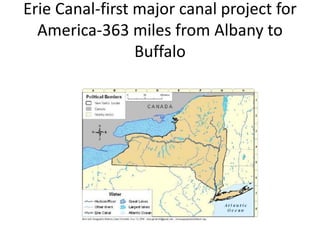
Erie Canal-first major canal project for
America-363 miles from Albany to
Buffalo
Francis Cabot Lowell
• The Lowell factory was a cotton textile mill
that produced finished clothing(spinning and
weaving). The Factory hired young, unmarried
woman-15-30 years old.
• http://youtu.be/3YDNfW20zr4?t=4s
Expanding Westward
• Becoming attractive to settlers
• After War of 1812, a series of treaties with
Native Americans afforded more land for
settlers without threat.
• Fertile land
Era of Good Feeling
• End of the First Party System
• Exemplifies both of Monroe’s presidencies,
1816-1824-few divisive issues, and
Republicans embraced some Federalists
issues—but was it?
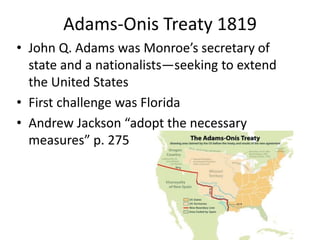
Adams-Onis Treaty 1819
• John Q. Adams was Monroe’s secretary of
state and a nationalists—seeking to extend
the United States
• First challenge was Florida
• Andrew Jackson “adopt the necessary
measures” p. 275
Adams-Onis Treaty
• The US gave up its claims to Texas
• Spain gave up all of Florida
John Marshall Court
• A Federalist, John Marshall served as Chief
Justice of the Supreme court from 1801 –
1835.
• How will he read the Constitution?
• Who will he give power to: States or Federal
government?
Important Court Cases-strength cases
• Marbury V. Madison—establishes Judicial Review
• McCulloch v. Maryland- National BankSupremacy Clause-can a state tax the Federal
government?
• Gibbons v. Ogden-who had the power to regulate
interstate commerce?
• Dartmouth College v. Woodward-established the
right to overturn a decision of a state’s court
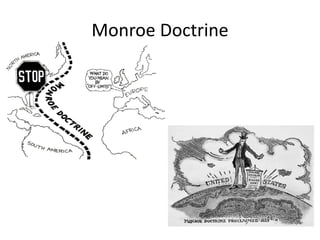
Monroe Doctrine
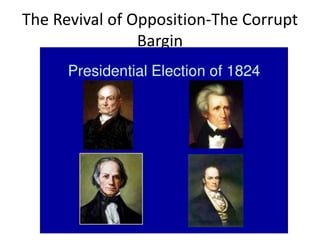
The Revival of Opposition-The Corrupt
Bargin
John Q. Adams
• Adams Presidency was marred by political
bitterness arising from the “corrupt bargain”
• A Nationalist, he wanted to promote programs
reminiscent of Clay’s American System but
opponents in Congress blocked every bill.
• In favor of the Tariff—earning the animosity of
southerners, who called it “tariff of
abominations”
Jackson Triumphant 1828
• New 2 Party system began to emerge
• John Q. Adams-National Republicansupporters of the economic nationalism of
the preceding years
• Andrew Jackson-Democrat-called for an
assault on privilege and a widening of
opportunity.
• America had entered a new era of democracy,
the “era of the common man”

Ap ch. 8

  • 1.
    Chapter 8 Varieties ofAmerican Nationalism Era of Good Feelings? During this time (1813-1824) both Nationalism and Sectionalism existed at the same time and in the same place.
  • 2.
  • 3.
    • “but thismomentous question, like a fire bell in the night, awakened and filled me with terror. I considered it at once as the knell of the Union. It is hushed indeed for the moment, but this is a reprieve only, not a final sentence. A geographical line, coinciding with a marked principle, moral and political, once conceived and held up to the angry passions of men, will never be obliterated; and every new irritation will mark it deeper and deeper”.
  • 4.
    A Growing Economy •At the same time of nationalism there was the political movement to support the growth of the nation’s economy—Henry Clay’s American System • --internal improvements-building roads and canals • Protecting budding industries from European competition-tariffs • Second Bank of the US
  • 5.
    • Internal improvements—PresidentsMadison and Monroe objected that the Constitution did not explicitly provide for the spending of federal money on roads and canals—vetoed many bills thus leaving the states with the burden of internal improvements. • National Road—a federally funded road from Cumberland, Maryland to Wheeling, Virginia.
  • 6.
  • 7.
    Erie Canal-first majorcanal project for America-363 miles from Albany to Buffalo
  • 8.
    Francis Cabot Lowell •The Lowell factory was a cotton textile mill that produced finished clothing(spinning and weaving). The Factory hired young, unmarried woman-15-30 years old. • http://youtu.be/3YDNfW20zr4?t=4s
  • 9.
    Expanding Westward • Becomingattractive to settlers • After War of 1812, a series of treaties with Native Americans afforded more land for settlers without threat. • Fertile land
  • 10.
    Era of GoodFeeling • End of the First Party System • Exemplifies both of Monroe’s presidencies, 1816-1824-few divisive issues, and Republicans embraced some Federalists issues—but was it?
  • 11.
    Adams-Onis Treaty 1819 •John Q. Adams was Monroe’s secretary of state and a nationalists—seeking to extend the United States • First challenge was Florida • Andrew Jackson “adopt the necessary measures” p. 275
  • 12.
    Adams-Onis Treaty • TheUS gave up its claims to Texas • Spain gave up all of Florida
  • 13.
    John Marshall Court •A Federalist, John Marshall served as Chief Justice of the Supreme court from 1801 – 1835. • How will he read the Constitution? • Who will he give power to: States or Federal government?
  • 14.
    Important Court Cases-strengthcases • Marbury V. Madison—establishes Judicial Review • McCulloch v. Maryland- National BankSupremacy Clause-can a state tax the Federal government? • Gibbons v. Ogden-who had the power to regulate interstate commerce? • Dartmouth College v. Woodward-established the right to overturn a decision of a state’s court
  • 15.
  • 16.
    The Revival ofOpposition-The Corrupt Bargin
  • 18.
    John Q. Adams •Adams Presidency was marred by political bitterness arising from the “corrupt bargain” • A Nationalist, he wanted to promote programs reminiscent of Clay’s American System but opponents in Congress blocked every bill. • In favor of the Tariff—earning the animosity of southerners, who called it “tariff of abominations”
  • 19.
    Jackson Triumphant 1828 •New 2 Party system began to emerge • John Q. Adams-National Republicansupporters of the economic nationalism of the preceding years • Andrew Jackson-Democrat-called for an assault on privilege and a widening of opportunity. • America had entered a new era of democracy, the “era of the common man”