AP Chapter 11
Cotton, Slavery and the Old
           South
The chapter is about the Old South—
 different from the North. The South
 began the 19th century agricultural
   and it remained overwhelmingly
 agrarian by the 1860’s—The South
       grew but did not develop.
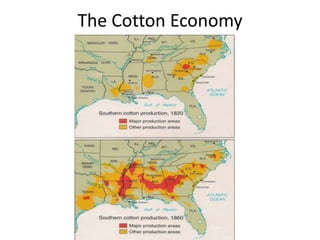
The Cotton Economy
South had a shift
• Why?
• Decline of tobacco
• Rice
• Sugar
• Short staple cotton—grew in many different
  soils and climates
• Cotton Gin
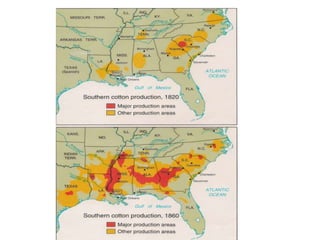
Cotton is King
• 1820-500,000 bales of cotton
• 1850 3 million
• 1860 5 million—bringing in over $200 million
  per year in exports
• A shift in the slave population
Southern Trade and Industry
• Industry and commerce was there, it just grew
  slowly—most were associated with agriculture
  and served the needs of the plantation
  economy.
• Iron Works—Tredegar Iron Works in Richmond
• Flour mills
• Lumber mills
Problems and Reasons for slow growth
• Transportation—Mississippi River, few canals
  and a smattering of rail lines
• Great profitability in cotton
• Only so much money to invest
• Southern climate less suitable for industrial
  development
• Some said the Southerners just don’t work as
  hard
A Special Way of Life
• Southerners thought of themselves as
  Cavaliers—with a life based on chivalry, leisure
  and elegance. Concerned more with “a refined
  and gracious way of life”.
• Chivalry -courteous and considerate behavior
• Why might that be?
Colonial Economic Relationship
• “From the rattle with which the nurse tickles
  the ear of the child born in the South to the
  shroud that covers the cold form of the dead,
  everything comes to us from the North.”
•                 Ak. Journalist Albert Pike
• The De Bow’s Review—editor wrote about the
  southern economic dependency and warned
  of the dangers
White Society in the South
• The Planter Class—Planter Asistocracy-20 slaves
  or more-only ÂĽ of the white Southerners owned
  slaves-of the 2 million white families in the South,
  only 1 in 40, or 50,000were families of planters
• Very small minority—but dominated the political
  landscape and social events—left a lasting image
  of the South
• Like Medieval towns—a business community-
  built elegant homes, entertained lavishly—
  behaved very much like European nobility
The Southern Lady
• Many similarities between middle class
  northern woman and the affluent white
  southern woman—home centered, serving
  needs of husband and children—no rights
• “The right to protection involved the
  obligation to obey” --George Fitzhugh
Middle Class Women
• Lived on farms, isolated from people outside
  from families, less likely to have access to
  education—1/4 of all white women over 20
  were illiterate.
• The slave labor system had a mixed impact on
  white women—spared them of labor but
  threatened many relationships with their
  husbands—infidelity
The Plain Folk
• These were the typical white southerners—no
  slaves, small farms, no education—over half of
  the country’s total illiterate population came
  from the South.
• Though they were deferential to the Planter
  class—tied to the system—access to cotton
  gins, markets, financial assistance, kinfolk,
The Hill People
• Some people did resist the social system of
  the South—the Hill people of the Appalachian
  ranges east of the Mississippi—slavery was
  unattractive—it threatened their sense of
  their own independence—
  nationalistic, personal freedom,
Lowest Class of Whites(Trash)
• White trash or Crackers owned no land, worked
  at odd jobs, hunted for food, suffered from
  diseases—so poor and so little strength to
  protest—ate clay—worse off than the slaves who
  looked down on them.
• And yet they did not look down on the social
  order—the hope and dream of one day they
  could own slaves, the pecking order—at least
  they were white
• The one thing that unified all classes together in
  the South was the perception of race
The Peculiar Institution
• Only existed in US, Brazil, Cuba and Puerto
  Rico
• Isolated the South from other northern
  states—as isolation increased so did the
  committed to defend it
• Within the South itself, the institution of
  slavery had paradoxical results—
• Separated yet joined together—dependent on
  each other for survival
• The institution was established and regulated
  by law with Masters having all the power and
  slaves powerless
• A huge body of laws that governed the slaves:
  Slave Codes
No Typical Slave Style
• Enforcement was spotty until Nat Turner
• Even with slave codes in place, some slaves
  did acquire property, learn to read,
  marry…some lived in strict rigid condition,
  other given more latitude
• Life under Slavery Page 383
• Slavery in the Cities—slaves worked on
  contracts, hired out by masters, not
  supervised very much
• Freed African Americans—about 250,000 in
  the South by 1860
• Slave Trade—deplorable, banned in 1808 but
  smuggling occurred
• Slave Resistance
Culture of Slavery
• Resistance was only part of the slave response
  to slavery—another was an elaborate process
  of adaptation—they developed their own
  unique culture with which they could sustain a
  sense of racial pride and unity.
Language and Music
Pidgen-mixture of African words and English--
Words like bogus, phony, gumbo, funky
Cuisine—deep fat frying, gumbos,
Music-yodeling, spirituals, the use of falsettos,
  the “call and response” pattern in sermons—
  music also served as a means of
  communication, jazz, the use of drums and
  the banjo
Religion
• Although a separate slave religion was not
  suppose to exist, all were mainly Christians
  with a mixture of African or West Indies
  influences—ex. Voodoo
• Af. Am. Religion was more
  emotional, emphasized the dream of freedom
  and deliverance
Slave Family
• Despite certain legal restrictions a “nuclear
  family” consistently emerged among slaves. They
  operated differently—black women began child
  bearing at a younger age, family ties were no less
  strong than those of whites. Extended families
  were distinctive characteristics of the black family
  and were “adopted” kinship
• http://youtu.be/pDukq8npXBk
•

Ap chapter 11

  • 1.
    AP Chapter 11 Cotton,Slavery and the Old South The chapter is about the Old South— different from the North. The South began the 19th century agricultural and it remained overwhelmingly agrarian by the 1860’s—The South grew but did not develop.
  • 2.
  • 3.
    South had ashift • Why? • Decline of tobacco • Rice • Sugar • Short staple cotton—grew in many different soils and climates • Cotton Gin
  • 4.
    Cotton is King •1820-500,000 bales of cotton • 1850 3 million • 1860 5 million—bringing in over $200 million per year in exports • A shift in the slave population
  • 6.
    Southern Trade andIndustry • Industry and commerce was there, it just grew slowly—most were associated with agriculture and served the needs of the plantation economy. • Iron Works—Tredegar Iron Works in Richmond • Flour mills • Lumber mills
  • 7.
    Problems and Reasonsfor slow growth • Transportation—Mississippi River, few canals and a smattering of rail lines • Great profitability in cotton • Only so much money to invest • Southern climate less suitable for industrial development • Some said the Southerners just don’t work as hard
  • 8.
    A Special Wayof Life • Southerners thought of themselves as Cavaliers—with a life based on chivalry, leisure and elegance. Concerned more with “a refined and gracious way of life”. • Chivalry -courteous and considerate behavior • Why might that be?
  • 9.
    Colonial Economic Relationship •“From the rattle with which the nurse tickles the ear of the child born in the South to the shroud that covers the cold form of the dead, everything comes to us from the North.” • Ak. Journalist Albert Pike • The De Bow’s Review—editor wrote about the southern economic dependency and warned of the dangers
  • 10.
    White Society inthe South • The Planter Class—Planter Asistocracy-20 slaves or more-only ¼ of the white Southerners owned slaves-of the 2 million white families in the South, only 1 in 40, or 50,000were families of planters • Very small minority—but dominated the political landscape and social events—left a lasting image of the South • Like Medieval towns—a business community- built elegant homes, entertained lavishly— behaved very much like European nobility
  • 11.
    The Southern Lady •Many similarities between middle class northern woman and the affluent white southern woman—home centered, serving needs of husband and children—no rights • “The right to protection involved the obligation to obey” --George Fitzhugh
  • 12.
    Middle Class Women •Lived on farms, isolated from people outside from families, less likely to have access to education—1/4 of all white women over 20 were illiterate. • The slave labor system had a mixed impact on white women—spared them of labor but threatened many relationships with their husbands—infidelity
  • 13.
    The Plain Folk •These were the typical white southerners—no slaves, small farms, no education—over half of the country’s total illiterate population came from the South. • Though they were deferential to the Planter class—tied to the system—access to cotton gins, markets, financial assistance, kinfolk,
  • 14.
    The Hill People •Some people did resist the social system of the South—the Hill people of the Appalachian ranges east of the Mississippi—slavery was unattractive—it threatened their sense of their own independence— nationalistic, personal freedom,
  • 15.
    Lowest Class ofWhites(Trash) • White trash or Crackers owned no land, worked at odd jobs, hunted for food, suffered from diseases—so poor and so little strength to protest—ate clay—worse off than the slaves who looked down on them. • And yet they did not look down on the social order—the hope and dream of one day they could own slaves, the pecking order—at least they were white • The one thing that unified all classes together in the South was the perception of race
  • 16.
    The Peculiar Institution •Only existed in US, Brazil, Cuba and Puerto Rico • Isolated the South from other northern states—as isolation increased so did the committed to defend it
  • 17.
    • Within theSouth itself, the institution of slavery had paradoxical results— • Separated yet joined together—dependent on each other for survival • The institution was established and regulated by law with Masters having all the power and slaves powerless • A huge body of laws that governed the slaves: Slave Codes
  • 18.
    No Typical SlaveStyle • Enforcement was spotty until Nat Turner • Even with slave codes in place, some slaves did acquire property, learn to read, marry…some lived in strict rigid condition, other given more latitude
  • 19.
    • Life underSlavery Page 383 • Slavery in the Cities—slaves worked on contracts, hired out by masters, not supervised very much • Freed African Americans—about 250,000 in the South by 1860 • Slave Trade—deplorable, banned in 1808 but smuggling occurred • Slave Resistance
  • 20.
    Culture of Slavery •Resistance was only part of the slave response to slavery—another was an elaborate process of adaptation—they developed their own unique culture with which they could sustain a sense of racial pride and unity.
  • 21.
    Language and Music Pidgen-mixtureof African words and English-- Words like bogus, phony, gumbo, funky Cuisine—deep fat frying, gumbos, Music-yodeling, spirituals, the use of falsettos, the “call and response” pattern in sermons— music also served as a means of communication, jazz, the use of drums and the banjo
  • 22.
    Religion • Although aseparate slave religion was not suppose to exist, all were mainly Christians with a mixture of African or West Indies influences—ex. Voodoo • Af. Am. Religion was more emotional, emphasized the dream of freedom and deliverance
  • 23.
    Slave Family • Despitecertain legal restrictions a “nuclear family” consistently emerged among slaves. They operated differently—black women began child bearing at a younger age, family ties were no less strong than those of whites. Extended families were distinctive characteristics of the black family and were “adopted” kinship • http://youtu.be/pDukq8npXBk •