Chapter 9
  Jacksonian America
Jackson the first “Common Man”
     President—Yes or No?
     Was he an egalitarian?
      Equal rights for all?
The Expanding Electorate
         Democracy Expands
• What does democracy expanding look like?
New Voters
• Many lived in the frontier states—life there
  had encouraged a democratic spirit—many
  prospered through hard work—more equality
  there and voting requirements dropped—any
  white man over the age of 21 could vote.
New Political Parties
• Growing number of voters helped spark the
  growth of new political parties—by 1832 two
  new parties had formed
• --The Whigs—supporters of J. Q. Adams—a
  name they took from a political party in
  England that opposed King George III –they
  called Jackson “King Andrew I”.
  Wealthier, more aristocratic
  families, commercially ambitious –expanding
  federal government power-Southern
  planters, ambitious farmers and rising
  commercial class of the west
• --The Democrats—supporters came from
  frontier states in the West, and craft workers
  and factory workers in the East. Opposed
  legislation establishing the bank, corporations
  and other modern institutions—support from
  smaller merchants, and workingmen of the
  Northeast, some southern planters suspicious
  of industrial growth, and westerners who
  favored agrarian economy
The Dorr Rebellion
• With change comes resistance—mainly peaceful
  but there are exceptions: Dorr’s rebellion.
• In Rhode Island a conservative group held off
  change until Thomas Dorr organized a political
  party known as the “Peoples Party”, held a
  convention, drafted a new constitution and
  submitted it to a popular vote which passed.
• The existing legislature refused to accept it.
• In 1842 Rhode Island had 2 governments and the
  old started to imprison members of the Peoples
  Party.
• Even though Dorr’s rebellion had failed, it did
  spur the legislature on to the broaden the
  number of people who were eligible to vote.
• It illustrated just how far people would go to
  extend voting rights
Caucuses and nominating conventions
• The democratic spirit of the time changed the
  way of choosing candidates for presidents.
• Caucus—a private meeting
• Nominating conventions—delegates from
  each state went to their party’s conventions
  and selected the party’s candidate for
  President
Jackson’s theory of Democracy
• “equal protection and equal benefits” to all its
  white male citizens and favored no region or
  class over another
• An assault against who?
The Spoils System
• “To the Victor belong the Spoils”
• Established the right of elected officials to
  appoint their own followers to public office—
  an established feature of American politics
  today
• Jackson seldom met with his official cabinet—
  instead relied on advice from his Kitchen
  Cabinet—democratic leader and newspaper
  editors—a motley crew
3 Major events
• The Nullification Crisis
• The Removal of the Indians
• The National Bank
The Nullification Crisis
• John C. Calhoun’s theory of Nullification
• Since the federal government was a creation
  of the states, the states themselves, not
  congress or the courts, were the final arbiters
  of the constitutionality of federal laws.
• (Kentucky-Virginia Resolution)
• This stemmed from the Tariff of 1828—highest
  in history,--Tariff of Abominations
• Calhoun raised a serious question: Could the
  states limit the power of the federal
  government?
• States Rights—the right of the states to limit
  the power of the Federal government.
Webster-Hayne Debate

• The South and the West were both “victims of
  the tyranny of the Northwest” –Robert Hayne

• “Liberty and Union, now and forever, one and
  inseparable”—Daniel Webster
• Many southerners hoped that Jackson would
  support states right.
• “Our Federal Union—it must be preserved”-
  Jackson
• “The Union –next to our Liberty, most dear” –
  Calhoun
• Calhoun resigns
• Congress passed a new tariff in 1832—slightly
  lowered than the Tariff of Abomination but
  South Carolina was not satisfied and passed
  the Nullification Act—declared the tariffs of
  1828 and 1632 illegal.
• South Carolina prepared to defend itself and
  threatened to secede
The Force Bill
• Jackson not happy
• Supported a compromise tariff proposed by
  Henry Clay
• Passed the Force Bill—a bill that allowed the
  President to use the army to enforce the law
• Because of Jackson’s strong leadership, the
  Nullification Crisis passed, but the differences
  between the North and South would only
  increase
Removal of the Indians
• A changing of attitude toward the Indians—
  Jefferson’s attitudes?
• Noble savages with an inherent dignity to
  savages who not only were uncivilized but
  were uncivilizable.
• Whites should not be expected to live in close
  proximity to them.
• Endless conflict
• Whites insatiable desire for territory
• By the 1820’s only about 125,000 Indians still lived east
  of the Mississippi—five nations lived on the fertile land
  of the Southeast—basically the white man wanted the
  land for cotton.
• The United States Supreme Court ruled that the
  Cherokee Nation was a dependent nation with the
  United States—Cherokee Nation v. Georgia
• Worcester v. Georgia--Marshall ruled in favor of the
  Indians
• “John Marshall has made his decision, now let him
  enforce it”
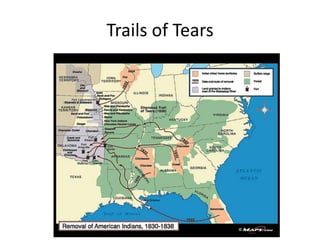
Trails of Tears
• Alternatives to the removal of the Indians
• No realistic ones
• In theory some alternatives—examples of the
  2 groups living peacefully together—Pueblos
  of the Southwest, the Pacific Northwest,
  during the Lewis and Clark expeditions,
  sometimes these close contacts between the
  two were beneficial to both
Bank of the United States
• The bank was a mighty institution by the
  1830’s.
• It provided credit
• It issued bank notes
• It served as a dependable medium of
  exchange
• It restrained the less well managed states
  banks
Jackson Battles the Bank
• Objections:
• The Bank of the United States controlled loans
  made by State banks. When the BOUS directors
  felt that state banks were making too many risky
  loans, they cut back on the money these banks
  could loan. The cutbacks hurt farmers, merchants
  and others who wanted to borrow money.
  Westerners especially suffered because they
  wanted loans to help finance new farms and
  businesses.
• Jackson also objected to the way the Bank was
  run. And he hated Nicolas Biddle, the
  president of the bank. He stood for everything
  Jackson and the Democrats mistrusted—
  educated, rich and from a prominent family.
• Bank was made an issue in the 1832
  election—Bank charter was issued—Jackson
  vetoed the bill and won reelection easily.
Pet Banks
• Jackson ordered his sec. of treasury to
  withdraw all the federal money out of the
  bank and deposit into states banks.

• The loss of federal money crippled the Bank of
  the US and it also helped to cause an
  economic crisis in 1837
Panic of 1837
• Several factors caused the Panic
• --besides the tariff, land sales were the main
  source of government income—millions of
  acres of land in the west—farmers bought
  some land but speculators bought more.
• --speculators borrowed from state banks—
  state banks printed money not backed by gold
  or silver to meet demand. Paper money
  became less valuable
• President Jackson became alarmed at the wild
  land speculation so he ordered the Specie
  Circular– meaning anyone buying public land
  had to pay with gold or silver.
• Everyone rushed to banks to exchange their
  paper money for gold and silver and ….
• The price of cotton fell …
• As a result more banks failed, business
  slowed, and the nation plunged into a deep
  economic depression.
• 90% of the nation’s factories were
  closed, thousands out of work, hungry crowds
  broke into warehouse and stole food.
• Martin Van Buren was the President now—
  Martin Van Ruin
The Election of 1840
• The Whigs had learned a lesson from their
  defeats by Jackson. To win a presidential
  election they needed the vote of the common
  people.
• William Henry Harrison and John Tyler
• “Tippecanoe and Tyler too”
• The Log Cabin Campaign
• John Tyler—disgruntled Democrat—but not
  trusted by Whigs
Jackson’s Legacy
• His Presidency marked a time of loosening
  political restrictions
• Democracy expanded
• Political parties viewed differently—a
  contribution to democracy
• He was a party man—the Democrats, a
  regional man—the West, he restrained the
  role of the Federal government in economic
  affairs, and a nationalist

Ap jackson chapter 9

  • 1.
    Chapter 9 Jacksonian America Jackson the first “Common Man” President—Yes or No? Was he an egalitarian? Equal rights for all?
  • 2.
    The Expanding Electorate Democracy Expands • What does democracy expanding look like?
  • 3.
    New Voters • Manylived in the frontier states—life there had encouraged a democratic spirit—many prospered through hard work—more equality there and voting requirements dropped—any white man over the age of 21 could vote.
  • 4.
    New Political Parties •Growing number of voters helped spark the growth of new political parties—by 1832 two new parties had formed
  • 5.
    • --The Whigs—supportersof J. Q. Adams—a name they took from a political party in England that opposed King George III –they called Jackson “King Andrew I”. Wealthier, more aristocratic families, commercially ambitious –expanding federal government power-Southern planters, ambitious farmers and rising commercial class of the west
  • 6.
    • --The Democrats—supporterscame from frontier states in the West, and craft workers and factory workers in the East. Opposed legislation establishing the bank, corporations and other modern institutions—support from smaller merchants, and workingmen of the Northeast, some southern planters suspicious of industrial growth, and westerners who favored agrarian economy
  • 7.
    The Dorr Rebellion •With change comes resistance—mainly peaceful but there are exceptions: Dorr’s rebellion. • In Rhode Island a conservative group held off change until Thomas Dorr organized a political party known as the “Peoples Party”, held a convention, drafted a new constitution and submitted it to a popular vote which passed. • The existing legislature refused to accept it. • In 1842 Rhode Island had 2 governments and the old started to imprison members of the Peoples Party.
  • 8.
    • Even thoughDorr’s rebellion had failed, it did spur the legislature on to the broaden the number of people who were eligible to vote. • It illustrated just how far people would go to extend voting rights
  • 9.
    Caucuses and nominatingconventions • The democratic spirit of the time changed the way of choosing candidates for presidents. • Caucus—a private meeting • Nominating conventions—delegates from each state went to their party’s conventions and selected the party’s candidate for President
  • 10.
    Jackson’s theory ofDemocracy • “equal protection and equal benefits” to all its white male citizens and favored no region or class over another • An assault against who?
  • 11.
    The Spoils System •“To the Victor belong the Spoils” • Established the right of elected officials to appoint their own followers to public office— an established feature of American politics today • Jackson seldom met with his official cabinet— instead relied on advice from his Kitchen Cabinet—democratic leader and newspaper editors—a motley crew
  • 12.
    3 Major events •The Nullification Crisis • The Removal of the Indians • The National Bank
  • 13.
    The Nullification Crisis •John C. Calhoun’s theory of Nullification • Since the federal government was a creation of the states, the states themselves, not congress or the courts, were the final arbiters of the constitutionality of federal laws. • (Kentucky-Virginia Resolution)
  • 14.
    • This stemmedfrom the Tariff of 1828—highest in history,--Tariff of Abominations • Calhoun raised a serious question: Could the states limit the power of the federal government? • States Rights—the right of the states to limit the power of the Federal government.
  • 15.
    Webster-Hayne Debate • TheSouth and the West were both “victims of the tyranny of the Northwest” –Robert Hayne • “Liberty and Union, now and forever, one and inseparable”—Daniel Webster
  • 16.
    • Many southernershoped that Jackson would support states right. • “Our Federal Union—it must be preserved”- Jackson • “The Union –next to our Liberty, most dear” – Calhoun • Calhoun resigns
  • 17.
    • Congress passeda new tariff in 1832—slightly lowered than the Tariff of Abomination but South Carolina was not satisfied and passed the Nullification Act—declared the tariffs of 1828 and 1632 illegal. • South Carolina prepared to defend itself and threatened to secede
  • 18.
    The Force Bill •Jackson not happy • Supported a compromise tariff proposed by Henry Clay • Passed the Force Bill—a bill that allowed the President to use the army to enforce the law • Because of Jackson’s strong leadership, the Nullification Crisis passed, but the differences between the North and South would only increase
  • 19.
    Removal of theIndians • A changing of attitude toward the Indians— Jefferson’s attitudes? • Noble savages with an inherent dignity to savages who not only were uncivilized but were uncivilizable. • Whites should not be expected to live in close proximity to them. • Endless conflict • Whites insatiable desire for territory
  • 20.
    • By the1820’s only about 125,000 Indians still lived east of the Mississippi—five nations lived on the fertile land of the Southeast—basically the white man wanted the land for cotton. • The United States Supreme Court ruled that the Cherokee Nation was a dependent nation with the United States—Cherokee Nation v. Georgia • Worcester v. Georgia--Marshall ruled in favor of the Indians • “John Marshall has made his decision, now let him enforce it”
  • 21.
  • 22.
    • Alternatives tothe removal of the Indians • No realistic ones • In theory some alternatives—examples of the 2 groups living peacefully together—Pueblos of the Southwest, the Pacific Northwest, during the Lewis and Clark expeditions, sometimes these close contacts between the two were beneficial to both
  • 23.
    Bank of theUnited States • The bank was a mighty institution by the 1830’s. • It provided credit • It issued bank notes • It served as a dependable medium of exchange • It restrained the less well managed states banks
  • 24.
    Jackson Battles theBank • Objections: • The Bank of the United States controlled loans made by State banks. When the BOUS directors felt that state banks were making too many risky loans, they cut back on the money these banks could loan. The cutbacks hurt farmers, merchants and others who wanted to borrow money. Westerners especially suffered because they wanted loans to help finance new farms and businesses.
  • 25.
    • Jackson alsoobjected to the way the Bank was run. And he hated Nicolas Biddle, the president of the bank. He stood for everything Jackson and the Democrats mistrusted— educated, rich and from a prominent family. • Bank was made an issue in the 1832 election—Bank charter was issued—Jackson vetoed the bill and won reelection easily.
  • 26.
    Pet Banks • Jacksonordered his sec. of treasury to withdraw all the federal money out of the bank and deposit into states banks. • The loss of federal money crippled the Bank of the US and it also helped to cause an economic crisis in 1837
  • 27.
    Panic of 1837 •Several factors caused the Panic • --besides the tariff, land sales were the main source of government income—millions of acres of land in the west—farmers bought some land but speculators bought more. • --speculators borrowed from state banks— state banks printed money not backed by gold or silver to meet demand. Paper money became less valuable
  • 28.
    • President Jacksonbecame alarmed at the wild land speculation so he ordered the Specie Circular– meaning anyone buying public land had to pay with gold or silver. • Everyone rushed to banks to exchange their paper money for gold and silver and …. • The price of cotton fell …
  • 29.
    • As aresult more banks failed, business slowed, and the nation plunged into a deep economic depression. • 90% of the nation’s factories were closed, thousands out of work, hungry crowds broke into warehouse and stole food. • Martin Van Buren was the President now— Martin Van Ruin
  • 30.
    The Election of1840 • The Whigs had learned a lesson from their defeats by Jackson. To win a presidential election they needed the vote of the common people. • William Henry Harrison and John Tyler • “Tippecanoe and Tyler too” • The Log Cabin Campaign • John Tyler—disgruntled Democrat—but not trusted by Whigs
  • 31.
    Jackson’s Legacy • HisPresidency marked a time of loosening political restrictions • Democracy expanded • Political parties viewed differently—a contribution to democracy • He was a party man—the Democrats, a regional man—the West, he restrained the role of the Federal government in economic affairs, and a nationalist