American Foreign Policy
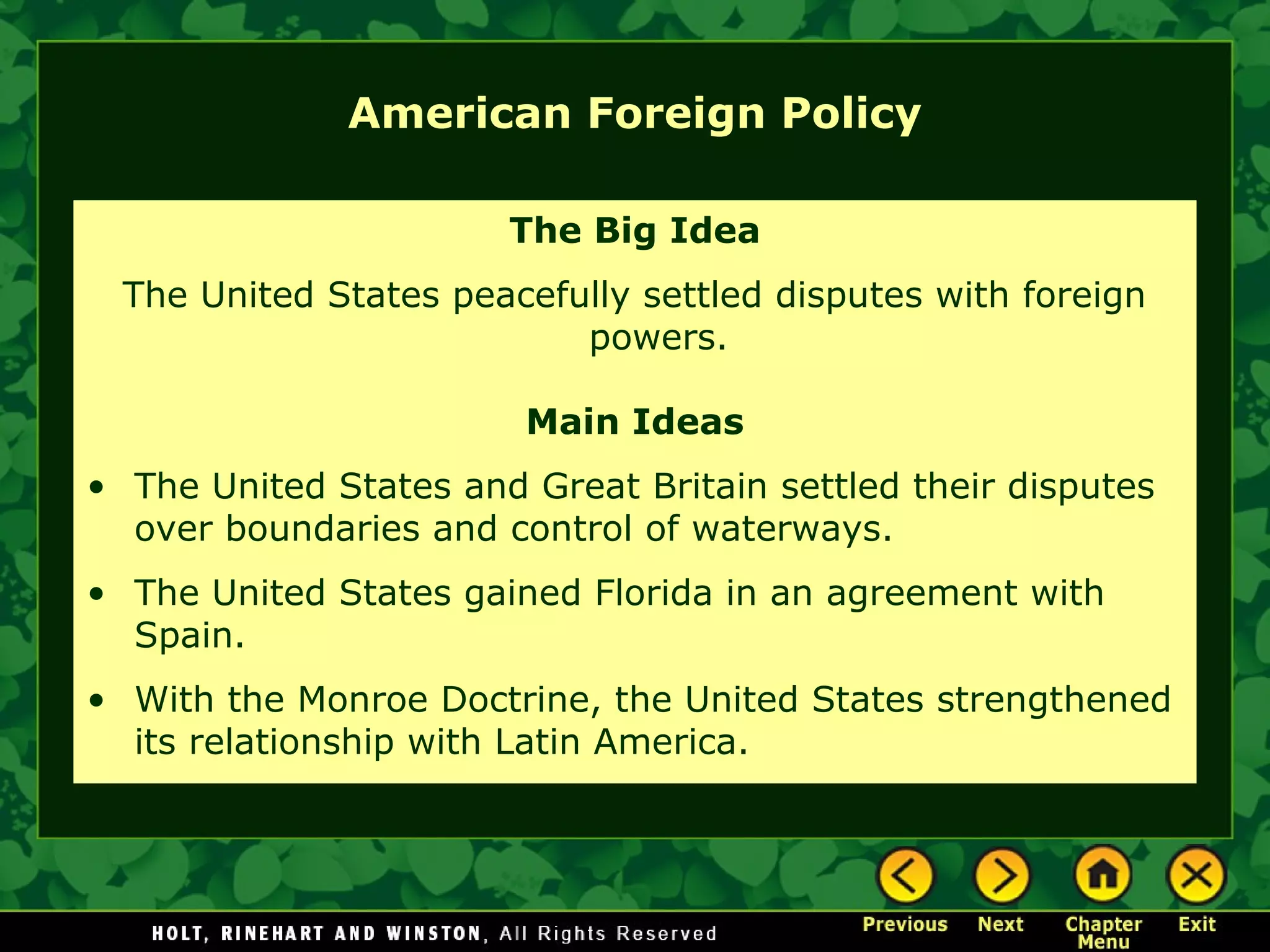
The Big Idea
The United States peacefully settled disputes with foreign
powers.
Main Ideas
• The United States and Great Britain settled their disputes
over boundaries and control of waterways.
• The United States gained Florida in an agreement with
Spain.
• With the Monroe Doctrine, the United States strengthened
its relationship with Latin America.
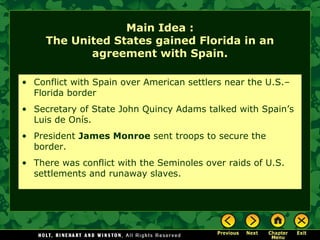
Main Idea :
The United States gained Florida in an
agreement with Spain.
• Conflict with Spain over American settlers near the U.S.–
Florida border
• Secretary of State John Quincy Adams talked with Spain’s
Luis de Onís.
• President James Monroe sent troops to secure the
border.
• There was conflict with the Seminoles over raids of U.S.
settlements and runaway slaves.
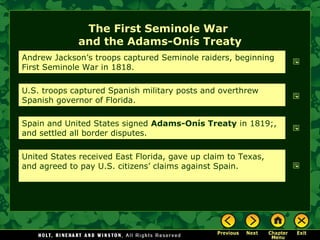
The First Seminole War
and the Adams-Onís Treaty
Andrew Jackson’s troops captured Seminole raiders, beginning
First Seminole War in 1818.
U.S. troops captured Spanish military posts and overthrew
Spanish governor of Florida.
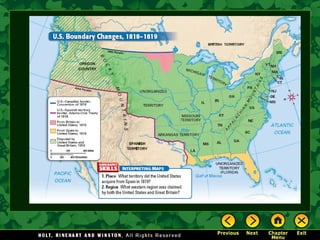
Spain and United States signed Adams-Onís Treaty in 1819;,
and settled all border disputes.
United States received East Florida, gave up claim to Texas,
and agreed to pay U.S. citizens’ claims against Spain.
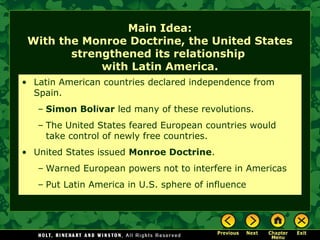
Main Idea:
With the Monroe Doctrine, the United States
strengthened its relationship
with Latin America.
• Latin American countries declared independence from
Spain.
– Simon Bolívar led many of these revolutions.
– The United States feared European countries would
take control of newly free countries.
• United States issued Monroe Doctrine.
– Warned European powers not to interfere in Americas
– Put Latin America in U.S. sphere of influence
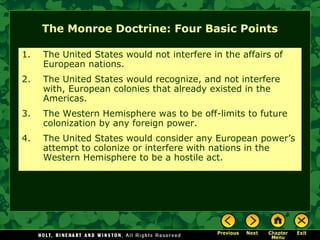
The Monroe Doctrine: Four Basic Points
1.

The United States would not interfere in the affairs of
European nations.

2.

The United States would recognize, and not interfere
with, European colonies that already existed in the
Americas.

3.

The Western Hemisphere was to be off-limits to future
colonization by any foreign power.

4.

The United States would consider any European power’s
attempt to colonize or interfere with nations in the
Western Hemisphere to be a hostile act.
Nationalism and Sectionalism
The Big Idea
A rising sense of national unity allowed some regional
differences to be set aside and national
interests to be served.
Main Ideas
• Growing nationalism led to improvements in the nation’s
transportation systems.
• The Missouri Compromise settled an important regional
conflict.
• The outcome of the election of 1824 led to controversy.
Main Idea :
Growing nationalism led to improvements in
the nation’s transportation systems.
• Nationalism: feelings of pride and loyalty to a nation
• Henry Clay proposed the American System: a series of
measures to make America economically self-sufficient.
– National bank to provide a single currency, and
improved roads and canals funded by a protective tariff
– Some in Congress felt such improvements were not
permitted by the Constitution.
– Clay argued that possible gains for the country justified
federal action.
– Congress agreed with Clay.
Henry Clay
• Served as a U.S. representative from Kentucky, a senator,
the Speaker of the House, and secretary of state
• Supported nationalism
• Developed the American System
• Dedicated to preserving the Union
• Initiated the Missouri Compromise
Roads and Canals
Roads
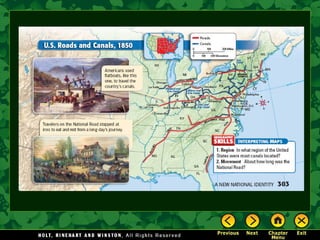
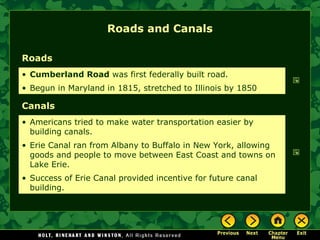
• Cumberland Road was first federally built road.
• Begun in Maryland in 1815, stretched to Illinois by 1850

Canals
• Americans tried to make water transportation easier by
building canals.
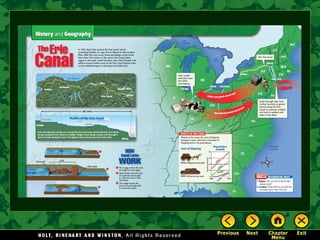
• Erie Canal ran from Albany to Buffalo in New York, allowing
goods and people to move between East Coast and towns on
Lake Erie.
• Success of Erie Canal provided incentive for future canal
building.
The Era of Good Feelings
Era of Good Feelings: time of peace, prosperity, and progress
from 1815–1825
National unity strengthened by two Supreme Court decisions
that reinforced federal power.
McCulloch v. Maryland (1819) asserted implied powers of
Congress in allowing for creation of national bank.
Gibbons v. Ogden (1824) said states could not interfere with
power of Congress to regulate interstate trade.
Main Idea :
The Missouri Compromise settled an
important regional conflict.
• Sectionalism, or disagreements between different regions, threatened
the Union.
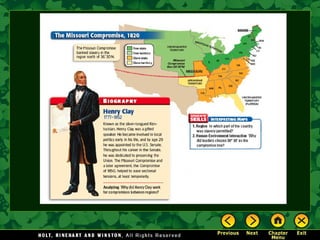
• Missouri applied to enter Union as slave state, which would change
balance between free and slave states.
• Initial compromise rejected
• Henry Clay proposed Missouri Compromise in 1820
– Missouri would enter as slave state.
– Maine would join Union as a free state, preserving balance between
free and slave states.
– Slavery would be prohibited in any new states or territories north of
latitude 36°30’.
• Disagreements between the North and South over slavery continued.
Main Idea:
The outcome of the election of 1824
led to controversy.
• Andrew Jackson won the popular vote but did not have
enough electoral votes.
• The House of Representatives was required by the
Constitution to choose the winner; they chose John
Quincy Adams.
• Jackson’s supporters claimed Adams had made a “corrupt
bargain” with Henry Clay.
• Accusations grew after Adams made Clay secretary of
state.
• Controversy weakened Adams’s support.
Nationalism and Sectionalism

Nationalism and Sectionalism

  • 1.
    American Foreign Policy TheBig Idea The United States peacefully settled disputes with foreign powers. Main Ideas • The United States and Great Britain settled their disputes over boundaries and control of waterways. • The United States gained Florida in an agreement with Spain. • With the Monroe Doctrine, the United States strengthened its relationship with Latin America.
  • 2.
    Main Idea : TheUnited States gained Florida in an agreement with Spain. • Conflict with Spain over American settlers near the U.S.– Florida border • Secretary of State John Quincy Adams talked with Spain’s Luis de Onís. • President James Monroe sent troops to secure the border. • There was conflict with the Seminoles over raids of U.S. settlements and runaway slaves.
  • 3.
    The First SeminoleWar and the Adams-Onís Treaty Andrew Jackson’s troops captured Seminole raiders, beginning First Seminole War in 1818. U.S. troops captured Spanish military posts and overthrew Spanish governor of Florida. Spain and United States signed Adams-Onís Treaty in 1819;, and settled all border disputes. United States received East Florida, gave up claim to Texas, and agreed to pay U.S. citizens’ claims against Spain.
  • 4.
    Main Idea: With theMonroe Doctrine, the United States strengthened its relationship with Latin America. • Latin American countries declared independence from Spain. – Simon Bolívar led many of these revolutions. – The United States feared European countries would take control of newly free countries. • United States issued Monroe Doctrine. – Warned European powers not to interfere in Americas – Put Latin America in U.S. sphere of influence
  • 5.
    The Monroe Doctrine:Four Basic Points 1. The United States would not interfere in the affairs of European nations. 2. The United States would recognize, and not interfere with, European colonies that already existed in the Americas. 3. The Western Hemisphere was to be off-limits to future colonization by any foreign power. 4. The United States would consider any European power’s attempt to colonize or interfere with nations in the Western Hemisphere to be a hostile act.
  • 6.
    Nationalism and Sectionalism TheBig Idea A rising sense of national unity allowed some regional differences to be set aside and national interests to be served. Main Ideas • Growing nationalism led to improvements in the nation’s transportation systems. • The Missouri Compromise settled an important regional conflict. • The outcome of the election of 1824 led to controversy.
  • 7.
    Main Idea : Growingnationalism led to improvements in the nation’s transportation systems. • Nationalism: feelings of pride and loyalty to a nation • Henry Clay proposed the American System: a series of measures to make America economically self-sufficient. – National bank to provide a single currency, and improved roads and canals funded by a protective tariff – Some in Congress felt such improvements were not permitted by the Constitution. – Clay argued that possible gains for the country justified federal action. – Congress agreed with Clay.
  • 8.
    Henry Clay • Servedas a U.S. representative from Kentucky, a senator, the Speaker of the House, and secretary of state • Supported nationalism • Developed the American System • Dedicated to preserving the Union • Initiated the Missouri Compromise
  • 9.
    Roads and Canals Roads •Cumberland Road was first federally built road. • Begun in Maryland in 1815, stretched to Illinois by 1850 Canals • Americans tried to make water transportation easier by building canals. • Erie Canal ran from Albany to Buffalo in New York, allowing goods and people to move between East Coast and towns on Lake Erie. • Success of Erie Canal provided incentive for future canal building.
  • 10.
    The Era ofGood Feelings Era of Good Feelings: time of peace, prosperity, and progress from 1815–1825 National unity strengthened by two Supreme Court decisions that reinforced federal power. McCulloch v. Maryland (1819) asserted implied powers of Congress in allowing for creation of national bank. Gibbons v. Ogden (1824) said states could not interfere with power of Congress to regulate interstate trade.
  • 11.
    Main Idea : TheMissouri Compromise settled an important regional conflict. • Sectionalism, or disagreements between different regions, threatened the Union. • Missouri applied to enter Union as slave state, which would change balance between free and slave states. • Initial compromise rejected • Henry Clay proposed Missouri Compromise in 1820 – Missouri would enter as slave state. – Maine would join Union as a free state, preserving balance between free and slave states. – Slavery would be prohibited in any new states or territories north of latitude 36°30’. • Disagreements between the North and South over slavery continued.
  • 12.
    Main Idea: The outcomeof the election of 1824 led to controversy. • Andrew Jackson won the popular vote but did not have enough electoral votes. • The House of Representatives was required by the Constitution to choose the winner; they chose John Quincy Adams. • Jackson’s supporters claimed Adams had made a “corrupt bargain” with Henry Clay. • Accusations grew after Adams made Clay secretary of state. • Controversy weakened Adams’s support.