FORMAL AND INFORMAL 
COMMUNICATION 
Prepared By:- 
Anubhav Verma 
MBA (RM) 1st Sem 
Roll no.32
Definition 
“Communication is the process by which information is transmitted 
between individuals and / or organizations so that an understanding 
response results.” 
“Peter Little.” 
“Communication is an exchange of facts, ideas, opinions, or emotions 
by two or more persons.” 
“W.H. Newman and C.F. Summer Jr. ”
Formal Communication 
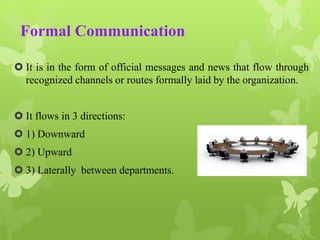
 It is in the form of official messages and news that flow through 
recognized channels or routes formally laid by the organization. 
 It flows in 3 directions: 
 1) Downward 
 2) Upward 
 3) Laterally between departments.
Formal Media of Communication 
 Company’s news bulletins. 
 Special interviews. 
 Conferences. 
 Employees handbook. 
 Company magazines.
Advantages And Disadvantaged Of 
Formal Communication 
Advantages 
 Effective 
 Provides close contact 
between members of the 
organization 
 Control over the sub-ordinates 
and fixing in 
their responsibility. 
 Flow of essential 
information in an orderly 
manner. 
Disadvantages 
 Stiff , Slow and Rigid 
 Channel of 
communication are not 
perfect. 
 Organizational distance
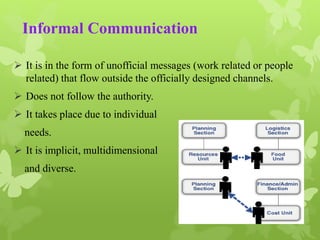
Informal Communication 
 It is in the form of unofficial messages (work related or people 
related) that flow outside the officially designed channels. 
 Does not follow the authority. 
 It takes place due to individual 
needs. 
 It is implicit, multidimensional 
and diverse.
Advantages And Disadvantages Of Informal 
Communication 
Advantages 
 More flexible and much 
faster. 
 Helps in achieving better 
human relations 
 Fulfills the psychological 
needs of the employees. 
Disadvantages 
 Information may be 
distorted. 
 Lacks official status and 
less dependable. 
 Has no definite origin 
and direction. 
 Leakage of confidential 
information.
Informal media of communication 
 Face to face discussion. 
 Telephone. 
 Email. 
 Voice messaging (voice mail). 
 Instant messaging (chatting).
Anubhav mba (rm)

Anubhav mba (rm)

  • 1.
    FORMAL AND INFORMAL COMMUNICATION Prepared By:- Anubhav Verma MBA (RM) 1st Sem Roll no.32
  • 2.
    Definition “Communication isthe process by which information is transmitted between individuals and / or organizations so that an understanding response results.” “Peter Little.” “Communication is an exchange of facts, ideas, opinions, or emotions by two or more persons.” “W.H. Newman and C.F. Summer Jr. ”
  • 3.
    Formal Communication It is in the form of official messages and news that flow through recognized channels or routes formally laid by the organization.  It flows in 3 directions:  1) Downward  2) Upward  3) Laterally between departments.
  • 4.
    Formal Media ofCommunication  Company’s news bulletins.  Special interviews.  Conferences.  Employees handbook.  Company magazines.
  • 5.
    Advantages And DisadvantagedOf Formal Communication Advantages  Effective  Provides close contact between members of the organization  Control over the sub-ordinates and fixing in their responsibility.  Flow of essential information in an orderly manner. Disadvantages  Stiff , Slow and Rigid  Channel of communication are not perfect.  Organizational distance
  • 6.
    Informal Communication It is in the form of unofficial messages (work related or people related) that flow outside the officially designed channels.  Does not follow the authority.  It takes place due to individual needs.  It is implicit, multidimensional and diverse.
  • 7.
    Advantages And DisadvantagesOf Informal Communication Advantages  More flexible and much faster.  Helps in achieving better human relations  Fulfills the psychological needs of the employees. Disadvantages  Information may be distorted.  Lacks official status and less dependable.  Has no definite origin and direction.  Leakage of confidential information.
  • 8.
    Informal media ofcommunication  Face to face discussion.  Telephone.  Email.  Voice messaging (voice mail).  Instant messaging (chatting).