Formal and Informal Communication
&
Improving Communication
Effectiveness
The word communication has been derived from the Latin
word ‘communis’ which means ‘common’ which
consequently implies common understanding.
Communication is defined in different ways. Generally, it is
understood as a process of exchange of ideas, views,
facts, feelings etc. between or among people to create
common understanding.
Formal Communication
• The messages which are circulating on regulated, preset
channels, of an organization are creating the formal
communication.
• The content of the communication is related to the
organization’s activity, to the work and to anything which is
related to those.
• The formal communication can consist in verbal
messages, nonverbal messages, written, under the shape
of letters, telephone messages, radio messages, printed,
internal notes.
• Usually, all formal communications are recorded and kept in
the organization’s evidence.
• Examples of formal communications are given by work
commands, reports and financial evidence, reports over sells /
inventory, statements referring to the company’s policies, post
descriptions, etc.
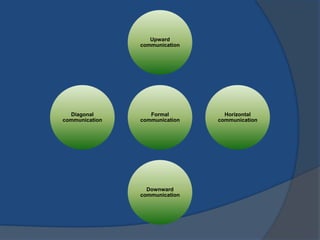
TYPES OF
FORMAL COMMUNICATION
Formal
communication
Upward
communication
Horizontal
communication
Downward
communication
Diagonal
communication
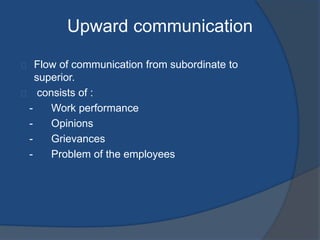
Upward communication
Flow of communication from subordinate to
superior.
consists of :
- Work performance
- Opinions
- Grievances
- Problem of the employees
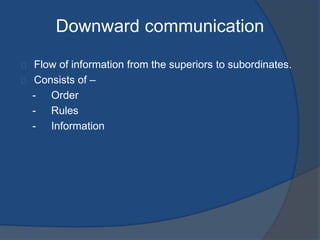
Downward communication
Flow of information from the superiors to subordinates.
Consists of –
- Order
- Rules
- Information
Horizontal communication
Communication between two or more persons
working at the same level of authority.
Discussion between managers of same rank.
Eg.- The marketing manager may discuss from
time to time the quality and packing of the product
with the production manager.
Diagonal communication
Flow of information between persons working at
different departments and holding different levels
of authority.
Prevents delay in flow of information.
Helps in taking fast decision.
Advantages of Formal
Communication
• Maintenance of authority of officers
• Clear and effective communication
• Orderly flow of information
• Easy knowledge and source of information
• Less errors and mistakes
• Discipline
• Permanent record
• Reliability
Disadvantages of Formal
Communication
• Wastage of time
• Delay in decision making
• Lack of initiative
• Lack of cordiality
• Fear
• Behavior
• Authoritarian system
Informal Communication
• Informal communication arises out of all those channels that
fall outside the formal channels and it is also known as
grapevine.
• It is established around the societal affiliation of members of
the organization.
• Informal communication does not follow authority lines as in
the case of formal communication.
• Informal communication takes place due to the individual
needs of the members of an organization and subsists in every
organization.
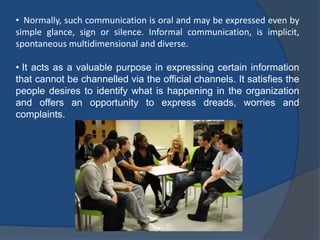
• Normally, such communication is oral and may be expressed even by
simple glance, sign or silence. Informal communication, is implicit,
spontaneous multidimensional and diverse.
• It acts as a valuable purpose in expressing certain information
that cannot be channelled via the official channels. It satisfies the
people desires to identify what is happening in the organization
and offers an opportunity to express dreads, worries and
complaints.
Advantages of Informal
Communication
• Alternative System
• Presenting Grievances
• Improving Relations
• Providing Recommendations
• Provide Emotional Relief
• Solution to Problems
Disadvantages of Informal
Communication
• Distortion
• Lack of Secrecy
• Rumor
• Misunderstanding
• Difficult to Control Employees
Formal Communication
Vs
Informal Communication
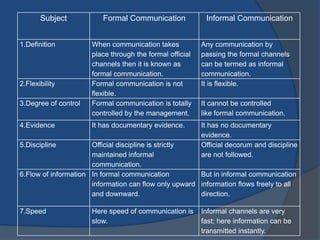
Subject Formal Communication Informal Communication
1.Definition When communication takes
place through the formal official
channels then it is known as
formal communication.
Any communication by
passing the formal channels
can be termed as informal
communication.
2.Flexibility Formal communication is not
flexible.
It is flexible.
3.Degree of control Formal communication is totally
controlled by the management.
It cannot be controlled
like formal communication.
4.Evidence It has documentary evidence. It has no documentary
evidence.
5.Discipline Official discipline is strictly
maintained informal
communication.
Official decorum and discipline
are not followed.
6.Flow of information In formal communication
information can flow only upward
and downward.
But in informal communication
information flows freely to all
direction.
7.Speed Here speed of communication is
slow.
Informal channels are very
fast; here information can be
transmitted instantly.
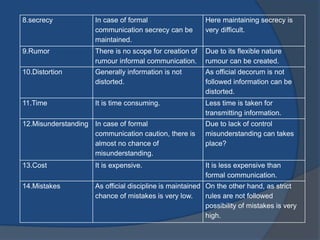
8.secrecy In case of formal
communication secrecy can be
maintained.
Here maintaining secrecy is
very difficult.
9.Rumor There is no scope for creation of
rumour informal communication.
Due to its flexible nature
rumour can be created.
10.Distortion Generally information is not
distorted.
As official decorum is not
followed information can be
distorted.
11.Time It is time consuming. Less time is taken for
transmitting information.
12.Misunderstanding In case of formal
communication caution, there is
almost no chance of
misunderstanding.
Due to lack of control
misunderstanding can takes
place?
13.Cost It is expensive. It is less expensive than
formal communication.
14.Mistakes As official discipline is maintained
chance of mistakes is very low.
On the other hand, as strict
rules are not followed
possibility of mistakes is very
high.
Improving Communication
Effectiveness
The barriers to effective communication exists in all
organizations to a greater or lesser degree. Organizations
keen on developing effective communication should
adopt suitable measures to overcome the barriers and
improve communication effectiveness.
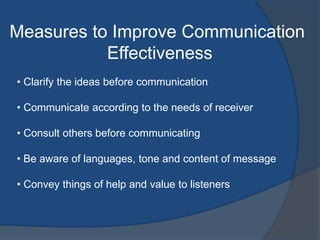
Measures to Improve Communication
Effectiveness
• Clarify the ideas before communication
• Communicate according to the needs of receiver
• Consult others before communicating
• Be aware of languages, tone and content of message
• Convey things of help and value to listeners
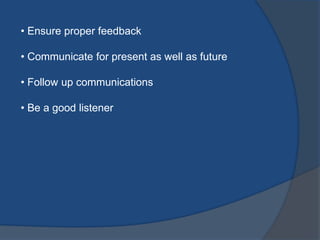
• Ensure proper feedback
• Communicate for present as well as future
• Follow up communications
• Be a good listener
Business communication

Business communication

  • 1.
    Formal and InformalCommunication & Improving Communication Effectiveness
  • 2.
    The word communicationhas been derived from the Latin word ‘communis’ which means ‘common’ which consequently implies common understanding. Communication is defined in different ways. Generally, it is understood as a process of exchange of ideas, views, facts, feelings etc. between or among people to create common understanding.
  • 3.
    Formal Communication • Themessages which are circulating on regulated, preset channels, of an organization are creating the formal communication. • The content of the communication is related to the organization’s activity, to the work and to anything which is related to those. • The formal communication can consist in verbal messages, nonverbal messages, written, under the shape of letters, telephone messages, radio messages, printed, internal notes.
  • 4.
    • Usually, allformal communications are recorded and kept in the organization’s evidence. • Examples of formal communications are given by work commands, reports and financial evidence, reports over sells / inventory, statements referring to the company’s policies, post descriptions, etc.
  • 5.
  • 6.
  • 7.
    Upward communication Flow ofcommunication from subordinate to superior. consists of : - Work performance - Opinions - Grievances - Problem of the employees
  • 8.
    Downward communication Flow ofinformation from the superiors to subordinates. Consists of – - Order - Rules - Information
  • 9.
    Horizontal communication Communication betweentwo or more persons working at the same level of authority. Discussion between managers of same rank. Eg.- The marketing manager may discuss from time to time the quality and packing of the product with the production manager.
  • 10.
    Diagonal communication Flow ofinformation between persons working at different departments and holding different levels of authority. Prevents delay in flow of information. Helps in taking fast decision.
  • 11.
    Advantages of Formal Communication •Maintenance of authority of officers • Clear and effective communication • Orderly flow of information • Easy knowledge and source of information • Less errors and mistakes • Discipline • Permanent record • Reliability
  • 12.
    Disadvantages of Formal Communication •Wastage of time • Delay in decision making • Lack of initiative • Lack of cordiality • Fear • Behavior • Authoritarian system
  • 13.
    Informal Communication • Informalcommunication arises out of all those channels that fall outside the formal channels and it is also known as grapevine. • It is established around the societal affiliation of members of the organization. • Informal communication does not follow authority lines as in the case of formal communication. • Informal communication takes place due to the individual needs of the members of an organization and subsists in every organization.
  • 14.
    • Normally, suchcommunication is oral and may be expressed even by simple glance, sign or silence. Informal communication, is implicit, spontaneous multidimensional and diverse. • It acts as a valuable purpose in expressing certain information that cannot be channelled via the official channels. It satisfies the people desires to identify what is happening in the organization and offers an opportunity to express dreads, worries and complaints.
  • 15.
    Advantages of Informal Communication •Alternative System • Presenting Grievances • Improving Relations • Providing Recommendations • Provide Emotional Relief • Solution to Problems
  • 16.
    Disadvantages of Informal Communication •Distortion • Lack of Secrecy • Rumor • Misunderstanding • Difficult to Control Employees
  • 17.
  • 18.
    Subject Formal CommunicationInformal Communication 1.Definition When communication takes place through the formal official channels then it is known as formal communication. Any communication by passing the formal channels can be termed as informal communication. 2.Flexibility Formal communication is not flexible. It is flexible. 3.Degree of control Formal communication is totally controlled by the management. It cannot be controlled like formal communication. 4.Evidence It has documentary evidence. It has no documentary evidence. 5.Discipline Official discipline is strictly maintained informal communication. Official decorum and discipline are not followed. 6.Flow of information In formal communication information can flow only upward and downward. But in informal communication information flows freely to all direction. 7.Speed Here speed of communication is slow. Informal channels are very fast; here information can be transmitted instantly.
  • 19.
    8.secrecy In caseof formal communication secrecy can be maintained. Here maintaining secrecy is very difficult. 9.Rumor There is no scope for creation of rumour informal communication. Due to its flexible nature rumour can be created. 10.Distortion Generally information is not distorted. As official decorum is not followed information can be distorted. 11.Time It is time consuming. Less time is taken for transmitting information. 12.Misunderstanding In case of formal communication caution, there is almost no chance of misunderstanding. Due to lack of control misunderstanding can takes place? 13.Cost It is expensive. It is less expensive than formal communication. 14.Mistakes As official discipline is maintained chance of mistakes is very low. On the other hand, as strict rules are not followed possibility of mistakes is very high.
  • 20.
  • 21.
    The barriers toeffective communication exists in all organizations to a greater or lesser degree. Organizations keen on developing effective communication should adopt suitable measures to overcome the barriers and improve communication effectiveness.
  • 22.
    Measures to ImproveCommunication Effectiveness • Clarify the ideas before communication • Communicate according to the needs of receiver • Consult others before communicating • Be aware of languages, tone and content of message • Convey things of help and value to listeners
  • 23.
    • Ensure properfeedback • Communicate for present as well as future • Follow up communications • Be a good listener