COUGH-SUPPRESSANTS
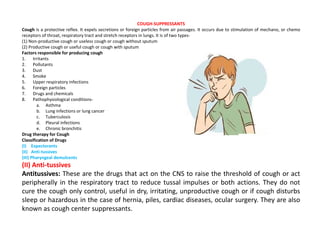
Cough is a protective reflex. It expels secretions or foreign particles from air passages. It occurs due to stimulation of mechano, or chemo
receptors of throat, respiratory tract and stretch receptors in lungs. It is of two types-
(1) Non-productive cough or useless cough or cough without sputum
(2) Productive cough or useful cough or cough with sputum
Factors responsible for producing cough
1. Irritants
2. Pollutants
3. Dust
4. Smoke
5. Upper respiratory infections
6. Foreign particles
7. Drugs and chemicals
8. Pathophysiological conditions-
a. Asthma
b. Lung infections or lung cancer
c. Tuberculosis
d. Pleural infections
e. Chronic bronchitis
Drug therapy for Cough
Classification of Drugs
(I) Expectorants
(II) Anti-tussives
(III) Pharyngeal demulcents
(II) Anti-tussives
Antitussives: These are the drugs that act on the CNS to raise the threshold of cough or act
peripherally in the respiratory tract to reduce tussal impulses or both actions. They do not
cure the cough only control, useful in dry, irritating, unproductive cough or if cough disturbs
sleep or hazardous in the case of hernia, piles, cardiac diseases, ocular surgery. They are also
known as cough center suppressants.
Classification of Anti-tussives
(A) Opioids (acts on opioid receptors in brain. They causes constipation, respiratory depression & drowsiness at higher doses)
• Benzonatate
• Codeine
• Ethylmorphine
• Levoproxyphene
• Methadone
• Morphine
• Naloxone
• Pholcodiene
(B) Non-opioids
• Caramiphen
• Carbetapentane
• Chlophedianol
• Dextromethorphan
• Noscapine
• Oxiladine
• Pipazethate
(C) Antihistamines
• Chlorpheniramine
• Diphenhydramine
• Promethazine
• Pseudoephedrine
• Fexofenadine
(III) Pharyngeal demulcents
They not ANTI-TUSSIVES, producing soothing action on throat directly and by increasing saliva secretion. They only provides
symptomatic relief of dry cough.
• Cough drops
• Glycerin
• Liquorices
• Linctuses containing syrups
• Lozenges
PROTOTYPE DRUGS
CODEINE
It is an opioid drug that depresses cough centers and used in the form of codeine linctus.
Pharmacological actions
 Similar to morphine with low addiction liability and does not dressed respiration as morphine, suppressed cough centers.
Mechanism of action
To raise the threshold of cough and to reduce tussal impulses or both actions, useful in dry unproductive cough.
ADME
Well absorbed after oral administration and have long duration of action.
Interactions
Antihistamines and ammonium chloride potentiate anti-cough action
Contra-indicated in-
Asthmatic conditions
Dose
10-30mg/TDS
Adverse effects
Nausea
Vomiting
Constipation
Dizziness
Drowsiness
Dependence
Uses
It is preferred in following cases-
 Dry or unproductive cough
 Diarrhea
 Analgesia
PIPAZETHATE
It is a derivative of phenothiazine, used in dry cough.
Dose
40-80mg/day
Uses
It is preferred in the following cases-
Dry cough as antitussive
Pain as analgesic
As sedative agent
CHLORPHENIRAMINE
It is an antihistaminic agent, used in common cold and allergic conditions.
Pharmacological actions
 Inhibition of flare, itching and weal
 Relaxes smooth muscles of various organs
 Reduces edema by suppressing capillary permeability
Mechanism of action-Competitively produces reversible blockade of H1 histamine receptors.
ADME-Well absorbed from GIT after oral administration and metabolized in liver by hydroxylation.
Interactions-Potentiation of action of CNS depressants
Contra-indicated in-
Renal dysfunctions
Hepatic disorders
Dose=2-4mg/orally
Adverse effects
Blurred vision
Constipation
Dermatitis
Diarrhea
Dizziness
Drug fever
Dryness of mouth
Dysuria
Epigastric distress
Impotence
Nausea
Photoallergy
Sedation
Tightness of chest
Tinnitus
Urinary retention
Vertigo
Vomiting
Wheezing
Uses
It is preferred in the following cases-
 Cough
 Common cold
 Anaphylactic shock
 Insect bite
 Allergic conditions
Anti-tussives

Anti-tussives

  • 2.
    COUGH-SUPPRESSANTS Cough is aprotective reflex. It expels secretions or foreign particles from air passages. It occurs due to stimulation of mechano, or chemo receptors of throat, respiratory tract and stretch receptors in lungs. It is of two types- (1) Non-productive cough or useless cough or cough without sputum (2) Productive cough or useful cough or cough with sputum Factors responsible for producing cough 1. Irritants 2. Pollutants 3. Dust 4. Smoke 5. Upper respiratory infections 6. Foreign particles 7. Drugs and chemicals 8. Pathophysiological conditions- a. Asthma b. Lung infections or lung cancer c. Tuberculosis d. Pleural infections e. Chronic bronchitis Drug therapy for Cough Classification of Drugs (I) Expectorants (II) Anti-tussives (III) Pharyngeal demulcents (II) Anti-tussives Antitussives: These are the drugs that act on the CNS to raise the threshold of cough or act peripherally in the respiratory tract to reduce tussal impulses or both actions. They do not cure the cough only control, useful in dry, irritating, unproductive cough or if cough disturbs sleep or hazardous in the case of hernia, piles, cardiac diseases, ocular surgery. They are also known as cough center suppressants.
  • 3.
    Classification of Anti-tussives (A)Opioids (acts on opioid receptors in brain. They causes constipation, respiratory depression & drowsiness at higher doses) • Benzonatate • Codeine • Ethylmorphine • Levoproxyphene • Methadone • Morphine • Naloxone • Pholcodiene (B) Non-opioids • Caramiphen • Carbetapentane • Chlophedianol • Dextromethorphan • Noscapine • Oxiladine • Pipazethate (C) Antihistamines • Chlorpheniramine • Diphenhydramine • Promethazine • Pseudoephedrine • Fexofenadine (III) Pharyngeal demulcents They not ANTI-TUSSIVES, producing soothing action on throat directly and by increasing saliva secretion. They only provides symptomatic relief of dry cough. • Cough drops • Glycerin • Liquorices • Linctuses containing syrups • Lozenges
  • 4.
    PROTOTYPE DRUGS CODEINE It isan opioid drug that depresses cough centers and used in the form of codeine linctus. Pharmacological actions  Similar to morphine with low addiction liability and does not dressed respiration as morphine, suppressed cough centers. Mechanism of action To raise the threshold of cough and to reduce tussal impulses or both actions, useful in dry unproductive cough. ADME Well absorbed after oral administration and have long duration of action. Interactions Antihistamines and ammonium chloride potentiate anti-cough action Contra-indicated in- Asthmatic conditions Dose 10-30mg/TDS Adverse effects Nausea Vomiting Constipation Dizziness Drowsiness Dependence Uses It is preferred in following cases-  Dry or unproductive cough  Diarrhea  Analgesia PIPAZETHATE It is a derivative of phenothiazine, used in dry cough. Dose 40-80mg/day Uses It is preferred in the following cases- Dry cough as antitussive Pain as analgesic As sedative agent
  • 5.
    CHLORPHENIRAMINE It is anantihistaminic agent, used in common cold and allergic conditions. Pharmacological actions  Inhibition of flare, itching and weal  Relaxes smooth muscles of various organs  Reduces edema by suppressing capillary permeability Mechanism of action-Competitively produces reversible blockade of H1 histamine receptors. ADME-Well absorbed from GIT after oral administration and metabolized in liver by hydroxylation. Interactions-Potentiation of action of CNS depressants Contra-indicated in- Renal dysfunctions Hepatic disorders Dose=2-4mg/orally Adverse effects Blurred vision Constipation Dermatitis Diarrhea Dizziness Drug fever Dryness of mouth Dysuria Epigastric distress Impotence Nausea Photoallergy Sedation Tightness of chest Tinnitus Urinary retention Vertigo Vomiting Wheezing Uses It is preferred in the following cases-  Cough  Common cold  Anaphylactic shock  Insect bite  Allergic conditions