Schizophrenia Diagnosis and Pharmacotherapy Jason Cavolina Clerkship Internal Medicine I
Epidemiology   Incidence:  uncommon (~1%) Prevalence:  equal across cultures and sexes Onset:  usually during adolescence and early adulthood (Male~18-20) (Female~26-30) Heredity:  higher prevalence in 1st degree biologic relatives w/ schizophrenia parents w/ schizophrenia have offspring w/ ~40% chance of schizophrenia
Diagnosis Characteristic psychotic symptoms:  exhibited for at least 1 month during the active phase of illness Lack of insight  Auditory hallucinations  Ideas of reference  Suspiciousness  Voices speaking to patient Delusions  Thoughts spoken aloud
Diagnosis Functioning below previous level:   Work Interpersonal relations  Self-care Signs and symptoms last for at least 6 months:  may include prodromal or residual symptoms
Diagnosis Must rule out: Schizoaffective disorder Mood disorder Medical disorder (organic causes) Substance abuse
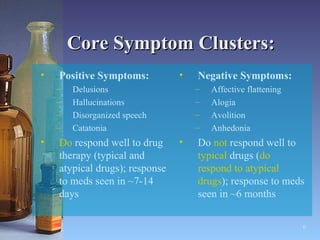
Core Symptom Clusters:  Positive Symptoms: Delusions Hallucinations Disorganized speech Catatonia Do  respond well to drug therapy (typical and atypical drugs); response to meds seen in ~7-14 days Negative Symptoms: Affective flattening  Alogia  Avolition  Anhedonia  Do  not  respond well to  typical  drugs ( do respond to atypical drugs ); response to meds seen in ~6 months
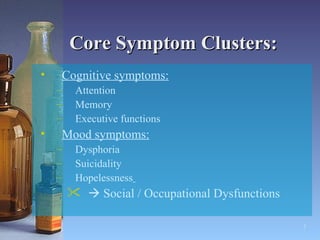
Core Symptom Clusters: Cognitive symptoms:   Attention Memory Executive functions Mood symptoms: Dysphoria Suicidality Hopelessness      Social / Occupational Dysfunctions
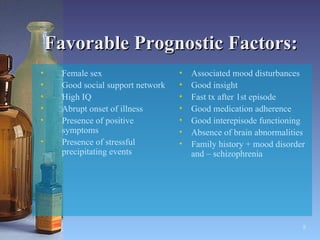
Favorable Prognostic Factors:  Female sex  Good social support network High IQ Abrupt onset of illness Presence of positive symptoms  Presence of stressful precipitating events Associated mood disturbances Good insight Fast tx after 1st episode Good medication adherence Good interepisode functioning Absence of brain abnormalities Family history + mood disorder and – schizophrenia
Pharmacotherapy Typical antipsychotics  1 st  generation Low Potency: Chlorpromazine [THORAZINE]:  dose range 300-1000 mg/d Thioridazine [MELLARIL]:  dose range 100-800 mg/d; high doses lead to  pigmentary   retinopathy  (need eye exams), and    QT interval Mesoridazine [SERENTIL]:  metabolite of thioridazine
Pharmacotherapy Typical antipsychotics  1 st  generation High Potency: Fluphenazine [PROLIXIN]: dose range 5-20 mg/d Fluphenazin D:  deconate ;  long-acting  IM  form for maintenance therapy in non-compliant patients; dose range 6.25-50 mg IM/ 2-4 weeks Haloperidol [HALDOL]:  dose range 2-20 mg/d Haloperidol  D :  dose range 50-200 mg/2-4 weeks Thiothixene [NAVANE]:  dose range 15-50 mg/d Trifluoperazine [STELAZINE]:  dose range 5-40 mg/d
Pharmacotherapy Typical antipsychotics  1 st  generation High Potency: Loxapine [LOXITANE]:  dose range 50-150 mg/d Molindone [MOBAN]:  dose range 50-150 mg/d Perphenazine [TRILAFON]:  dose range 16-64 mg/d
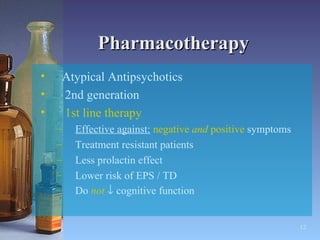
Pharmacotherapy Atypical Antipsychotics 2nd generation 1st line therapy   Effective against:   negative  and  positive  symptoms Treatment resistant patients Less prolactin effect Lower risk of EPS / TD Do  not     cognitive function
Pharmacotherapy Atypical Antipsychotics: Clozapine [CLOZARIL]:  dose range 300-900 mg/d (given BID 1/3 AM 2/3 PM); serum levels at doses >600 mg/d Side Effects:  agranulocytosis, seizures, myocarditis, anticholinergic effects,    salivation, weight gain Usually reserved for tx resistant patients b/c of side effect profile Olanzapine [ZYPREXA]:  dose range 10-20 mg/d Side Effects:  weight gain and sedation (dosing given HS) Quetiapine [SEROQUEL]:  dose range 300-800 mg/d (given BID) Side Effect:  weight gain (monitor TG, cholesterol, LFT)
Pharmacotherapy Atypical Antipsychotics cont: Risperidone [RISPERDAL]:  dose range 2-6 mg/d (given HS or AM); > 6 mg/d lead to    EPS Ziprasidone [GEODON]:  dose range 80-160 mg/d (divided BID) [food can    absorption two-fold] NO  weight gain, orthostasis, or sedation are seen Aripiprazole [ABILIFY]:  dose range 10-30 mg/d (given QD) Partial DA agonist:   antagonist  during high DAergic activity (mesolimbic DA, psychotic symptoms);  agonist  during low DAergic activity (low EPS or negative symptoms) Partial serotonin agonist No  prolactin  or anticholinergic effects  Minimal weight gain, hypotension and sedation
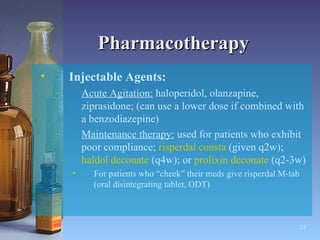
Pharmacotherapy Injectable Agents:   Acute Agitation:  haloperidol, olanzapine, ziprasidone; (can use a lower dose if combined with a benzodiazepine) Maintenance therapy:  used for patients who exhibit poor compliance;  risperdal consta  (given q2w);  haldol deconate  (q4w); or  prolixin deconate  (q2-3w) For patients who “cheek” their meds give risperdal M-tab (oral disintegrating tablet, ODT)
Monitoring Extrapyramidal Side effects:  seen mostly in 1st generation (especially high potency) and w/ risperidone Acute dystonia:  can be life threatening Includes:  oculogyric crisis; torticollis; opisthotonus; trismus; and spasming of other muscles Occurrence:  seen usually in young males; 90% occurs w/in 72 hours of tx Tx:  parenteral anticholinergic agents (benztropine [Cogentin]; and/or    dose Pseudoparkinsonism:   Includes:  akinesia (rigidity, immobility, masklike expression, stooped posture, slow speech); and tremors (especially hands) Occurrence:  seen usually in elderly females; occurs ~3 months into therapy Akathisia:  least responsive to drug therapy Includes:  inability to sit still; restless movement; and tapping of feet Tx:  prevent with inderal; and/or    dose; and/or give BZD’s
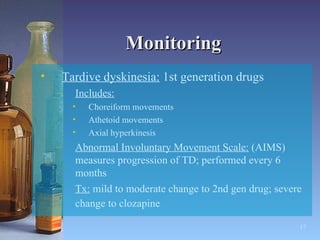
Monitoring Tardive dyskinesia:  1st generation drugs Includes:   Choreiform movements Athetoid movements Axial hyperkinesis Abnormal Involuntary Movement Scale:  (AIMS) measures progression of TD; performed every 6 months Tx:  mild to moderate change to 2nd gen drug; severe change to clozapine
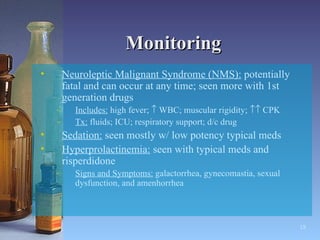
Monitoring Neuroleptic Malignant Syndrome (NMS):  potentially fatal and can occur at any time; seen more with 1st generation drugs Includes:  high fever;    WBC; muscular rigidity;    CPK Tx:  fluids; ICU; respiratory support; d/c drug Sedation:  seen mostly w/ low potency typical meds Hyperprolactinemia:  seen with typical meds and risperdidone Signs and Symptoms:  galactorrhea, gynecomastia, sexual dysfunction, and amenhorrhea
Monitoring Anticholinergic effects:  seen mostly w/ low potency 1st generation drugs Orthostatic Hypotension:  seen mostly w/ low potency 1st generation drugs QTc interval prolongation:  > 0.44s seen with thioridazine
Monitoring Weight gain:  most common with atypicals clozapine and olanzapine (not as common, but still seen, with risperidone, quetiapine and typical drugs) Ophthalmic effects:  thioridazine causes pigmentary retinopathy  (atrophy and pigment infiltration) Seizures:  mostly seen with low potency typical drugs and clozapine;  minimize with slow dose titration and use of lowest effective dose
Monitoring Sexual Dysfunctions:  most common with thioridazine but can be seen with any typical or atypical agents Agranulocytosis:  seen with  clozapine  ~ 1-2%  Risk:  seen @ 6-18 weeks;    in female, elderly, and cachectic patients Do not  start if:  WBC <3.5 K/mm 3 D/C permanently  if:  WBC  <2.0  K/mm 3 D/C temporarily  if:  WBC  <3.0  K/mm 3 Warning signs:  pharyngeal infections; fever Monitoring:  baseline, weekly, then every 4 weeks after D/C drug
Monitoring Drug Interactions:   Dopamine receptor antagonists + Anticonvulsants:  dopamine antagonists    anticonvulsant levels Antihypertensives:  dopamine antagonists potentiate hypotension Barbiturates:  long term use will    antipsychotic levels; short term use will    CNS depressant effects Levodopa;  mutual antagonism between levodopa and dopamine receptor antagonist Pressor agents: α-agonists:  pressor effect is antagonized β-agonists:  marked hypotension Sedative-Hypnotics:  additive CNS depressant effects
Monitoring CYP450 Drug Interactions:   Clozapine:  major 1A2; minor 3A4 and 2D6 Inhibited by:  cimtidine; erythromycin; fluoxetine; paroxetine; fluvoxamine; and quinidine Induced by:  smoking; carbemazepine; and phenytoin Olanzapine:  major 1A2; minor 3A4 and 2D6 Inhibited by:  fluvoxamine Induced by:  smoking Quetiapine:  major 3A4; minor 2D6 Inhibited by:  cimetidine, erythromycin; fluconzaole; itraconazole; and ketoconazole Induced by:  carbamezapine and phenytoin Risperidone:  major 2D6 Inhibited by:  fluoxetine; paroxetine; and quinidine Ziprasidone:  major aldehyde oxidase; minor 3A4 and 1A2 Induced by:  carbemazepine Aripiprazole:  major 3A4; minor 2D6 ( see quetiapine above ) Thioridazine:  avoid all drugs that inhibit 2D6 (   QTc interval)
Monitoring Efficacy: Acute Phase:      hostility and aggression; relieve acute symptoms to    functioning  Stabilization Phase:  ~ 6+ months after onset of acute symptoms    stress,    symptoms (see +/-) Stable Phase:  symptoms stable or not present or less severe Pt may exhibit anxiety, tension, depression, and insomnia (add adjunctive tx)
References Lexi-interact Lexi-comp hand held reference, 2005  Lexi-onhand. Lexi-complete and specialties. Updated 8/05 http://www.clevelandclinicmeded.com/diseasemanagement/psychiatry/schizophrenia/table1schizo.htm   , accessed 9/20/05 http://www.clevelandclinicmeded.com/diseasemanagement/psychiatry/schizophrenia/schizophrenia.htm#table1  , accessed 9/20/05 http://depts.washington.edu/stellalb/images/Schizophrenia.pdf  , accessed 9/20/05 http://www.mentalhealth.com , accessed 9/20/05 http://www.psych.org/research/dor/dsm/index.cfm  ,accessed 9/20/05 Micromedex Drugdex system 2005, accessed, 9/19/05

Schizophrenia

  • 1.
    Schizophrenia Diagnosis andPharmacotherapy Jason Cavolina Clerkship Internal Medicine I
  • 2.
    Epidemiology Incidence: uncommon (~1%) Prevalence: equal across cultures and sexes Onset: usually during adolescence and early adulthood (Male~18-20) (Female~26-30) Heredity: higher prevalence in 1st degree biologic relatives w/ schizophrenia parents w/ schizophrenia have offspring w/ ~40% chance of schizophrenia
  • 3.
    Diagnosis Characteristic psychoticsymptoms: exhibited for at least 1 month during the active phase of illness Lack of insight Auditory hallucinations Ideas of reference Suspiciousness Voices speaking to patient Delusions Thoughts spoken aloud
  • 4.
    Diagnosis Functioning belowprevious level: Work Interpersonal relations Self-care Signs and symptoms last for at least 6 months: may include prodromal or residual symptoms
  • 5.
    Diagnosis Must ruleout: Schizoaffective disorder Mood disorder Medical disorder (organic causes) Substance abuse
  • 6.
    Core Symptom Clusters: Positive Symptoms: Delusions Hallucinations Disorganized speech Catatonia Do respond well to drug therapy (typical and atypical drugs); response to meds seen in ~7-14 days Negative Symptoms: Affective flattening Alogia Avolition Anhedonia Do not respond well to typical drugs ( do respond to atypical drugs ); response to meds seen in ~6 months
  • 7.
    Core Symptom Clusters:Cognitive symptoms: Attention Memory Executive functions Mood symptoms: Dysphoria Suicidality Hopelessness  Social / Occupational Dysfunctions
  • 8.
    Favorable Prognostic Factors: Female sex Good social support network High IQ Abrupt onset of illness Presence of positive symptoms Presence of stressful precipitating events Associated mood disturbances Good insight Fast tx after 1st episode Good medication adherence Good interepisode functioning Absence of brain abnormalities Family history + mood disorder and – schizophrenia
  • 9.
    Pharmacotherapy Typical antipsychotics 1 st generation Low Potency: Chlorpromazine [THORAZINE]: dose range 300-1000 mg/d Thioridazine [MELLARIL]: dose range 100-800 mg/d; high doses lead to pigmentary retinopathy (need eye exams), and  QT interval Mesoridazine [SERENTIL]: metabolite of thioridazine
  • 10.
    Pharmacotherapy Typical antipsychotics 1 st generation High Potency: Fluphenazine [PROLIXIN]: dose range 5-20 mg/d Fluphenazin D: deconate ; long-acting IM form for maintenance therapy in non-compliant patients; dose range 6.25-50 mg IM/ 2-4 weeks Haloperidol [HALDOL]: dose range 2-20 mg/d Haloperidol D : dose range 50-200 mg/2-4 weeks Thiothixene [NAVANE]: dose range 15-50 mg/d Trifluoperazine [STELAZINE]: dose range 5-40 mg/d
  • 11.
    Pharmacotherapy Typical antipsychotics 1 st generation High Potency: Loxapine [LOXITANE]: dose range 50-150 mg/d Molindone [MOBAN]: dose range 50-150 mg/d Perphenazine [TRILAFON]: dose range 16-64 mg/d
  • 12.
    Pharmacotherapy Atypical Antipsychotics2nd generation 1st line therapy Effective against: negative and positive symptoms Treatment resistant patients Less prolactin effect Lower risk of EPS / TD Do not  cognitive function
  • 13.
    Pharmacotherapy Atypical Antipsychotics:Clozapine [CLOZARIL]: dose range 300-900 mg/d (given BID 1/3 AM 2/3 PM); serum levels at doses >600 mg/d Side Effects: agranulocytosis, seizures, myocarditis, anticholinergic effects,  salivation, weight gain Usually reserved for tx resistant patients b/c of side effect profile Olanzapine [ZYPREXA]: dose range 10-20 mg/d Side Effects: weight gain and sedation (dosing given HS) Quetiapine [SEROQUEL]: dose range 300-800 mg/d (given BID) Side Effect: weight gain (monitor TG, cholesterol, LFT)
  • 14.
    Pharmacotherapy Atypical Antipsychoticscont: Risperidone [RISPERDAL]: dose range 2-6 mg/d (given HS or AM); > 6 mg/d lead to  EPS Ziprasidone [GEODON]: dose range 80-160 mg/d (divided BID) [food can  absorption two-fold] NO weight gain, orthostasis, or sedation are seen Aripiprazole [ABILIFY]: dose range 10-30 mg/d (given QD) Partial DA agonist: antagonist during high DAergic activity (mesolimbic DA, psychotic symptoms); agonist during low DAergic activity (low EPS or negative symptoms) Partial serotonin agonist No prolactin or anticholinergic effects Minimal weight gain, hypotension and sedation
  • 15.
    Pharmacotherapy Injectable Agents: Acute Agitation: haloperidol, olanzapine, ziprasidone; (can use a lower dose if combined with a benzodiazepine) Maintenance therapy: used for patients who exhibit poor compliance; risperdal consta (given q2w); haldol deconate (q4w); or prolixin deconate (q2-3w) For patients who “cheek” their meds give risperdal M-tab (oral disintegrating tablet, ODT)
  • 16.
    Monitoring Extrapyramidal Sideeffects: seen mostly in 1st generation (especially high potency) and w/ risperidone Acute dystonia: can be life threatening Includes: oculogyric crisis; torticollis; opisthotonus; trismus; and spasming of other muscles Occurrence: seen usually in young males; 90% occurs w/in 72 hours of tx Tx: parenteral anticholinergic agents (benztropine [Cogentin]; and/or  dose Pseudoparkinsonism: Includes: akinesia (rigidity, immobility, masklike expression, stooped posture, slow speech); and tremors (especially hands) Occurrence: seen usually in elderly females; occurs ~3 months into therapy Akathisia: least responsive to drug therapy Includes: inability to sit still; restless movement; and tapping of feet Tx: prevent with inderal; and/or  dose; and/or give BZD’s
  • 17.
    Monitoring Tardive dyskinesia: 1st generation drugs Includes: Choreiform movements Athetoid movements Axial hyperkinesis Abnormal Involuntary Movement Scale: (AIMS) measures progression of TD; performed every 6 months Tx: mild to moderate change to 2nd gen drug; severe change to clozapine
  • 18.
    Monitoring Neuroleptic MalignantSyndrome (NMS): potentially fatal and can occur at any time; seen more with 1st generation drugs Includes: high fever;  WBC; muscular rigidity;  CPK Tx: fluids; ICU; respiratory support; d/c drug Sedation: seen mostly w/ low potency typical meds Hyperprolactinemia: seen with typical meds and risperdidone Signs and Symptoms: galactorrhea, gynecomastia, sexual dysfunction, and amenhorrhea
  • 19.
    Monitoring Anticholinergic effects: seen mostly w/ low potency 1st generation drugs Orthostatic Hypotension: seen mostly w/ low potency 1st generation drugs QTc interval prolongation: > 0.44s seen with thioridazine
  • 20.
    Monitoring Weight gain: most common with atypicals clozapine and olanzapine (not as common, but still seen, with risperidone, quetiapine and typical drugs) Ophthalmic effects: thioridazine causes pigmentary retinopathy (atrophy and pigment infiltration) Seizures: mostly seen with low potency typical drugs and clozapine; minimize with slow dose titration and use of lowest effective dose
  • 21.
    Monitoring Sexual Dysfunctions: most common with thioridazine but can be seen with any typical or atypical agents Agranulocytosis: seen with clozapine ~ 1-2% Risk: seen @ 6-18 weeks;  in female, elderly, and cachectic patients Do not start if: WBC <3.5 K/mm 3 D/C permanently if: WBC <2.0 K/mm 3 D/C temporarily if: WBC <3.0 K/mm 3 Warning signs: pharyngeal infections; fever Monitoring: baseline, weekly, then every 4 weeks after D/C drug
  • 22.
    Monitoring Drug Interactions: Dopamine receptor antagonists + Anticonvulsants: dopamine antagonists  anticonvulsant levels Antihypertensives: dopamine antagonists potentiate hypotension Barbiturates: long term use will  antipsychotic levels; short term use will  CNS depressant effects Levodopa; mutual antagonism between levodopa and dopamine receptor antagonist Pressor agents: α-agonists: pressor effect is antagonized β-agonists: marked hypotension Sedative-Hypnotics: additive CNS depressant effects
  • 23.
    Monitoring CYP450 DrugInteractions: Clozapine: major 1A2; minor 3A4 and 2D6 Inhibited by: cimtidine; erythromycin; fluoxetine; paroxetine; fluvoxamine; and quinidine Induced by: smoking; carbemazepine; and phenytoin Olanzapine: major 1A2; minor 3A4 and 2D6 Inhibited by: fluvoxamine Induced by: smoking Quetiapine: major 3A4; minor 2D6 Inhibited by: cimetidine, erythromycin; fluconzaole; itraconazole; and ketoconazole Induced by: carbamezapine and phenytoin Risperidone: major 2D6 Inhibited by: fluoxetine; paroxetine; and quinidine Ziprasidone: major aldehyde oxidase; minor 3A4 and 1A2 Induced by: carbemazepine Aripiprazole: major 3A4; minor 2D6 ( see quetiapine above ) Thioridazine: avoid all drugs that inhibit 2D6 (  QTc interval)
  • 24.
    Monitoring Efficacy: AcutePhase:  hostility and aggression; relieve acute symptoms to  functioning Stabilization Phase: ~ 6+ months after onset of acute symptoms  stress,  symptoms (see +/-) Stable Phase: symptoms stable or not present or less severe Pt may exhibit anxiety, tension, depression, and insomnia (add adjunctive tx)
  • 25.
    References Lexi-interact Lexi-comphand held reference, 2005 Lexi-onhand. Lexi-complete and specialties. Updated 8/05 http://www.clevelandclinicmeded.com/diseasemanagement/psychiatry/schizophrenia/table1schizo.htm , accessed 9/20/05 http://www.clevelandclinicmeded.com/diseasemanagement/psychiatry/schizophrenia/schizophrenia.htm#table1 , accessed 9/20/05 http://depts.washington.edu/stellalb/images/Schizophrenia.pdf , accessed 9/20/05 http://www.mentalhealth.com , accessed 9/20/05 http://www.psych.org/research/dor/dsm/index.cfm ,accessed 9/20/05 Micromedex Drugdex system 2005, accessed, 9/19/05