Anticholinergic Agents
PRESENTED BY : DR JITHIN M
CHAIRED BY : DR SOUMYA
• An anticholinergic agent is a substance that blocks the action of the
neurotransmitter acetylcholine at synapses in the central and the
peripheral nervous system
• In the clinical practice of psychiatry, the anticholinergic drugs are
primarily used to treat medication-induced movement disorders,
particularly neuroleptic-induced Parkinsonism, neuroleptic-induced
acute dystonia, and medication-induced postural tremor
• Among the most frequently used in psychiatry are Trihexyphenidyl;
Biperidine; Benztropine; and the Procyclidine.
• Absorption and Distribution : Anticholinergic agents are widely
distributed after absorption and achieve significant levels in the CNS
within 30 minutes to 1 hour, and this high concentration in brain
tissue may be related to their high lipophilicity.
• In humans, the bioavailability of these drugs is not reported and
plasma protein binding is also poorly understood.
• All of these drugs are extensively metabolized, and all unchanged
drugs as well as metabolites are excreted in the bile and urine.
• Trihexyphenidyl is rapidly absorbed from the GI tract. After oral
administration, the onset of action occurs within 1 hour, peak effects
last 2 to 3 hours, and the duration of action is 6 to 12 hours. It is
excreted in the urine.
• Benztropine is well absorbed by the GI tract. However, it exhibits a
more rapid onset of action when administered either by the
intravenous (IV) or intramuscular (IM) route, although there is no
difference in onset of action between these two parenteral routes. All
of these agents readily cross the blood–brain barrier (BBB)
Pharmacodynamics
• Anticholinergic drugs act by blocking acetylcholine receptors.
• Acetylcholine, an organic chemical that functions in the brain and
body as neurotransmitter, has multiple physiological functions in the
peripheral and central nervous system .
• Acetylcholine exerts its effect by binding two major subtypes of
receptors: the metabotropic muscarinic receptors and the inotropic
nicotinic receptors .
• Distribution is quite different with the muscarinic receptors being
located in the CNS, smooth muscle, cardiac muscle, and
parasympathetically innervated glands, such as the salivary glands.
• Nicotinic receptors are located on striated muscle at the
neuromuscular junction (motor end plate), the autonomic ganglia,
and in the CNS.
• The muscarinic receptors are G-protein–coupled receptors. There are
numerous muscarinic receptor subtypes (M1 to M5), and all are
present in the brain
• Anticholinergic medications, such as benztropine, trihexyphenidyl,
procyclidine, and biperiden, act as competitive antagonists at
muscarinic receptors
• The beneficial effect of agents in Parkinson disease is mediated by
CNS muscarinic receptor blockade.
• The anticholinergic activity is independent of the serum drug levels of
anticholinergic medications because drug levels vary up to 100-fold,
and hence, are not routinely measured.
• There is evidence that there is a threshold serum level for
anticholinergics, and once this threshold is achieved, it is unlikely for
extrapyramidal side effects to occur.
• This threshold level is a result of muscarinic receptor blockade.
• the decrease in extrapyramidal side effects is not related to the dose
of anticholinergic medication nor the dose or serum level of
antipsychotic medication, but only to the serum level of
anticholinergic activity.
Effects on Specific Organs and Systems
• Central Nervous System : In the usual recommended dosages, these drugs
have a mild stimulant effect and a slower, longer-lasting sedative effect.
• The initial central vagal stimulant effect causes bradycardia, but as the
antimuscarinic effects take place, it is supplanted by tachycardia.
• Scopolamine is used for motion sickness and produces drowsiness and can
cause amnesia in sensitive individuals.
• Toxic doses can cause agitation, hallucinations, excitement, and coma.
• Parkinson disease is a result of excess of cholinergic activity and a
deficiency of dopaminergic activity. The centrally acting antimuscarinic
agents reduce the tremor, and when used in combination with a
dopaminergic drug can have more effective response.
• Eye : These agents cause cycloplegia (paralysis of the ciliary muscle),
leading to loss of accommodation and the inability of the eye to focus
for near vision.
• These medications also block the response of the sphincter muscle of
the iris, which causes dilation of the pupil.
• Anticholinergic medications have little effect on intraocular pressure,
except in patients with narrow-angle glaucoma, in whom the pressure
may rise to dangerous levels
• Cardiovascular System : In the heart, the atria are innervated by the
parasympathetic (vagal) nerve fibers.
• The anticholinergic agents cause tachycardia when moderate to high
therapeutic doses are used.
• In toxic doses, these agents can cause intraventricular conduction
block.
• Gastrointestinal Tract : The GI tract is innervated by both cholinergic
and noncholinergic fibers and is also modulated by local hormones.
• The net effect of these agents is decreased motility via inhibition of
parasympathetic control, which may result in constipation or paralytic
ileus.
• These agents also cause dry mouth and delay the gastric emptying
time.
• Genitourinary Tract : Anticholinergics cause relaxation of the smooth
muscle in the ureter and the bladder wall and are used in the
treatment of spasm caused by inflammatory conditions.
• At the same time, this can lead to urinary hesitancy, particularly in
elderly men with prostatic hypertrophy.
Psychiatric Use of Anticholinergic Drugs
• EXTRAPYRAMIDAL SIDE EFFECTS : Extrapyramidal side effects (acute
dystonias, parkinsonism, and akathisia) are caused by neuroleptic blockade
of dopaminergic nigrostriatal tracts, leading to an increase in cholinergic
activity.
• Other mechanisms involved include decreased serum calcium levels, which
affect the cholinergic and dopaminergic systems.
• Acute dystonic reactions usually appear early and may occur within 1 to 4
days of neuroleptic therapy,
• while parkinsonism and akathisia usually manifest within the first 3 months
of treatment.
• Anticholinergics reduce cholinergic activity and restore the cholinergic and
dopaminergic equilibrium, leading to improvement in extrapyramidal side
effect
• Acute Dystonia : Acute dystonia is characterized by a spastic
contraction of muscle groups and often affects the neck, eyes, and
trunk and develops early in the treatment or after rapid dose
escalation of antipsychotic medication.
• The various forms of dystonia include torticollis, retrocollis, trismus or
lockjaw, grimacing, dysarthria, blepharospasm, oculogyric crisis, and
opisthotonos. These involuntary muscle contractions that occur
suddenly are frightening and painful to the patient and may, in rare
cases, be life-threatening (e.g., laryngospasm).
• In most cases, this side effect occurs within the first couple of days of
treatment. It can be effectively and rapidly treated with medication
• Treatment of a dystonic reaction is typically with benztropine (1 to 2
mg) or diphenhydramine (25 to 50 mg), either IM or IV.
• Onset of action of these medications, IM or IV, is rapid, with
resolution of the symptoms often within 10 to 15 minutes.
• As dystonic reactions may recur, prophylaxis with oral medications
such as benztropine (1 to 2 mg twice daily) or trihexyphenidyl (2 mg
three times a day) is recommended.
• Tardive dystonia may develop after months or years of treatment with
antipsychotic medications and usually does not respond rapidly to
anticholinergic medication
• Akathisia : Akathisia is characterized by an internal sense of motor
restlessness often described as an inability to resist the urge to move.
• The most common form of akathisia involves pacing and an inability
to sit still and most often occurs during the first few months of
conventional antipsychotic use.
• At times, patients may have difficulty explaining the sensation of
akathisia and can be often misdiagnosed as agitated, leading to an
increase in antipsychotic medication and hence worsening the
akathisia.
• Anticholinergics have limited utility in the treatment of akathisia;
they should be considered second-line therapy and used when first-
line agents, such as adrenergic receptor antagonists (propranolol),
either fail or are contraindicated
• Parkinsonism : Parkinson disease and parkinsonism secondary to the
use of antipsychotics can be indistinguishable.
• The symptoms include generalized slowing of movement (akinesia),
rigidity, resting tremor, hypersalivation, cog-wheeling, and masked
facies.
• These symptoms are caused by a blockade of dopamine receptors of
nigrostriatal neurons, which terminate in the caudate nucleus.
• These symptoms can be mistaken for the negative symptoms of
schizophrenia.
• Parkinsonism is more common with the high potency antipsychotics and is
seen much less frequently with atypical antipsychotics.
• These symptoms may manifest any time during antipsychotic treatment,
but usually begin within the first 3 months of treatment and can be
managed by lowering the antipsychotic dose to the lowest effective dose.
• Anticholinergics are found to be useful in treating the symptoms of
neuroleptic-induced parkinsonism.
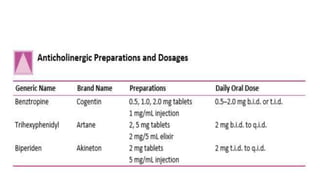
• The additions of benztropine (0.5 to 6.0 mg per day), trihexyphenidyl (2
mg, two to four times daily), procyclidine (5 to 20 mg per day), and
biperiden (2 to 24 mg per day) have been found to be effective therapies.
• “the prophylactic use of anticholinergics in patients on neuroleptic
treatment is not recommended, and may be justified only early in
treatment (after which it should be discontinued and its need should
be reevaluated).” Based on the above, since many patients will not
develop parkinsonism, they do not need these medications.
Precautions and Adverse Reactions
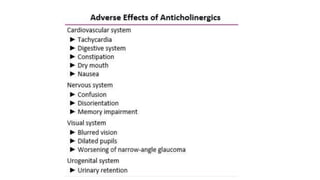
• Anticholinergic medications have CNS as well as peripheral adverse
reactions due to their widespread antagonism of muscarinic receptors
in the periphery. These agents produce clinically meaningful effects
on the cardiovascular, GI, autonomic, and urogenital system
• Toxic doses or an overdose of anticholinergic medication may lead to
an atropine-like poisoning, which may manifest as confusion,
nervousness, psychosis, ataxia, dry mouth, blurred vision, tachycardia,
elevated blood pressure, GI upset, anhidrosis, hyperthermia, and
respiratory collapse.
• In general, supportive measures are used after an overdose.
• However, 1 to 2 mg of physostigmine salicylate (Antilirium), an
acetylcholinesterase inhibitor, may be used to reverse the
anticholinergic symptoms of overdose.
• If required, a second dose of physostigmine may be administered 2
hours after the first dose.
• Anticholinergic Abuse : These agents have an abuse potential
secondary to their euphoriant and hallucinogenic effects, especially
when combined with other street drugs.
• The prevalence of anticholinergic abuse varies from 0 to 34 percent.
The most common reason for abuse is the drug-induced euphoria.
• Trihexyphenidyl is the most commonly abused anticholinergic for the
reason that it tends to be the most stimulating of all anticholinergics.
Drug Interactions
• The most common drug-drug interactions with the anticholinergics occur
when they are coadministered with psychotropics that also have high
anticholinergic activity, such as DRAs, tricyclic and tetracyclic drugs, and
monoamine oxidase inhibitors (MAOis).
• Many other prescription drugs and over-the-counter cold preparations also
induce significant anticholinergic activity. The coadministration of those
drugs can result in a lifethreatening anticholinergic intoxication syndrome.
• In addition, anticholinergic drugs can delay gastric emptying, thereby
decreasing the absorption of drugs that are broken down in the stomach
and usually absorbed in the duodenum (e.g., levodopa [Larodopa] and
DRAs).
• Anticholinergic doses can vary widely among individuals and must be
empirically determined.
• In general, prophylactic doses are the same as the doses usually needed to
treat parkinsonism.
• For acute dystonias, an IM or IV medication such as benztropine (1 to 2 mg
IM) or the antihistamine diphenhydramine (25 to 50 mg IM or IV) is usually
given.
• The starting dose for trihexyphenidyl is 0.5 to 1 mg per day and the dose
should be increased no faster than every 7 to 14 days.
• Dose increase of 1 mg per day is reasonable and a dose of 2 mg three to
four times per day is the usual goal.
• The dose of benztropine is begun at 0.5 mg per day and can be raised
to 4 to 8 mg per day and requires dosing two to three times per day.
• The dose of procyclidine is begun at 2.5 mg per day and increased
gradually to a maximum of approximately 30 mg per day.
• The starting dose of diphenhydramine is 25 mg per day, and it can be
titrated to 150 to 200 mg per day in divided doses.
Anticholinergic agents in psychiatry

Anticholinergic agents in psychiatry

  • 1.
    Anticholinergic Agents PRESENTED BY: DR JITHIN M CHAIRED BY : DR SOUMYA
  • 2.
    • An anticholinergicagent is a substance that blocks the action of the neurotransmitter acetylcholine at synapses in the central and the peripheral nervous system • In the clinical practice of psychiatry, the anticholinergic drugs are primarily used to treat medication-induced movement disorders, particularly neuroleptic-induced Parkinsonism, neuroleptic-induced acute dystonia, and medication-induced postural tremor
  • 3.
    • Among themost frequently used in psychiatry are Trihexyphenidyl; Biperidine; Benztropine; and the Procyclidine.
  • 4.
    • Absorption andDistribution : Anticholinergic agents are widely distributed after absorption and achieve significant levels in the CNS within 30 minutes to 1 hour, and this high concentration in brain tissue may be related to their high lipophilicity. • In humans, the bioavailability of these drugs is not reported and plasma protein binding is also poorly understood. • All of these drugs are extensively metabolized, and all unchanged drugs as well as metabolites are excreted in the bile and urine.
  • 5.
    • Trihexyphenidyl israpidly absorbed from the GI tract. After oral administration, the onset of action occurs within 1 hour, peak effects last 2 to 3 hours, and the duration of action is 6 to 12 hours. It is excreted in the urine. • Benztropine is well absorbed by the GI tract. However, it exhibits a more rapid onset of action when administered either by the intravenous (IV) or intramuscular (IM) route, although there is no difference in onset of action between these two parenteral routes. All of these agents readily cross the blood–brain barrier (BBB)
  • 6.
    Pharmacodynamics • Anticholinergic drugsact by blocking acetylcholine receptors. • Acetylcholine, an organic chemical that functions in the brain and body as neurotransmitter, has multiple physiological functions in the peripheral and central nervous system . • Acetylcholine exerts its effect by binding two major subtypes of receptors: the metabotropic muscarinic receptors and the inotropic nicotinic receptors .
  • 7.
    • Distribution isquite different with the muscarinic receptors being located in the CNS, smooth muscle, cardiac muscle, and parasympathetically innervated glands, such as the salivary glands. • Nicotinic receptors are located on striated muscle at the neuromuscular junction (motor end plate), the autonomic ganglia, and in the CNS. • The muscarinic receptors are G-protein–coupled receptors. There are numerous muscarinic receptor subtypes (M1 to M5), and all are present in the brain
  • 8.
    • Anticholinergic medications,such as benztropine, trihexyphenidyl, procyclidine, and biperiden, act as competitive antagonists at muscarinic receptors • The beneficial effect of agents in Parkinson disease is mediated by CNS muscarinic receptor blockade. • The anticholinergic activity is independent of the serum drug levels of anticholinergic medications because drug levels vary up to 100-fold, and hence, are not routinely measured.
  • 9.
    • There isevidence that there is a threshold serum level for anticholinergics, and once this threshold is achieved, it is unlikely for extrapyramidal side effects to occur. • This threshold level is a result of muscarinic receptor blockade. • the decrease in extrapyramidal side effects is not related to the dose of anticholinergic medication nor the dose or serum level of antipsychotic medication, but only to the serum level of anticholinergic activity.
  • 10.
    Effects on SpecificOrgans and Systems • Central Nervous System : In the usual recommended dosages, these drugs have a mild stimulant effect and a slower, longer-lasting sedative effect. • The initial central vagal stimulant effect causes bradycardia, but as the antimuscarinic effects take place, it is supplanted by tachycardia. • Scopolamine is used for motion sickness and produces drowsiness and can cause amnesia in sensitive individuals. • Toxic doses can cause agitation, hallucinations, excitement, and coma. • Parkinson disease is a result of excess of cholinergic activity and a deficiency of dopaminergic activity. The centrally acting antimuscarinic agents reduce the tremor, and when used in combination with a dopaminergic drug can have more effective response.
  • 11.
    • Eye :These agents cause cycloplegia (paralysis of the ciliary muscle), leading to loss of accommodation and the inability of the eye to focus for near vision. • These medications also block the response of the sphincter muscle of the iris, which causes dilation of the pupil. • Anticholinergic medications have little effect on intraocular pressure, except in patients with narrow-angle glaucoma, in whom the pressure may rise to dangerous levels
  • 12.
    • Cardiovascular System: In the heart, the atria are innervated by the parasympathetic (vagal) nerve fibers. • The anticholinergic agents cause tachycardia when moderate to high therapeutic doses are used. • In toxic doses, these agents can cause intraventricular conduction block.
  • 13.
    • Gastrointestinal Tract: The GI tract is innervated by both cholinergic and noncholinergic fibers and is also modulated by local hormones. • The net effect of these agents is decreased motility via inhibition of parasympathetic control, which may result in constipation or paralytic ileus. • These agents also cause dry mouth and delay the gastric emptying time.
  • 14.
    • Genitourinary Tract: Anticholinergics cause relaxation of the smooth muscle in the ureter and the bladder wall and are used in the treatment of spasm caused by inflammatory conditions. • At the same time, this can lead to urinary hesitancy, particularly in elderly men with prostatic hypertrophy.
  • 15.
    Psychiatric Use ofAnticholinergic Drugs • EXTRAPYRAMIDAL SIDE EFFECTS : Extrapyramidal side effects (acute dystonias, parkinsonism, and akathisia) are caused by neuroleptic blockade of dopaminergic nigrostriatal tracts, leading to an increase in cholinergic activity. • Other mechanisms involved include decreased serum calcium levels, which affect the cholinergic and dopaminergic systems. • Acute dystonic reactions usually appear early and may occur within 1 to 4 days of neuroleptic therapy, • while parkinsonism and akathisia usually manifest within the first 3 months of treatment. • Anticholinergics reduce cholinergic activity and restore the cholinergic and dopaminergic equilibrium, leading to improvement in extrapyramidal side effect
  • 16.
    • Acute Dystonia: Acute dystonia is characterized by a spastic contraction of muscle groups and often affects the neck, eyes, and trunk and develops early in the treatment or after rapid dose escalation of antipsychotic medication. • The various forms of dystonia include torticollis, retrocollis, trismus or lockjaw, grimacing, dysarthria, blepharospasm, oculogyric crisis, and opisthotonos. These involuntary muscle contractions that occur suddenly are frightening and painful to the patient and may, in rare cases, be life-threatening (e.g., laryngospasm). • In most cases, this side effect occurs within the first couple of days of treatment. It can be effectively and rapidly treated with medication
  • 17.
    • Treatment ofa dystonic reaction is typically with benztropine (1 to 2 mg) or diphenhydramine (25 to 50 mg), either IM or IV. • Onset of action of these medications, IM or IV, is rapid, with resolution of the symptoms often within 10 to 15 minutes. • As dystonic reactions may recur, prophylaxis with oral medications such as benztropine (1 to 2 mg twice daily) or trihexyphenidyl (2 mg three times a day) is recommended. • Tardive dystonia may develop after months or years of treatment with antipsychotic medications and usually does not respond rapidly to anticholinergic medication
  • 18.
    • Akathisia :Akathisia is characterized by an internal sense of motor restlessness often described as an inability to resist the urge to move. • The most common form of akathisia involves pacing and an inability to sit still and most often occurs during the first few months of conventional antipsychotic use. • At times, patients may have difficulty explaining the sensation of akathisia and can be often misdiagnosed as agitated, leading to an increase in antipsychotic medication and hence worsening the akathisia.
  • 19.
    • Anticholinergics havelimited utility in the treatment of akathisia; they should be considered second-line therapy and used when first- line agents, such as adrenergic receptor antagonists (propranolol), either fail or are contraindicated
  • 20.
    • Parkinsonism :Parkinson disease and parkinsonism secondary to the use of antipsychotics can be indistinguishable. • The symptoms include generalized slowing of movement (akinesia), rigidity, resting tremor, hypersalivation, cog-wheeling, and masked facies. • These symptoms are caused by a blockade of dopamine receptors of nigrostriatal neurons, which terminate in the caudate nucleus. • These symptoms can be mistaken for the negative symptoms of schizophrenia.
  • 21.
    • Parkinsonism ismore common with the high potency antipsychotics and is seen much less frequently with atypical antipsychotics. • These symptoms may manifest any time during antipsychotic treatment, but usually begin within the first 3 months of treatment and can be managed by lowering the antipsychotic dose to the lowest effective dose. • Anticholinergics are found to be useful in treating the symptoms of neuroleptic-induced parkinsonism. • The additions of benztropine (0.5 to 6.0 mg per day), trihexyphenidyl (2 mg, two to four times daily), procyclidine (5 to 20 mg per day), and biperiden (2 to 24 mg per day) have been found to be effective therapies.
  • 22.
    • “the prophylacticuse of anticholinergics in patients on neuroleptic treatment is not recommended, and may be justified only early in treatment (after which it should be discontinued and its need should be reevaluated).” Based on the above, since many patients will not develop parkinsonism, they do not need these medications.
  • 23.
    Precautions and AdverseReactions • Anticholinergic medications have CNS as well as peripheral adverse reactions due to their widespread antagonism of muscarinic receptors in the periphery. These agents produce clinically meaningful effects on the cardiovascular, GI, autonomic, and urogenital system
  • 25.
    • Toxic dosesor an overdose of anticholinergic medication may lead to an atropine-like poisoning, which may manifest as confusion, nervousness, psychosis, ataxia, dry mouth, blurred vision, tachycardia, elevated blood pressure, GI upset, anhidrosis, hyperthermia, and respiratory collapse. • In general, supportive measures are used after an overdose. • However, 1 to 2 mg of physostigmine salicylate (Antilirium), an acetylcholinesterase inhibitor, may be used to reverse the anticholinergic symptoms of overdose. • If required, a second dose of physostigmine may be administered 2 hours after the first dose.
  • 26.
    • Anticholinergic Abuse: These agents have an abuse potential secondary to their euphoriant and hallucinogenic effects, especially when combined with other street drugs. • The prevalence of anticholinergic abuse varies from 0 to 34 percent. The most common reason for abuse is the drug-induced euphoria. • Trihexyphenidyl is the most commonly abused anticholinergic for the reason that it tends to be the most stimulating of all anticholinergics.
  • 27.
    Drug Interactions • Themost common drug-drug interactions with the anticholinergics occur when they are coadministered with psychotropics that also have high anticholinergic activity, such as DRAs, tricyclic and tetracyclic drugs, and monoamine oxidase inhibitors (MAOis). • Many other prescription drugs and over-the-counter cold preparations also induce significant anticholinergic activity. The coadministration of those drugs can result in a lifethreatening anticholinergic intoxication syndrome. • In addition, anticholinergic drugs can delay gastric emptying, thereby decreasing the absorption of drugs that are broken down in the stomach and usually absorbed in the duodenum (e.g., levodopa [Larodopa] and DRAs).
  • 28.
    • Anticholinergic dosescan vary widely among individuals and must be empirically determined. • In general, prophylactic doses are the same as the doses usually needed to treat parkinsonism. • For acute dystonias, an IM or IV medication such as benztropine (1 to 2 mg IM) or the antihistamine diphenhydramine (25 to 50 mg IM or IV) is usually given. • The starting dose for trihexyphenidyl is 0.5 to 1 mg per day and the dose should be increased no faster than every 7 to 14 days. • Dose increase of 1 mg per day is reasonable and a dose of 2 mg three to four times per day is the usual goal.
  • 29.
    • The doseof benztropine is begun at 0.5 mg per day and can be raised to 4 to 8 mg per day and requires dosing two to three times per day. • The dose of procyclidine is begun at 2.5 mg per day and increased gradually to a maximum of approximately 30 mg per day. • The starting dose of diphenhydramine is 25 mg per day, and it can be titrated to 150 to 200 mg per day in divided doses.