TRYPANOCIDAL DRUGS
1. Diamidine group -
- Diminazene aceturate,phenamidine,
stilbamidine and pentamidine
2. Phenanthridium group –
- phenidium, dimidium, homidium and
isometamidium (trypamidium).
3. Quinapyramine compounds –
- quinapyramine chloride and
quinapyramine sulphate.
- Diminazene aceturate
Mechanism of action-
- binds rapidly to complementary strands of
DNA.
- Interfere with DNA formation and parasite
replication.
- interfere aerobic glycosis
- Displace Mg ions and inhibit function of
polyamines in the parasite.
- Pharmacology–
- Poorly absorbed orally, rapid absorption
through IM and subcut route.
- Wide and rapid distribution in tissues.
- Half life is 29 days in cattle.
- Accumulate in liver, kidney and adrenal
glands.
- side effects–
- Local reaction in horses at the site of
injection .
- In exotic dog neurotoxicity and nephrotoxicity.
- Hepatic impairment.
- Dose-
for babesia and trypanosomal infection
3.5 mg/kg of 7% freshly prepared aqueous
solution.
- Use –
1) trypanosomiasis in early stages.
2) babesial infection.
3)bactericidal against ( Brucella and
streptococcus).
- Phenanthridiumgroup–
- it include phenidium, dimidium, homidium and
isometamidium (trypamidium).
Mechanism of action –
- Cleave kinetoplast DNA resulting in
diskinetoplastic DNA.
- Inhibit cell division of protozoa.
- Interfare with glycosomal function.
- Homidium is mutagenic, trypanosoma exposed to
it for 1 hour may retain motility for 24 hrs but no
longer infective.
- Pharmacology –
- Phenidium and dimidium show photo
sensation and toxicity, so homidium and
isometamidium are used.
- Orally poorly absorbed, IM and subcut rapidly
absorbed.
- Elemination in 24 hrs.
Use –
- effective against T.vivax, T.congolense.
Less effective to T. brucei.
- dose –
- homidium as bromide and chloride salts
single dose of 1mg/kg 2% solution IM.
- isometamidium–
- MOA-
- Inhibit DNA synthesis.
- Modify mitochondrial membrane and glycoprotein
structure of ER.
- Uses–
- Narrow margin of safety.
- Narrow spectrum of activity.
- Used for prophylaxis against T. congolense and T.
brucei in dogs.
- Dose –
- 0.5 – 1 mg/kg deep IM.
Quinapyramine compounds–
- it include quinapyramine chloride
and quinapyramine sulphate.
- 3 parts of dimethyl sulphate + 2 parts
of dimethyl chloride = antrycide prosalt.
it is used for therapy and prophylaxis.
MOA –
Cause kinetoplastic DNA convulsion, loss of
ribosomes, aggregate formation with large
no of lysosomes.
- Trypanostatic in action.
Pharmacology–
- Poorly tolerated by horses.
- Local reaction at site of injection so given 2 or
more divided doses at 6 hr interval in 5% or
10% solution.
- Effective against T.congolense, T.vivax, T.
evensi
Doses–
- 4.4 mg/kg or 1gm total dose for body weight
150-200 kg.
- Not given in young one cause polypnea,
salvation, tachycardia and death may occur.
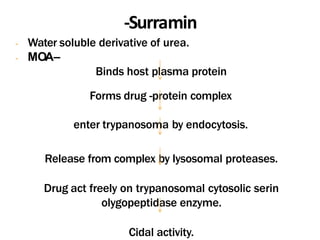
-Surramin
- Water soluble derivative of urea.
- MOA–
Binds host plasma protein
Forms drug -protein complex
enter trypanosoma by endocytosis.
Release from complex by lysosomal proteases.
Drug act freely on trypanosomal cytosolic serin
olygopeptidase enzyme.
Cidal activity.
- Effective to T.evansi, T.brucei and T.equinum.
- Ineffective to T.congolense and T.vivax.
- Narrow margin of safety.
- Cause hepato and nephrotoxicity, demage to
spleen and adrenal gland.
- Do not cross BBB, so not used in chronic
cases.
- Protozoa of camel resistant.
- Doses–
- Cattle – 12 mg/kg body wt.
- Horse – 7-10mg/kg body wt. slow IV
ANTIBABESIAL DRUGS.
• -Dimizine aceturate :
• doses– 3-5 mg/kg IM in cattle,
• 3.5 – 7 mg/kg subcut in dog.
• -Imidocarp
dipropionate: MOA–
• Cause an alteration in number and size of
nuclei and morphology (vacuolation) of
cytoplasm.
• Doses–
• 6.6 mg/kg IM or subcut to be repeated after
2 weeks in dogs.
-Amicabalide istheonate –
dose – cattle 5 – 10 mg/kg IM or subcut.
-T
erracyclines–
long acting formulation are used for prophylaxis
of babesia.
dose – 20 mg/kg every 4 days.
-Quinuroniumsulphate
it is used for pre-immunity in cattle against
babesia.
dose – 0.5 mg/kg subcut.
-T
rypanblue –
dose – 1 -4 gm IV cattle.
ANTI THELERIAL DRUGS.
1) Buparvaquone and parvaquone –
MOA–
- interfare with mitrochondral electron
transport and ATP synthesis, together with
nucleotide synthesis of protozoa.
- vaculation of cytoplasm.
Dose – 2.5 mg/kg IM single dose.
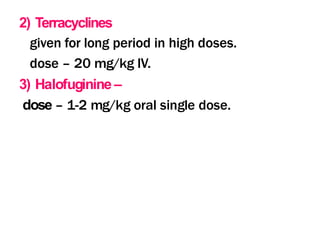
2) Terracyclines
given for long period in high doses.
dose – 20 mg/kg IV.
3) Halofuginine –
dose – 1-2 mg/kg oral single dose.
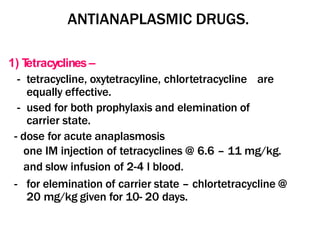
ANTIANAPLASMIC DRUGS.
1) T
etracyclines –
- tetracycline, oxytetracyline, chlortetracycline are
equally effective.
- used for both prophylaxis and elemination of
carrier state.
- dose for acute anaplasmosis
one IM injection of tetracyclines @ 6.6 – 11 mg/kg.
and slow infusion of 2-4 l blood.
- for elemination of carrier state – chlortetracycline @
20 mg/kg given for 10- 20 days.
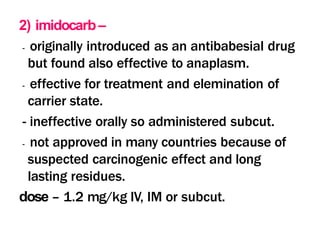
2) imidocarb–
- originally introduced as an antibabesial drug
but found also effective to anaplasm.
- effective for treatment and elemination of
carrier state.
- ineffective orally so administered subcut.
- not approved in many countries because of
suspected carcinogenic effect and long
lasting residues.
dose – 1.2 mg/kg IV, IM or subcut.

anti-protozoan.pptx

  • 1.
    TRYPANOCIDAL DRUGS 1. Diamidinegroup - - Diminazene aceturate,phenamidine, stilbamidine and pentamidine 2. Phenanthridium group – - phenidium, dimidium, homidium and isometamidium (trypamidium). 3. Quinapyramine compounds – - quinapyramine chloride and quinapyramine sulphate.
  • 2.
    - Diminazene aceturate Mechanismof action- - binds rapidly to complementary strands of DNA. - Interfere with DNA formation and parasite replication. - interfere aerobic glycosis - Displace Mg ions and inhibit function of polyamines in the parasite.
  • 3.
    - Pharmacology– - Poorlyabsorbed orally, rapid absorption through IM and subcut route. - Wide and rapid distribution in tissues. - Half life is 29 days in cattle. - Accumulate in liver, kidney and adrenal glands. - side effects– - Local reaction in horses at the site of injection . - In exotic dog neurotoxicity and nephrotoxicity. - Hepatic impairment.
  • 4.
    - Dose- for babesiaand trypanosomal infection 3.5 mg/kg of 7% freshly prepared aqueous solution. - Use – 1) trypanosomiasis in early stages. 2) babesial infection. 3)bactericidal against ( Brucella and streptococcus).
  • 5.
    - Phenanthridiumgroup– - itinclude phenidium, dimidium, homidium and isometamidium (trypamidium). Mechanism of action – - Cleave kinetoplast DNA resulting in diskinetoplastic DNA. - Inhibit cell division of protozoa. - Interfare with glycosomal function. - Homidium is mutagenic, trypanosoma exposed to it for 1 hour may retain motility for 24 hrs but no longer infective.
  • 6.
    - Pharmacology – -Phenidium and dimidium show photo sensation and toxicity, so homidium and isometamidium are used. - Orally poorly absorbed, IM and subcut rapidly absorbed. - Elemination in 24 hrs.
  • 7.
    Use – - effectiveagainst T.vivax, T.congolense. Less effective to T. brucei. - dose – - homidium as bromide and chloride salts single dose of 1mg/kg 2% solution IM.
  • 8.
    - isometamidium– - MOA- -Inhibit DNA synthesis. - Modify mitochondrial membrane and glycoprotein structure of ER. - Uses– - Narrow margin of safety. - Narrow spectrum of activity. - Used for prophylaxis against T. congolense and T. brucei in dogs. - Dose – - 0.5 – 1 mg/kg deep IM.
  • 9.
    Quinapyramine compounds– - itinclude quinapyramine chloride and quinapyramine sulphate. - 3 parts of dimethyl sulphate + 2 parts of dimethyl chloride = antrycide prosalt. it is used for therapy and prophylaxis. MOA – Cause kinetoplastic DNA convulsion, loss of ribosomes, aggregate formation with large no of lysosomes. - Trypanostatic in action.
  • 10.
    Pharmacology– - Poorly toleratedby horses. - Local reaction at site of injection so given 2 or more divided doses at 6 hr interval in 5% or 10% solution. - Effective against T.congolense, T.vivax, T. evensi Doses– - 4.4 mg/kg or 1gm total dose for body weight 150-200 kg. - Not given in young one cause polypnea, salvation, tachycardia and death may occur.
  • 11.
    -Surramin - Water solublederivative of urea. - MOA– Binds host plasma protein Forms drug -protein complex enter trypanosoma by endocytosis. Release from complex by lysosomal proteases. Drug act freely on trypanosomal cytosolic serin olygopeptidase enzyme. Cidal activity.
  • 12.
    - Effective toT.evansi, T.brucei and T.equinum. - Ineffective to T.congolense and T.vivax. - Narrow margin of safety. - Cause hepato and nephrotoxicity, demage to spleen and adrenal gland. - Do not cross BBB, so not used in chronic cases. - Protozoa of camel resistant. - Doses– - Cattle – 12 mg/kg body wt. - Horse – 7-10mg/kg body wt. slow IV
  • 13.
    ANTIBABESIAL DRUGS. • -Dimizineaceturate : • doses– 3-5 mg/kg IM in cattle, • 3.5 – 7 mg/kg subcut in dog. • -Imidocarp dipropionate: MOA– • Cause an alteration in number and size of nuclei and morphology (vacuolation) of cytoplasm. • Doses– • 6.6 mg/kg IM or subcut to be repeated after 2 weeks in dogs.
  • 14.
    -Amicabalide istheonate – dose– cattle 5 – 10 mg/kg IM or subcut. -T erracyclines– long acting formulation are used for prophylaxis of babesia. dose – 20 mg/kg every 4 days. -Quinuroniumsulphate it is used for pre-immunity in cattle against babesia. dose – 0.5 mg/kg subcut. -T rypanblue – dose – 1 -4 gm IV cattle.
  • 15.
    ANTI THELERIAL DRUGS. 1)Buparvaquone and parvaquone – MOA– - interfare with mitrochondral electron transport and ATP synthesis, together with nucleotide synthesis of protozoa. - vaculation of cytoplasm. Dose – 2.5 mg/kg IM single dose.
  • 16.
    2) Terracyclines given forlong period in high doses. dose – 20 mg/kg IV. 3) Halofuginine – dose – 1-2 mg/kg oral single dose.
  • 17.
    ANTIANAPLASMIC DRUGS. 1) T etracyclines– - tetracycline, oxytetracyline, chlortetracycline are equally effective. - used for both prophylaxis and elemination of carrier state. - dose for acute anaplasmosis one IM injection of tetracyclines @ 6.6 – 11 mg/kg. and slow infusion of 2-4 l blood. - for elemination of carrier state – chlortetracycline @ 20 mg/kg given for 10- 20 days.
  • 18.
    2) imidocarb– - originallyintroduced as an antibabesial drug but found also effective to anaplasm. - effective for treatment and elemination of carrier state. - ineffective orally so administered subcut. - not approved in many countries because of suspected carcinogenic effect and long lasting residues. dose – 1.2 mg/kg IV, IM or subcut.