Prof G N Purohit
Estrus synchronization in
domestic farm animals
Benefits of Estrus Synchronization
• Bringing a large number of animals in estrus at
nearly the same time is estrus synchronization
• Saving labor- Avoiding estrus detection
• Planned matings – Timed inseminations
• Planned calvings
• Shortened calving periods
• Uniformity of calves
Structures that regulate estrus
• Dominant Follicle
• Corpus luteum
Approaches
• Extending the luteal phase or
terminating the luteal phase
Progestins or prostaglandins
• Controlling the CL
• Control the Dominant Follicle and
initiation of new follicular wave
Optimum Management
• Cows should be well fed
• Regularly cyclic
• Grouping for estrus synchronization
»Heifers
»Post partum cows
»Anestrus non pregnant cows
Method Tradename Utilization
Gonadotropins Cystorelin
Fertagyl
Buserelin
Mature females
Prostaglandins Estrumate
Lutalyse
Prostamate
Cycling females
Progestins MGA
CIDR
Pre-pubertal heifers
Post-partum or
Anestrous females
Synchronization Methods
Prostaglandins
Prostaglandins
–Naturally occurring hormone that
causes regression of the CL
(luteolysis) and decreases
progesterone secretion
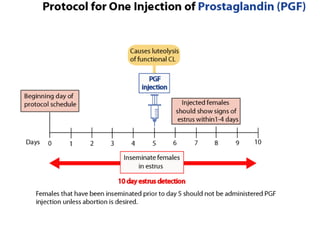
–Can expect estrus within two days
following injection
Principle of PGF2a Use
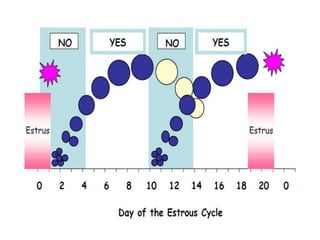
• Regress active corpus luteum
»Only effective on day 5 - 17
corpus luteum
»Not effective on days:
1 - 4 (CL not responsive)
18 - 21 (CL already
regressed)
Prostaglandins: PGF2a
Lutalyse - Natural compound 25
mg dose I.M.
Estrumate - Analogue 500 µg
dose I.M.
Lustin - Analogue 500 µg dose
I.M.
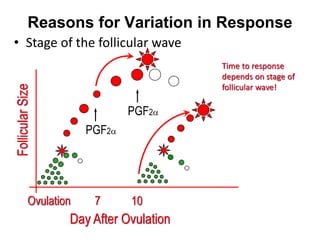
Reasons for Variation in Response
• Stage of the follicular wave
FollicularSize
PGF2
PGF2
Ovulation 7
Time to response
depends on stage of
follicular wave!
10
Day After Ovulation
• Heifers react faster than cows
– Follicular growth is faster in heifers
• Animals may be pregnant
• No CL may be present – Anestrus
• Brahman cattle respond poorly to the two
injection system of PGF2a
Management Considerations
• Have proper facilities to handle animals
• Good reproductive records
• Have enough A.I. technician help
– One technician/100 cows will cause problems
– Should be around 30-50 cows/technician
• Anestrus cows don’t respond to PGF2
– No CL!!!!!!
– Be sure cows & heifers cycling
• Use good fertility semen
Breeding
1. Breed 72-80 hours after
2nd injection (FTAI)
2. Breed based on estrus
detection after PGF2a
Conception Rate
31 - 80%
67%
• Progestagens have been specially useful for
estrus synchronization of
• Treatment of cycling heifers or cows with low
levels of a progestin, following luteolysis,
resulted in the formation of persistent follicles
that had a large diameter, extended lifespan,
and increased production of estradiol
Use of Progestogens
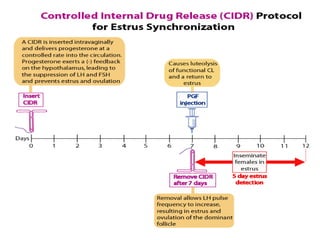
Mechanisms of action of progestins
• Progesterone concentrations are maintained
at a relatively constant level during the seven
days the insert is in the vagina. Upon removal
of the insert, progesterone concentrations are
quickly eliminated.
• The progesterone treatment blocks ovulation
of a DF and also suprresses its dominance.
Thus a new follicular wave is initiated
• Suppresses LH surge and estrus behavior
Effective method for treating anestrus
• -increases DF development
• -primes estrus expression and LH surge
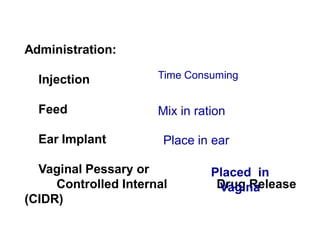
Administration:
Injection
Feed
Ear Implant
Vaginal Pessary or
Controlled Internal Drug Release
(CIDR)
Time Consuming
Mix in ration
Place in ear
Placed in
Vagina
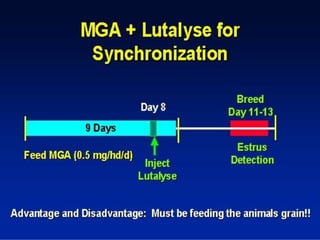
Oral feeding of melengesterol to
heifers 14 days
Disadvantages of oral feeding for 14
days
• Persistent follicles
Progesterone Vaginal Implants
• CIDR-B
• TRIU-B
• PRID
GnRH Based Protocols
• Principle:
• GnRH-induced LH release causes ovulation or
• luteinization of the physiologically mature DF
• –Loss of the DF leads to emergence of a new
• follicular wave
• Destruction or ovulation of a dominant follicle results
in a transient rise in circulating concentrations of FSH
and subsequent initiation of a new follicular wave. PG
administered 7 days later induces estrus and a second
GnRH 2 days later assures ovulation.
• OVSYNCH
• SELECT SYNCH
• CO SYNCH
Estrus synchronization for heifers
5-day PG + CIDR
66-72 hr
Cow Systems
With heat detection
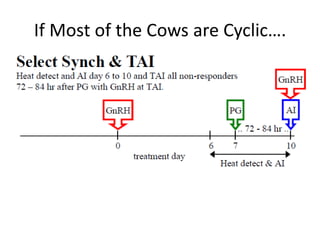
If Most of the Cows are Cyclic….
If Most of The Cows Are Anestrus…
Estrus synchronization in buffaloes
• PG and Ovsynch protocols useful in the breeding
season only
• Progesterone treatments along with estradiol,
eCG, PG and GnRH more useful during non-
breeding seasons.
• Day 0-------------------- Day 9 ---------------Day 11---------------- Day 12
• PRID/CIDR+E2 eCG + PG GnRH or hCG (AI)
Estrus synchronization in sheep and
goats
• Non-breeding season
• Use progestagen/progesterone impregnated
vaginal devices
• Use the ram effect
• Use melatonin Melovine/Regulin Implants
Use progestagen/progesterone impregnated
vaginal devices
• Three types of devices are available:
cronolone (20mg) impregnated
sponges (Chronogest CR, MSD AH),
Methyl Acetoxy Progesterone (60mg)
impregnated sponges and CIDR(0.3g
progesterone)
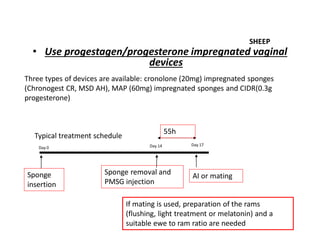
• Use progestagen/progesterone impregnated vaginal
devices
Three types of devices are available: cronolone (20mg) impregnated sponges
(Chronogest CR, MSD AH), MAP (60mg) impregnated sponges and CIDR(0.3g
progesterone)
Typical treatment schedule
Day 0 Day 14 Day 17
Sponge
insertion
Sponge removal and
PMSG injection
AI or mating
55h
SHEEP
If mating is used, preparation of the rams
(flushing, light treatment or melatonin) and a
suitable ewe to ram ratio are needed
Three types of devices are available: cronolone (20mg) impregnated sponges
(Chronogest CR, MSD AH), and CIDR
Typical treatment schedule
Day 0 Day 11 Day 13
Sponge
insertion
Sponge
removal
AI or mating
44h
GOAT
Day 9
Prostaglandin
injection and
PMSG
administration
Bucks also need to be
prepared!
Use PMSG at removal of
progestagen/progesterone impregnated vaginal
devices
Use Androvax, a vaccine against an ovarian
steroid
Breeding season
Use of Ovsynch type protocols
Use of double prostaglandin protocols
Estrus synchronization in sows
• Gilts PG600 estrus within 5-8 d
• Oral Feeding of metallibure 19 d estrus in 5-8 d
• Allyl trenbolone (Regumate) 10-15 mg/gilt/day
Mixed in feed for 18 d
• Norgestomet ear implant
• Estradiol benzoate 5-15 d followed by PG
Estrus synchronization in mares
• Light treatment 60 W incandescent bulb for 1
month
Deslorelin 1.5 mg IM once
Domperidone 1.1 mg/kg PO SID for 10-14 days
Sulpiride 1.0 mg/kg IM SID or BID
Induction of ovulation – hCG effective only after
follicle is 30 mm
Single GnRH ineffective
Termination of luteal phase (Use prostaglandins)
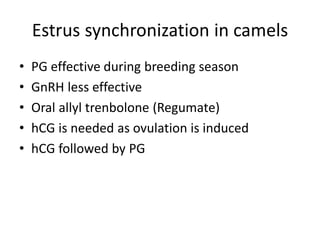
Estrus synchronization in camels
• PG effective during breeding season
• GnRH less effective
• Oral allyl trenbolone (Regumate)
• hCG is needed as ovulation is induced
• hCG followed by PG
• The above lectures are also explained in video
lectures at my YouTube Channel Govind
Narayan Purohit
• Kindly share the videos and subscribe to my
channel if you like them
• Thanks

Lecture 6 estrus synchronization

  • 1.
    Prof G NPurohit Estrus synchronization in domestic farm animals
  • 2.
    Benefits of EstrusSynchronization • Bringing a large number of animals in estrus at nearly the same time is estrus synchronization • Saving labor- Avoiding estrus detection • Planned matings – Timed inseminations • Planned calvings • Shortened calving periods • Uniformity of calves
  • 3.
    Structures that regulateestrus • Dominant Follicle • Corpus luteum
  • 4.
    Approaches • Extending theluteal phase or terminating the luteal phase Progestins or prostaglandins • Controlling the CL • Control the Dominant Follicle and initiation of new follicular wave
  • 5.
    Optimum Management • Cowsshould be well fed • Regularly cyclic • Grouping for estrus synchronization »Heifers »Post partum cows »Anestrus non pregnant cows
  • 6.
    Method Tradename Utilization GonadotropinsCystorelin Fertagyl Buserelin Mature females Prostaglandins Estrumate Lutalyse Prostamate Cycling females Progestins MGA CIDR Pre-pubertal heifers Post-partum or Anestrous females Synchronization Methods
  • 7.
    Prostaglandins Prostaglandins –Naturally occurring hormonethat causes regression of the CL (luteolysis) and decreases progesterone secretion –Can expect estrus within two days following injection
  • 8.
    Principle of PGF2aUse • Regress active corpus luteum »Only effective on day 5 - 17 corpus luteum »Not effective on days: 1 - 4 (CL not responsive) 18 - 21 (CL already regressed)
  • 10.
    Prostaglandins: PGF2a Lutalyse -Natural compound 25 mg dose I.M. Estrumate - Analogue 500 µg dose I.M. Lustin - Analogue 500 µg dose I.M.
  • 13.
    Reasons for Variationin Response • Stage of the follicular wave FollicularSize PGF2 PGF2 Ovulation 7 Time to response depends on stage of follicular wave! 10 Day After Ovulation
  • 14.
    • Heifers reactfaster than cows – Follicular growth is faster in heifers • Animals may be pregnant • No CL may be present – Anestrus • Brahman cattle respond poorly to the two injection system of PGF2a
  • 15.
    Management Considerations • Haveproper facilities to handle animals • Good reproductive records • Have enough A.I. technician help – One technician/100 cows will cause problems – Should be around 30-50 cows/technician • Anestrus cows don’t respond to PGF2 – No CL!!!!!! – Be sure cows & heifers cycling • Use good fertility semen
  • 16.
    Breeding 1. Breed 72-80hours after 2nd injection (FTAI) 2. Breed based on estrus detection after PGF2a Conception Rate 31 - 80% 67%
  • 17.
    • Progestagens havebeen specially useful for estrus synchronization of • Treatment of cycling heifers or cows with low levels of a progestin, following luteolysis, resulted in the formation of persistent follicles that had a large diameter, extended lifespan, and increased production of estradiol Use of Progestogens
  • 18.
    Mechanisms of actionof progestins • Progesterone concentrations are maintained at a relatively constant level during the seven days the insert is in the vagina. Upon removal of the insert, progesterone concentrations are quickly eliminated. • The progesterone treatment blocks ovulation of a DF and also suprresses its dominance. Thus a new follicular wave is initiated
  • 19.
    • Suppresses LHsurge and estrus behavior Effective method for treating anestrus • -increases DF development • -primes estrus expression and LH surge
  • 20.
    Administration: Injection Feed Ear Implant Vaginal Pessaryor Controlled Internal Drug Release (CIDR) Time Consuming Mix in ration Place in ear Placed in Vagina
  • 21.
    Oral feeding ofmelengesterol to heifers 14 days
  • 22.
    Disadvantages of oralfeeding for 14 days • Persistent follicles
  • 24.
    Progesterone Vaginal Implants •CIDR-B • TRIU-B • PRID
  • 26.
    GnRH Based Protocols •Principle: • GnRH-induced LH release causes ovulation or • luteinization of the physiologically mature DF • –Loss of the DF leads to emergence of a new • follicular wave • Destruction or ovulation of a dominant follicle results in a transient rise in circulating concentrations of FSH and subsequent initiation of a new follicular wave. PG administered 7 days later induces estrus and a second GnRH 2 days later assures ovulation.
  • 28.
    • OVSYNCH • SELECTSYNCH • CO SYNCH
  • 33.
  • 35.
  • 36.
    5-day PG +CIDR 66-72 hr
  • 37.
  • 38.
    If Most ofthe Cows are Cyclic….
  • 39.
    If Most ofThe Cows Are Anestrus…
  • 41.
    Estrus synchronization inbuffaloes • PG and Ovsynch protocols useful in the breeding season only • Progesterone treatments along with estradiol, eCG, PG and GnRH more useful during non- breeding seasons. • Day 0-------------------- Day 9 ---------------Day 11---------------- Day 12 • PRID/CIDR+E2 eCG + PG GnRH or hCG (AI)
  • 42.
    Estrus synchronization insheep and goats • Non-breeding season • Use progestagen/progesterone impregnated vaginal devices • Use the ram effect • Use melatonin Melovine/Regulin Implants
  • 43.
    Use progestagen/progesterone impregnated vaginaldevices • Three types of devices are available: cronolone (20mg) impregnated sponges (Chronogest CR, MSD AH), Methyl Acetoxy Progesterone (60mg) impregnated sponges and CIDR(0.3g progesterone)
  • 44.
    • Use progestagen/progesteroneimpregnated vaginal devices Three types of devices are available: cronolone (20mg) impregnated sponges (Chronogest CR, MSD AH), MAP (60mg) impregnated sponges and CIDR(0.3g progesterone) Typical treatment schedule Day 0 Day 14 Day 17 Sponge insertion Sponge removal and PMSG injection AI or mating 55h SHEEP If mating is used, preparation of the rams (flushing, light treatment or melatonin) and a suitable ewe to ram ratio are needed
  • 45.
    Three types ofdevices are available: cronolone (20mg) impregnated sponges (Chronogest CR, MSD AH), and CIDR Typical treatment schedule Day 0 Day 11 Day 13 Sponge insertion Sponge removal AI or mating 44h GOAT Day 9 Prostaglandin injection and PMSG administration Bucks also need to be prepared!
  • 46.
    Use PMSG atremoval of progestagen/progesterone impregnated vaginal devices Use Androvax, a vaccine against an ovarian steroid
  • 47.
    Breeding season Use ofOvsynch type protocols Use of double prostaglandin protocols
  • 48.
    Estrus synchronization insows • Gilts PG600 estrus within 5-8 d • Oral Feeding of metallibure 19 d estrus in 5-8 d • Allyl trenbolone (Regumate) 10-15 mg/gilt/day Mixed in feed for 18 d • Norgestomet ear implant • Estradiol benzoate 5-15 d followed by PG
  • 49.
    Estrus synchronization inmares • Light treatment 60 W incandescent bulb for 1 month Deslorelin 1.5 mg IM once Domperidone 1.1 mg/kg PO SID for 10-14 days Sulpiride 1.0 mg/kg IM SID or BID Induction of ovulation – hCG effective only after follicle is 30 mm Single GnRH ineffective Termination of luteal phase (Use prostaglandins)
  • 50.
    Estrus synchronization incamels • PG effective during breeding season • GnRH less effective • Oral allyl trenbolone (Regumate) • hCG is needed as ovulation is induced • hCG followed by PG
  • 51.
    • The abovelectures are also explained in video lectures at my YouTube Channel Govind Narayan Purohit • Kindly share the videos and subscribe to my channel if you like them • Thanks