ANTINEMATODAL DRUGS
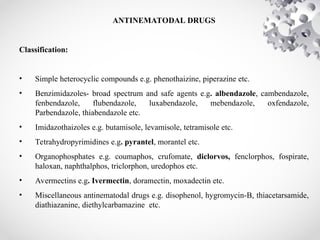
Classification:
• Simple heterocyclic compounds e.g. phenothaizine, piperazine etc.
• Benzimidazoles- broad spectrum and safe agents e.g. albendazole, cambendazole,
fenbendazole, flubendazole, luxabendazole, mebendazole, oxfendazole,
Parbendazole, thiabendazole etc.
• Imidazothaizoles e.g. butamisole, levamisole, tetramisole etc.
• Tetrahydropyrimidines e.g. pyrantel, morantel etc.
• Organophosphates e.g. coumaphos, crufomate, diclorvos, fenclorphos, fospirate,
haloxan, naphthalphos, triclorphon, uredophos etc.
• Avermectins e.g. Ivermectin, doramectin, moxadectin etc.
• Miscellaneous antinematodal drugs e.g. disophenol, hygromycin-B, thiacetarsamide,
diathiazanine, diethylcarbamazine etc.
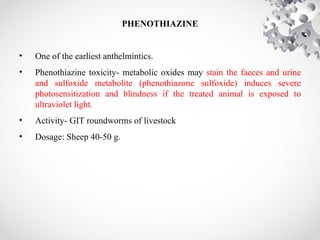
PHENOTHIAZINE
• One of the earliest anthelmintics.
• Phenothiazine toxicity- metabolic oxides may stain the faeces and urine
and sulfoxide metabolite (phenothiazone sulfoxide) induces severe
photosensitization and blindness if the treated animal is exposed to
ultraviolet light.
• Activity- GIT roundworms of livestock
• Dosage: Sheep 40-50 g.
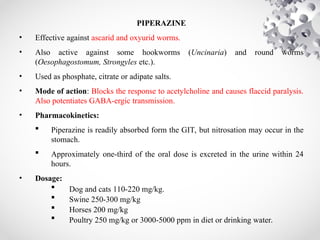
PIPERAZINE
• Effective against ascarid and oxyurid worms.
• Also active against some hookworms (Uncinaria) and round worms
(Oesophagostomum, Strongyles etc.).
• Used as phosphate, citrate or adipate salts.
• Mode of action: Blocks the response to acetylcholine and causes flaccid paralysis.
Also potentiates GABA-ergic transmission.
• Pharmacokinetics:
 Piperazine is readily absorbed form the GIT, but nitrosation may occur in the
stomach.
 Approximately one-third of the oral dose is excreted in the urine within 24
hours.
• Dosage:
 Dog and cats 110-220 mg/kg.
 Swine 250-300 mg/kg
 Horses 200 mg/kg
 Poultry 250 mg/kg or 3000-5000 ppm in diet or drinking water.
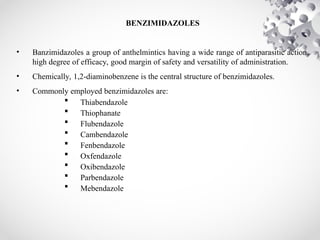
BENZIMIDAZOLES
• Banzimidazoles a group of anthelmintics having a wide range of antiparasitic action,
high degree of efficacy, good margin of safety and versatility of administration.
• Chemically, 1,2-diaminobenzene is the central structure of benzimidazoles.
• Commonly employed benzimidazoles are:
 Thiabendazole
 Thiophanate
 Flubendazole
 Cambendazole
 Fenbendazole
 Oxfendazole
 Oxibendazole
 Parbendazole
 Mebendazole
Mechanism of action:
• The benzimidazoles act primarily by binding to nematode
tubulin – specifically dimeric tubulin, which in turn prevents
plomerization of tubulin during microtubule assembly.
• The earlier effects ascribed to benzimidazoles; such as
inhibition of fumarate reductase activity may be secondary
to disruption of microtubules, which are essential for
secretion of many enzymes.
• Benzimidazoles have much higher affinity for nematode
than mammalian tubulin (hence selectivity). The tubulin of
benzimidazole-resistant nematodes has a much lower
affinity to benzimidazoles.
• Anthelmintic spectrum:
Horse:
 Substituted benzimidazoles and thiabendazole have high activity (>90%) against
adult forms of large Strongyles, small strongyles, mature Oxyuris equi, small pin-
worms, Trichostrogyles axei.
 Ascarids and immature oxyurids are effectively eliminated by substituted
benzimidazoles than thiabendazole.
 Albendazole- effective against equine lungworms (@25 mg/kg b.i.d. for 5 days).
Cattle & Sheep:
 Substituted benzimidazoles can be used to control lungworms of cattle and sheep.
 Substituted benzimidazoles are markedly effective against GI nematodes (both adult
and immature larval stage) of sheep and cattle.
 Most benzimidazoles have limited efficacy against ruminant whipworm, filarial
parasites, tapeworms and flukes. However, flubendazole, oxibendazole and
oxfendazole are useful for whipworms and albendazole and fenbendazole are active
against certain tapeworms and flukes.
Swine:
 Thiabendazole is effective against Hyostrongylus rubidis, Strogyles ransomi and
Oesophagostomum dentatum.
 Fenbedazole is highly effective against kidney worm (Stephanarus dentatus) and lunworm
(metastrongyles spp.).
 Parbendazole has 90% efficacy against Trichuris suis.
Dogs & Cats:
 Mebendazole effective against hookworms and tapeworms (Taenia spp.).
 Fenbendazole effective against nematodes and cestodes (Taenia spp.).
 Oxfendazole effective against Filaroides osleri infection of trachea.
Birds:
 Cambendazole, mebendazole and fenbendazole are effective against the parasites of GI and
respiratory tracts.
 Cambendazole eliminates 99% of adult population of Syngamus trachea.
 Mebendazole and fenbendazole are also effective against the common avian tapeworms.
Toxicity:
• Benzimidazoles are extremely well tolerated by domestic
animals and are generally free from side effects/adverse effects
at normal therapeutic doses.
Contraindications:
• Slaughter clearance time is necessary because of tissue and
milk residues.
• For sheep or cattle treated with parbendazole, pre-slaughter
withdrawal time is 5 day and 6 days, respectively; while for
cambendazole it is 28 days and 21 days, respectively.
• Parbendazole and cambendazole exert teratogenic effect in
pregnant sheep (contraindicated in pregnant sheep).
Benzimidazoles are not recommended in pregnant animals.
PROBENZIMIDAZOLES
• Probenzimidazoles are produgs e.g. netobimin and febantel. After metabolic
cyclizization, netobimin and febantel yield active metabolite- albendazole and
fenbendazole, respectively.
Netobimin:
• Broad spectrum anthelmintic.
• Possesses nematocidal, cestocidal and fasciolicidal activities in ruminants and
nematocidal in equines.
Febantel:
• Broad spectrum anthelmintic.
• Used in dogs in combination with praziquantel.
• Toxicity- has a wide margin of safety, however teratogenic in pregnant sheep.
• Dosage and administration: Horse 6 mg/kg as oral suspension; Dogs & cats (>6
months old) 10 mg/kg for 3 days and Pups and Kitten 15 mg/kg for 3 days.
IMIDAZOTHIAZOLES
• Important derivatives of imidazothaizoles include tetramisole, levamisole,
butamisole and m-aminotetramisole.
LEVAMISOLE
Mechanism of action:
• Nicotine-like action, first stimulating and subsequently blocking the
neuromuscular junctions i.e. essentially a cholinergic agent. Also reported
to inhibit fumarate reductase.
Anthelmintic spectrum:
• Levamisole is effective against the matured and larval (immature)
roundworms and lungworms following oral/parenteral administration.
• Limited efficacy against canine heartworm.
• Exerts very rapid effect on the targets, removing most of the parasites
within a day (24 hours).
Pharmacokinetic Profile:
• Rapidly absorbed following oral or parenteral dosing.
• Levamisole gets hydrolyzed to insoluble metabolite
• Rapidly excreted from the body (46% in urine and 32 % in faeces within 24 hours).
• Has a short withdrawal period of 3 days for meat and one day for milk.
• Not recommended in lactating animals.
Dosage:
 Cattle 7.5 mg/kg
 Sheep 7.5 mg/kg
 Pigs 7.5 mg/kg
 Dogs 5 mg/kg
 Poultry 25-30 mg/kg
Toxicity:
• Margin of safety- 5 to 6 times the recommended dose.
• Non-embryo toxic and non teratogenic.
BUTAMISOLE
• Injectable imidazothaizole anthelmintic used in dogs to treat
whipworm (Trichuris vulpis) and hookworm (Ancylostoma
caninum).
• Dosage 2.4 mg/kg SC
TETRAMISOLE
• Effective against the gapeworm (Syngamus trachea).
• Administered in drinking water @ 3.6 mg/kg/day for 3 days.
TETRAHYDROPYRIMIDINES
• Pyrantel and morantel are two important derivatives of tetrahydropyrimidines used as effective
anthelmintics.
PYRANTEL
• Broad spectrum anthelmintic introduced in 1966. Used as hydrochloride, tartarate or pamoate
salts.
Mechanism of action:
• Acts by depolarizing the helminth neuromuscular junction, causing spasm and paralysis.
Pyrantel also possesses some anti-cholinesterase activity.
Anthelmintic spectrum:
• Horse: Active against Parascaris equorum, Strongyles vulgaris, S. equinus and Prosbtmyria
vivipara (equine pinworm). Less active and variable activity against S. edantatus, small
stronglyes and mature O. equi.
• Swine: Pyrantel tartarate is effective against Ascaris and Oesophagostomum spp. Of swine.
• Sheep and cattle: Pyrantel tartarate is an effective broad spectrum anthelmintic in ruminants.
Active against Haemonchus contortus, Ostertagia ostertagia, O. cicumcinta, Trichostrongylus
axie and T. colubriformis, Nematodorius battus and N. spathiger, Cooperia and Bunustomum.
• Dogs: Pyrantel pamoate is highly effective against common hookworms, ascarids and stomach
worms of dogs at s single does of 5 mg/kg.
Toxicity:
• Generally free from toxic effects up to 7 times the therapeutic dose.
• Tartarate salt is less tolerated than pamoate salt in horses. Mortality reported
with tartarate salt (@ 100 mg/kg).
• Ataxia observed in cattle treated with high dose of pyrantel tartarate (@ 200
mg/kg).
Contraindications:
• Contraindicated in severely weak and emaciated animals.
• Withdrawal time be followed in food animals.
• Should not be given together with other cholinergic drugs like levamisole
(potentiates toxicity).
Dosage:
• Pyrantel tartarate
 Horse 12.5 mg/kk
 Swine 22 mg/kg
 Sheep, goats and cattle 25 mg/kg
• Pyrantel pamoate
 Horse 6.6 mg/kg
 Dogs 5 mg/kg for dogs over 2.2 kg; 15 mg/kg for dogs
less than 2.2 kg body weight (with or 30 minutes after
light meal).
MORANTEL
• Methyl ester of pyrantel.
• Used as fumarate or tartarate salt.
• Morantel has greater anthelmintic activity than the parent compound
(pyrantel).
ORGANOPHOSPHORUS COMPOUNDS
• Mechanism of action: Irreversible inhibition of acetylcholinesterase
enzyme of the parasites.
• Commonly employed OP anthelmintics:
 Dichlorovos (O, O-dimethyl O- (2,2-dichlorovinyl) phosphate
(DDVP).
 Haloxan: Safest OP- anthelmintic fir use in ruminants.
 Coumaphos: Can be safely used in lactating animals.
 Trichlorfon: Used as an anthelmintic in horses.
 Crufomate: Anthelmintic for control of warble fly.
AVERMECTINS/MACROLIDES
 Avermectins and closely related milbemycins are antibiotics
produced by Actinomyces microbes and are termed as
macrocytic lactones “ Macrolides”.
 Extremely potent agents.
 Effective against endo- and ectoparasites.
 Effective at very small dose.
 Streptomyces avermitilis produced 8 major avermectins.
 Avermectins are not effective against plythhelminthes
(flukes and tapeworms) because these worms do not use
GABA as neurotransmitter.
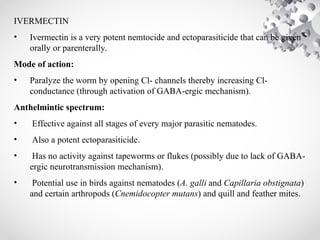
IVERMECTIN
• Ivermectin is a very potent nemtocide and ectoparasiticide that can be given
orally or parenterally.
Mode of action:
• Paralyze the worm by opening Cl- channels thereby increasing Cl-
conductance (through activation of GABA-ergic mechanism).
Anthelmintic spectrum:
• Effective against all stages of every major parasitic nematodes.
• Also a potent ectoparasiticide.
• Has no activity against tapeworms or flukes (possibly due to lack of GABA-
ergic neurotransmission mechanism).
• Potential use in birds against nematodes (A. galli and Capillaria obstignata)
and certain arthropods (Cnemidocopter mutans) and quill and feather mites.
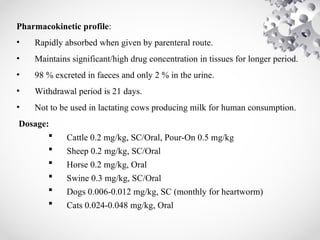
Pharmacokinetic profile:
• Rapidly absorbed when given by parenteral route.
• Maintains significant/high drug concentration in tissues for longer period.
• 98 % excreted in faeces and only 2 % in the urine.
• Withdrawal period is 21 days.
• Not to be used in lactating cows producing milk for human consumption.
Dosage:
 Cattle 0.2 mg/kg, SC/Oral, Pour-On 0.5 mg/kg
 Sheep 0.2 mg/kg, SC/Oral
 Horse 0.2 mg/kg, Oral
 Swine 0.3 mg/kg, SC/Oral
 Dogs 0.006-0.012 mg/kg, SC (monthly for heartworm)
 Cats 0.024-0.048 mg/kg, Oral
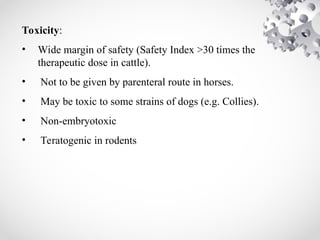
Toxicity:
• Wide margin of safety (Safety Index >30 times the
therapeutic dose in cattle).
• Not to be given by parenteral route in horses.
• May be toxic to some strains of dogs (e.g. Collies).
• Non-embryotoxic
• Teratogenic in rodents
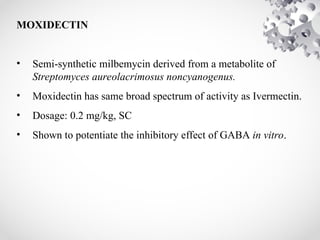
MOXIDECTIN
• Semi-synthetic milbemycin derived from a metabolite of
Streptomyces aureolacrimosus noncyanogenus.
• Moxidectin has same broad spectrum of activity as Ivermectin.
• Dosage: 0.2 mg/kg, SC
• Shown to potentiate the inhibitory effect of GABA in vitro.
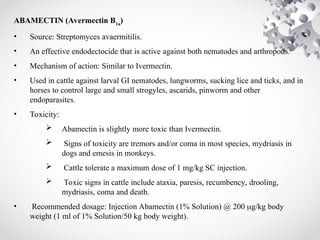
ABAMECTIN (Avermectin B1a
)
• Source: Streptomyces avaermitilis.
• An effective endodectocide that is active against both nematodes and arthropods.
• Mechanism of action: Similar to Ivermectin.
• Used in cattle against larval GI nematodes, lungworms, sucking lice and ticks, and in
horses to control large and small strogyles, ascarids, pinworm and other
endoparasites.
• Toxicity:
 Abamectin is slightly more toxic than Ivermectin.
 Signs of toxicity are tremors and/or coma in most species, mydriasis in
dogs and emesis in monkeys.
 Cattle tolerate a maximum dose of 1 mg/kg SC injection.
 Toxic signs in cattle include ataxia, paresis, recumbency, drooling,
mydriasis, coma and death.
• Recommended dosage: Injection Abamectin (1% Solution) @ 200 g/kg body
weight (1 ml of 1% Solution/50 kg body weight).
DORAMECTIN
• Endodectocide effective against GI nematodes, lungworms, eyeworms,
sucking lice, grubs, ticks, mites and screw worms in cattle.
• Also used against swine endo- and ectoparasites.
• Mechanism of Action: Similar to Ivermectin.
• Recommended dosage: Cattle 200 g/kg SC; Swine 300 g/kg IM; Pour-On
(5%) 0.5 mg/kg.
EPRINOMECTIN
• Modified fermentation derivative of Streptomyces avermitilis.
• Used as endodectocide in beef and dairy cattle.
• Mechanism of action: Similar to Ivermectin.
• Recommended dose: Pour-On (5%) 0.5 mg/kg.
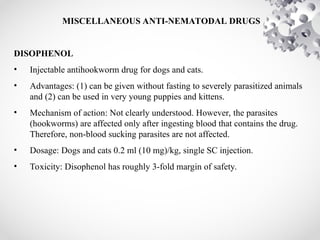
MISCELLANEOUS ANTI-NEMATODAL DRUGS
DISOPHENOL
• Injectable antihookworm drug for dogs and cats.
• Advantages: (1) can be given without fasting to severely parasitized animals
and (2) can be used in very young puppies and kittens.
• Mechanism of action: Not clearly understood. However, the parasites
(hookworms) are affected only after ingesting blood that contains the drug.
Therefore, non-blood sucking parasites are not affected.
• Dosage: Dogs and cats 0.2 ml (10 mg)/kg, single SC injection.
• Toxicity: Disophenol has roughly 3-fold margin of safety.
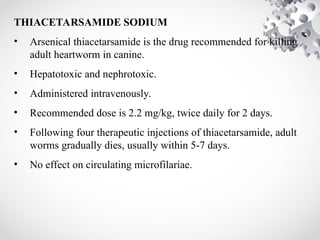
THIACETARSAMIDE SODIUM
• Arsenical thiacetarsamide is the drug recommended for killing
adult heartworm in canine.
• Hepatotoxic and nephrotoxic.
• Administered intravenously.
• Recommended dose is 2.2 mg/kg, twice daily for 2 days.
• Following four therapeutic injections of thiacetarsamide, adult
worms gradually dies, usually within 5-7 days.
• No effect on circulating microfilariae.
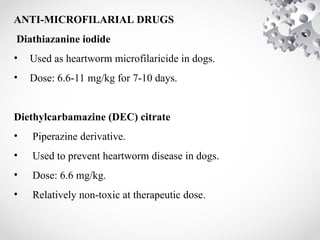
ANTI-MICROFILARIAL DRUGS
Diathiazanine iodide
• Used as heartworm microfilaricide in dogs.
• Dose: 6.6-11 mg/kg for 7-10 days.
Diethylcarbamazine (DEC) citrate
• Piperazine derivative.
• Used to prevent heartworm disease in dogs.
• Dose: 6.6 mg/kg.
• Relatively non-toxic at therapeutic dose.

ANTINEMATODAL bbbbbbbbbbhhjhhhhDRUGS.ppt

  • 1.
    ANTINEMATODAL DRUGS Classification: • Simpleheterocyclic compounds e.g. phenothaizine, piperazine etc. • Benzimidazoles- broad spectrum and safe agents e.g. albendazole, cambendazole, fenbendazole, flubendazole, luxabendazole, mebendazole, oxfendazole, Parbendazole, thiabendazole etc. • Imidazothaizoles e.g. butamisole, levamisole, tetramisole etc. • Tetrahydropyrimidines e.g. pyrantel, morantel etc. • Organophosphates e.g. coumaphos, crufomate, diclorvos, fenclorphos, fospirate, haloxan, naphthalphos, triclorphon, uredophos etc. • Avermectins e.g. Ivermectin, doramectin, moxadectin etc. • Miscellaneous antinematodal drugs e.g. disophenol, hygromycin-B, thiacetarsamide, diathiazanine, diethylcarbamazine etc.
  • 2.
    PHENOTHIAZINE • One ofthe earliest anthelmintics. • Phenothiazine toxicity- metabolic oxides may stain the faeces and urine and sulfoxide metabolite (phenothiazone sulfoxide) induces severe photosensitization and blindness if the treated animal is exposed to ultraviolet light. • Activity- GIT roundworms of livestock • Dosage: Sheep 40-50 g.
  • 3.
    PIPERAZINE • Effective againstascarid and oxyurid worms. • Also active against some hookworms (Uncinaria) and round worms (Oesophagostomum, Strongyles etc.). • Used as phosphate, citrate or adipate salts. • Mode of action: Blocks the response to acetylcholine and causes flaccid paralysis. Also potentiates GABA-ergic transmission. • Pharmacokinetics:  Piperazine is readily absorbed form the GIT, but nitrosation may occur in the stomach.  Approximately one-third of the oral dose is excreted in the urine within 24 hours. • Dosage:  Dog and cats 110-220 mg/kg.  Swine 250-300 mg/kg  Horses 200 mg/kg  Poultry 250 mg/kg or 3000-5000 ppm in diet or drinking water.
  • 4.
    BENZIMIDAZOLES • Banzimidazoles agroup of anthelmintics having a wide range of antiparasitic action, high degree of efficacy, good margin of safety and versatility of administration. • Chemically, 1,2-diaminobenzene is the central structure of benzimidazoles. • Commonly employed benzimidazoles are:  Thiabendazole  Thiophanate  Flubendazole  Cambendazole  Fenbendazole  Oxfendazole  Oxibendazole  Parbendazole  Mebendazole
  • 5.
    Mechanism of action: •The benzimidazoles act primarily by binding to nematode tubulin – specifically dimeric tubulin, which in turn prevents plomerization of tubulin during microtubule assembly. • The earlier effects ascribed to benzimidazoles; such as inhibition of fumarate reductase activity may be secondary to disruption of microtubules, which are essential for secretion of many enzymes. • Benzimidazoles have much higher affinity for nematode than mammalian tubulin (hence selectivity). The tubulin of benzimidazole-resistant nematodes has a much lower affinity to benzimidazoles.
  • 6.
    • Anthelmintic spectrum: Horse: Substituted benzimidazoles and thiabendazole have high activity (>90%) against adult forms of large Strongyles, small strongyles, mature Oxyuris equi, small pin- worms, Trichostrogyles axei.  Ascarids and immature oxyurids are effectively eliminated by substituted benzimidazoles than thiabendazole.  Albendazole- effective against equine lungworms (@25 mg/kg b.i.d. for 5 days). Cattle & Sheep:  Substituted benzimidazoles can be used to control lungworms of cattle and sheep.  Substituted benzimidazoles are markedly effective against GI nematodes (both adult and immature larval stage) of sheep and cattle.  Most benzimidazoles have limited efficacy against ruminant whipworm, filarial parasites, tapeworms and flukes. However, flubendazole, oxibendazole and oxfendazole are useful for whipworms and albendazole and fenbendazole are active against certain tapeworms and flukes.
  • 7.
    Swine:  Thiabendazole iseffective against Hyostrongylus rubidis, Strogyles ransomi and Oesophagostomum dentatum.  Fenbedazole is highly effective against kidney worm (Stephanarus dentatus) and lunworm (metastrongyles spp.).  Parbendazole has 90% efficacy against Trichuris suis. Dogs & Cats:  Mebendazole effective against hookworms and tapeworms (Taenia spp.).  Fenbendazole effective against nematodes and cestodes (Taenia spp.).  Oxfendazole effective against Filaroides osleri infection of trachea. Birds:  Cambendazole, mebendazole and fenbendazole are effective against the parasites of GI and respiratory tracts.  Cambendazole eliminates 99% of adult population of Syngamus trachea.  Mebendazole and fenbendazole are also effective against the common avian tapeworms.
  • 8.
    Toxicity: • Benzimidazoles areextremely well tolerated by domestic animals and are generally free from side effects/adverse effects at normal therapeutic doses. Contraindications: • Slaughter clearance time is necessary because of tissue and milk residues. • For sheep or cattle treated with parbendazole, pre-slaughter withdrawal time is 5 day and 6 days, respectively; while for cambendazole it is 28 days and 21 days, respectively. • Parbendazole and cambendazole exert teratogenic effect in pregnant sheep (contraindicated in pregnant sheep). Benzimidazoles are not recommended in pregnant animals.
  • 9.
    PROBENZIMIDAZOLES • Probenzimidazoles areprodugs e.g. netobimin and febantel. After metabolic cyclizization, netobimin and febantel yield active metabolite- albendazole and fenbendazole, respectively. Netobimin: • Broad spectrum anthelmintic. • Possesses nematocidal, cestocidal and fasciolicidal activities in ruminants and nematocidal in equines. Febantel: • Broad spectrum anthelmintic. • Used in dogs in combination with praziquantel. • Toxicity- has a wide margin of safety, however teratogenic in pregnant sheep. • Dosage and administration: Horse 6 mg/kg as oral suspension; Dogs & cats (>6 months old) 10 mg/kg for 3 days and Pups and Kitten 15 mg/kg for 3 days.
  • 10.
    IMIDAZOTHIAZOLES • Important derivativesof imidazothaizoles include tetramisole, levamisole, butamisole and m-aminotetramisole. LEVAMISOLE Mechanism of action: • Nicotine-like action, first stimulating and subsequently blocking the neuromuscular junctions i.e. essentially a cholinergic agent. Also reported to inhibit fumarate reductase. Anthelmintic spectrum: • Levamisole is effective against the matured and larval (immature) roundworms and lungworms following oral/parenteral administration. • Limited efficacy against canine heartworm. • Exerts very rapid effect on the targets, removing most of the parasites within a day (24 hours).
  • 11.
    Pharmacokinetic Profile: • Rapidlyabsorbed following oral or parenteral dosing. • Levamisole gets hydrolyzed to insoluble metabolite • Rapidly excreted from the body (46% in urine and 32 % in faeces within 24 hours). • Has a short withdrawal period of 3 days for meat and one day for milk. • Not recommended in lactating animals. Dosage:  Cattle 7.5 mg/kg  Sheep 7.5 mg/kg  Pigs 7.5 mg/kg  Dogs 5 mg/kg  Poultry 25-30 mg/kg Toxicity: • Margin of safety- 5 to 6 times the recommended dose. • Non-embryo toxic and non teratogenic.
  • 12.
    BUTAMISOLE • Injectable imidazothaizoleanthelmintic used in dogs to treat whipworm (Trichuris vulpis) and hookworm (Ancylostoma caninum). • Dosage 2.4 mg/kg SC TETRAMISOLE • Effective against the gapeworm (Syngamus trachea). • Administered in drinking water @ 3.6 mg/kg/day for 3 days.
  • 13.
    TETRAHYDROPYRIMIDINES • Pyrantel andmorantel are two important derivatives of tetrahydropyrimidines used as effective anthelmintics. PYRANTEL • Broad spectrum anthelmintic introduced in 1966. Used as hydrochloride, tartarate or pamoate salts. Mechanism of action: • Acts by depolarizing the helminth neuromuscular junction, causing spasm and paralysis. Pyrantel also possesses some anti-cholinesterase activity. Anthelmintic spectrum: • Horse: Active against Parascaris equorum, Strongyles vulgaris, S. equinus and Prosbtmyria vivipara (equine pinworm). Less active and variable activity against S. edantatus, small stronglyes and mature O. equi. • Swine: Pyrantel tartarate is effective against Ascaris and Oesophagostomum spp. Of swine. • Sheep and cattle: Pyrantel tartarate is an effective broad spectrum anthelmintic in ruminants. Active against Haemonchus contortus, Ostertagia ostertagia, O. cicumcinta, Trichostrongylus axie and T. colubriformis, Nematodorius battus and N. spathiger, Cooperia and Bunustomum. • Dogs: Pyrantel pamoate is highly effective against common hookworms, ascarids and stomach worms of dogs at s single does of 5 mg/kg.
  • 14.
    Toxicity: • Generally freefrom toxic effects up to 7 times the therapeutic dose. • Tartarate salt is less tolerated than pamoate salt in horses. Mortality reported with tartarate salt (@ 100 mg/kg). • Ataxia observed in cattle treated with high dose of pyrantel tartarate (@ 200 mg/kg). Contraindications: • Contraindicated in severely weak and emaciated animals. • Withdrawal time be followed in food animals. • Should not be given together with other cholinergic drugs like levamisole (potentiates toxicity).
  • 15.
    Dosage: • Pyrantel tartarate Horse 12.5 mg/kk  Swine 22 mg/kg  Sheep, goats and cattle 25 mg/kg • Pyrantel pamoate  Horse 6.6 mg/kg  Dogs 5 mg/kg for dogs over 2.2 kg; 15 mg/kg for dogs less than 2.2 kg body weight (with or 30 minutes after light meal). MORANTEL • Methyl ester of pyrantel. • Used as fumarate or tartarate salt. • Morantel has greater anthelmintic activity than the parent compound (pyrantel).
  • 16.
    ORGANOPHOSPHORUS COMPOUNDS • Mechanismof action: Irreversible inhibition of acetylcholinesterase enzyme of the parasites. • Commonly employed OP anthelmintics:  Dichlorovos (O, O-dimethyl O- (2,2-dichlorovinyl) phosphate (DDVP).  Haloxan: Safest OP- anthelmintic fir use in ruminants.  Coumaphos: Can be safely used in lactating animals.  Trichlorfon: Used as an anthelmintic in horses.  Crufomate: Anthelmintic for control of warble fly.
  • 17.
    AVERMECTINS/MACROLIDES  Avermectins andclosely related milbemycins are antibiotics produced by Actinomyces microbes and are termed as macrocytic lactones “ Macrolides”.  Extremely potent agents.  Effective against endo- and ectoparasites.  Effective at very small dose.  Streptomyces avermitilis produced 8 major avermectins.  Avermectins are not effective against plythhelminthes (flukes and tapeworms) because these worms do not use GABA as neurotransmitter.
  • 18.
    IVERMECTIN • Ivermectin isa very potent nemtocide and ectoparasiticide that can be given orally or parenterally. Mode of action: • Paralyze the worm by opening Cl- channels thereby increasing Cl- conductance (through activation of GABA-ergic mechanism). Anthelmintic spectrum: • Effective against all stages of every major parasitic nematodes. • Also a potent ectoparasiticide. • Has no activity against tapeworms or flukes (possibly due to lack of GABA- ergic neurotransmission mechanism). • Potential use in birds against nematodes (A. galli and Capillaria obstignata) and certain arthropods (Cnemidocopter mutans) and quill and feather mites.
  • 19.
    Pharmacokinetic profile: • Rapidlyabsorbed when given by parenteral route. • Maintains significant/high drug concentration in tissues for longer period. • 98 % excreted in faeces and only 2 % in the urine. • Withdrawal period is 21 days. • Not to be used in lactating cows producing milk for human consumption. Dosage:  Cattle 0.2 mg/kg, SC/Oral, Pour-On 0.5 mg/kg  Sheep 0.2 mg/kg, SC/Oral  Horse 0.2 mg/kg, Oral  Swine 0.3 mg/kg, SC/Oral  Dogs 0.006-0.012 mg/kg, SC (monthly for heartworm)  Cats 0.024-0.048 mg/kg, Oral
  • 20.
    Toxicity: • Wide marginof safety (Safety Index >30 times the therapeutic dose in cattle). • Not to be given by parenteral route in horses. • May be toxic to some strains of dogs (e.g. Collies). • Non-embryotoxic • Teratogenic in rodents
  • 21.
    MOXIDECTIN • Semi-synthetic milbemycinderived from a metabolite of Streptomyces aureolacrimosus noncyanogenus. • Moxidectin has same broad spectrum of activity as Ivermectin. • Dosage: 0.2 mg/kg, SC • Shown to potentiate the inhibitory effect of GABA in vitro.
  • 22.
    ABAMECTIN (Avermectin B1a ) •Source: Streptomyces avaermitilis. • An effective endodectocide that is active against both nematodes and arthropods. • Mechanism of action: Similar to Ivermectin. • Used in cattle against larval GI nematodes, lungworms, sucking lice and ticks, and in horses to control large and small strogyles, ascarids, pinworm and other endoparasites. • Toxicity:  Abamectin is slightly more toxic than Ivermectin.  Signs of toxicity are tremors and/or coma in most species, mydriasis in dogs and emesis in monkeys.  Cattle tolerate a maximum dose of 1 mg/kg SC injection.  Toxic signs in cattle include ataxia, paresis, recumbency, drooling, mydriasis, coma and death. • Recommended dosage: Injection Abamectin (1% Solution) @ 200 g/kg body weight (1 ml of 1% Solution/50 kg body weight).
  • 23.
    DORAMECTIN • Endodectocide effectiveagainst GI nematodes, lungworms, eyeworms, sucking lice, grubs, ticks, mites and screw worms in cattle. • Also used against swine endo- and ectoparasites. • Mechanism of Action: Similar to Ivermectin. • Recommended dosage: Cattle 200 g/kg SC; Swine 300 g/kg IM; Pour-On (5%) 0.5 mg/kg. EPRINOMECTIN • Modified fermentation derivative of Streptomyces avermitilis. • Used as endodectocide in beef and dairy cattle. • Mechanism of action: Similar to Ivermectin. • Recommended dose: Pour-On (5%) 0.5 mg/kg.
  • 24.
    MISCELLANEOUS ANTI-NEMATODAL DRUGS DISOPHENOL •Injectable antihookworm drug for dogs and cats. • Advantages: (1) can be given without fasting to severely parasitized animals and (2) can be used in very young puppies and kittens. • Mechanism of action: Not clearly understood. However, the parasites (hookworms) are affected only after ingesting blood that contains the drug. Therefore, non-blood sucking parasites are not affected. • Dosage: Dogs and cats 0.2 ml (10 mg)/kg, single SC injection. • Toxicity: Disophenol has roughly 3-fold margin of safety.
  • 25.
    THIACETARSAMIDE SODIUM • Arsenicalthiacetarsamide is the drug recommended for killing adult heartworm in canine. • Hepatotoxic and nephrotoxic. • Administered intravenously. • Recommended dose is 2.2 mg/kg, twice daily for 2 days. • Following four therapeutic injections of thiacetarsamide, adult worms gradually dies, usually within 5-7 days. • No effect on circulating microfilariae.
  • 26.
    ANTI-MICROFILARIAL DRUGS Diathiazanine iodide •Used as heartworm microfilaricide in dogs. • Dose: 6.6-11 mg/kg for 7-10 days. Diethylcarbamazine (DEC) citrate • Piperazine derivative. • Used to prevent heartworm disease in dogs. • Dose: 6.6 mg/kg. • Relatively non-toxic at therapeutic dose.