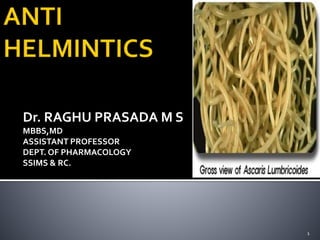
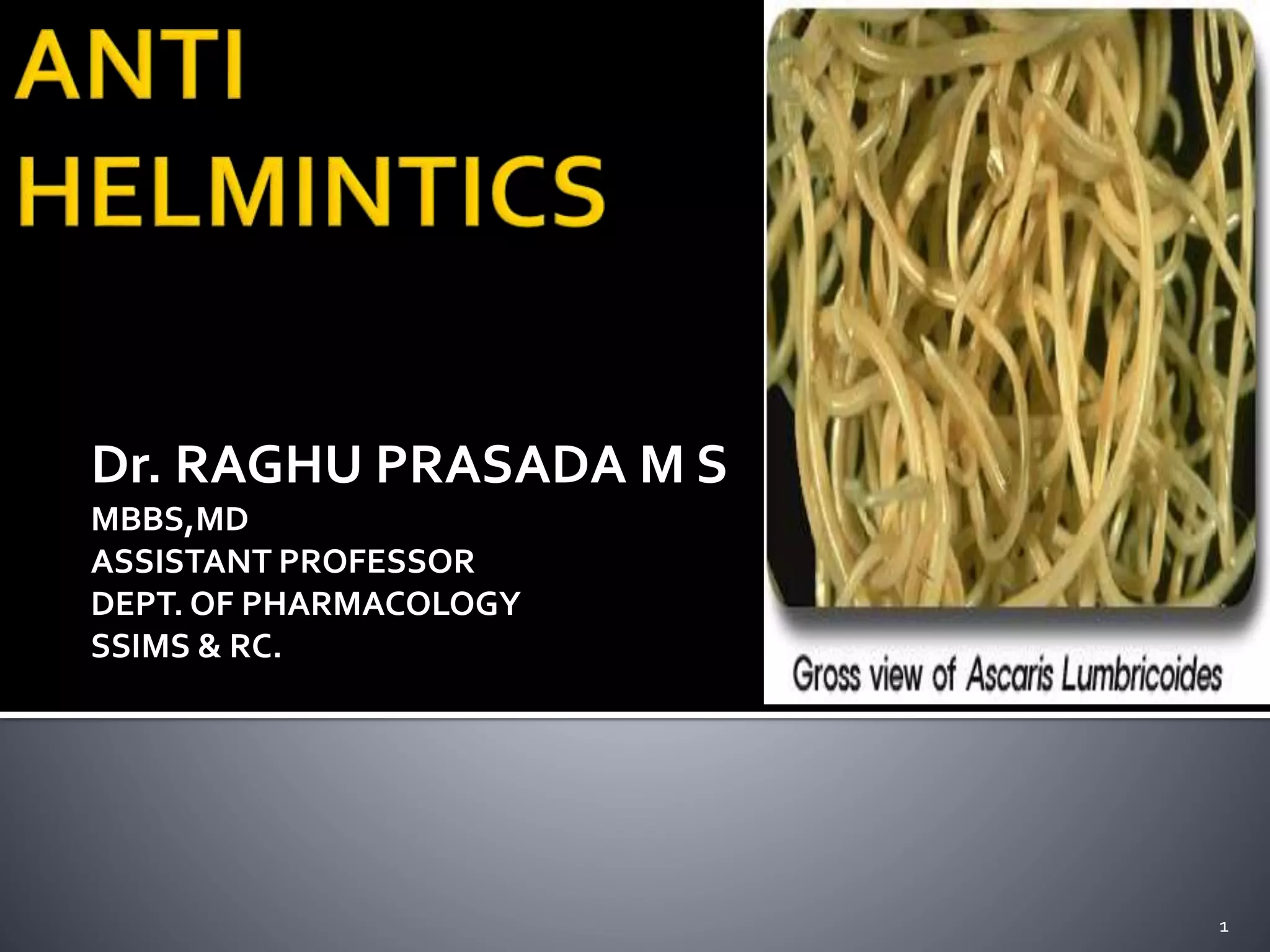
Dr. RAGHU PRASADA M S
MBBS,MD
ASSISTANT PROFESSOR
DEPT. OF PHARMACOLOGY
SSIMS & RC.
1
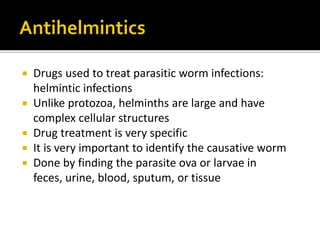
Drugs used to treat parasitic worm infections
Unlike protozoa, helminths are large and have complex
cellular structures
Drug treatment is very specific
It is very important to identify the causative worm
Done by finding the parasite ova or larvae in
faeces, urine, blood, sputum, or tissue
VERMICIDAL or VERMIFUGE drugs
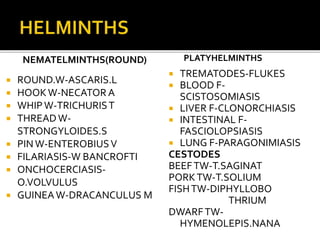
NEMATELMINTHS(ROUND)
 ROUND.W-ASCARIS.L
 HOOKW-NECATOR A
 WHIPW-TRICHURIST
 THREAD W-
STRONGYLOIDES.S
 PINW-ENTEROBIUSV
 FILARIASIS-W BANCROFTI
 ONCHOCERCIASIS-
O.VOLVULUS
 GUINEA W-DRACANCULUS M
PLATYHELMINTHS
 TREMATODES-FLUKES
 BLOOD F-
SCISTOSOMIASIS
 LIVER F-CLONORCHIASIS
 INTESTINAL F-
FASCIOLOPSIASIS
 LUNG F-PARAGONIMIASIS
CESTODES
BEEFTW-T.SAGINATA
PORKTW-T.SOLIUM
FISHTW-DIPHYLLOBO
THRIUM
DWARFTW-
HYMENOLEPIS.NANA
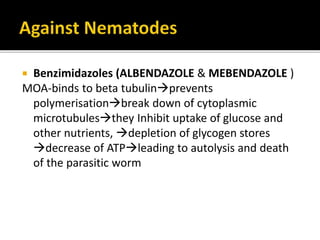
Benzimidazoles(Albendazole & Mebendazole )binds
to beta tubulin prevents polymerisation
break down of cytoplasmic microtubules
they Inhibit uptake of glucose and other nutrients
depletion of glycogen stores
decrease of ATP
leading to autolysis and death of the parasitic worm
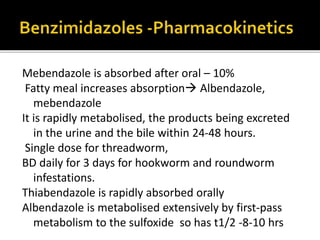
Mebendazole is absorbed after oral – 10%
Fatty meal increases absorption Albendazole,
mebendazole
It is rapidly metabolised, the products being excreted
in the urine and the bile within 24-48 hours.
Single dose for threadworm,
BD daily for 3 days for hookworm and roundworm
infestations.
Thiabendazole is rapidly absorbed orally
Albendazole is metabolised extensively by first-pass
metabolism to the sulfoxide so has t1/2 -8-10 hrs
It is effective in infections with the common round-worm as well
as hook worm
MOA: It has a nicotine-like action, stimulating and subsequently
blocking the neuromuscular junctions. The paralyzed worms
are then expelled in the faeces. Ova are not killed.
Phamacokinetics:
The drug is given orally, is rapidly absorbed and is widely
distributed. It crosses the blood-brain barrier.
Side effects: They include gastrointestinal disturbances,
Dizziness and skin eruptions. High concentrations can have
nicotinic actions on autonomic ganglia in the mammalian
host. There are some reports of encephalopathy
It is highly effective broad-spectrum antiparasitic
First choice of drug for the treatment of filarial infections
and is very effective in onchocerciasis
MOA:
It kill the worm by opening glutamate-gated chloride
channels (found only in invertebrates) and increasing Cl-
conductance; by binding to a novel allosteric site on the
acetylcholine nicotinic receptor to cause an increase in
transmission, leading to motor paralysis; or by binding to
aminobutyric acid receptors.
Uses :
It has given good results against W. bancrofti, which
causes elephantiasis.
A single dose kills the immature microfilariae of O.
volvulus- river blindness
The drug also has activity against common
roundworms, whipworms, and threadworms
Side effect: skin rashes, fever, giddiness, headaches
and pains in muscles, joints and lymph glands
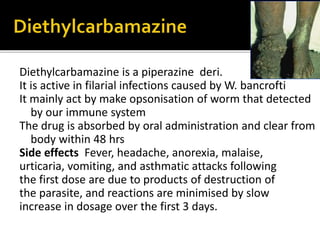
Diethylcarbamazine is a piperazine derivative
It is active in filarial infections caused by W. bancrofti
It mainly act by make opsonisation of worm that detected by
our immune system alters microfilarial membrane
surface characters It hyperpolarises worm
musculature phagocytosed by tissue fixed monocytes
expelled from body
The drug is absorbed by oral administration and clear from
body within 48 hrs
Side effects
Gastrointestinal disturbances, arthralgias, headache and a
general feeling of weakness
MOA:
Its action has been ascribed to inhibition of the parasite's
mitochondrial anaerobic phosphorylation of ADP which
produces usable energy
The scolex and a proximal segment are irreversibly damaged
by the drug
The worm separates from the intestinal wall and is expelled
There is negligible absorption of the drug from the
gastrointestinal tract.
Taenia solium, the drug is given in a single dose after a light
meal, followed by a purgative 2 hours
Unwanted effects are few, infrequent and transient. Nausea
and vomiting can occur.
Adverse effects
Drowsiness, dizziness, Malaise,
anorexia, as well as gastrointestinal upsets.
It is contradicted in pregnant women or nursing mothers.
Drug interaction:
Enzyme inducers dexamethasone, phenytoin, and
carbamazepine increase metabolism
Cimetidine, known to inhibit cytochrome P-450 isozymes,
causes increased praziquantel levels.
It is the drug of choice for all forms of schistos and for
cestode infections like cysticercosis.
MOA:
paralyses both adult worms and Larvae.
It causes influx of Ca+ vacuolation and exposure of
antigens phagocytosis
Permeability of the cell membrane to calcium is
increased, causing contracture and paralysis of the
parasite.
Pharmacokinetics:
It is rapidly absorbed after oral administration and
distributes into the cerebrospinal fluid.
Thiabendazole inhibits cellular enzymes
of susceptible helminths. Inhibits the helminth-specific
enzyme, fumarate reductase
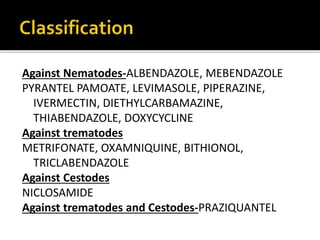
Piperazine-It reversibly inhibits neuromuscular
transmission in the worm
It probably acts on GABA/GABA-gated chloride
channels in nematode muscle. The paralyzed worms
are expelled alive
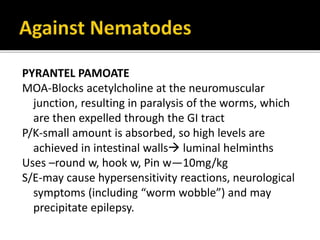
Pyrantel pamoate- blocks acetylcholine at the
neuromuscular junction, resulting in paralysis of the
worms, which are then expelled through the GI tract
Niclosamide, Oxamniquine, Praziquantel,
Thiabendazole, Piperazine, Pyrantel
 nausea, vomiting, diarrhea, dizziness, headache
Mebendazole
 diarrhea, abdominal pain, tissue necrosis
Worms (helminths) Drug of choice
Tapeworms (cestodes) Niclosamide or Praziquantel or
Albendazole
Roundworms (nematodes)
•Enterobius vermicularis (pinworm)
•Ascaris lumbricoides
•Trichuris trichiura (whipworm)
•Trichinella spiralis (trichinellosis)
•Strongyloides stercoralis
•Necator americanus (hookworm)
•Ancylostoma duodenale
•Onchocerca volvulus (Onchocercosis)
•Wuchereria bancrofti (Elephantiasis)
Mebendazole or Pyrantel
Mebendazole or Albendazole
Mebendazole
and Thiabendazole
Thiabendazole
Mebendazole or Pyrantel
Mebendazole, Pyrantel, or
Albendazole
Ivermectin
Diethylcarbamazine
Flukes (trematodes)
•Schistzoma (Schistozomes) Praziquantel
Metrifonate:
It is safe and cost effective for schistosoma
infection
It is cholinesterase inhibitors
Orally active and t1/2 =1-5 hrs
Oxaminiquine:
It is the drug of choice for all forms of
schistosomiasis
It intercalated with parasite DNA and inactivate it
Bithionol
Triclabendazole
THANKYOU
Download slides from
Authorstream-raghuprasada
Slideshare-raghuprasada
Youtube-raghuprasada

Class antihelmintics 4

  • 1.
    Dr. RAGHU PRASADAM S MBBS,MD ASSISTANT PROFESSOR DEPT. OF PHARMACOLOGY SSIMS & RC. 1
  • 2.
    Drugs used totreat parasitic worm infections Unlike protozoa, helminths are large and have complex cellular structures Drug treatment is very specific It is very important to identify the causative worm Done by finding the parasite ova or larvae in faeces, urine, blood, sputum, or tissue VERMICIDAL or VERMIFUGE drugs
  • 3.
    NEMATELMINTHS(ROUND)  ROUND.W-ASCARIS.L  HOOKW-NECATORA  WHIPW-TRICHURIST  THREAD W- STRONGYLOIDES.S  PINW-ENTEROBIUSV  FILARIASIS-W BANCROFTI  ONCHOCERCIASIS- O.VOLVULUS  GUINEA W-DRACANCULUS M PLATYHELMINTHS  TREMATODES-FLUKES  BLOOD F- SCISTOSOMIASIS  LIVER F-CLONORCHIASIS  INTESTINAL F- FASCIOLOPSIASIS  LUNG F-PARAGONIMIASIS CESTODES BEEFTW-T.SAGINATA PORKTW-T.SOLIUM FISHTW-DIPHYLLOBO THRIUM DWARFTW- HYMENOLEPIS.NANA
  • 5.
    Benzimidazoles(Albendazole & Mebendazole)binds to beta tubulin prevents polymerisation break down of cytoplasmic microtubules they Inhibit uptake of glucose and other nutrients depletion of glycogen stores decrease of ATP leading to autolysis and death of the parasitic worm Mebendazole is absorbed after oral – 10% Fatty meal increases absorption Albendazole, mebendazole
  • 6.
    It is rapidlymetabolised, the products being excreted in the urine and the bile within 24-48 hours. Single dose for threadworm, BD daily for 3 days for hookworm and roundworm infestations. Thiabendazole is rapidly absorbed orally Albendazole is metabolised extensively by first-pass metabolism to the sulfoxide so has t1/2 -8-10 hrs
  • 7.
    It is effectivein infections with the common round-worm as well as hook worm MOA: It has a nicotine-like action, stimulating and subsequently blocking the neuromuscular junctions. The paralyzed worms are then expelled in the faeces. Ova are not killed. Phamacokinetics: The drug is given orally, is rapidly absorbed and is widely distributed. It crosses the blood-brain barrier. Side effects: They include gastrointestinal disturbances, Dizziness and skin eruptions. High concentrations can have nicotinic actions on autonomic ganglia in the mammalian host. There are some reports of encephalopathy
  • 8.
    It is highlyeffective broad-spectrum antiparasitic First choice of drug for the treatment of filarial infections and is very effective in onchocerciasis MOA: It kill the worm by opening glutamate-gated chloride channels (found only in invertebrates) and increasing Cl- conductance; by binding to a novel allosteric site on the acetylcholine nicotinic receptor to cause an increase in transmission, leading to motor paralysis; or by binding to aminobutyric acid receptors.
  • 9.
    Uses : It hasgiven good results against W. bancrofti, which causes elephantiasis. A single dose kills the immature microfilariae of O. volvulus- river blindness The drug also has activity against common roundworms, whipworms, and threadworms Side effect: skin rashes, fever, giddiness, headaches and pains in muscles, joints and lymph glands
  • 10.
    Diethylcarbamazine is apiperazine derivative It is active in filarial infections caused by W. bancrofti It mainly act by make opsonisation of worm that detected by our immune system alters microfilarial membrane surface characters It hyperpolarises worm musculature phagocytosed by tissue fixed monocytes expelled from body The drug is absorbed by oral administration and clear from body within 48 hrs Side effects Gastrointestinal disturbances, arthralgias, headache and a general feeling of weakness
  • 11.
    MOA: Its action hasbeen ascribed to inhibition of the parasite's mitochondrial anaerobic phosphorylation of ADP which produces usable energy The scolex and a proximal segment are irreversibly damaged by the drug The worm separates from the intestinal wall and is expelled There is negligible absorption of the drug from the gastrointestinal tract. Taenia solium, the drug is given in a single dose after a light meal, followed by a purgative 2 hours Unwanted effects are few, infrequent and transient. Nausea and vomiting can occur.
  • 12.
    Adverse effects Drowsiness, dizziness,Malaise, anorexia, as well as gastrointestinal upsets. It is contradicted in pregnant women or nursing mothers. Drug interaction: Enzyme inducers dexamethasone, phenytoin, and carbamazepine increase metabolism Cimetidine, known to inhibit cytochrome P-450 isozymes, causes increased praziquantel levels.
  • 13.
    It is thedrug of choice for all forms of schistos and for cestode infections like cysticercosis. MOA: paralyses both adult worms and Larvae. It causes influx of Ca+ vacuolation and exposure of antigens phagocytosis Permeability of the cell membrane to calcium is increased, causing contracture and paralysis of the parasite. Pharmacokinetics: It is rapidly absorbed after oral administration and distributes into the cerebrospinal fluid.
  • 14.
    Thiabendazole inhibits cellularenzymes of susceptible helminths. Inhibits the helminth-specific enzyme, fumarate reductase Piperazine-It reversibly inhibits neuromuscular transmission in the worm It probably acts on GABA/GABA-gated chloride channels in nematode muscle. The paralyzed worms are expelled alive Pyrantel pamoate- blocks acetylcholine at the neuromuscular junction, resulting in paralysis of the worms, which are then expelled through the GI tract
  • 15.
    Niclosamide, Oxamniquine, Praziquantel, Thiabendazole,Piperazine, Pyrantel  nausea, vomiting, diarrhea, dizziness, headache Mebendazole  diarrhea, abdominal pain, tissue necrosis
  • 16.
    Worms (helminths) Drugof choice Tapeworms (cestodes) Niclosamide or Praziquantel or Albendazole Roundworms (nematodes) •Enterobius vermicularis (pinworm) •Ascaris lumbricoides •Trichuris trichiura (whipworm) •Trichinella spiralis (trichinellosis) •Strongyloides stercoralis •Necator americanus (hookworm) •Ancylostoma duodenale •Onchocerca volvulus (Onchocercosis) •Wuchereria bancrofti (Elephantiasis) Mebendazole or Pyrantel Mebendazole or Pyrantel Mebendazole or Albendazole Mebendazole and Thiabendazole Thiabendazole Mebendazole or Pyrantel Mebendazole, Pyrantel, or Albendazole Ivermectin Diethylcarbamazine Flukes (trematodes) •Schistzoma (Schistozomes) Praziquantel
  • 17.
    Metrifonate: It is safeand cost effective for schistosoma infection It is cholinesterase inhibitors Orally active and t1/2 =1-5 hrs Oxaminiquine: It is the drug of choice for all forms of schistosomiasis It intercalated with parasite DNA and inactivate it Bithionol Triclabendazole
  • 18.