Antimicrobial Prophylaxis in
Surgery
Dr.Tarup Gokia
International school of Medicine
Antibiotic prophylaxis refers to the
prevention of infection complications
using antimicrobial therapy
Even when sterile techniques are adhered to,
surgical procedures can introduce bacteria and other
microbes in the blood (causing bacteremia), which
can colonize and infect different parts of the body. An
estimated 5 to 10 percent of hospitalized patients
undergoing otolaryngology ("head and neck") surgery
acquire a nosocomial ("hospital") infection, which
adds a substantial cost and an average of 4 extra
days to the hospital stay.
Antibiotics can be effective in reducing the
occurrence of such infections. Patients
should be selected for prophylaxis if the
medical condition or the surgical procedure is
associated with a considerable risk of
infection or if a postoperative infection would
pose a serious hazard to the patient's
recovery and well-being.
Worldwide experience with antimicrobial
prophylaxis in surgery has proven to be
effective and cost-efficient, both avoiding
severe patient suffering while saving lives
(provided the appropriate antibiotics have
been carefully chosen and used to the best
of current medical knowledge).
A proper regimen of antibiotics for perioperative
prophylaxis of septic complications decreases the
total amount of antimicrobials needed and eases the
burden on hospitals. The choice of antibiotics should
be made according to data on pharmacology,
microbiology, clinical experience and economy. Drugs
should be selected with a reasonable spectrum of
activity against pathogens likely to be encountered,
and antibiotics should be chosen with kinetics that will
ensure adequate serum and tissue levels throughout
the risk period.
For prophylaxis in surgery, only antibiotics with good tolerability
should be used. Cephalosporins remain the preferred drugs for
perioperative prophylaxis due to their low toxicity. Parenteral
systemic antibiotics seem to be more appropriate than oral or
topical antibiotics because the chosen antibiotics must reach
high concentrations at all sites of danger. It is well recognized
that broad-spectrum antibiotics are more likely to prevent
gram-negative sepsis. New data demonstrate that third
generation cephalosporins are more effective than first and
second generation cephalosporins if all perioperative infectious
complications are taken into consideration. Dermatologic
surgeons commonly use antibiotic prophylaxis to prevent
bacterial endocarditis. Based on previous studies, though, the
risk of endocarditis following cutaneous surgery is low and thus
the use of antibiotic prophylaxis is controversial. Although this
practice is appropriate for high-risk patients when skin is
contaminated, it is not recommended for noneroded,
Duration of antibiotic administration
Prophylaxis of the shortest possible duration should
be aimed at in order to minimize the risk of serious
adverse effects or dangerous development of
resistance. The minimum frequency of administration
is the single dose, which usually produces fewer
adverse effects than the multiple dosage and at the
same time often represents the most economical form
of administration. There is controversy about
fluoroquinolone antibiotic prophylaxis in neutropenic
patients as there are little benefit, e.g. no reduced
mortality and because the risks likely outweigh the
benefits.
The goal of antimicrobial prophylaxis is to achieve sufficient
antibiotic tissue concentrations prior to possible
contamination in the relevant tissues and to ensure adequate
levels throughout the operative procedure to prevent
subsequent bacterial growth. Of crucial importance for
success in surgical prophylaxis is the timing of administration
of short-acting antibiotics, as persistent antimicrobial activity
throughout the entire operation is essential; the longer a
surgical procedure lasts, the longer an appropriate antibiotic
tissue level must be maintained. This can be achieved either
by repeated administrations or by giving a single dose of a
suitable long-lasting antimicrobial.
By extending the antimicrobial cover some hours beyond the
duration of the actual surgical procedure, it is possible to
reduce the perioperative infection rates of urinary and
respiratory septic complications considerably (provided an
adequately broad spectrum antibiotic prophylaxis is chosen).
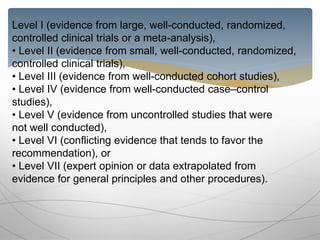
Level I (evidence from large, well-conducted, randomized,
controlled clinical trials or a meta-analysis),
• Level II (evidence from small, well-conducted, randomized,
controlled clinical trials),
• Level III (evidence from well-conducted cohort studies),
• Level IV (evidence from well-conducted case–control
studies),
• Level V (evidence from uncontrolled studies that were
not well conducted),
• Level VI (conflicting evidence that tends to favor the
recommendation), or
• Level VII (expert opinion or data extrapolated from
evidence for general principles and other procedures).
Advantages of long-acting antibiotics
Long-acting, broad-spectrum antibiotics offer the following
advantages by comparison to short-acting antimicrobials in
perioperative prophylaxis:
A single dose covers the whole perioperative risk period -
even if the operation is delayed or long-lasting - and with
regard to respiratory and urinary tract infections
Repeat administrations for prophylaxis are not necessary, so
that additional doses are less likely to be forgotten (an
advantage of practical value in a busy working situation such
as a hospital)
Less risk of development of resistance and less side effects
Increased compliance and reduced errors of administration
Possibly better-effectiveness (less material and labor cost,
less septic perioperative complications)
Preoperative-dose timing
The optimal time for administration of preoperative
doses is within 60 minutes before surgical incision.
Some agents, such as fluoroquinolones and
vancomycin, require administration over one to two
hours; therefore, the administration of these agents
should begin within 120 minutes before surgical
incision
Duration of prophylaxis
New recommendations for a shortened
postoperative course of antimicrobials
involving
a single dose or continuation for less than 24
hours are provided. Further clarity on the lack
of need for postoperative antimicrobial
prophylaxis based on the presence of
indwelling drains and intravascular catheters is
included.
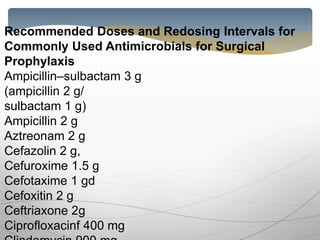
Recommended Doses and Redosing Intervals for
Commonly Used Antimicrobials for Surgical
Prophylaxis
Ampicillin–sulbactam 3 g
(ampicillin 2 g/
sulbactam 1 g)
Ampicillin 2 g
Aztreonam 2 g
Cefazolin 2 g,
Cefuroxime 1.5 g
Cefotaxime 1 gd
Cefoxitin 2 g
Ceftriaxone 2g
Ciprofloxacinf 400 mg
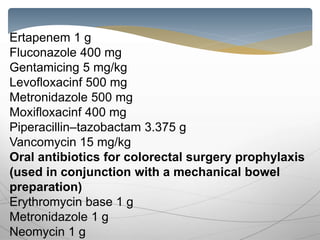
Ertapenem 1 g
Fluconazole 400 mg
Gentamicing 5 mg/kg
Levofloxacinf 500 mg
Metronidazole 500 mg
Moxifloxacinf 400 mg
Piperacillin–tazobactam 3.375 g
Vancomycin 15 mg/kg
Oral antibiotics for colorectal surgery prophylaxis
(used in conjunction with a mechanical bowel
preparation)
Erythromycin base 1 g
Metronidazole 1 g
Neomycin 1 g

Antimicrobial prophylaxis in surgery...by mark gokia

  • 1.
    Antimicrobial Prophylaxis in Surgery Dr.TarupGokia International school of Medicine
  • 2.
    Antibiotic prophylaxis refersto the prevention of infection complications using antimicrobial therapy
  • 3.
    Even when steriletechniques are adhered to, surgical procedures can introduce bacteria and other microbes in the blood (causing bacteremia), which can colonize and infect different parts of the body. An estimated 5 to 10 percent of hospitalized patients undergoing otolaryngology ("head and neck") surgery acquire a nosocomial ("hospital") infection, which adds a substantial cost and an average of 4 extra days to the hospital stay.
  • 4.
    Antibiotics can beeffective in reducing the occurrence of such infections. Patients should be selected for prophylaxis if the medical condition or the surgical procedure is associated with a considerable risk of infection or if a postoperative infection would pose a serious hazard to the patient's recovery and well-being.
  • 5.
    Worldwide experience withantimicrobial prophylaxis in surgery has proven to be effective and cost-efficient, both avoiding severe patient suffering while saving lives (provided the appropriate antibiotics have been carefully chosen and used to the best of current medical knowledge).
  • 6.
    A proper regimenof antibiotics for perioperative prophylaxis of septic complications decreases the total amount of antimicrobials needed and eases the burden on hospitals. The choice of antibiotics should be made according to data on pharmacology, microbiology, clinical experience and economy. Drugs should be selected with a reasonable spectrum of activity against pathogens likely to be encountered, and antibiotics should be chosen with kinetics that will ensure adequate serum and tissue levels throughout the risk period.
  • 7.
    For prophylaxis insurgery, only antibiotics with good tolerability should be used. Cephalosporins remain the preferred drugs for perioperative prophylaxis due to their low toxicity. Parenteral systemic antibiotics seem to be more appropriate than oral or topical antibiotics because the chosen antibiotics must reach high concentrations at all sites of danger. It is well recognized that broad-spectrum antibiotics are more likely to prevent gram-negative sepsis. New data demonstrate that third generation cephalosporins are more effective than first and second generation cephalosporins if all perioperative infectious complications are taken into consideration. Dermatologic surgeons commonly use antibiotic prophylaxis to prevent bacterial endocarditis. Based on previous studies, though, the risk of endocarditis following cutaneous surgery is low and thus the use of antibiotic prophylaxis is controversial. Although this practice is appropriate for high-risk patients when skin is contaminated, it is not recommended for noneroded,
  • 8.
    Duration of antibioticadministration Prophylaxis of the shortest possible duration should be aimed at in order to minimize the risk of serious adverse effects or dangerous development of resistance. The minimum frequency of administration is the single dose, which usually produces fewer adverse effects than the multiple dosage and at the same time often represents the most economical form of administration. There is controversy about fluoroquinolone antibiotic prophylaxis in neutropenic patients as there are little benefit, e.g. no reduced mortality and because the risks likely outweigh the benefits.
  • 9.
    The goal ofantimicrobial prophylaxis is to achieve sufficient antibiotic tissue concentrations prior to possible contamination in the relevant tissues and to ensure adequate levels throughout the operative procedure to prevent subsequent bacterial growth. Of crucial importance for success in surgical prophylaxis is the timing of administration of short-acting antibiotics, as persistent antimicrobial activity throughout the entire operation is essential; the longer a surgical procedure lasts, the longer an appropriate antibiotic tissue level must be maintained. This can be achieved either by repeated administrations or by giving a single dose of a suitable long-lasting antimicrobial. By extending the antimicrobial cover some hours beyond the duration of the actual surgical procedure, it is possible to reduce the perioperative infection rates of urinary and respiratory septic complications considerably (provided an adequately broad spectrum antibiotic prophylaxis is chosen).
  • 10.
    Level I (evidencefrom large, well-conducted, randomized, controlled clinical trials or a meta-analysis), • Level II (evidence from small, well-conducted, randomized, controlled clinical trials), • Level III (evidence from well-conducted cohort studies), • Level IV (evidence from well-conducted case–control studies), • Level V (evidence from uncontrolled studies that were not well conducted), • Level VI (conflicting evidence that tends to favor the recommendation), or • Level VII (expert opinion or data extrapolated from evidence for general principles and other procedures).
  • 11.
    Advantages of long-actingantibiotics Long-acting, broad-spectrum antibiotics offer the following advantages by comparison to short-acting antimicrobials in perioperative prophylaxis: A single dose covers the whole perioperative risk period - even if the operation is delayed or long-lasting - and with regard to respiratory and urinary tract infections Repeat administrations for prophylaxis are not necessary, so that additional doses are less likely to be forgotten (an advantage of practical value in a busy working situation such as a hospital) Less risk of development of resistance and less side effects Increased compliance and reduced errors of administration Possibly better-effectiveness (less material and labor cost, less septic perioperative complications)
  • 12.
    Preoperative-dose timing The optimaltime for administration of preoperative doses is within 60 minutes before surgical incision. Some agents, such as fluoroquinolones and vancomycin, require administration over one to two hours; therefore, the administration of these agents should begin within 120 minutes before surgical incision
  • 13.
    Duration of prophylaxis Newrecommendations for a shortened postoperative course of antimicrobials involving a single dose or continuation for less than 24 hours are provided. Further clarity on the lack of need for postoperative antimicrobial prophylaxis based on the presence of indwelling drains and intravascular catheters is included.
  • 14.
    Recommended Doses andRedosing Intervals for Commonly Used Antimicrobials for Surgical Prophylaxis Ampicillin–sulbactam 3 g (ampicillin 2 g/ sulbactam 1 g) Ampicillin 2 g Aztreonam 2 g Cefazolin 2 g, Cefuroxime 1.5 g Cefotaxime 1 gd Cefoxitin 2 g Ceftriaxone 2g Ciprofloxacinf 400 mg
  • 15.
    Ertapenem 1 g Fluconazole400 mg Gentamicing 5 mg/kg Levofloxacinf 500 mg Metronidazole 500 mg Moxifloxacinf 400 mg Piperacillin–tazobactam 3.375 g Vancomycin 15 mg/kg Oral antibiotics for colorectal surgery prophylaxis (used in conjunction with a mechanical bowel preparation) Erythromycin base 1 g Metronidazole 1 g Neomycin 1 g