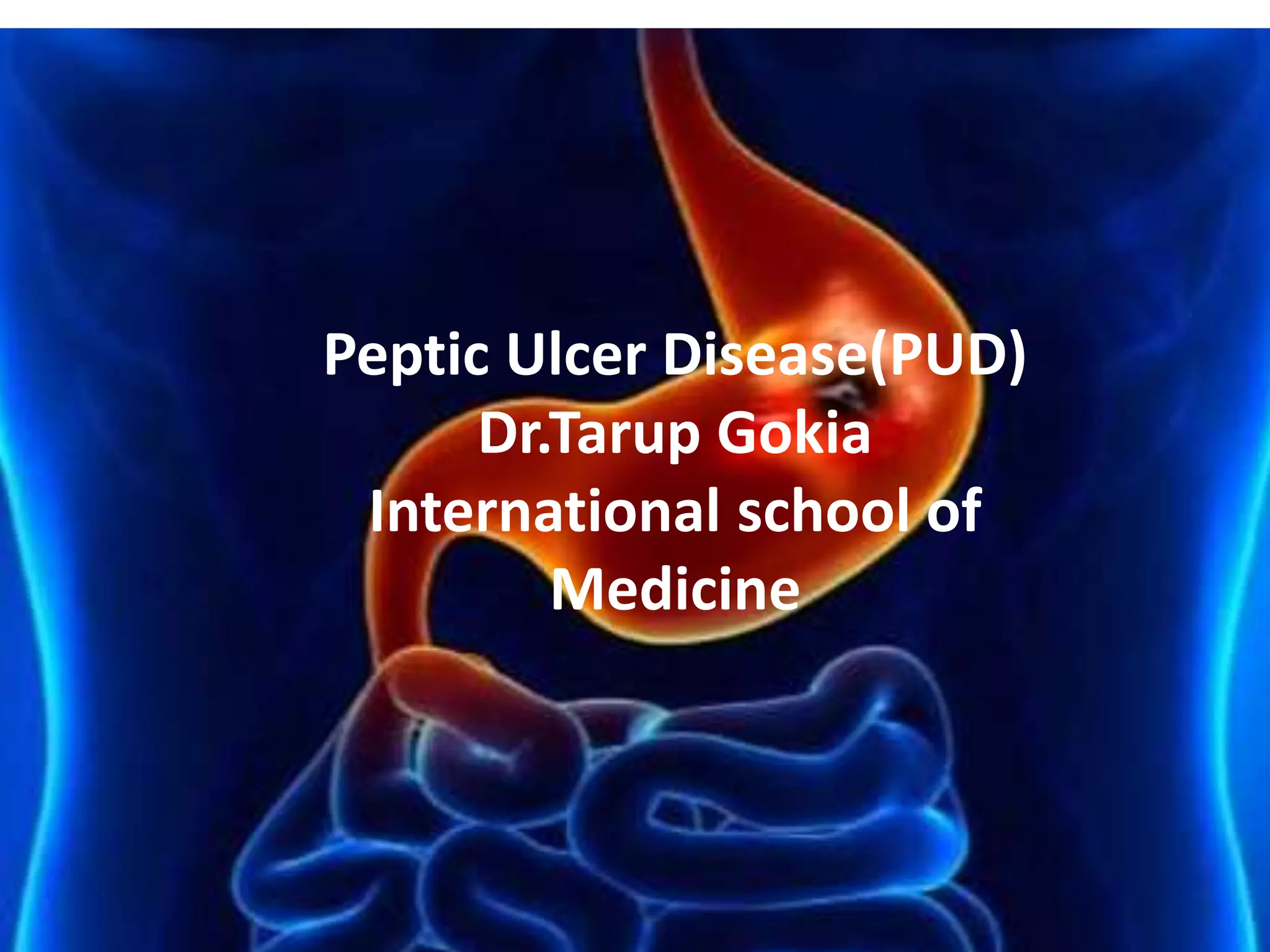
Peptic Ulcer Disease(PUD)
Dr.Tarup Gokia
International school of
Medicine
http://mbbshelp.com
Definition
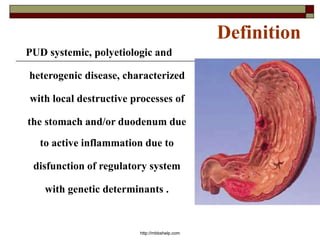
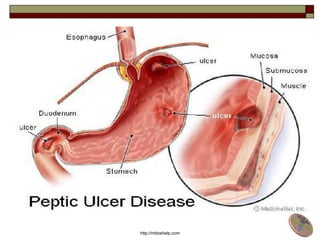
PUD systemic, polyetiologic and
heterogenic disease, characterized
with local destructive processes of
the stomach and/or duodenum due
to active inflammation due to
disfunction of regulatory system
with genetic determinants .
http://mbbshelp.com
http://mbbshelp.com
Etiology
H pylori
NSAIDs, aspirin
Gastrinoma (Zollinger-Ellison syndrome)
Severe stress (eg, trauma, burns), Curling ulcers
Alcohol
Bile reflux
Pancreatic enzyme reflux
Radiation
Crohn's disease
Bacterial or viral infection
http://mbbshelp.com
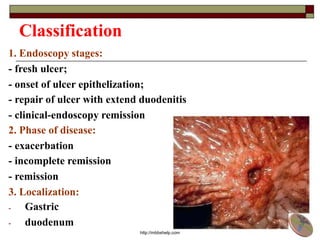
Classification
1. Endoscopy stages:
- fresh ulcer;
- onset of ulcer epithelization;
- repair of ulcer with extend duodenitis
- clinical-endoscopy remission
2. Phase of disease:
- exacerbation
- incomplete remission
- remission
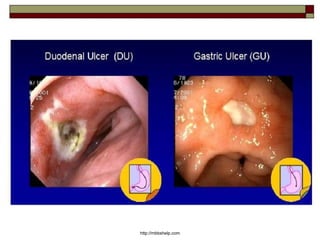
3. Localization:
-
-
Gastric
duodenum
http://mbbshelp.com
http://mbbshelp.com
4. Complication
Refractory, symptomatic peptic ulcers, though rare with the
cure of H pylori infection and the appropriate use of
antisecretory therapy, are a potential complication of PUD.
Perforation usually is managed emergently with surgical
repair. However, this is not mandatory for all patients.
Obstruction can complicate PUD, particularly if PUD is
refractory to aggressive antisecretory therapy, H pylori
eradication, or avoidance of NSAIDs. Obstruction may
persist or recur despite endoscopic balloon dilation.
Penetration, particularly if not walled off or if a gastrocolic
fistula develops, is a potential complication of PUD.
http://mbbshelp.com
http://mbbshelp.com
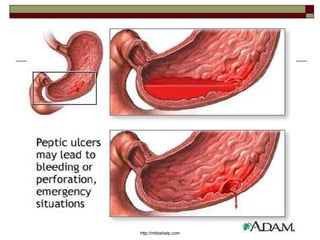
Bleeding can complicate PUD, particularly in patients with massive
hemorrhage and hemodynamic instability, recurrent bleeding on
medical therapy, and failure of therapeutic endoscopy to control
bleeding.
The appropriate surgical procedure depends on the location and nature
of the ulcer.
Many authorities recommend simple oversewing of the ulcer with
treatment of the underlying H pylori infection or cessation of NSAIDs
for bleeding PUD.
Additional surgical options for refractory or complicated PUD include
vagotomy and pyloroplasty, vagotomy and antrectomy with
gastroduodenal reconstruction (Billroth I) or gastrojejunal
reconstruction (Billroth II), or a highly selective vagotomy.
http://mbbshelp.com
Clinical feature
Abdominal pain that has the following characteristics:
Epigastric to left upper quadrant
Frequently described as Gnawing or burning sensation
May radiate to the back
Usually occurs 1-3 hours after meals
Patient awakens with pain at night.
May be relieved by food, antacids (duodenal), or vomiting (gastric)
Typically follows a daily pattern specific to patient
http://mbbshelp.com
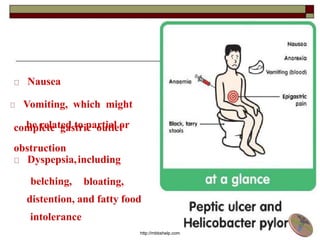
Nausea
Vomiting, which might
be related to partial orcomplete gastric outlet
obstruction
Dyspepsia,including
belching, bloating,
distention, and fatty food
intolerance
http://mbbshelp.com
Heartburn
Chest discomfort
Anorexia, weight loss
Hematemesis or melena resulting from gastrointestinal
bleeding
Dyspeptic symptoms that might suggest PUD are not
specific because only 20-25% of patients with symptoms
suggestive of peptic ulceration are found on investigation
to have a peptic ulcer.
http://mbbshelp.com
"Alarm features" that warrant prompt gastroenterology referral
include the following:
Bleeding or anemia
Early satiety
Unexplained weight loss
Progressive dysphagia or odynophagia
Recurrent vomiting
Family history of GI cancer
NSAID-induced gastritis or ulcers may be silent.
Sudden onset of symptoms may indicate perforation.
Gastritis may present as bleeding, which is more likely in elderly
patients.Symptoms consistent with anemia (eg, fatigue, dyspnea)
may manifest.
http://mbbshelp.com
Physical
Epigastric tenderness is present and usually mild.
Bowel sounds are typically normal.
Perform a rectal examination and Hemoccult testing.
Signs of peritonitis may be present with perforation.
A succussion splash may be present with gastric outletobstruction.
Melena resulting from acute or subacute gastrointestinal
bleeding
http://mbbshelp.com
Laboratory Studies
Complete blood count is used to evaluate acute or chronic
blood loss.
Electrolytes,, and creatinine levels are useful tests for
critical-appearing patients who require fluid resuscitation.
aPTT, PT, and INR are indicated in patients with active
bleeding and those on anticoagulants.
http://mbbshelp.com
PCR is being developed as a highly specific and sensitive test
Patients younger than 55 years with no alarm features should be
referred for noninvasive testing for H pylori infection in the
outpatient setting.
Antibody tests of serum, blood, or urine are widely available
and inexpensive but lack reliable sensitivity and specificity.
They also cannot distinguish between active and remote
infection, thus limiting their usefulness.
Urea breath test identifies active H pylori infection and is
also used to detect recurrence, but sensitivity is decreased by
PPIs, bismuth preparations, and many antibiotics.
Fecal antigen testing also detects ongoing infection and is
preferred in populations with low pretest probability of
disease. This test is not recommended in the setting of
bleeding and also requires suspension of PPIs, antibiotics,
and bismuth preparations prior to testing.
http://mbbshelp.com
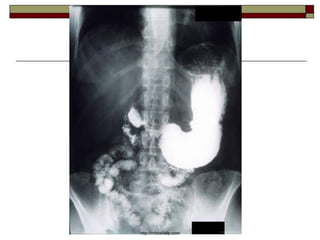
Imaging Studies and Other Tests
A chest x-ray may be useful to detect free
abdominal air when perforation is a possibility.
A CT scan is only useful when other conditions
are being considered.
ECG should be ordered in patients with risk
factors for cardiac disease.
Serial abdominal exams are useful in
determining that the patient is improving and not
developing signs of peritonitis.
http://mbbshelp.com
http://mbbshelp.com
Medication
Proton pump inhibitor (PPI)-based triple therapy, which
results in a cure rate of infection and healing in
approximately 85-90% of cases.
Ulcers can relapse in the absence of successful H pylori
eradication.
Dual therapies, which are alternative regimens for treating
H pylori infection, are usually not recommended as first-
line therapy because of a variable cure rate that is
significantly less than the cure rate achieved with triple
therapy.
http://mbbshelp.com
Active ulcers associated with NSAID use are treated with an appropriate
course of PPI therapy and the cessation of NSAIDs. For patients with a
known history of ulcer, and in whom NSAID use is unavoidable, the
lowest possible dose and duration of the NSAID and co-therapy with a
PPI or misoprostol are recommended.
PPI-based triple therapies for H pylori are considered the first-line
therapies for the treatment of H pylori in the United States with a cure
rate of85-90%. These regimens consist of a PPI, amoxicillin, and
clarithromycin for 7-14 days. A longer duration of treatment (14 d vs 7
d) appears to be more affective and is currently the recommended
duration of treatment. Amoxicillin should only be substituted by
metronidazole in penicillin-allergic patients because of the high rate of
metronidazole resistance.4
In the setting of active ulcers caused by H pylori, treatment with a PPI
beyond the 14-day course of antibiotics and until the confirmation for
the eradication of H pylori is recommended for complicated ulcers.
http://mbbshelp.com
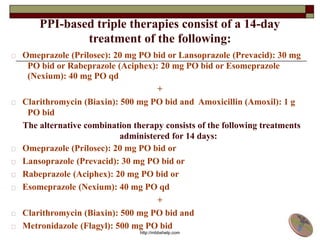
PPI-based triple therapies consist of a 14-day
treatment of the following:
Omeprazole (Prilosec): 20 mg PO bid or Lansoprazole (Prevacid): 30 mg
PO bid or Rabeprazole (Aciphex): 20 mg PO bid or Esomeprazole
(Nexium): 40 mg PO qd
+
Clarithromycin (Biaxin): 500 mg PO bid and Amoxicillin (Amoxil): 1 g
PO bid
The alternative combination therapy consists of the following treatments
administered for 14 days:
Omeprazole (Prilosec): 20 mg PO bid or
Lansoprazole (Prevacid): 30 mg PO bid or
Rabeprazole (Aciphex): 20 mg PO bid or
Esomeprazole (Nexium): 40 mg PO qd
+
Clarithromycin (Biaxin): 500 mg PO bid and
Metronidazole (Flagyl): 500 mg PO bid
http://mbbshelp.com
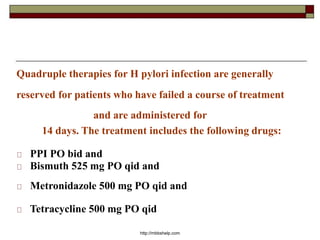
Quadruple therapies for H pylori infection are generally
reserved for patients who have failed a course of treatment
and are administered for
14 days. The treatment includes the following drugs:
PPI PO bid and
Bismuth 525 mg PO qid and
Metronidazole 500 mg PO qid and
Tetracycline 500 mg PO qid
http://mbbshelp.com
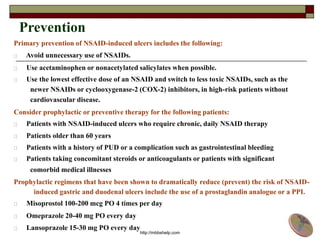
Prevention
Primary prevention of NSAID-induced ulcers includes the following:
Avoid unnecessary use of NSAIDs.
Use acetaminophen or nonacetylated salicylates when possible.
Use the lowest effective dose of an NSAID and switch to less toxic NSAIDs, such as the
newer NSAIDs or cyclooxygenase-2 (COX-2) inhibitors, in high-risk patients without
cardiovascular disease.
Consider prophylactic or preventive therapy for the following patients:
Patients with NSAID-induced ulcers who require chronic, daily NSAID therapy
Patients older than 60 years
Patients with a history of PUD or a complication such as gastrointestinal bleeding
Patients taking concomitant steroids or anticoagulants or patients with significant
comorbid medical illnesses
Prophylactic regimens that have been shown to dramatically reduce (prevent) the risk of NSAID-
induced gastric and duodenal ulcers include the use of a prostaglandin analogue or a PPI.
Misoprostol 100-200 mcg PO 4 times per day
Omeprazole 20-40 mg PO every day
Lansoprazole 15-30 mg PO every day
http://mbbshelp.com
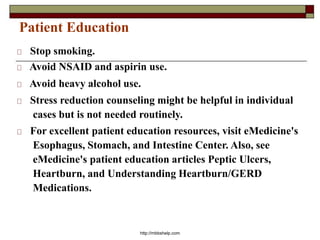
Patient Education
Stop smoking.
Avoid NSAID and aspirin use.
Avoid heavy alcohol use.
Stress reduction counseling might be helpful in individual
cases but is not needed routinely.
For excellent patient education resources, visit eMedicine's
Esophagus, Stomach, and Intestine Center. Also, see
eMedicine's patient education articles Peptic Ulcers,
Heartburn, and Understanding Heartburn/GERD
Medications.
http://mbbshelp.com

Peptic ulcer Disease

  • 1.
    Peptic Ulcer Disease(PUD) Dr.TarupGokia International school of Medicine
  • 2.
  • 3.
    Definition PUD systemic, polyetiologicand heterogenic disease, characterized with local destructive processes of the stomach and/or duodenum due to active inflammation due to disfunction of regulatory system with genetic determinants . http://mbbshelp.com
  • 4.
  • 5.
    Etiology H pylori NSAIDs, aspirin Gastrinoma(Zollinger-Ellison syndrome) Severe stress (eg, trauma, burns), Curling ulcers Alcohol Bile reflux Pancreatic enzyme reflux Radiation Crohn's disease Bacterial or viral infection http://mbbshelp.com
  • 6.
    Classification 1. Endoscopy stages: -fresh ulcer; - onset of ulcer epithelization; - repair of ulcer with extend duodenitis - clinical-endoscopy remission 2. Phase of disease: - exacerbation - incomplete remission - remission 3. Localization: - - Gastric duodenum http://mbbshelp.com
  • 7.
  • 8.
    4. Complication Refractory, symptomaticpeptic ulcers, though rare with the cure of H pylori infection and the appropriate use of antisecretory therapy, are a potential complication of PUD. Perforation usually is managed emergently with surgical repair. However, this is not mandatory for all patients. Obstruction can complicate PUD, particularly if PUD is refractory to aggressive antisecretory therapy, H pylori eradication, or avoidance of NSAIDs. Obstruction may persist or recur despite endoscopic balloon dilation. Penetration, particularly if not walled off or if a gastrocolic fistula develops, is a potential complication of PUD. http://mbbshelp.com
  • 9.
  • 10.
    Bleeding can complicatePUD, particularly in patients with massive hemorrhage and hemodynamic instability, recurrent bleeding on medical therapy, and failure of therapeutic endoscopy to control bleeding. The appropriate surgical procedure depends on the location and nature of the ulcer. Many authorities recommend simple oversewing of the ulcer with treatment of the underlying H pylori infection or cessation of NSAIDs for bleeding PUD. Additional surgical options for refractory or complicated PUD include vagotomy and pyloroplasty, vagotomy and antrectomy with gastroduodenal reconstruction (Billroth I) or gastrojejunal reconstruction (Billroth II), or a highly selective vagotomy. http://mbbshelp.com
  • 11.
    Clinical feature Abdominal painthat has the following characteristics: Epigastric to left upper quadrant Frequently described as Gnawing or burning sensation May radiate to the back Usually occurs 1-3 hours after meals Patient awakens with pain at night. May be relieved by food, antacids (duodenal), or vomiting (gastric) Typically follows a daily pattern specific to patient http://mbbshelp.com
  • 12.
    Nausea Vomiting, which might berelated to partial orcomplete gastric outlet obstruction Dyspepsia,including belching, bloating, distention, and fatty food intolerance http://mbbshelp.com
  • 13.
    Heartburn Chest discomfort Anorexia, weightloss Hematemesis or melena resulting from gastrointestinal bleeding Dyspeptic symptoms that might suggest PUD are not specific because only 20-25% of patients with symptoms suggestive of peptic ulceration are found on investigation to have a peptic ulcer. http://mbbshelp.com
  • 14.
    "Alarm features" thatwarrant prompt gastroenterology referral include the following: Bleeding or anemia Early satiety Unexplained weight loss Progressive dysphagia or odynophagia Recurrent vomiting Family history of GI cancer NSAID-induced gastritis or ulcers may be silent. Sudden onset of symptoms may indicate perforation. Gastritis may present as bleeding, which is more likely in elderly patients.Symptoms consistent with anemia (eg, fatigue, dyspnea) may manifest. http://mbbshelp.com
  • 15.
    Physical Epigastric tenderness ispresent and usually mild. Bowel sounds are typically normal. Perform a rectal examination and Hemoccult testing. Signs of peritonitis may be present with perforation. A succussion splash may be present with gastric outletobstruction. Melena resulting from acute or subacute gastrointestinal bleeding http://mbbshelp.com
  • 16.
    Laboratory Studies Complete bloodcount is used to evaluate acute or chronic blood loss. Electrolytes,, and creatinine levels are useful tests for critical-appearing patients who require fluid resuscitation. aPTT, PT, and INR are indicated in patients with active bleeding and those on anticoagulants. http://mbbshelp.com PCR is being developed as a highly specific and sensitive test
  • 17.
    Patients younger than55 years with no alarm features should be referred for noninvasive testing for H pylori infection in the outpatient setting. Antibody tests of serum, blood, or urine are widely available and inexpensive but lack reliable sensitivity and specificity. They also cannot distinguish between active and remote infection, thus limiting their usefulness. Urea breath test identifies active H pylori infection and is also used to detect recurrence, but sensitivity is decreased by PPIs, bismuth preparations, and many antibiotics. Fecal antigen testing also detects ongoing infection and is preferred in populations with low pretest probability of disease. This test is not recommended in the setting of bleeding and also requires suspension of PPIs, antibiotics, and bismuth preparations prior to testing. http://mbbshelp.com
  • 18.
    Imaging Studies andOther Tests A chest x-ray may be useful to detect free abdominal air when perforation is a possibility. A CT scan is only useful when other conditions are being considered. ECG should be ordered in patients with risk factors for cardiac disease. Serial abdominal exams are useful in determining that the patient is improving and not developing signs of peritonitis. http://mbbshelp.com
  • 19.
  • 20.
    Medication Proton pump inhibitor(PPI)-based triple therapy, which results in a cure rate of infection and healing in approximately 85-90% of cases. Ulcers can relapse in the absence of successful H pylori eradication. Dual therapies, which are alternative regimens for treating H pylori infection, are usually not recommended as first- line therapy because of a variable cure rate that is significantly less than the cure rate achieved with triple therapy. http://mbbshelp.com
  • 21.
    Active ulcers associatedwith NSAID use are treated with an appropriate course of PPI therapy and the cessation of NSAIDs. For patients with a known history of ulcer, and in whom NSAID use is unavoidable, the lowest possible dose and duration of the NSAID and co-therapy with a PPI or misoprostol are recommended. PPI-based triple therapies for H pylori are considered the first-line therapies for the treatment of H pylori in the United States with a cure rate of85-90%. These regimens consist of a PPI, amoxicillin, and clarithromycin for 7-14 days. A longer duration of treatment (14 d vs 7 d) appears to be more affective and is currently the recommended duration of treatment. Amoxicillin should only be substituted by metronidazole in penicillin-allergic patients because of the high rate of metronidazole resistance.4 In the setting of active ulcers caused by H pylori, treatment with a PPI beyond the 14-day course of antibiotics and until the confirmation for the eradication of H pylori is recommended for complicated ulcers. http://mbbshelp.com
  • 22.
    PPI-based triple therapiesconsist of a 14-day treatment of the following: Omeprazole (Prilosec): 20 mg PO bid or Lansoprazole (Prevacid): 30 mg PO bid or Rabeprazole (Aciphex): 20 mg PO bid or Esomeprazole (Nexium): 40 mg PO qd + Clarithromycin (Biaxin): 500 mg PO bid and Amoxicillin (Amoxil): 1 g PO bid The alternative combination therapy consists of the following treatments administered for 14 days: Omeprazole (Prilosec): 20 mg PO bid or Lansoprazole (Prevacid): 30 mg PO bid or Rabeprazole (Aciphex): 20 mg PO bid or Esomeprazole (Nexium): 40 mg PO qd + Clarithromycin (Biaxin): 500 mg PO bid and Metronidazole (Flagyl): 500 mg PO bid http://mbbshelp.com
  • 23.
    Quadruple therapies forH pylori infection are generally reserved for patients who have failed a course of treatment and are administered for 14 days. The treatment includes the following drugs: PPI PO bid and Bismuth 525 mg PO qid and Metronidazole 500 mg PO qid and Tetracycline 500 mg PO qid http://mbbshelp.com
  • 24.
    Prevention Primary prevention ofNSAID-induced ulcers includes the following: Avoid unnecessary use of NSAIDs. Use acetaminophen or nonacetylated salicylates when possible. Use the lowest effective dose of an NSAID and switch to less toxic NSAIDs, such as the newer NSAIDs or cyclooxygenase-2 (COX-2) inhibitors, in high-risk patients without cardiovascular disease. Consider prophylactic or preventive therapy for the following patients: Patients with NSAID-induced ulcers who require chronic, daily NSAID therapy Patients older than 60 years Patients with a history of PUD or a complication such as gastrointestinal bleeding Patients taking concomitant steroids or anticoagulants or patients with significant comorbid medical illnesses Prophylactic regimens that have been shown to dramatically reduce (prevent) the risk of NSAID- induced gastric and duodenal ulcers include the use of a prostaglandin analogue or a PPI. Misoprostol 100-200 mcg PO 4 times per day Omeprazole 20-40 mg PO every day Lansoprazole 15-30 mg PO every day http://mbbshelp.com
  • 25.
    Patient Education Stop smoking. AvoidNSAID and aspirin use. Avoid heavy alcohol use. Stress reduction counseling might be helpful in individual cases but is not needed routinely. For excellent patient education resources, visit eMedicine's Esophagus, Stomach, and Intestine Center. Also, see eMedicine's patient education articles Peptic Ulcers, Heartburn, and Understanding Heartburn/GERD Medications. http://mbbshelp.com