Surgical Site Infections
– Role of Cefuroxime
SSIs: Magnitude of the
Problem
Surgical site infections:
• are the third most prevalent HCAI in hospital inpatients
• are present in 1% of hospital inpatients surveyed (2011)
• account for 1.4% of overall HCAI incidence in England
• developed in 10% of large bowel operation cases*
• are largely preventable.
Surgical Wound Classification
• Class 1 – Clean
– Uninfected operative wound, no inflammation
• Class II – Clean-Contaminated
– Alimentary tract (and others), under controlled conditions without
unusual contamination
• Class III – Contaminated
– Major breaks in sterile technique, eg, gross spillage from the
gastrointestinal tract
– Incisions encountering acute inflammation
• Class IV – Dirty-Infected
– Old traumatic wounds with dead tissue, infection, perforated
viscera
Mangram AJ et al. Am J Infect Control. 1999;27:97–134.
Risk Factors for SSI: The Patient
• Age
• Nutritional status
• Diabetes
• Nicotine use
• Obesity
• Coexistent infection
• Colonization
• Altered immune response
• Long preoperative stay
Risk Factors for SSI: Pre- and Intraoperative
• Inappropriate use of antimicrobial prophylaxis
• Infection at remote site not treated prior to surgery
• Shaving the site vs. clipping
• Long duration of surgery
• Improper skin preparation
• Improper surgical team hand antisepsis
• Environment of the room (ventilation, sterilization)
• Surgical attire and drapes
• Asepsis
• Surgical technique: hemostasis, sterile field
CDC recommendation to
prevent SSIs
Prevention Strategies: Core
Preoperative Measures
Administer antimicrobial prophylaxis in accordance with
evidence based standards and guidelines
– Administer within 1 hour prior to incision*
• 2hr for vancomycin and fluoroquinolones
– Select appropriate agents on basis of
• Surgical procedure
• Most common SSI pathogens for the procedure
• Published recommendations
*Fry DE. Surgical Site Infections and the Surgical Care Improvement Project (SCIP): Evolution of National Quality
Measures. Surg Infect 2008;9(6):579-84.
• Remote infections-whenever possible:
– Identify and treat before elective operation
– Postpone operation until infection has resolved
• Do not remove hair at the operative site unless it will interfere
with the operation; do not use razors
– If necessary, remove by clipping or by use of a depilatory
agent
Prevention Strategies: Core
Preoperative Measures
• Skin Prep
– Use appropriate antiseptic agent and technique for skin
preparation
• Maintain immediate postoperative normothermia*
• Colorectal surgery patients
– Mechanically prepare the colon (Enemas, cathartic agents)
– Administer non-absorbable oral antimicrobial agents in
divided doses on the day before the operation
*Fry DE. Surgical Site Infections and the Surgical Care Improvement Project (SCIP): Evolution of National Quality
Measures. Surg Infect 2008;9(6):579-84.
Prevention Strategies: Core
Preoperative Measures
• Operating Room (OR) Traffic
– Keep OR doors closed during surgery except as
needed for passage of equipment, personnel, and
the patient
Prevention Strategies: Core
Intra-operative Measures
• Surgical Wound Dressing
– Protect primary closure incisions with sterile dressing for 24-
48 hrs post-op
• Control blood glucose level during the immediate post-
operative period (cardiac)*
– Measure blood glucose level at 6AM on POD#1 and #2 with
procedure day = POD#0
– Maintain post-op blood glucose level at <200mg/dL
*Fry DE. Surgical Site Infections and the Surgical Care Improvement Project (SCIP):
Evolution of Nationaluality Measures. Surg Infect 2008;9(6):579-84.
Prevention Strategies: Core
Postoperative Measures
Antibiotic Prophylaxis (NICE)
– Give antibiotic prophylaxis before:
- clean surgery for the placement of a prosthesis or
implant
- clean-contaminated surgery
- contaminated surgery
– Do not routinely use for clean non-prosthetic
uncomplicated surgery
– Use local antibiotic formulary and consider adverse
effects
– Consider prophylaxis on starting anaesthesia, or
earlier for operations using a tourniquet
Other Recommendation Sources
• American Society of Health-System Pharmacists
• Infectious Diseases Society of America
• The Hospital Infection Control Practices Advisory
Committee
• Medical Letter
• Surgical Infection Society
• Sanford Guide to Antimicrobial Therapy 2003
Bratzler DW. Available at:
http://www.medqic.org/scip/pdf/spkrnotesSIP_to_SCIP_101205.ppt. Accessed May
26, 2006.
Antimicrobial Requirements
• Active against most likely aerobes and anaerobes1,2
• Appropriate dosage and timing for adequate
concentration at wound site1,2
• Generally well tolerated1
• Administer for shortest effective period to minimize
adverse effects, cost, and resistance1
1. American Society of Health-System Pharmacists. Am J Health-Syst Pharm
1999;56:1839–1888.
2. Song et al. Br J Surg 1998;85:1232–1241.
Common Principles
Ideally, an antimicrobial agent for surgical prophylaxis should
1. Prevent SSI,
2. Prevent ssi-related morbidity and mortality,
3. Reduce the duration and cost of health care (when the costs
associated with the management of SSI are considered, the
cost-effectiveness of prophylaxis becomes evident),
4. Produce no adverse effects, and
5. Have no adverse consequences for the microbial flora of the
patient or the hospital
Ideal antimicrobial agent
1. To achieve these goals, an antimicrobial agent should be
1. Active against the pathogens most likely to
contaminate the surgical site,
2. Given in an appropriate dosage and at time that
ensures adequate serum and tissue concentrations
during the period of potential contamination,
3. Safe, and
4. Administered for the shortest effective period to
minimize adverse effects, the development of
resistance, and costs.
Cefuroxime is a second generation Cephalosporin,
highly stable to most ß-lactamases, both Penicillinases
and Cephalosporinases of gram positive and gram
negative bacteria
Description
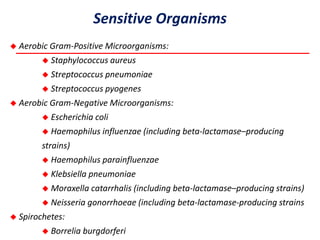
 Aerobic Gram-Positive Microorganisms:
 Staphylococcus aureus
 Streptococcus pneumoniae
 Streptococcus pyogenes
 Aerobic Gram-Negative Microorganisms:
 Escherichia coli
 Haemophilus influenzae (including beta-lactamase–producing
strains)
 Haemophilus parainfluenzae
 Klebsiella pneumoniae
 Moraxella catarrhalis (including beta-lactamase–producing strains)
 Neisseria gonorrhoeae (including beta-lactamase-producing strains
 Spirochetes:
 Borrelia burgdorferi
Sensitive Organisms
 Cefuroxime is subsequently distributed throughout the
extracellular fluids. The axetil moiety is metabolized to
acetaldehyde and acetic acid.
 Absorption of the tablet is greater when taken after food
(absolute bioavailability of Cefuroxime Axetil tablets increases
from 37% to 52%).
 Cefuroxime is excreted unchanged in the urine; in adults,
approximately 50% of the administered dose is recovered in the
urine within 12 hours.
Pharmacokinetics
Tissue concentration during preoperative use
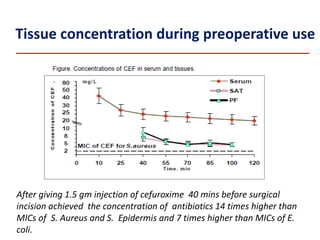
After giving 1.5 gm injection of cefuroxime 40 mins before surgical
incision achieved the concentration of antibiotics 14 times higher than
MICs of S. Aureus and S. Epidermis and 7 times higher than MICs of E.
coli.
Antibiotic prophylaxis for hysterectomy, a prospective
cohort study: cefuroxime, metronidazole, or both?
• Study was conducted in fifty-three hospitals in Finland.
A total of 5279 women undergoing hysterectomy for
benign indications were selected and given either
cefuroxime or metronidazole or both.
• In this study, cefuroxime appeared to be effective in
prophylaxis against infections. Metronidazole appeared
to be ineffective, with no additional risk-reductive
effect when combined with cefuroxime.
Suitability of cefuroxime for perioperative antibiotic
prophylaxis in maxillofacial surgical procedures
• Serum and tissue samples were taken, to determine the
intraoperative cefuroxime concentration, from 40
patients who had been given 1.5 g cefuroxime i.v. during
maxillofacial surgery.
• Maximum serum levels averaging 80 mg/l were
measured within 30 min of administration. Average
levels of 1–3 mg/kg were still measurable after 4 h. No
postoperative wound infection was seen under
prophylaxis with cefuroxime.
• Cefuroxime is suitable for perioperative prophylaxis
during maxillofacial surgical procedures because of its
favourable kinetics and broad spectrum of action.
Cefuroxime as antibiotic prophylaxis in CABG
surgery
• To determine the efficacy of cefuroxime as a
prophylactic agent against infection.
• The study enrolled 1232 adult patients (age )16
years who underwent isolated CABG surgery with
the use of extracorporeal circulation within two
periods.
• All these surgical procedures were performed by
the same three surgical teams. General anesthesia
was provided by the same three teams according to
a set protocol.
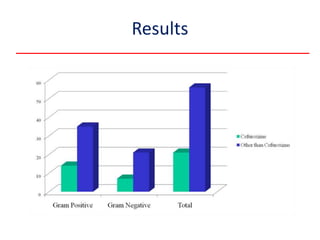
Results
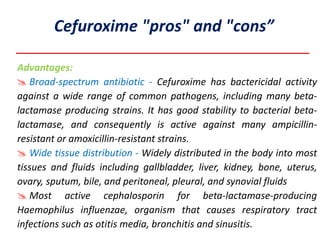
Advantages:
 Broad-spectrum antibiotic - Cefuroxime has bactericidal activity
against a wide range of common pathogens, including many beta-
lactamase producing strains. It has good stability to bacterial beta-
lactamase, and consequently is active against many ampicillin-
resistant or amoxicillin-resistant strains.
 Wide tissue distribution - Widely distributed in the body into most
tissues and fluids including gallbladder, liver, kidney, bone, uterus,
ovary, sputum, bile, and peritoneal, pleural, and synovial fluids
 Most active cephalosporin for beta-lactamase-producing
Haemophilus influenzae, organism that causes respiratory tract
infections such as otitis media, bronchitis and sinusitis.
Cefuroxime "pros" and "cons”
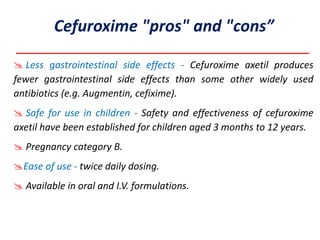
 Less gastrointestinal side effects - Cefuroxime axetil produces
fewer gastrointestinal side effects than some other widely used
antibiotics (e.g. Augmentin, cefixime).
 Safe for use in children - Safety and effectiveness of cefuroxime
axetil have been established for children aged 3 months to 12 years.
 Pregnancy category B.
Ease of use - twice daily dosing.
 Available in oral and I.V. formulations.
Cefuroxime "pros" and "cons”
Surgical Site Infections.ppt

Surgical Site Infections.ppt

  • 1.
    Surgical Site Infections –Role of Cefuroxime
  • 2.
    SSIs: Magnitude ofthe Problem Surgical site infections: • are the third most prevalent HCAI in hospital inpatients • are present in 1% of hospital inpatients surveyed (2011) • account for 1.4% of overall HCAI incidence in England • developed in 10% of large bowel operation cases* • are largely preventable.
  • 3.
    Surgical Wound Classification •Class 1 – Clean – Uninfected operative wound, no inflammation • Class II – Clean-Contaminated – Alimentary tract (and others), under controlled conditions without unusual contamination • Class III – Contaminated – Major breaks in sterile technique, eg, gross spillage from the gastrointestinal tract – Incisions encountering acute inflammation • Class IV – Dirty-Infected – Old traumatic wounds with dead tissue, infection, perforated viscera Mangram AJ et al. Am J Infect Control. 1999;27:97–134.
  • 4.
    Risk Factors forSSI: The Patient • Age • Nutritional status • Diabetes • Nicotine use • Obesity • Coexistent infection • Colonization • Altered immune response • Long preoperative stay
  • 5.
    Risk Factors forSSI: Pre- and Intraoperative • Inappropriate use of antimicrobial prophylaxis • Infection at remote site not treated prior to surgery • Shaving the site vs. clipping • Long duration of surgery • Improper skin preparation • Improper surgical team hand antisepsis • Environment of the room (ventilation, sterilization) • Surgical attire and drapes • Asepsis • Surgical technique: hemostasis, sterile field
  • 6.
  • 7.
    Prevention Strategies: Core PreoperativeMeasures Administer antimicrobial prophylaxis in accordance with evidence based standards and guidelines – Administer within 1 hour prior to incision* • 2hr for vancomycin and fluoroquinolones – Select appropriate agents on basis of • Surgical procedure • Most common SSI pathogens for the procedure • Published recommendations *Fry DE. Surgical Site Infections and the Surgical Care Improvement Project (SCIP): Evolution of National Quality Measures. Surg Infect 2008;9(6):579-84.
  • 8.
    • Remote infections-wheneverpossible: – Identify and treat before elective operation – Postpone operation until infection has resolved • Do not remove hair at the operative site unless it will interfere with the operation; do not use razors – If necessary, remove by clipping or by use of a depilatory agent Prevention Strategies: Core Preoperative Measures
  • 9.
    • Skin Prep –Use appropriate antiseptic agent and technique for skin preparation • Maintain immediate postoperative normothermia* • Colorectal surgery patients – Mechanically prepare the colon (Enemas, cathartic agents) – Administer non-absorbable oral antimicrobial agents in divided doses on the day before the operation *Fry DE. Surgical Site Infections and the Surgical Care Improvement Project (SCIP): Evolution of National Quality Measures. Surg Infect 2008;9(6):579-84. Prevention Strategies: Core Preoperative Measures
  • 10.
    • Operating Room(OR) Traffic – Keep OR doors closed during surgery except as needed for passage of equipment, personnel, and the patient Prevention Strategies: Core Intra-operative Measures
  • 11.
    • Surgical WoundDressing – Protect primary closure incisions with sterile dressing for 24- 48 hrs post-op • Control blood glucose level during the immediate post- operative period (cardiac)* – Measure blood glucose level at 6AM on POD#1 and #2 with procedure day = POD#0 – Maintain post-op blood glucose level at <200mg/dL *Fry DE. Surgical Site Infections and the Surgical Care Improvement Project (SCIP): Evolution of Nationaluality Measures. Surg Infect 2008;9(6):579-84. Prevention Strategies: Core Postoperative Measures
  • 12.
    Antibiotic Prophylaxis (NICE) –Give antibiotic prophylaxis before: - clean surgery for the placement of a prosthesis or implant - clean-contaminated surgery - contaminated surgery – Do not routinely use for clean non-prosthetic uncomplicated surgery – Use local antibiotic formulary and consider adverse effects – Consider prophylaxis on starting anaesthesia, or earlier for operations using a tourniquet
  • 13.
    Other Recommendation Sources •American Society of Health-System Pharmacists • Infectious Diseases Society of America • The Hospital Infection Control Practices Advisory Committee • Medical Letter • Surgical Infection Society • Sanford Guide to Antimicrobial Therapy 2003 Bratzler DW. Available at: http://www.medqic.org/scip/pdf/spkrnotesSIP_to_SCIP_101205.ppt. Accessed May 26, 2006.
  • 14.
    Antimicrobial Requirements • Activeagainst most likely aerobes and anaerobes1,2 • Appropriate dosage and timing for adequate concentration at wound site1,2 • Generally well tolerated1 • Administer for shortest effective period to minimize adverse effects, cost, and resistance1 1. American Society of Health-System Pharmacists. Am J Health-Syst Pharm 1999;56:1839–1888. 2. Song et al. Br J Surg 1998;85:1232–1241.
  • 15.
    Common Principles Ideally, anantimicrobial agent for surgical prophylaxis should 1. Prevent SSI, 2. Prevent ssi-related morbidity and mortality, 3. Reduce the duration and cost of health care (when the costs associated with the management of SSI are considered, the cost-effectiveness of prophylaxis becomes evident), 4. Produce no adverse effects, and 5. Have no adverse consequences for the microbial flora of the patient or the hospital
  • 16.
    Ideal antimicrobial agent 1.To achieve these goals, an antimicrobial agent should be 1. Active against the pathogens most likely to contaminate the surgical site, 2. Given in an appropriate dosage and at time that ensures adequate serum and tissue concentrations during the period of potential contamination, 3. Safe, and 4. Administered for the shortest effective period to minimize adverse effects, the development of resistance, and costs.
  • 17.
    Cefuroxime is asecond generation Cephalosporin, highly stable to most ß-lactamases, both Penicillinases and Cephalosporinases of gram positive and gram negative bacteria Description
  • 18.
     Aerobic Gram-PositiveMicroorganisms:  Staphylococcus aureus  Streptococcus pneumoniae  Streptococcus pyogenes  Aerobic Gram-Negative Microorganisms:  Escherichia coli  Haemophilus influenzae (including beta-lactamase–producing strains)  Haemophilus parainfluenzae  Klebsiella pneumoniae  Moraxella catarrhalis (including beta-lactamase–producing strains)  Neisseria gonorrhoeae (including beta-lactamase-producing strains  Spirochetes:  Borrelia burgdorferi Sensitive Organisms
  • 19.
     Cefuroxime issubsequently distributed throughout the extracellular fluids. The axetil moiety is metabolized to acetaldehyde and acetic acid.  Absorption of the tablet is greater when taken after food (absolute bioavailability of Cefuroxime Axetil tablets increases from 37% to 52%).  Cefuroxime is excreted unchanged in the urine; in adults, approximately 50% of the administered dose is recovered in the urine within 12 hours. Pharmacokinetics
  • 20.
    Tissue concentration duringpreoperative use After giving 1.5 gm injection of cefuroxime 40 mins before surgical incision achieved the concentration of antibiotics 14 times higher than MICs of S. Aureus and S. Epidermis and 7 times higher than MICs of E. coli.
  • 21.
    Antibiotic prophylaxis forhysterectomy, a prospective cohort study: cefuroxime, metronidazole, or both? • Study was conducted in fifty-three hospitals in Finland. A total of 5279 women undergoing hysterectomy for benign indications were selected and given either cefuroxime or metronidazole or both. • In this study, cefuroxime appeared to be effective in prophylaxis against infections. Metronidazole appeared to be ineffective, with no additional risk-reductive effect when combined with cefuroxime.
  • 22.
    Suitability of cefuroximefor perioperative antibiotic prophylaxis in maxillofacial surgical procedures • Serum and tissue samples were taken, to determine the intraoperative cefuroxime concentration, from 40 patients who had been given 1.5 g cefuroxime i.v. during maxillofacial surgery. • Maximum serum levels averaging 80 mg/l were measured within 30 min of administration. Average levels of 1–3 mg/kg were still measurable after 4 h. No postoperative wound infection was seen under prophylaxis with cefuroxime. • Cefuroxime is suitable for perioperative prophylaxis during maxillofacial surgical procedures because of its favourable kinetics and broad spectrum of action.
  • 23.
    Cefuroxime as antibioticprophylaxis in CABG surgery • To determine the efficacy of cefuroxime as a prophylactic agent against infection. • The study enrolled 1232 adult patients (age )16 years who underwent isolated CABG surgery with the use of extracorporeal circulation within two periods. • All these surgical procedures were performed by the same three surgical teams. General anesthesia was provided by the same three teams according to a set protocol.
  • 24.
  • 25.
    Advantages:  Broad-spectrum antibiotic- Cefuroxime has bactericidal activity against a wide range of common pathogens, including many beta- lactamase producing strains. It has good stability to bacterial beta- lactamase, and consequently is active against many ampicillin- resistant or amoxicillin-resistant strains.  Wide tissue distribution - Widely distributed in the body into most tissues and fluids including gallbladder, liver, kidney, bone, uterus, ovary, sputum, bile, and peritoneal, pleural, and synovial fluids  Most active cephalosporin for beta-lactamase-producing Haemophilus influenzae, organism that causes respiratory tract infections such as otitis media, bronchitis and sinusitis. Cefuroxime "pros" and "cons”
  • 26.
     Less gastrointestinalside effects - Cefuroxime axetil produces fewer gastrointestinal side effects than some other widely used antibiotics (e.g. Augmentin, cefixime).  Safe for use in children - Safety and effectiveness of cefuroxime axetil have been established for children aged 3 months to 12 years.  Pregnancy category B. Ease of use - twice daily dosing.  Available in oral and I.V. formulations. Cefuroxime "pros" and "cons”