GRACE COLLEGE OF PHARMACY,PALAKKAD
APPROVED BY PCI,GOVERNMENT OF KERALA AFFLIATED TO KERALA UNIVERSITY OF HEALTH SCIENCES
ANTI-MALARIAL DRUGS
Prepared by:
Mr. GOKUL J SIDDHARTH
RESEARCH SCHOLAR
gokulsiddu@gmail.com
ANTIMALARIAL DRUGS
ANTIMALARIAL DRUGS
• These are drugs used for prophylaxis, treatment and
prevention of relapses of malaria
• malaria is an acute infectious disease caused by four
species of the protozoal genus Plasmodium
• Plasmodium species which infect humans
1. Plasmodium vivax (tertian)
2. Plasmodium ovale (tertian)
3. Plasmodium falciparum (tertian): Most dangerous species
4. Plasmodium malariae (quartan)
• The parasite is transmitted to human through the bite of a
female Anopheles mosquito
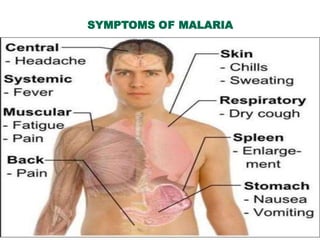
SYMPTOMS OF MALARIA
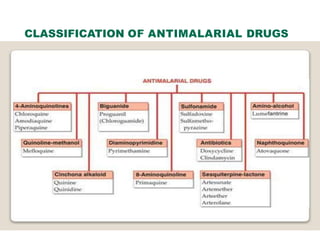
CLASSIFICATION OF ANTIMALARIAL DRUGS
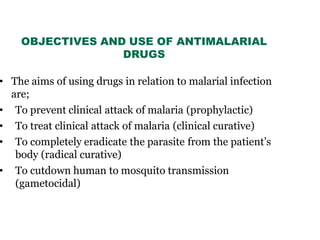
OBJECTIVES AND USE OF ANTIMALARIAL
DRUGS
• The aims of using drugs in relation to malarial infection
are;
• To prevent clinical attack of malaria (prophylactic)
• To treat clinical attack of malaria (clinical curative)
• To completely eradicate the parasite from the patient’s
body (radical curative)
• To cutdown human to mosquito transmission
(gametocidal)
LIFE CYCLE OF THE MALARIAL PARASITE,
PLASMODIUM FALCIPARUM
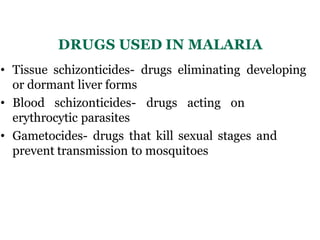
DRUGS USED IN MALARIA
• Tissue schizonticides- drugs eliminating developing
or dormant liver forms
• Blood schizonticides- drugs acting on
erythrocytic parasites
• Gametocides- drugs that kill sexual stages and
prevent transmission to mosquitoes
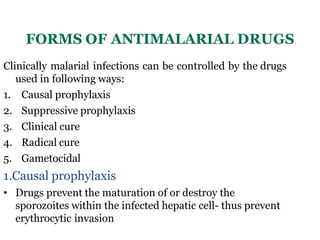
FORMS OF ANTIMALARIAL DRUGS
Clinically malarial infections can be controlled by the drugs
used in following ways:
1. Causal prophylaxis
2. Suppressive prophylaxis
3. Clinical cure
4. Radical cure
5. Gametocidal
1.Causal prophylaxis
• Drugs prevent the maturation of or destroy the
sporozoites within the infected hepatic cell- thus prevent
erythrocytic invasion
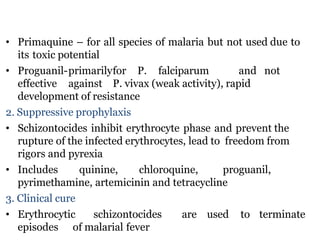
• Primaquine – for all species of malaria but not used due to
its toxic potential
• Proguanil-primarilyfor P. falciparum and not
effective against P. vivax (weak activity), rapid
development of resistance
2. Suppressive prophylaxis
• Schizontocides inhibit erythrocyte phase and prevent the
rupture of the infected erythrocytes, lead to freedom from
rigors and pyrexia
• Includes quinine, chloroquine, proguanil,
pyrimethamine, artemicinin and tetracycline
3. Clinical cure
• Erythrocytic schizontocides are used to terminate
episodes of malarial fever
• Fast acting high efficacy drugs: Chloroquine, quinine,
mefloquine, halofantrine, artemisinin Used
singlyto treat malaria fever o Faster acting, preferably
used in falciparum malaria where delayed treatment may lead
to death even if parasites are clear from blood
• Slow acting low efficacy drugs: Proguanil,
pyrimethamine, sulfonamides, tetracyclines- Used only in
combination
4. Radical cure
• Drug attack exoerythrocytic stage (hypnozoites) given
with clinical curative for the total eradication of the
parasite from the patient’s body.
• Radical cure of the P. falciparum malaria can be
achieved by suppressives only
• For radical cure of P.vivax infection, primaquine and
proguanil are effective
5. Gametocial
• Removal of male and female gametes of Plasmodia
formed in the patient’s blood
• It has no benefit for treated patient
• Primaquine and artemisinins are highly effective against
gametocytes of all species.
CHLOROQUINE (CQ)
• Rapidly acting erythrocytic schizontocide against
all species of Plasmodia
• Drug of choice for treating acute attacks caused by
sensitive strains of P. vivax or P. falciparum
• Controls most clinical attack in 1-2days with
disappearance of parasite from peripheral blood in 1- 3days
• No effect on exo- erythrocytic phase
• Neither prevent primary infection nor relapse in P.
vivax and P.ovale
• Drug of choice for use in pregnancy, prophylaxis
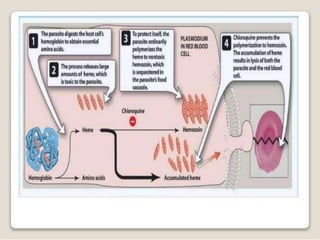
Chloroquine- mechanism of action
• The parasite digests the host cell’s hemoglobin to
obtain essential amino acids
• The processreleases large amounts of heme, which
is toxic to the parasite
• To protect itself the parasite ordinarily polymerizes
the heme to nontoxic hemozoin, which is sequestered in
the parasite’s food vacuole Cholroquine prevents the
polymerization to hemozoin
• The accumulation of heme results in lysis of both the parasite
and the red blood cell
Pharmacokinetics
• Rapidly and completely absorbed from GI tract
• Substantial amount is deposited in erythrocytes, liver, spleen,
kidney, lung, melanin containing tissues and leukocytes
• Slowrelease from these sites helps in maintaining
the therapeutic plasma levels – when used for prophylaxis,
it is administered just once a week
• Also crosses the blood- brain barrier and traverses the placenta
Excreted predominantly in the urine
Uses
• Extraintestinal amoebiasis • Rheumatoid arthritis •
Discoid lupus erythematosus • Lepra reaction •
Photogenic reactions • Infectious mononucleosis
Adverse effects
• CNS- mild headache, confusion, psychosis,
convulsion, impaired hearing
• Eye (with high dose)- loss of vision due to retinal damage,
reversible corneal damage
• GIT- Nausea, vomiting, anorexia, epigastric pain,
diarrhea( can be minimized by taking with meal)
• Skin- uncontrolled itching, urticaria, exfoliative dermatitis
Parenteral administration- Hypotension, cardiac
arrhythmias, cardiac depression
Contraindications
• Patient with psoriasis, porphyria
• In dermatitis, liver damage, alcoholism,
neurological, retinal and hematological diseases
MEFLOQUINE (MQ)
• Fast acting erythrocytic (blood) schizontocide but slower
than CQ or quinine
• Effective against CQ-sensitive as well as resistant
Plasmodia Efficacious suppressive prophylactic for multi-
resistant P. falciparum
Mechanism of action
• Like CQ, it accumulates in infected RBCs, binds to
heme and this complex damages the parasite’s membrane
• However recent evidence suggests that the site of action of
MQ is in the parasitic cytosol rather than in the acidic vacuole
Pharmacokinetics
• Prolonged absorption after oral ingestion
• It is highly plasma protein bound and concentrated in the
liver, lung and intestines
• Extensive metabolism occurs in liver and is primarily secreted
in bile It has a long half life (17days) due to
its concentration in various
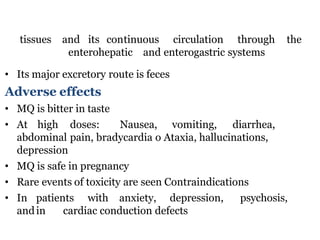
tissues and its continuous circulation through the
enterohepatic and enterogastric systems
• Its major excretory route is feces
Adverse effects
• MQ is bitter in taste
• At high doses: Nausea, vomiting, diarrhea,
abdominal pain, bradycardia o Ataxia, hallucinations,
depression
• MQ is safe in pregnancy
• Rare events of toxicity are seen Contraindications
• In patients with anxiety, depression, psychosis,
andin cardiac conduction defects
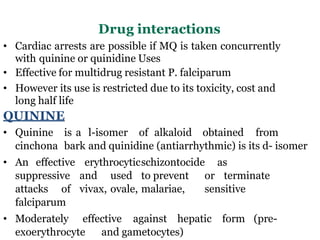
Drug interactions
• Cardiac arrests are possible if MQ is taken concurrently
with quinine or quinidine Uses
• Effective for multidrug resistant P. falciparum
• However its use is restricted due to its toxicity, cost and
long half life
QUININE
• Quinine is a l-isomer of alkaloid obtained from
cinchona bark and quinidine (antiarrhythmic) is its d- isomer
• An effective erythrocyticschizontocide as
suppressive and used to prevent or terminate
attacks of vivax, ovale, malariae, sensitive
falciparum
• Moderately effective against hepatic form (pre-
exoerythrocyte and gametocytes)
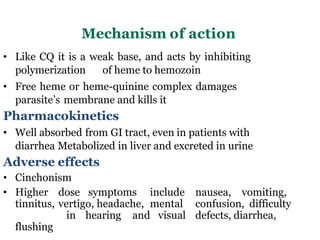
Mechanism of action
• Like CQ it is a weak base, and acts by inhibiting
polymerization of heme to hemozoin
• Free heme or heme-quinine complex damages
parasite’s membrane and kills it
Pharmacokinetics
• Well absorbed from GI tract, even in patients with
diarrhea Metabolized in liver and excreted in urine
Adverse effects
• Cinchonism
• Higher dose symptoms include nausea, vomiting,
tinnitus, vertigo, headache, mental confusion, difficulty
in hearing and visual defects, diarrhea,
flushing
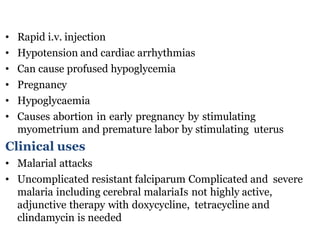
• Rapid i.v. injection
• Hypotension and cardiac arrhythmias
• Can cause profused hypoglycemia
• Pregnancy
• Hypoglycaemia
• Causes abortion in early pregnancy by stimulating
myometrium and premature labor by stimulating uterus
Clinical uses
• Malarial attacks
• Uncomplicated resistant falciparum Complicated and severe
malaria including cerebral malariaIs not highly active,
adjunctive therapy with doxycycline, tetracycline and
clindamycin is needed
• PROGUANIL (CHLOROGUANIDE)
• Slow acting erythrocytic schizontocide
• Cyclized in body to a triazine derivative (cycloguanil)
• Cycloguanil inhibits plasmodial dihydrofolate reductase
(DHFRase) Resistance developed due to
mutational changes in the plasmodialDHFRase enzyme
• Slow but adequate absorption from the gut
• Partly metabolized and excreted in urine
• Half life 16-20 hour ; noncumulative
Adverse effects
• Mild abdominal upset, vomiting, occasional stomatitis,
haematuria, rashes and transient loss of hair
PYRIMETHAMINE
• Slow acting erythrocytic schizontocide
• Direct inhibitor of plasmodial dihydrofolate reductase
(DHFRase) Conversion of dihydrofolic acid to tetrafolic acid is
inhibited
• High doses inhibits Toxoplasma gondii
• Resistance develops by mutation in DHFRase enzyme
Adverse effects
• Occasional nausea and rashes
• Folate deficiency rare
• Megaloblastic anaemia and granulocytopenia with higher
dose
• Can be treated with folinic acid
• Combined with a sulfonamide (S/P) or dapsone for
treatment of falciparum malaria
SULFONAMIDE-PYRIMETHAMINE(S/P)
• Sulphadoxine is a sulfonamide thus competes with para–
amino benzoic acid – inhibits the formation of dihydropteric
acid
• Pyrimethamine inhibits DHFRase enzyme as a
result of which conversion of dihydrofolic acid to
tetrahydrofolic acid is blocked – thus inhibits DNA
synthesis
• Effective blood schizontocide against Plasmodium
falciparum Treatment and prophylaxis of
falciparum malaria resistantto chloroquine
Adverse effects
• Mild GIT upset • Megaloblastic anemia, bone marrow
depletion • Rashes, urticaria, serum sickness,
drug fever • Exfoliative dermatitis, Stevens Johnson
syndrome • Nephrotoxicity
PRIMAQUINE
• Poor erythrocytic schizontocide
• Has marked effect on primary and secondary
hepatic phases of malarial parasite
• Highly active against gametocytes and hypnozoites
Mechanism of action
• Intermediate act as oxidant that are responsible for the
schizontocial action
Pharmacokinetics
• Readily absorbed after oral absorption
• Oxidized in liver with a plasma half life of 3-6
hours
• Excreted in urine within 24 hour
• Not a cumulative drug
Adverse effects
• Abdominal pain, gastrointestinal upset, weakness or
uneasiness chest Leucopenia (high dose)
• Hemolysis
• Methaemoglobinaemia
• Tachypnoea
• Cyanosis
Clinical uses
• Radical cure of relapsing malaria (P.ovale and P.vivax)
• Single 45mg dose given with curative dose of
chloroquine to kill gametes (P. falciparum)
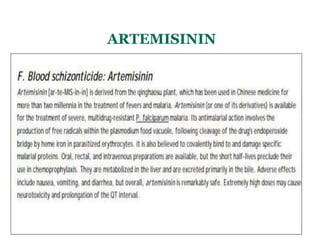
ARTEMISININ
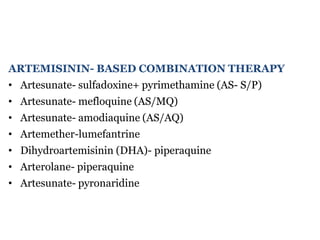
ARTEMISININ- BASED COMBINATION THERAPY
• Artesunate- sulfadoxine+ pyrimethamine (AS- S/P)
• Artesunate- mefloquine (AS/MQ)
• Artesunate- amodiaquine (AS/AQ)
• Artemether-lumefantrine
• Dihydroartemisinin (DHA)- piperaquine
• Arterolane- piperaquine
• Artesunate- pyronaridine
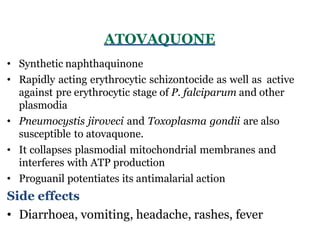
ATOVAQUONE
• Synthetic naphthaquinone
• Rapidly acting erythrocytic schizontocide as well as active
against pre erythrocytic stage of P. falciparum and other
plasmodia
• Pneumocystis jiroveci and Toxoplasma gondii are also
susceptible to atovaquone.
• It collapses plasmodial mitochondrial membranes and
interferes with ATP production
• Proguanil potentiates its antimalarial action
Side effects
• Diarrhoea, vomiting, headache, rashes, fever
REFERANCE
KD Tripathi Essential of Medical Pharmacology
7th Edition Page no:
©2013,KD Tripathi

antimalarial drugs.pptx

  • 1.
    GRACE COLLEGE OFPHARMACY,PALAKKAD APPROVED BY PCI,GOVERNMENT OF KERALA AFFLIATED TO KERALA UNIVERSITY OF HEALTH SCIENCES ANTI-MALARIAL DRUGS Prepared by: Mr. GOKUL J SIDDHARTH RESEARCH SCHOLAR gokulsiddu@gmail.com
  • 2.
  • 3.
    ANTIMALARIAL DRUGS • Theseare drugs used for prophylaxis, treatment and prevention of relapses of malaria • malaria is an acute infectious disease caused by four species of the protozoal genus Plasmodium • Plasmodium species which infect humans 1. Plasmodium vivax (tertian) 2. Plasmodium ovale (tertian) 3. Plasmodium falciparum (tertian): Most dangerous species 4. Plasmodium malariae (quartan) • The parasite is transmitted to human through the bite of a female Anopheles mosquito
  • 4.
  • 5.
  • 6.
    OBJECTIVES AND USEOF ANTIMALARIAL DRUGS • The aims of using drugs in relation to malarial infection are; • To prevent clinical attack of malaria (prophylactic) • To treat clinical attack of malaria (clinical curative) • To completely eradicate the parasite from the patient’s body (radical curative) • To cutdown human to mosquito transmission (gametocidal)
  • 7.
    LIFE CYCLE OFTHE MALARIAL PARASITE, PLASMODIUM FALCIPARUM
  • 8.
    DRUGS USED INMALARIA • Tissue schizonticides- drugs eliminating developing or dormant liver forms • Blood schizonticides- drugs acting on erythrocytic parasites • Gametocides- drugs that kill sexual stages and prevent transmission to mosquitoes
  • 9.
    FORMS OF ANTIMALARIALDRUGS Clinically malarial infections can be controlled by the drugs used in following ways: 1. Causal prophylaxis 2. Suppressive prophylaxis 3. Clinical cure 4. Radical cure 5. Gametocidal 1.Causal prophylaxis • Drugs prevent the maturation of or destroy the sporozoites within the infected hepatic cell- thus prevent erythrocytic invasion
  • 10.
    • Primaquine –for all species of malaria but not used due to its toxic potential • Proguanil-primarilyfor P. falciparum and not effective against P. vivax (weak activity), rapid development of resistance 2. Suppressive prophylaxis • Schizontocides inhibit erythrocyte phase and prevent the rupture of the infected erythrocytes, lead to freedom from rigors and pyrexia • Includes quinine, chloroquine, proguanil, pyrimethamine, artemicinin and tetracycline 3. Clinical cure • Erythrocytic schizontocides are used to terminate episodes of malarial fever
  • 11.
    • Fast actinghigh efficacy drugs: Chloroquine, quinine, mefloquine, halofantrine, artemisinin Used singlyto treat malaria fever o Faster acting, preferably used in falciparum malaria where delayed treatment may lead to death even if parasites are clear from blood • Slow acting low efficacy drugs: Proguanil, pyrimethamine, sulfonamides, tetracyclines- Used only in combination 4. Radical cure • Drug attack exoerythrocytic stage (hypnozoites) given with clinical curative for the total eradication of the parasite from the patient’s body.
  • 12.
    • Radical cureof the P. falciparum malaria can be achieved by suppressives only • For radical cure of P.vivax infection, primaquine and proguanil are effective 5. Gametocial • Removal of male and female gametes of Plasmodia formed in the patient’s blood • It has no benefit for treated patient • Primaquine and artemisinins are highly effective against gametocytes of all species.
  • 13.
    CHLOROQUINE (CQ) • Rapidlyacting erythrocytic schizontocide against all species of Plasmodia • Drug of choice for treating acute attacks caused by sensitive strains of P. vivax or P. falciparum • Controls most clinical attack in 1-2days with disappearance of parasite from peripheral blood in 1- 3days • No effect on exo- erythrocytic phase • Neither prevent primary infection nor relapse in P. vivax and P.ovale • Drug of choice for use in pregnancy, prophylaxis
  • 14.
    Chloroquine- mechanism ofaction • The parasite digests the host cell’s hemoglobin to obtain essential amino acids • The processreleases large amounts of heme, which is toxic to the parasite • To protect itself the parasite ordinarily polymerizes the heme to nontoxic hemozoin, which is sequestered in the parasite’s food vacuole Cholroquine prevents the polymerization to hemozoin • The accumulation of heme results in lysis of both the parasite and the red blood cell
  • 16.
    Pharmacokinetics • Rapidly andcompletely absorbed from GI tract • Substantial amount is deposited in erythrocytes, liver, spleen, kidney, lung, melanin containing tissues and leukocytes • Slowrelease from these sites helps in maintaining the therapeutic plasma levels – when used for prophylaxis, it is administered just once a week • Also crosses the blood- brain barrier and traverses the placenta Excreted predominantly in the urine Uses • Extraintestinal amoebiasis • Rheumatoid arthritis • Discoid lupus erythematosus • Lepra reaction • Photogenic reactions • Infectious mononucleosis
  • 17.
    Adverse effects • CNS-mild headache, confusion, psychosis, convulsion, impaired hearing • Eye (with high dose)- loss of vision due to retinal damage, reversible corneal damage • GIT- Nausea, vomiting, anorexia, epigastric pain, diarrhea( can be minimized by taking with meal) • Skin- uncontrolled itching, urticaria, exfoliative dermatitis Parenteral administration- Hypotension, cardiac arrhythmias, cardiac depression
  • 18.
    Contraindications • Patient withpsoriasis, porphyria • In dermatitis, liver damage, alcoholism, neurological, retinal and hematological diseases MEFLOQUINE (MQ) • Fast acting erythrocytic (blood) schizontocide but slower than CQ or quinine • Effective against CQ-sensitive as well as resistant Plasmodia Efficacious suppressive prophylactic for multi- resistant P. falciparum
  • 19.
    Mechanism of action •Like CQ, it accumulates in infected RBCs, binds to heme and this complex damages the parasite’s membrane • However recent evidence suggests that the site of action of MQ is in the parasitic cytosol rather than in the acidic vacuole Pharmacokinetics • Prolonged absorption after oral ingestion • It is highly plasma protein bound and concentrated in the liver, lung and intestines • Extensive metabolism occurs in liver and is primarily secreted in bile It has a long half life (17days) due to its concentration in various
  • 20.
    tissues and itscontinuous circulation through the enterohepatic and enterogastric systems • Its major excretory route is feces Adverse effects • MQ is bitter in taste • At high doses: Nausea, vomiting, diarrhea, abdominal pain, bradycardia o Ataxia, hallucinations, depression • MQ is safe in pregnancy • Rare events of toxicity are seen Contraindications • In patients with anxiety, depression, psychosis, andin cardiac conduction defects
  • 21.
    Drug interactions • Cardiacarrests are possible if MQ is taken concurrently with quinine or quinidine Uses • Effective for multidrug resistant P. falciparum • However its use is restricted due to its toxicity, cost and long half life QUININE • Quinine is a l-isomer of alkaloid obtained from cinchona bark and quinidine (antiarrhythmic) is its d- isomer • An effective erythrocyticschizontocide as suppressive and used to prevent or terminate attacks of vivax, ovale, malariae, sensitive falciparum • Moderately effective against hepatic form (pre- exoerythrocyte and gametocytes)
  • 22.
    Mechanism of action •Like CQ it is a weak base, and acts by inhibiting polymerization of heme to hemozoin • Free heme or heme-quinine complex damages parasite’s membrane and kills it Pharmacokinetics • Well absorbed from GI tract, even in patients with diarrhea Metabolized in liver and excreted in urine Adverse effects • Cinchonism • Higher dose symptoms include nausea, vomiting, tinnitus, vertigo, headache, mental confusion, difficulty in hearing and visual defects, diarrhea, flushing
  • 23.
    • Rapid i.v.injection • Hypotension and cardiac arrhythmias • Can cause profused hypoglycemia • Pregnancy • Hypoglycaemia • Causes abortion in early pregnancy by stimulating myometrium and premature labor by stimulating uterus Clinical uses • Malarial attacks • Uncomplicated resistant falciparum Complicated and severe malaria including cerebral malariaIs not highly active, adjunctive therapy with doxycycline, tetracycline and clindamycin is needed
  • 24.
    • PROGUANIL (CHLOROGUANIDE) •Slow acting erythrocytic schizontocide • Cyclized in body to a triazine derivative (cycloguanil) • Cycloguanil inhibits plasmodial dihydrofolate reductase (DHFRase) Resistance developed due to mutational changes in the plasmodialDHFRase enzyme • Slow but adequate absorption from the gut • Partly metabolized and excreted in urine • Half life 16-20 hour ; noncumulative Adverse effects • Mild abdominal upset, vomiting, occasional stomatitis, haematuria, rashes and transient loss of hair
  • 25.
    PYRIMETHAMINE • Slow actingerythrocytic schizontocide • Direct inhibitor of plasmodial dihydrofolate reductase (DHFRase) Conversion of dihydrofolic acid to tetrafolic acid is inhibited • High doses inhibits Toxoplasma gondii • Resistance develops by mutation in DHFRase enzyme Adverse effects • Occasional nausea and rashes • Folate deficiency rare • Megaloblastic anaemia and granulocytopenia with higher dose • Can be treated with folinic acid • Combined with a sulfonamide (S/P) or dapsone for treatment of falciparum malaria
  • 26.
    SULFONAMIDE-PYRIMETHAMINE(S/P) • Sulphadoxine isa sulfonamide thus competes with para– amino benzoic acid – inhibits the formation of dihydropteric acid • Pyrimethamine inhibits DHFRase enzyme as a result of which conversion of dihydrofolic acid to tetrahydrofolic acid is blocked – thus inhibits DNA synthesis • Effective blood schizontocide against Plasmodium falciparum Treatment and prophylaxis of falciparum malaria resistantto chloroquine Adverse effects • Mild GIT upset • Megaloblastic anemia, bone marrow depletion • Rashes, urticaria, serum sickness, drug fever • Exfoliative dermatitis, Stevens Johnson syndrome • Nephrotoxicity
  • 27.
    PRIMAQUINE • Poor erythrocyticschizontocide • Has marked effect on primary and secondary hepatic phases of malarial parasite • Highly active against gametocytes and hypnozoites Mechanism of action • Intermediate act as oxidant that are responsible for the schizontocial action Pharmacokinetics • Readily absorbed after oral absorption • Oxidized in liver with a plasma half life of 3-6 hours • Excreted in urine within 24 hour • Not a cumulative drug
  • 28.
    Adverse effects • Abdominalpain, gastrointestinal upset, weakness or uneasiness chest Leucopenia (high dose) • Hemolysis • Methaemoglobinaemia • Tachypnoea • Cyanosis Clinical uses • Radical cure of relapsing malaria (P.ovale and P.vivax) • Single 45mg dose given with curative dose of chloroquine to kill gametes (P. falciparum)
  • 29.
  • 30.
    ARTEMISININ- BASED COMBINATIONTHERAPY • Artesunate- sulfadoxine+ pyrimethamine (AS- S/P) • Artesunate- mefloquine (AS/MQ) • Artesunate- amodiaquine (AS/AQ) • Artemether-lumefantrine • Dihydroartemisinin (DHA)- piperaquine • Arterolane- piperaquine • Artesunate- pyronaridine
  • 31.
    ATOVAQUONE • Synthetic naphthaquinone •Rapidly acting erythrocytic schizontocide as well as active against pre erythrocytic stage of P. falciparum and other plasmodia • Pneumocystis jiroveci and Toxoplasma gondii are also susceptible to atovaquone. • It collapses plasmodial mitochondrial membranes and interferes with ATP production • Proguanil potentiates its antimalarial action Side effects • Diarrhoea, vomiting, headache, rashes, fever
  • 32.
    REFERANCE KD Tripathi Essentialof Medical Pharmacology 7th Edition Page no: ©2013,KD Tripathi