Antiviral Agents for
Nonretrovirals
Pin on Nursing Apps (pinterest.com)
Learning Outcomes
• Outline the main features of viral infections, viral
structure, and steps involved in viral replicative life
cycle.
• Classification of antiviral agents according to their
spectrum of activity.
• Discuss the mechanisms of action of antiviral agents.
• Discuss the mechanisms of resistance of antiviral
agents.
• Explain the:
 Pharmacokinetics of antiviral agents.
 Adverse effects of antiviral agents.
 Drug-drug interactions.
Viral infections
HIV
1. Influenza
2. Herpes
3. Hepatitis
Caused by Retroviral viruses
Caused by Non-Retroviral viruses
 Viruses are smaller than bacteria ,and they cannot be observed using a light
microscope.
 They lack both a cell wall and a cell membrane, and they do not carry out
metabolic processes.
 A virus cannot replicate on its own, they replicate only inside living cells
 They contain either DNA or RNA, but not both
 . Viruses are difficult to be killed because, and any drug that kills a virus may also kill
the host cells.
 Viral diseases are further complicated by the fact that the clinical symptoms appear late
in the course of the disease, at a time when most of the virus particles have replicated.
 This contrasts with bacterial diseases, in which the clinical symptoms are usually
coincident with bacterial proliferation.
Viruses are different from other Microbes
Key characteristics of antiviral drugs
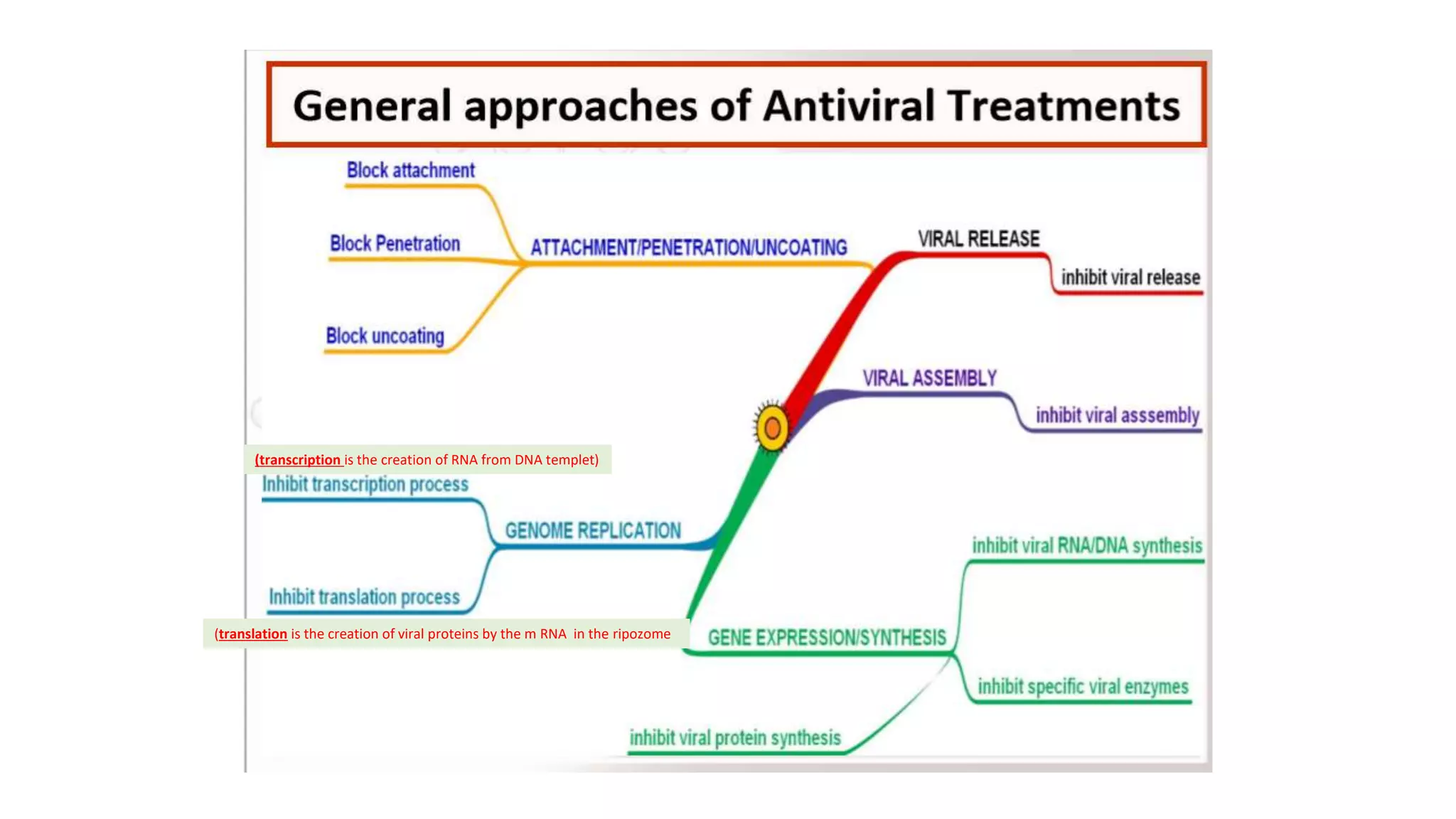
• Most Antiviral drugs inhibit viral replication.
• They do not eliminate non-replicating or latent virus.
Therefore, the viral growth resumes after drug removal.
• The cure depends on the host immune system to
eradicate.
• Best responses to antiviral drugs are in patients with
competent immune systems.
• Many Antiviral drugs are Prodrugs , They need to be
activated by viral and cellular enzymes to produce the
antiviral effect.
o How do they act ?????
o Antiviral drugs can enter the cells infected with virus
o Interfere with viral nucleic acid synthesis and/or
regulation
o Some drugs interfere with ability of virus to bind to cells
o Some drugs stimulate the body’s immune system
Antiviral drug classification
1. Anti HIV
1. Anti-influenza Agents
2. Anti-herpes virus Agents
3. Anti-viral Agents for hepatic viral
infections
B. Antiretroviral Agents
A. Non-Retroviral Antiviral Agents
Antiviral drug classification
1. Nucleoside Reverse Transcriptase Inhibitors
(NRTI)
2. Non-nucleoside Reverse Transcriptase
Inhibitors (NNRTI)
3. Protease Inhibitors (PI)
4. Entry Inhibitors
5. Integrase Strand Transfer Inhibitors
1. Anti-influenza Agents
2. Anti-herpes virus Agents
3. Anti-viral Agents for hepatic viral
infections
B. Antiretroviral Agents
A. Non-Retroviral Antiviral Agents
Antiviral drug classification
Anti HIV
A. Anti-influenza Agents
B. Anti-herpesvirus Agents
C. Anti-hepatitis Agents
Antiretroviral Agents
Non-Retroviral Antiviral Agents
- (found only in Flu A)
Influenza virus, which affects the respiratory tract, is one of the few RNA viruses that replicates in the nucleus of cells.
Steps of replication for influenza virus
https://openstax.org/books/microbiology/pages/6-2-the-viral-life-cycle
(transcription is the creation of RNA from DNA templet)
(translation is the creation of viral proteins by the m RNA in the ripozome
Anti-influenza Agents
Viral respiratory tract infections for
which treatments exist include those
of influenza A and B and respiratory
syncytial virus (RSV).
(limited to influenza A infections)
Amantadine & Rimantadine (Pharmacokinetics)
Both drugs are well absorbed orally.
Amantadine distributes throughout the body and readily
penetrates into the central nervous system (CNS), whereas
rimantadine does not cross the blood-brain barrier to the
same extent.
Amantadine is not extensively metabolized. It is excreted
into the urine and may accumulate to toxic levels in
patients with renal failure.
On the other hand, rimantadine is extensively
metabolized by the liver, and both the metabolites and the
parent drug are eliminated by the kidney
Amantadine & Rimantadine (Adverse effects)
 Insomnia
 dizziness
 ataxia. More serious side eff ects have
been reported (for example
 The drug should be employed
cautiously in patients with CNS
disorders , renal impairment, or
epilepsy.
 Rimantadine causes fewer CNS
reactions, because it does not
efficiently cross the blood-brain
barrier.
 Both drugs cause GI intolerance.
 Amantadine and rimantadine should
be used with caution in pregnant and
nursing mothers, because they have
been found to be embryotoxic and
teratogenic in rats.
Antiviral drugs classification
A. anti HIV
A. Anti-influenza Agents
B. Anti-herpes virus Agents
C. Anti-hepatitis Agents
Antiretroviral Agents
Non-Retroviral Antiviral Agents
 The name is derived from Greek word herpein (to
creep or crawl), referring to latent, recurring infections.
herpes viruses infections - Google Search
Herpes viruses
Affected site
Neuron
Neuron
Neuron
B cells
Monocyte and
lymphocyte
T cells
T cells
B cells
Congenital CMV Disease
https://www.memorangapp.com/flashcards/59896/DNA+Viruses+2+L15/
Herpes virus infections
http://tmedweb.tulane.edu/pharmwiki/lib/exe/fetch.php/mondalanti-viral_drugs_f09.pdf
(transcription is the creation of RNA from DNA templet)
(translation is the creation of viral proteins by the m RNA in the ribozom
Hepes virus replication
Anti-herpes virus Agents
1. Nucleoside Analogs
2. Non-Nucleoside Analogs
Anti-herpes virus Agents are classified to :
 Aciclovir is a Guanosine analogue that lacks a true sugar moiety
(containing an acyclic side chain in place of ribose).
Aciclovir, Ganciclovir & valganciclovir
Mechanism of action (MOA)
1. Acyclovir is activated
(monophosphorylated) by the viral
thymidine kinase (TK) enzyme to mono-
phosphate.
2. Host enzymes then convert the mono-
phosphate to di- and tri-phosphates
(which is false nucleotide).
3. The false nucleotide will be incorporated
into the viral DNA, causing premature
DNA-chain termination.
4. inhibits viral DNA polymerase activity by
inhibiting DNA chain elongation due to lack
of 3’ –OH group.
Inhibit viral DNA synthesis: Chain termination
Mechanism
of resistance
 Altered of thymidine kinase
 Deficient activity of thymidine kinase
 Altered DNA/ mutation in polymerases
 Reduction in drug phosphorelation
 [Note: Cytomegalovirus (CMV) is resistant,
because it lacks a specific viral thymidine
kinase.
Valciclovir is an
Ganciclovir & Valganciclovir
• Ganciclovir is an analog of acyclovir that has 8 to 20 times greater activity against CMV,
which is the only viral infection for which it is approved.
• Valganciclovir is the valyl ester of ganciclovir.
• Like valacyclovir, valganciclovir has high oral bioavailability, because rapid hydrolysis
(metabolism) in the intestine and liver after oral administration leads to high levels of
ganciclovir.
Ganciclovir & valganciclovir are the best agents for Cytomegalovirus (CMV)
treatment
Inhibit the DNA polymerase
Anti-viral Agents for
hepatic viral infections
 Should not be used alone for chronic Hepatitis C (not effective)
 Because of its teratogenic effects in experimental animals, ribavirin is contraindicated
in pregnancy.
 Effective birth control method must be taken to avoide pregnancy during therapy & for
6 months after completetion of treatment in both male and female patients.
(Didanosine (ddI)
Lamivudine
This cytosine analog is an inhibitor of both hepatitis B virus (HBV) DNA polymerase and human
immunodeficiency virus (HIV) reverse transcriptase.
Telbivudine
Telbivudine can be used in the treatment of HBV. Telbivudine is not active against HIV or other viruses. The
drug is phosphorylated intracellularly to the triphosphate, which can either compete with endogenous thymidine
triphosphate for incorporation into DNA or else be incorporated into viral DNA, where it serves to terminate
further elongation
of the DNA chain.
Adefovir
Adefovir is used for hepatitis B virus (HBV), it is a nucleotide analog that is phosphorylated to adefovir
diphosphate , which is then incorporated into viral DNA. This leads to termination of further DNA
synthesis and prevents viral replication.
Entecavir
Entecavir is a guanosine analog approved for the treatment of HBV infections. Following intracellular
phosphorylation to
the triphosphate, it competes with the natural substrate, deoxyguanosine triphosphate, for viral reverse
transcriptase. Entecavir has been shown to be effective against lamivudine-resistant strains of
HBV. Liver inflammation and scarring are improved.
Thank you

Antiviral Agents(R1).pptx

  • 1.
    Antiviral Agents for Nonretrovirals Pinon Nursing Apps (pinterest.com)
  • 2.
    Learning Outcomes • Outlinethe main features of viral infections, viral structure, and steps involved in viral replicative life cycle. • Classification of antiviral agents according to their spectrum of activity. • Discuss the mechanisms of action of antiviral agents. • Discuss the mechanisms of resistance of antiviral agents. • Explain the:  Pharmacokinetics of antiviral agents.  Adverse effects of antiviral agents.  Drug-drug interactions.
  • 3.
    Viral infections HIV 1. Influenza 2.Herpes 3. Hepatitis Caused by Retroviral viruses Caused by Non-Retroviral viruses
  • 4.
     Viruses aresmaller than bacteria ,and they cannot be observed using a light microscope.  They lack both a cell wall and a cell membrane, and they do not carry out metabolic processes.  A virus cannot replicate on its own, they replicate only inside living cells  They contain either DNA or RNA, but not both  . Viruses are difficult to be killed because, and any drug that kills a virus may also kill the host cells.  Viral diseases are further complicated by the fact that the clinical symptoms appear late in the course of the disease, at a time when most of the virus particles have replicated.  This contrasts with bacterial diseases, in which the clinical symptoms are usually coincident with bacterial proliferation. Viruses are different from other Microbes
  • 6.
    Key characteristics ofantiviral drugs • Most Antiviral drugs inhibit viral replication. • They do not eliminate non-replicating or latent virus. Therefore, the viral growth resumes after drug removal. • The cure depends on the host immune system to eradicate. • Best responses to antiviral drugs are in patients with competent immune systems. • Many Antiviral drugs are Prodrugs , They need to be activated by viral and cellular enzymes to produce the antiviral effect. o How do they act ????? o Antiviral drugs can enter the cells infected with virus o Interfere with viral nucleic acid synthesis and/or regulation o Some drugs interfere with ability of virus to bind to cells o Some drugs stimulate the body’s immune system
  • 7.
    Antiviral drug classification 1.Anti HIV 1. Anti-influenza Agents 2. Anti-herpes virus Agents 3. Anti-viral Agents for hepatic viral infections B. Antiretroviral Agents A. Non-Retroviral Antiviral Agents
  • 8.
    Antiviral drug classification 1.Nucleoside Reverse Transcriptase Inhibitors (NRTI) 2. Non-nucleoside Reverse Transcriptase Inhibitors (NNRTI) 3. Protease Inhibitors (PI) 4. Entry Inhibitors 5. Integrase Strand Transfer Inhibitors 1. Anti-influenza Agents 2. Anti-herpes virus Agents 3. Anti-viral Agents for hepatic viral infections B. Antiretroviral Agents A. Non-Retroviral Antiviral Agents
  • 9.
    Antiviral drug classification AntiHIV A. Anti-influenza Agents B. Anti-herpesvirus Agents C. Anti-hepatitis Agents Antiretroviral Agents Non-Retroviral Antiviral Agents
  • 11.
    - (found onlyin Flu A) Influenza virus, which affects the respiratory tract, is one of the few RNA viruses that replicates in the nucleus of cells.
  • 12.
    Steps of replicationfor influenza virus https://openstax.org/books/microbiology/pages/6-2-the-viral-life-cycle
  • 13.
    (transcription is thecreation of RNA from DNA templet) (translation is the creation of viral proteins by the m RNA in the ripozome
  • 14.
    Anti-influenza Agents Viral respiratorytract infections for which treatments exist include those of influenza A and B and respiratory syncytial virus (RSV).
  • 18.
    (limited to influenzaA infections)
  • 19.
    Amantadine & Rimantadine(Pharmacokinetics) Both drugs are well absorbed orally. Amantadine distributes throughout the body and readily penetrates into the central nervous system (CNS), whereas rimantadine does not cross the blood-brain barrier to the same extent. Amantadine is not extensively metabolized. It is excreted into the urine and may accumulate to toxic levels in patients with renal failure. On the other hand, rimantadine is extensively metabolized by the liver, and both the metabolites and the parent drug are eliminated by the kidney
  • 20.
    Amantadine & Rimantadine(Adverse effects)  Insomnia  dizziness  ataxia. More serious side eff ects have been reported (for example  The drug should be employed cautiously in patients with CNS disorders , renal impairment, or epilepsy.  Rimantadine causes fewer CNS reactions, because it does not efficiently cross the blood-brain barrier.  Both drugs cause GI intolerance.  Amantadine and rimantadine should be used with caution in pregnant and nursing mothers, because they have been found to be embryotoxic and teratogenic in rats.
  • 26.
    Antiviral drugs classification A.anti HIV A. Anti-influenza Agents B. Anti-herpes virus Agents C. Anti-hepatitis Agents Antiretroviral Agents Non-Retroviral Antiviral Agents
  • 27.
     The nameis derived from Greek word herpein (to creep or crawl), referring to latent, recurring infections. herpes viruses infections - Google Search Herpes viruses
  • 28.
    Affected site Neuron Neuron Neuron B cells Monocyteand lymphocyte T cells T cells B cells
  • 29.
    Congenital CMV Disease https://www.memorangapp.com/flashcards/59896/DNA+Viruses+2+L15/ Herpesvirus infections http://tmedweb.tulane.edu/pharmwiki/lib/exe/fetch.php/mondalanti-viral_drugs_f09.pdf
  • 30.
    (transcription is thecreation of RNA from DNA templet) (translation is the creation of viral proteins by the m RNA in the ribozom Hepes virus replication
  • 31.
    Anti-herpes virus Agents 1.Nucleoside Analogs 2. Non-Nucleoside Analogs Anti-herpes virus Agents are classified to :
  • 33.
     Aciclovir isa Guanosine analogue that lacks a true sugar moiety (containing an acyclic side chain in place of ribose).
  • 34.
    Aciclovir, Ganciclovir &valganciclovir Mechanism of action (MOA) 1. Acyclovir is activated (monophosphorylated) by the viral thymidine kinase (TK) enzyme to mono- phosphate. 2. Host enzymes then convert the mono- phosphate to di- and tri-phosphates (which is false nucleotide). 3. The false nucleotide will be incorporated into the viral DNA, causing premature DNA-chain termination. 4. inhibits viral DNA polymerase activity by inhibiting DNA chain elongation due to lack of 3’ –OH group. Inhibit viral DNA synthesis: Chain termination
  • 36.
    Mechanism of resistance  Alteredof thymidine kinase  Deficient activity of thymidine kinase  Altered DNA/ mutation in polymerases  Reduction in drug phosphorelation  [Note: Cytomegalovirus (CMV) is resistant, because it lacks a specific viral thymidine kinase.
  • 38.
  • 39.
    Ganciclovir & Valganciclovir •Ganciclovir is an analog of acyclovir that has 8 to 20 times greater activity against CMV, which is the only viral infection for which it is approved. • Valganciclovir is the valyl ester of ganciclovir. • Like valacyclovir, valganciclovir has high oral bioavailability, because rapid hydrolysis (metabolism) in the intestine and liver after oral administration leads to high levels of ganciclovir. Ganciclovir & valganciclovir are the best agents for Cytomegalovirus (CMV) treatment
  • 41.
    Inhibit the DNApolymerase
  • 43.
  • 44.
     Should notbe used alone for chronic Hepatitis C (not effective)
  • 46.
     Because ofits teratogenic effects in experimental animals, ribavirin is contraindicated in pregnancy.  Effective birth control method must be taken to avoide pregnancy during therapy & for 6 months after completetion of treatment in both male and female patients. (Didanosine (ddI)
  • 50.
    Lamivudine This cytosine analogis an inhibitor of both hepatitis B virus (HBV) DNA polymerase and human immunodeficiency virus (HIV) reverse transcriptase. Telbivudine Telbivudine can be used in the treatment of HBV. Telbivudine is not active against HIV or other viruses. The drug is phosphorylated intracellularly to the triphosphate, which can either compete with endogenous thymidine triphosphate for incorporation into DNA or else be incorporated into viral DNA, where it serves to terminate further elongation of the DNA chain. Adefovir Adefovir is used for hepatitis B virus (HBV), it is a nucleotide analog that is phosphorylated to adefovir diphosphate , which is then incorporated into viral DNA. This leads to termination of further DNA synthesis and prevents viral replication. Entecavir Entecavir is a guanosine analog approved for the treatment of HBV infections. Following intracellular phosphorylation to the triphosphate, it competes with the natural substrate, deoxyguanosine triphosphate, for viral reverse transcriptase. Entecavir has been shown to be effective against lamivudine-resistant strains of HBV. Liver inflammation and scarring are improved.
  • 51.