Santosh Yadav
ANTIGEN, IMMUNOGENICITY AND
MAJOR HISTOCOMPATIBILITY COMPLEX
Santosh Yadav
M.Sc. Clinical Microbiology
Dept. of Microbiology
Institute of Medicine
Tribhuvan Univarsity Teaching Hospital, Nepal
1
Santosh Yadav
Outlines
• Antigen- explanation and types
• Determinants of immunogenicity
• MHC gene-introduction, polymorphism and
inheritance
• Expression and restriction of MHC
• MHC molecules
• MHC-peptide interaction
• Processing and presentation of peptide
antigen.
2
Santosh Yadav
ANTIGEN
• Any substance that may be specifically bound by an antibody
molecule or T cell receptor.
• An antigen by itself need not produce an immune response of
any kind but it bind specifically with antibodies and sensitized
T-cell and its ability to bind is referred to as antigenicity.
3
Santosh Yadav
Contd…
• Immunogen ,on the other hand, is a substance which
produces an immune response as well as bind to its products
i.e. antibodies or sensitized T-cell.
• So an immunogen is an antigen but reverse is not true and its
property of producing immune response is called
immunogenicity.
4
Santosh Yadav
HAPTEN
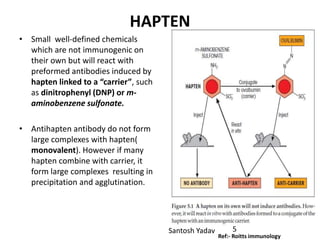
• Small well-defined chemicals
which are not immunogenic on
their own but will react with
preformed antibodies induced by
hapten linked to a “carrier”, such
as dinitrophenyl (DNP) or m-
aminobenzene sulfonate.
• Antihapten antibody do not form
large complexes with hapten(
monovalent). However if many
hapten combine with carrier, it
form large complexes resulting in
precipitation and agglutination.
Ref:- Roitts immunology
5
Santosh Yadav
ANTIGENIC DETERMINANT OR EPITOPE
• Part of the antigen which is in contact with the paratope or
receptor of lymphocyte, is designated the epitope or
antigenic determinant.
• Presence of multiple identical determinants in an antigen is
referred to as polyvalency or multivalency.
• B cells and T cells do not recognise the same epitopes on the
antigen molecules, but different epitopes.
6
Santosh Yadav
Contd…
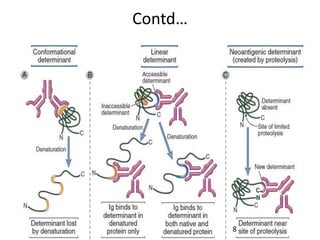
 B-cell epitope:-
• Recognised in free state without combining with any other
molecules.
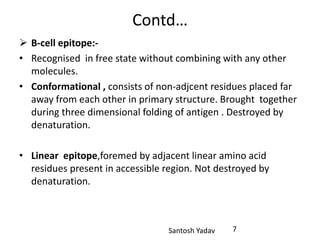
• Conformational , consists of non-adjcent residues placed far
away from each other in primary structure. Brought together
during three dimensional folding of antigen . Destroyed by
denaturation.
• Linear epitope,foremed by adjacent linear amino acid
residues present in accessible region. Not destroyed by
denaturation.
7
Santosh Yadav
Contd…
8
Santosh Yadav
Contd…
 T-cell epitope:-
• Are recognised after combined with MHC molecule.
• Located internally deep and not present on surface, so T-cell
epitope undergo antigen processing to make these epitope
accessible.
• T-cell epitope recognition involves the formation of a ternary
complex of MHC, antigen and TCR. In this complex ,the
antigen has 2 binding site- one for MHC (aggretope) and
another for TCR (epitope).
9
Santosh Yadav
ANTIGEN TYPES
10
Santosh Yadav
EXOGENOUS AND ENDOGENOUS
• Exogenous antigens, enters into the host from external
environment. (eg. Bacterial , viral antigens, some drugs, etc)
• Endogenous antigen, produced within the host.( eg.. Products
of genetically mutated cells or virally infected cells or
cancerous cell , etc)
11
Santosh Yadav
AUTOANTIGEN,ALLOANTIGEN AND HETEROANTIGEN
 Autoantigen, belonging to the host itself.( eg.. Sperm and
corneal protein ).
 Alloantigen, derived from other members of species of host.
Important in transplantation and blood transfusion.( eg.
Antigen on donor and recipient RBCs are alloantigen to each
other)
 Heteroantigen, Antigens from two different species. (
eg..heterophile antigen, human blood group A antigen and
pneumococcal polysaccharide type XIV)
12
Santosh Yadav
TD AND TI ANTIGENS
• T- cell dependent antigens are those that do not
directly stimulate the production of antibody without the
help of T cells. Proteins are T-dependent antigens.
• T-cell independent antigens are antigens which can
directly stimulate the B cells to produce antibody without
the requirement for T cell help.
In general,polysaccharides are T-independent antigens.
13
Santosh Yadav
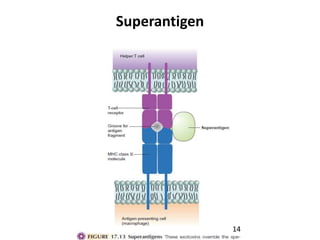
Superantigen
14
Santosh Yadav
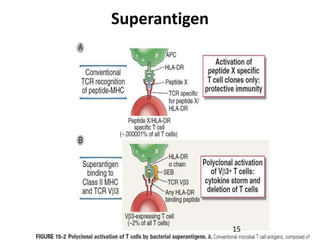
Superantigen
15
Santosh Yadav
IMMUNOGENICITY
• Properties of immunogen,
• Properties of host,
• Route and dose of administration, and
• Adjuvants
16
Santosh Yadav
PROPERTIES OF AN IMMUNOGEN
 Foreignness:-
• Immunogen molecule must be recognised as non-self i.e.
foreign by host cell.
• Typically , more distant taxonomically the source of an
immunogen from the host, better It is as immunogen. ( eg..
BSA is more immunogenic in chicken than goat).
 Chemical nature:-
• Protein >polysaccharide>lipids and nucleic acid.
• All protein except gelatin are immunogenic.
17
Santosh Yadav
Contd…
 Molecular size:-
• To become most active immunogen,molecular mass of 10,000 Da is
required. Generally, substances with a molecular mass less than
5000–10,000 Da are poor immunogens.
 Molecular heterogenicity and structure complexity:-
• Co-polymers composed of different amino acids or sugars are
usually more immunogenic than homopolymers of their
constituents.
18
Santosh Yadav
Contd…
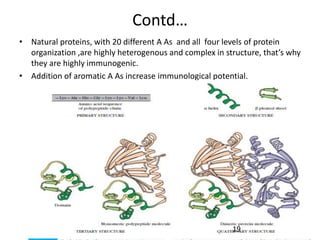
• Natural proteins, with 20 different A As and all four levels of protein
organization ,are highly heterogenous and complex in structure, that’s why
they are highly immunogenic.
• Addition of aromatic A As increase immunological potential.
19
Santosh Yadav
Contd…
 Susceptibility to antigen processing and
presentation:-
• Antigen is degraded and some selected fragment of it is
presented for recognition by T-cell in order to generate an
immune response.
• Large, insolube molecules ,being easily phagocytosed, are
potent immunogens than small and soluble ones.
• D-amino acids polymer cannot be metabolised in human body
and they are not immunogenic.
20
Santosh Yadav
HOST CHARACTERS
 Genetic make up:-
• Genetic basis of MHC, gene encoding BCR and TCR are also
involved in immune regulation.
 Nutritional status:-
• Malnutrition and/or undernutrition also leads to a poor response
on immunogenic challenge.
 Age:-
• Neonates and elderly people show poor immune response as
compared to young adults.
21
Santosh Yadav
ROUTE AND DOSE OF ADMINISTRATION
• A too little dose fails to elicit a immune response and a too
large dose leads to the development of immunological
tolerance.
• Eg.. 5ₓ10⁻⁴ mg of purified pneumococcal capular
polysaccharide antigen is sufficient to induce antibody
production. But a dose of 0.5 mg doesnot produce a response.
22
Santosh Yadav
Contd…
• Repeated immunogen exposure increase the clonal
proliferation of T and B cells to augment the response
(booster dose).
• Intravenously administered immunogens go to spleen while
while suncutaneous route leads the immunogen to regional
lymph nodes and hence they are more potential than those
administered orally.
23
Santosh Yadav
ADJUVANTS
• Substances that potentiate the action of immunogen.
• They are usually mixed with antigen to boost the
immune response.
• Also used when antigen is available in small quantity.
• Common examples- alum( alluminium potassium sulfate) and
Freunds adjuvants.
24
Santosh Yadav
Contd…
a) Freunds complete adjuvnts:-
• Contains antigen in aqueous phase and a suspension of
killed mtb in the oil phase( water in oil emulsion)
b) Freunds incomplete adjuvants:-
• Same but oil phase contains mannide mono-oleate , rather
than mtb.
• Bordetella pertussis acts as a good adjuvant for diphtheria and
tetanus toxoid in triple vaccine.
25
Santosh Yadav
Contd…
• Adjuvant acts in following ways:
o By prolonging antigen exposure by slowing the release( depot
action.)
o By activating the phagocytes(muramyl dipeptide,IL-11, MHC-
II).
o By activating the TH cells.
o Granuloma formation.
26
Santosh Yadav
MAJOR HISTOCOMPATIBILITY
COMPLEX
27
Santosh Yadav
Introduction
• Cluster of genes whose products play important role
in the development of immune response and
discrimination between self and non-self.
• Determine wheather a grafted tissue will be
accepted as self (histocompatible) or rejected as non
-self (histiincompatible) by the host.
28
Santosh Yadav
Contd…
• Formely called human leucocyte antigen(HLA)
(major determinant of rejection) Jean Dausset
• Also important for acquired immune response
because TH and Tc donot recognize antigens alone but
only when they are combined with MHC molecules.
29
Santosh Yadav
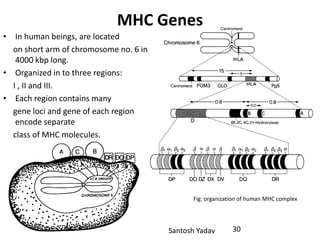
MHC Genes
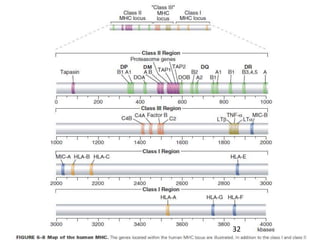
• In human beings, are located
on short arm of chromosome no. 6 in a
4000 kbp long.
• Organized in to three regions:
I , II and III.
• Each region contains many
gene loci and gene of each region
encode separate
class of MHC molecules.
Fig: organization of human MHC complex
30
Santosh Yadav
Contd…
• In chromosome no. 6 , region III lies in between
region I and II.
• Region I is longest (2000kbp).
• Region II and III are short ( about 1000 kbp).
• Class I MHC genes are organized into three main loci
i.e. A , B and C in region I.
• Class II MHC genes are also organized into three main
loci i.e. DP, DQ and DR in region II.
• Also many loci in region III.
31
Santosh Yadav
Contd…
32
Santosh Yadav
Polymorphism
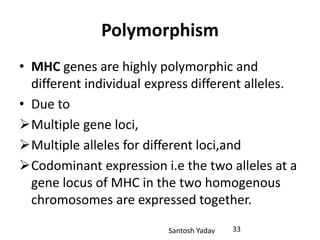
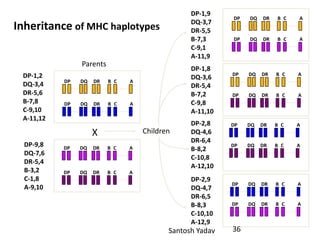
• MHC genes are highly polymorphic and
different individual express different alleles.
• Due to
Multiple gene loci,
Multiple alleles for different loci,and
Codominant expression i.e the two alleles at a
gene locus of MHC in the two homogenous
chromosomes are expressed together.
33
Santosh Yadav
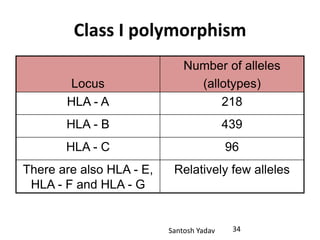
Class I polymorphism
Locus
Number of alleles
(allotypes)
HLA - A 218
HLA - B 439
HLA - C 96
There are also HLA - E,
HLA - F and HLA - G
Relatively few alleles
34
Santosh Yadav
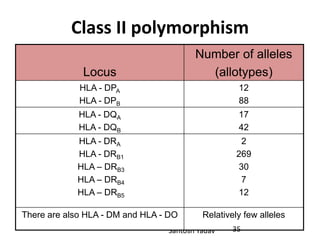
Class II polymorphism
Locus
Number of alleles
(allotypes)
HLA - DPA
HLA - DPB
12
88
HLA - DQA
HLA - DQB
17
42
HLA - DRA
HLA - DRB1
HLA – DRB3
HLA – DRB4
HLA – DRB5
2
269
30
7
12
There are also HLA - DM and HLA - DO Relatively few alleles
35
Santosh Yadav
Inheritance of MHC haplotypes
B C ADP DQ DR
B C ADP DQ DR
B C ADP DQ DR
B C ADP DQ DR
X
Parents
DP-1,2
DQ-3,4
DR-5,6
B-7,8
C-9,10
A-11,12
DP-9,8
DQ-7,6
DR-5,4
B-3,2
C-1,8
A-9,10
DP-1,8
DQ-3,6
DR-5,4
B-7,2
C-9,8
A-11,10
DP-1,9
DQ-3,7
DR-5,5
B-7,3
C-9,1
A-11,9
DP-2,8
DQ-4,6
DR-6,4
B-8,2
C-10,8
A-12,10
DP-2,9
DQ-4,7
DR-6,5
B-8,3
C-10,10
A-12,9
B C ADP DQ DR
B C ADP DQ DR
B C ADP DQ DR
B C ADP DQ DR
B C ADP DQ DR
B C ADP DQ DR
B C ADP DQ DR
B C ADP DQ DR
Children
36
Santosh Yadav
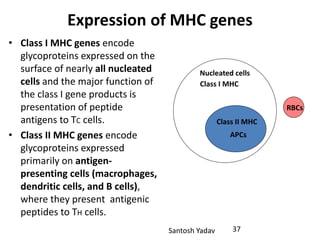
Expression of MHC genes
• Class I MHC genes encode
glycoproteins expressed on the
surface of nearly all nucleated
cells and the major function of
the class I gene products is
presentation of peptide
antigens to TC cells.
• Class II MHC genes encode
glycoproteins expressed
primarily on antigen-
presenting cells (macrophages,
dendritic cells, and B cells),
where they present antigenic
peptides to TH cells.
Class I MHC
Class II MHC
RBCs
APCs
Nucleated cells
37
Santosh Yadav
Contd…
• Class III MHC genes encode various secreted
proteins having immune functions(eg. complement
proteins, TNF, etc)
• Expression of MHC molecule is increased by
cytokines.
• Transcription factor is major determinant of
MHC molecule synthesis.
- CIITA (Trans activator), RFX (Trans activator)
• Some Viruses Decrease MHC Expression
– CMV, HBV,etc.
38
Santosh Yadav
MHC RESTRICTION
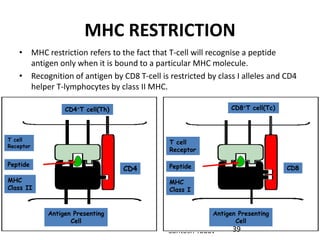
• MHC restriction refers to the fact that T-cell will recognise a peptide
antigen only when it is bound to a particular MHC molecule.
• Recognition of antigen by CD8 T-cell is restricted by class I alleles and CD4
helper T-lymphocytes by class II MHC.
CD4+T cell(Th) CD8+T cell(Tc)
T cell
Receptor
Peptide
MHC
Class II
T cell
Receptor
Peptide
MHC
Class I
Antigen Presenting
Cell
Antigen Presenting
Cell
CD4 CD8
39
Santosh Yadav
Class I MHC Molecules
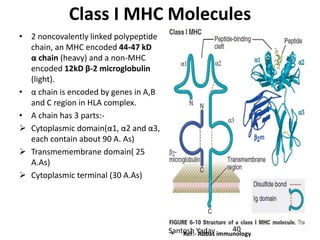
• 2 noncovalently linked polypeptide
chain, an MHC encoded 44-47 kD
α chain (heavy) and a non-MHC
encoded 12kD β-2 microglobulin
(light).
• α chain is encoded by genes in A,B
and C region in HLA complex.
• Α chain has 3 parts:-
 Cytoplasmic domain(α1, α2 and α3,
each contain about 90 A. As)
 Transmemembrane domain( 25
A.As)
 Cytoplasmic terminal (30 A.As)
• Ref:- Abbas immunology
40
Santosh Yadav
Contd…
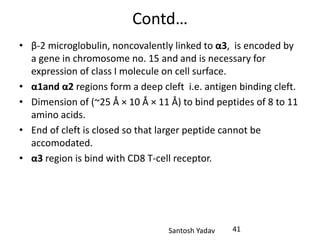
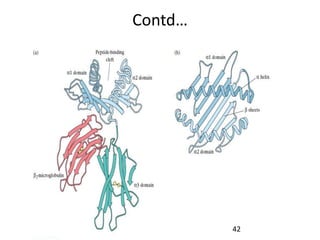
• β-2 microglobulin, noncovalently linked to α3, is encoded by
a gene in chromosome no. 15 and and is necessary for
expression of class I molecule on cell surface.
• α1and α2 regions form a deep cleft i.e. antigen binding cleft.
• Dimension of (~25 Å × 10 Å × 11 Å) to bind peptides of 8 to 11
amino acids.
• End of cleft is closed so that larger peptide cannot be
accomodated.
• α3 region is bind with CD8 T-cell receptor.
41
Santosh Yadav
Contd…
42
Santosh Yadav
Class II MHC Molecules
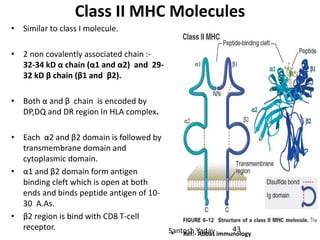
• Similar to class I molecule.
• 2 non covalently associated chain :-
32-34 kD α chain (α1 and α2) and 29-
32 kD β chain (β1 and β2).
• Both α and β chain is encoded by
DP,DQ and DR region In HLA complex.
• Each α2 and β2 domain is followed by
transmembrane domain and
cytoplasmic domain.
• α1 and β2 domain form antigen
binding cleft which is open at both
ends and binds peptide antigen of 10-
30 A.As.
• β2 region is bind with CD8 T-cell
receptor.
• Ref:- Abbas immunology
43
Santosh Yadav
Contd…
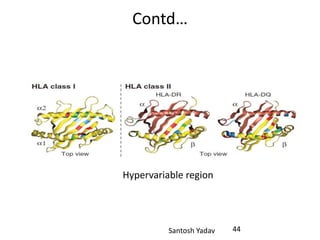
Hypervariable region
44
Santosh Yadav
Contd….
45
Santosh Yadav
Binding of peptide to MHC molecule
• Each class I or class II MHC molecule has a single peptide-
binding cleft that binds one peptide at a time, but each MHC
molecule can bind many different peptides.
• MHC molecules acquire their peptide cargo during their
biosynthesis and assembly inside cells.
• The association of antigenic peptides and MHC molecules is a
saturable interaction with a very slow off-rate.
• Very small numbers of peptide-MHC complexes are capable of
activating specific T lymphocytes.
46
Santosh Yadav
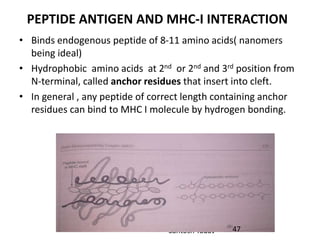
PEPTIDE ANTIGEN AND MHC-I INTERACTION
• Binds endogenous peptide of 8-11 amino acids( nanomers
being ideal)
• Hydrophobic amino acids at 2nd or 2nd and 3rd position from
N-terminal, called anchor residues that insert into cleft.
• In general , any peptide of correct length containing anchor
residues can bind to MHC I molecule by hydrogen bonding.
47
Santosh Yadav
PEPTIDE ANTIGEN AND MHC-II INTERACTION
• Binds with exogenous peptide of 10-30 amino acids.
• No anchor residues.
• Central 7-10 amino acids is critical in this peptide
binding, usually rich in aromatic and hydrophobic
amino acids.
• Hydrogen bond.
48
Santosh Yadav
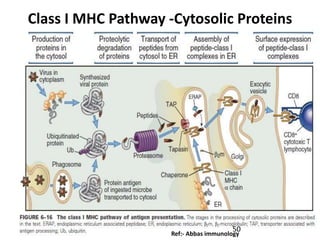
PROCESSING AND PRESENTATION OF PROTEIN
ANTIGENS
• Antigen processing convert protein antigens present in the
cytosol or internalized from the extracellular environment into
peptides and load these peptides onto MHC molecules for
display to T lymphocytes.
• Protein antigens that are present in the cytosol (usually
synthesized in the cell) generate class I–associated peptides
that are recognized by CD8+ T cells,
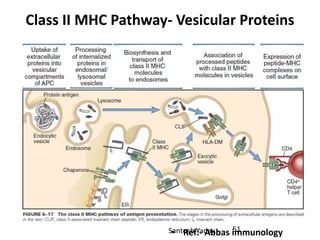
• whereas antigens internalized from the extracellular
environment into the vesicles of APCs generate peptides that
are displayed by class II MHC molecules and recognized by
CD4+ T cells.
49
Santosh Yadav
Class I MHC Pathway -Cytosolic Proteins
Ref:- Abbas immunology
50
Santosh Yadav
Class II MHC Pathway- Vesicular Proteins
• Ref:- Abbas immunology51
Santosh Yadav
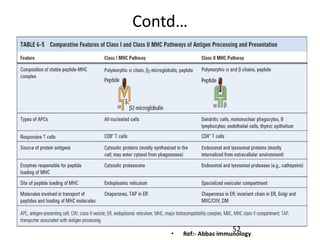
Contd…
• Ref:- Abbas immunology
52
Santosh Yadav
Contd…
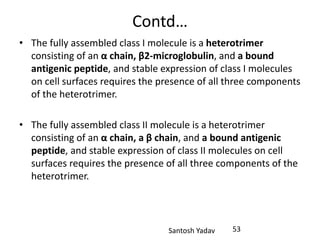
• The fully assembled class I molecule is a heterotrimer
consisting of an α chain, β2-microglobulin, and a bound
antigenic peptide, and stable expression of class I molecules
on cell surfaces requires the presence of all three components
of the heterotrimer.
• The fully assembled class II molecule is a heterotrimer
consisting of an α chain, a β chain, and a bound antigenic
peptide, and stable expression of class II molecules on cell
surfaces requires the presence of all three components of the
heterotrimer.
53
Santosh Yadav
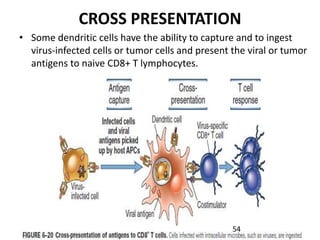
CROSS PRESENTATION
• Some dendritic cells have the ability to capture and to ingest
virus-infected cells or tumor cells and present the viral or tumor
antigens to naive CD8+ T lymphocytes.
54
Santosh Yadav
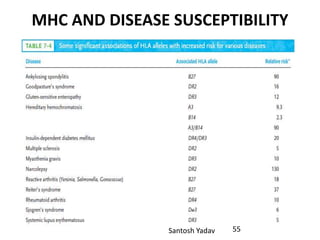
MHC AND DISEASE SUSCEPTIBILITY
55
Santosh Yadav
Bibiliography
 Cellular and Molecular immunology, Abbul K. Abbas,
7th edition.
 Immunology, Ivan Roitt and David Male, 7th edition.
 Kuby immunology., 6th edition.
 Essential of immunology, Dr. S.K. Gupta.
56
Santosh Yadav 57

Antigen and MHC

  • 1.
    Santosh Yadav ANTIGEN, IMMUNOGENICITYAND MAJOR HISTOCOMPATIBILITY COMPLEX Santosh Yadav M.Sc. Clinical Microbiology Dept. of Microbiology Institute of Medicine Tribhuvan Univarsity Teaching Hospital, Nepal 1
  • 2.
    Santosh Yadav Outlines • Antigen-explanation and types • Determinants of immunogenicity • MHC gene-introduction, polymorphism and inheritance • Expression and restriction of MHC • MHC molecules • MHC-peptide interaction • Processing and presentation of peptide antigen. 2
  • 3.
    Santosh Yadav ANTIGEN • Anysubstance that may be specifically bound by an antibody molecule or T cell receptor. • An antigen by itself need not produce an immune response of any kind but it bind specifically with antibodies and sensitized T-cell and its ability to bind is referred to as antigenicity. 3
  • 4.
    Santosh Yadav Contd… • Immunogen,on the other hand, is a substance which produces an immune response as well as bind to its products i.e. antibodies or sensitized T-cell. • So an immunogen is an antigen but reverse is not true and its property of producing immune response is called immunogenicity. 4
  • 5.
    Santosh Yadav HAPTEN • Smallwell-defined chemicals which are not immunogenic on their own but will react with preformed antibodies induced by hapten linked to a “carrier”, such as dinitrophenyl (DNP) or m- aminobenzene sulfonate. • Antihapten antibody do not form large complexes with hapten( monovalent). However if many hapten combine with carrier, it form large complexes resulting in precipitation and agglutination. Ref:- Roitts immunology 5
  • 6.
    Santosh Yadav ANTIGENIC DETERMINANTOR EPITOPE • Part of the antigen which is in contact with the paratope or receptor of lymphocyte, is designated the epitope or antigenic determinant. • Presence of multiple identical determinants in an antigen is referred to as polyvalency or multivalency. • B cells and T cells do not recognise the same epitopes on the antigen molecules, but different epitopes. 6
  • 7.
    Santosh Yadav Contd…  B-cellepitope:- • Recognised in free state without combining with any other molecules. • Conformational , consists of non-adjcent residues placed far away from each other in primary structure. Brought together during three dimensional folding of antigen . Destroyed by denaturation. • Linear epitope,foremed by adjacent linear amino acid residues present in accessible region. Not destroyed by denaturation. 7
  • 8.
  • 9.
    Santosh Yadav Contd…  T-cellepitope:- • Are recognised after combined with MHC molecule. • Located internally deep and not present on surface, so T-cell epitope undergo antigen processing to make these epitope accessible. • T-cell epitope recognition involves the formation of a ternary complex of MHC, antigen and TCR. In this complex ,the antigen has 2 binding site- one for MHC (aggretope) and another for TCR (epitope). 9
  • 10.
  • 11.
    Santosh Yadav EXOGENOUS ANDENDOGENOUS • Exogenous antigens, enters into the host from external environment. (eg. Bacterial , viral antigens, some drugs, etc) • Endogenous antigen, produced within the host.( eg.. Products of genetically mutated cells or virally infected cells or cancerous cell , etc) 11
  • 12.
    Santosh Yadav AUTOANTIGEN,ALLOANTIGEN ANDHETEROANTIGEN  Autoantigen, belonging to the host itself.( eg.. Sperm and corneal protein ).  Alloantigen, derived from other members of species of host. Important in transplantation and blood transfusion.( eg. Antigen on donor and recipient RBCs are alloantigen to each other)  Heteroantigen, Antigens from two different species. ( eg..heterophile antigen, human blood group A antigen and pneumococcal polysaccharide type XIV) 12
  • 13.
    Santosh Yadav TD ANDTI ANTIGENS • T- cell dependent antigens are those that do not directly stimulate the production of antibody without the help of T cells. Proteins are T-dependent antigens. • T-cell independent antigens are antigens which can directly stimulate the B cells to produce antibody without the requirement for T cell help. In general,polysaccharides are T-independent antigens. 13
  • 14.
  • 15.
  • 16.
    Santosh Yadav IMMUNOGENICITY • Propertiesof immunogen, • Properties of host, • Route and dose of administration, and • Adjuvants 16
  • 17.
    Santosh Yadav PROPERTIES OFAN IMMUNOGEN  Foreignness:- • Immunogen molecule must be recognised as non-self i.e. foreign by host cell. • Typically , more distant taxonomically the source of an immunogen from the host, better It is as immunogen. ( eg.. BSA is more immunogenic in chicken than goat).  Chemical nature:- • Protein >polysaccharide>lipids and nucleic acid. • All protein except gelatin are immunogenic. 17
  • 18.
    Santosh Yadav Contd…  Molecularsize:- • To become most active immunogen,molecular mass of 10,000 Da is required. Generally, substances with a molecular mass less than 5000–10,000 Da are poor immunogens.  Molecular heterogenicity and structure complexity:- • Co-polymers composed of different amino acids or sugars are usually more immunogenic than homopolymers of their constituents. 18
  • 19.
    Santosh Yadav Contd… • Naturalproteins, with 20 different A As and all four levels of protein organization ,are highly heterogenous and complex in structure, that’s why they are highly immunogenic. • Addition of aromatic A As increase immunological potential. 19
  • 20.
    Santosh Yadav Contd…  Susceptibilityto antigen processing and presentation:- • Antigen is degraded and some selected fragment of it is presented for recognition by T-cell in order to generate an immune response. • Large, insolube molecules ,being easily phagocytosed, are potent immunogens than small and soluble ones. • D-amino acids polymer cannot be metabolised in human body and they are not immunogenic. 20
  • 21.
    Santosh Yadav HOST CHARACTERS Genetic make up:- • Genetic basis of MHC, gene encoding BCR and TCR are also involved in immune regulation.  Nutritional status:- • Malnutrition and/or undernutrition also leads to a poor response on immunogenic challenge.  Age:- • Neonates and elderly people show poor immune response as compared to young adults. 21
  • 22.
    Santosh Yadav ROUTE ANDDOSE OF ADMINISTRATION • A too little dose fails to elicit a immune response and a too large dose leads to the development of immunological tolerance. • Eg.. 5ₓ10⁻⁴ mg of purified pneumococcal capular polysaccharide antigen is sufficient to induce antibody production. But a dose of 0.5 mg doesnot produce a response. 22
  • 23.
    Santosh Yadav Contd… • Repeatedimmunogen exposure increase the clonal proliferation of T and B cells to augment the response (booster dose). • Intravenously administered immunogens go to spleen while while suncutaneous route leads the immunogen to regional lymph nodes and hence they are more potential than those administered orally. 23
  • 24.
    Santosh Yadav ADJUVANTS • Substancesthat potentiate the action of immunogen. • They are usually mixed with antigen to boost the immune response. • Also used when antigen is available in small quantity. • Common examples- alum( alluminium potassium sulfate) and Freunds adjuvants. 24
  • 25.
    Santosh Yadav Contd… a) Freundscomplete adjuvnts:- • Contains antigen in aqueous phase and a suspension of killed mtb in the oil phase( water in oil emulsion) b) Freunds incomplete adjuvants:- • Same but oil phase contains mannide mono-oleate , rather than mtb. • Bordetella pertussis acts as a good adjuvant for diphtheria and tetanus toxoid in triple vaccine. 25
  • 26.
    Santosh Yadav Contd… • Adjuvantacts in following ways: o By prolonging antigen exposure by slowing the release( depot action.) o By activating the phagocytes(muramyl dipeptide,IL-11, MHC- II). o By activating the TH cells. o Granuloma formation. 26
  • 27.
  • 28.
    Santosh Yadav Introduction • Clusterof genes whose products play important role in the development of immune response and discrimination between self and non-self. • Determine wheather a grafted tissue will be accepted as self (histocompatible) or rejected as non -self (histiincompatible) by the host. 28
  • 29.
    Santosh Yadav Contd… • Formelycalled human leucocyte antigen(HLA) (major determinant of rejection) Jean Dausset • Also important for acquired immune response because TH and Tc donot recognize antigens alone but only when they are combined with MHC molecules. 29
  • 30.
    Santosh Yadav MHC Genes •In human beings, are located on short arm of chromosome no. 6 in a 4000 kbp long. • Organized in to three regions: I , II and III. • Each region contains many gene loci and gene of each region encode separate class of MHC molecules. Fig: organization of human MHC complex 30
  • 31.
    Santosh Yadav Contd… • Inchromosome no. 6 , region III lies in between region I and II. • Region I is longest (2000kbp). • Region II and III are short ( about 1000 kbp). • Class I MHC genes are organized into three main loci i.e. A , B and C in region I. • Class II MHC genes are also organized into three main loci i.e. DP, DQ and DR in region II. • Also many loci in region III. 31
  • 32.
  • 33.
    Santosh Yadav Polymorphism • MHCgenes are highly polymorphic and different individual express different alleles. • Due to Multiple gene loci, Multiple alleles for different loci,and Codominant expression i.e the two alleles at a gene locus of MHC in the two homogenous chromosomes are expressed together. 33
  • 34.
    Santosh Yadav Class Ipolymorphism Locus Number of alleles (allotypes) HLA - A 218 HLA - B 439 HLA - C 96 There are also HLA - E, HLA - F and HLA - G Relatively few alleles 34
  • 35.
    Santosh Yadav Class IIpolymorphism Locus Number of alleles (allotypes) HLA - DPA HLA - DPB 12 88 HLA - DQA HLA - DQB 17 42 HLA - DRA HLA - DRB1 HLA – DRB3 HLA – DRB4 HLA – DRB5 2 269 30 7 12 There are also HLA - DM and HLA - DO Relatively few alleles 35
  • 36.
    Santosh Yadav Inheritance ofMHC haplotypes B C ADP DQ DR B C ADP DQ DR B C ADP DQ DR B C ADP DQ DR X Parents DP-1,2 DQ-3,4 DR-5,6 B-7,8 C-9,10 A-11,12 DP-9,8 DQ-7,6 DR-5,4 B-3,2 C-1,8 A-9,10 DP-1,8 DQ-3,6 DR-5,4 B-7,2 C-9,8 A-11,10 DP-1,9 DQ-3,7 DR-5,5 B-7,3 C-9,1 A-11,9 DP-2,8 DQ-4,6 DR-6,4 B-8,2 C-10,8 A-12,10 DP-2,9 DQ-4,7 DR-6,5 B-8,3 C-10,10 A-12,9 B C ADP DQ DR B C ADP DQ DR B C ADP DQ DR B C ADP DQ DR B C ADP DQ DR B C ADP DQ DR B C ADP DQ DR B C ADP DQ DR Children 36
  • 37.
    Santosh Yadav Expression ofMHC genes • Class I MHC genes encode glycoproteins expressed on the surface of nearly all nucleated cells and the major function of the class I gene products is presentation of peptide antigens to TC cells. • Class II MHC genes encode glycoproteins expressed primarily on antigen- presenting cells (macrophages, dendritic cells, and B cells), where they present antigenic peptides to TH cells. Class I MHC Class II MHC RBCs APCs Nucleated cells 37
  • 38.
    Santosh Yadav Contd… • ClassIII MHC genes encode various secreted proteins having immune functions(eg. complement proteins, TNF, etc) • Expression of MHC molecule is increased by cytokines. • Transcription factor is major determinant of MHC molecule synthesis. - CIITA (Trans activator), RFX (Trans activator) • Some Viruses Decrease MHC Expression – CMV, HBV,etc. 38
  • 39.
    Santosh Yadav MHC RESTRICTION •MHC restriction refers to the fact that T-cell will recognise a peptide antigen only when it is bound to a particular MHC molecule. • Recognition of antigen by CD8 T-cell is restricted by class I alleles and CD4 helper T-lymphocytes by class II MHC. CD4+T cell(Th) CD8+T cell(Tc) T cell Receptor Peptide MHC Class II T cell Receptor Peptide MHC Class I Antigen Presenting Cell Antigen Presenting Cell CD4 CD8 39
  • 40.
    Santosh Yadav Class IMHC Molecules • 2 noncovalently linked polypeptide chain, an MHC encoded 44-47 kD α chain (heavy) and a non-MHC encoded 12kD β-2 microglobulin (light). • α chain is encoded by genes in A,B and C region in HLA complex. • Α chain has 3 parts:-  Cytoplasmic domain(α1, α2 and α3, each contain about 90 A. As)  Transmemembrane domain( 25 A.As)  Cytoplasmic terminal (30 A.As) • Ref:- Abbas immunology 40
  • 41.
    Santosh Yadav Contd… • β-2microglobulin, noncovalently linked to α3, is encoded by a gene in chromosome no. 15 and and is necessary for expression of class I molecule on cell surface. • α1and α2 regions form a deep cleft i.e. antigen binding cleft. • Dimension of (~25 Å × 10 Å × 11 Å) to bind peptides of 8 to 11 amino acids. • End of cleft is closed so that larger peptide cannot be accomodated. • α3 region is bind with CD8 T-cell receptor. 41
  • 42.
  • 43.
    Santosh Yadav Class IIMHC Molecules • Similar to class I molecule. • 2 non covalently associated chain :- 32-34 kD α chain (α1 and α2) and 29- 32 kD β chain (β1 and β2). • Both α and β chain is encoded by DP,DQ and DR region In HLA complex. • Each α2 and β2 domain is followed by transmembrane domain and cytoplasmic domain. • α1 and β2 domain form antigen binding cleft which is open at both ends and binds peptide antigen of 10- 30 A.As. • β2 region is bind with CD8 T-cell receptor. • Ref:- Abbas immunology 43
  • 44.
  • 45.
  • 46.
    Santosh Yadav Binding ofpeptide to MHC molecule • Each class I or class II MHC molecule has a single peptide- binding cleft that binds one peptide at a time, but each MHC molecule can bind many different peptides. • MHC molecules acquire their peptide cargo during their biosynthesis and assembly inside cells. • The association of antigenic peptides and MHC molecules is a saturable interaction with a very slow off-rate. • Very small numbers of peptide-MHC complexes are capable of activating specific T lymphocytes. 46
  • 47.
    Santosh Yadav PEPTIDE ANTIGENAND MHC-I INTERACTION • Binds endogenous peptide of 8-11 amino acids( nanomers being ideal) • Hydrophobic amino acids at 2nd or 2nd and 3rd position from N-terminal, called anchor residues that insert into cleft. • In general , any peptide of correct length containing anchor residues can bind to MHC I molecule by hydrogen bonding. 47
  • 48.
    Santosh Yadav PEPTIDE ANTIGENAND MHC-II INTERACTION • Binds with exogenous peptide of 10-30 amino acids. • No anchor residues. • Central 7-10 amino acids is critical in this peptide binding, usually rich in aromatic and hydrophobic amino acids. • Hydrogen bond. 48
  • 49.
    Santosh Yadav PROCESSING ANDPRESENTATION OF PROTEIN ANTIGENS • Antigen processing convert protein antigens present in the cytosol or internalized from the extracellular environment into peptides and load these peptides onto MHC molecules for display to T lymphocytes. • Protein antigens that are present in the cytosol (usually synthesized in the cell) generate class I–associated peptides that are recognized by CD8+ T cells, • whereas antigens internalized from the extracellular environment into the vesicles of APCs generate peptides that are displayed by class II MHC molecules and recognized by CD4+ T cells. 49
  • 50.
    Santosh Yadav Class IMHC Pathway -Cytosolic Proteins Ref:- Abbas immunology 50
  • 51.
    Santosh Yadav Class IIMHC Pathway- Vesicular Proteins • Ref:- Abbas immunology51
  • 52.
  • 53.
    Santosh Yadav Contd… • Thefully assembled class I molecule is a heterotrimer consisting of an α chain, β2-microglobulin, and a bound antigenic peptide, and stable expression of class I molecules on cell surfaces requires the presence of all three components of the heterotrimer. • The fully assembled class II molecule is a heterotrimer consisting of an α chain, a β chain, and a bound antigenic peptide, and stable expression of class II molecules on cell surfaces requires the presence of all three components of the heterotrimer. 53
  • 54.
    Santosh Yadav CROSS PRESENTATION •Some dendritic cells have the ability to capture and to ingest virus-infected cells or tumor cells and present the viral or tumor antigens to naive CD8+ T lymphocytes. 54
  • 55.
    Santosh Yadav MHC ANDDISEASE SUSCEPTIBILITY 55
  • 56.
    Santosh Yadav Bibiliography  Cellularand Molecular immunology, Abbul K. Abbas, 7th edition.  Immunology, Ivan Roitt and David Male, 7th edition.  Kuby immunology., 6th edition.  Essential of immunology, Dr. S.K. Gupta. 56
  • 57.