Antifungal agents
• Fungal diseases are those caused by pathogenic fungi,
which are 100 species known to cause mycoses in
human. Human fungi infections can be divided into four
groups: systemic or deep mycoses, affect primarily
internal organs and viscera. They are often extensively
spread and involve many different tissues; subcutaneous
mycoses which involve bone fascia, skin and
subcutaneous tissue, once fungi penetrate the skin
remain localized in subcutaneous tissues, cutaneous
mycoses infest only epidermis and its appendages (hair
and nail), and superficial mycoses affect only hair and
the most superficial layer of epidermis.
Oral Candidiasis
Cutaneous
Mycoses
Subcutaneous mycoses
Toenail fungal infection
Tinea versicolor
infections
Tinea capitis
Ringworm
Classification of antifungal
agents
• Synthetic agents
– Acids and derivatives -Phenolic
derivatives
– Halogen containing compounds - Thiocarbamate
derivatives
– Pyrimimidine derivatives -Acridine
derivatives
– Azole derivatives (imidazole derivatives and
triazole derivatives)
– Allylamine derivatives
• Antibiotics: i-Polyenes ii- Nonpolyenes
I- Acids and derivatives
E.gs.: Fatty acids, benzoic acid, salicylic
acid and triacetin (glyceryl triacetate).
Fatty acids like propionic acid, caprylic
acid, and undecylenic acid.
- Propionic acid
CH3CH2COOH
Caprylic acid
CH3(CH2)6COOH
Present in coconut, and palm oil.
Undecylenic acid
CH2=CH(CH2)8COOH
Obtained by destructive distillation of castor oil.
Triacetin
O
O
O
O
OO
CH3
CH3
CH3
Benzoic acid
C6H5COOH
Salicylic acid
COOH
OH
II- Pyrimidine derivatives
E.g.: Flucytosine (Ancbon)®
• 5- Fluorocytosine or 5-FC
4-Amino-5-fluoro-2(1H)-pyrimidinone, or 4-Amino-2-
hydroxy-5-fluoropyrimidine.
N
N
H
O
NH2
F
N
N
NH2
F
OH
Mode of action
Selective deamination
5-FC 5-FU toxic antimetabolite
This enzyme is deficient in human incorporated into RNA
cell and resistant fungal strains (thus
no formation of toxic metabolite)
Thus inhibits nucleic acid synthesis
in fungal cell via cyto-
sine deaminase
Uses: 5-FC has narrow spectrum. It is used orally
for treatment of serious systemic infections
caused by pathogenic yeasts such as Candida albicans.
III- Phenolic derivatives
e. g. Parachlorometaxylenol
Cl
OH
CH3 CH3
Mode of action
Denaturation of protein via the reaction of the acidic
phenolic group with basic centers in the protein molecule
located on cell wall of fungal cell.
Uses: It is used topically in the treatment of tinea
infection such as athlete’s foot
4-Chloro-3,5-dimethylphenol
IV-Halogens and halogenophors
E.g. Clioquinol
N
OH
I
Cl
Mode of action
Competes with co-enzymes for metal binding sites
on enzymes.
Assay: Oxygen flask followed by Volhard’s method.
5-Chloro-8-hydroxy-7-iodoquinoline.
V- Thiocarbamate derivatives
E.g. Tolnaftate
N
O
S
CH3
CH3
Uses
Treatment of superficial tinea infections of the skin
in the form of 1% cream, powder, aerosol, gel,
and solution.
O-2-Naphthyl-N-methyl-m-tolylthiocarbamate.
VI- Azole
derivatives
N
N
Cl
1-[(o-Chloro-α,α-diphenyl) benzyl]- 1H- imidazole.
1. Clotrimazole
Uses: Clotrimazole is used for the treatment of topical infections like tinea,
mucocutaneous candidiasis, and vaginal candidiasis. It is not used orally
for treatment of systemic infections as it causes severe GIT disturbances.
2-Miconazole
N
N
O
ClCl
Cl
Cl
1-[2-(2,4-Dichlorophenyl)-2-[(2,4-dichlorophenyl)methoxy]ethyl]-1H-imidazole
Uses
Miconazole base can be used intravenously in the treatment of
systemic fungal infections.
Topically miconazole nitrate can be used in the treatment of
tinea versicolor, mucocutaneous candidiasis, and of corneal infection caused
by candida and aspergillus.
O
N
O
N
N
N
O
Cl
O
Cl
CH3
H
3- Ketoconazole
Uses
- Topically in treatment of many fungal infections.
- Orally, it is effective in many mucocutaneous and systemic
mycoses, or to treat severe cutaneous dermatophytic infections,
which do not respond to topical therapy or oral griseofulvin.
Adverse effects
Hepatotoxicity.
Structural requirements of imidazole derivatives:
-Weakly basic imidazole ring bonded by N-C linkage to the rest of
the molecule.
-The more potent compounds possess two or three aromatic rings at
least one of them has halogen substituent.
Mode of action of azole derivatives:
They cause disorganization or alteration of fungal cytoplasmic membrane.
They inhibit the lanosterol 14 α -demethylase,
a cytochrome P450 in the ergosterol biosynthesis pathway
consequently damage cell membrane with loss of essential cellular
constituents such as K+ and amino acids.
N
N
N N N
N
OH
F
F
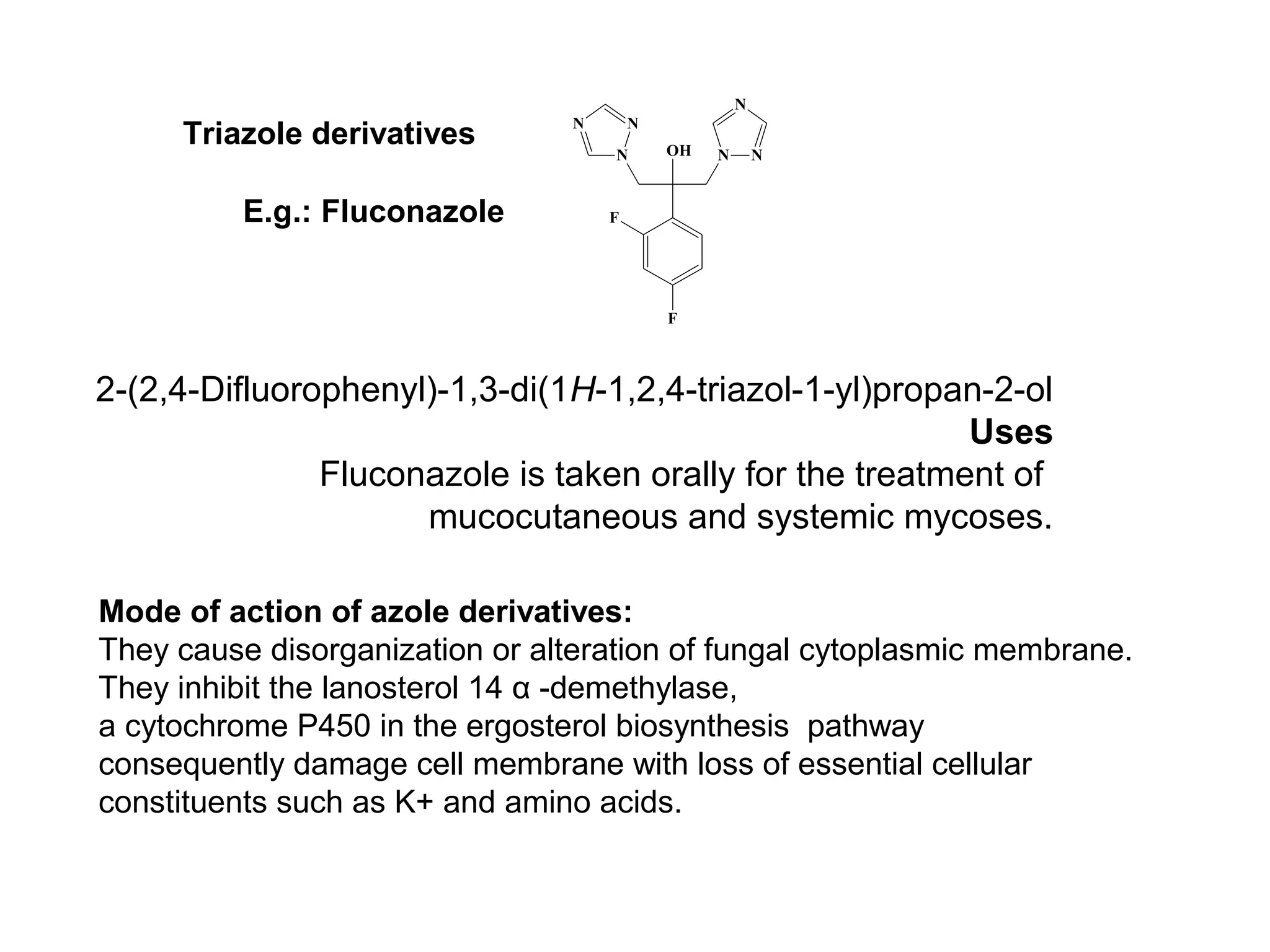
2-(2,4-Difluorophenyl)-1,3-di(1H-1,2,4-triazol-1-yl)propan-2-ol
Uses
Fluconazole is taken orally for the treatment of
mucocutaneous and systemic mycoses.
Triazole derivatives
E.g.: Fluconazole
H- Allylamine derivatives
E.g. Terbinafine
(E)-N,6,6-Trimethyl-N-(naphthalen- 1-ylmethyl)hept-
2-en-4-yn-1-amine
Terbinafine hydrochloride (Lamisil)®
is a synthetic allylamine
antifungal. It is highly lipophilic in nature and tends to
accumulate in skin, nails, and fatty tissues.
• Mode of action
• Like other allylamines, terbinafine inhibits
ergosterol synthesis by inhibiting
squalene epoxidase, an enzyme that is
part of the fungal cell membrane synthesis
pathway. Because terbinafine prevents
conversion of squalene to lanosterol,
ergosterol cannot be synthesized. This is
thought to change cell membrane
permeability.
Indications
• Terbinafine is mainly effective on the dermatophytes
group of fungi. As a 1% cream or powder, used for
superficial skin infections such as jock itch (Tinea cruris),
athlete's foot (Tinea pedis) and other types of ringworm
(Tinea corporis).
• Oral 250 mg tablets are often prescribed for the
treatment of onychomycosis of the toenail or fingernail
due to the dermatophyte Tinea unguium. Fungal nail
infections are located deep under the nail in the cuticle to
which topically applied treatments are unable to
penetrate in sufficient amounts. The tablets may, rarely,
cause hepatotoxicity, so patients are warned of this and
may be monitored with liver function tests.
Antifungal antibiotics
Non polyenes
E.g.: Griseofulvin
• Obtention Griseofulvin is isolated from certain strains of
Penicillium griseofulvum or obtained by other means.
• Uses
• Griseofulvin is recommended for the systemic treatment
of refractory ringworm infections of the body, nails, hair,
and feet i.e. tinea caused by various species of
dermatophytic fungi but not effective against tinea
neither versicolor nor pathogenic yeasts.
O
O
O
Cl
O
O
O
CH3
CH3CH3
CH3
7-chloro-2',4,6-trimethoxy-6'-methyl-3H,4'H-spiro[1-benzofuran-2,1'-cyclohex[2]ene]-3,4'-dione
Following oral absorption, some griseofulvin is
carried by the systemic circulation to the skin,
hair, and finger nails where it concentrates in
keratin precursor cells, which are gradually
exfoliated and replaced by new tissue.
Consequently, therapy of infections in slow
growing tissues, such as nails must be
continued for several months.
• Mode of action
• Griseofulvin arrests cell division in metaphase
in vitro. The drug causes a rapid, reversible
dissolution of mitotic spindle apparatus,
apparently by binding with tubulin dimer required
for microtubule assembly.
B- Polyene antifungal antibiotics
They are structurally complex antifungal
antibiotics isolated from soil bacteria
containing a conjugated system of double
bonds in large lactone ring.
They fall into two groupings either 26-
membered ring polyenes such as
natamycin, or 38-membered ring polyenes
such as nystatin, amphotericin B, and
candicidin.
1.Amphotericin B
(More active than amphotericin A)
O
O
O
O
O O
NH2
O H
OH
O H
O H
O H
OH O H
O H
O H O H
CH3
O H
CH3
CH3
CH3
As the name implies, amphotericin is an
amphoteric substance containing a primary
amino group in the sugar moiety and a carboxyl
group attached to the macrolide group.
• Intravenously, it is indicated for the
treatment of serious potentially life
threatening fungal infections &
leishmaniasis, also it is used topically for
treatment candida albicans.
• A high prevalence of adverse reactions
limits the usefulness of amphotericin B.
some forms of nephrotoxicity in nearly 80
% of the patients is the most important
adverse reaction.
2- Nystatin
• It is a valuable agent for the treatment of local
and GIT monilial infections, for the management
of cutaneous and mucocutaneous candidiasis.
• It is considered safe, as the systemic absorption
of nysatitin following oral administration is
practically nil.
O
O
O
O
OO
NH2
O H
O H
OH
OH
O H
O HO H
O H
O HO H
CH3
O H
CH3
CH3
CH3
HydrophilicHydrophilic
Hydrophilic
Hydrophobic
O
OO
O
O
O
O
NH2
O
O H
O H
O H
O H
O
NH
O H O HO HO H O H
O H
CH3
CH3
CH3
CH3
CH3
O
O
O
O
O
O
O
NH2
O H
O H
O H
O H
O HO H
CH3
CH3
3- Candicidin
Candicidin is used in the treatment of vaginal candidiasis in
the form of vaginal tablets.
4- Natamycin
(26-Membered lactone ring)
Natamycin is supplied as 5 % ophthalmic suspension, intended for the
treatment of fungal conjunctivitis, plepharitis, and keratitis.
• Mode of action of polyene antibiotics
• They interact with the lipids of fungal cell membranes to
build 'tunnels' through the membrane. Once in place, the
contents of the cell are drained away and the cell is
killed. As shown from their structure one half of the
structure is made up of double bonds and is
hydrophobic, while the other half contains a series of
hydroxyl groups and is hydrophilic. It is a molecule of
extremes and as such is ideally suited to act on the cell
membrane in the way that it does. Several polyenes
molecules cluster together such that the alkene chains
are to the exterior and interact favorably with the
hydrophobic centre of the cell membrane. The tunnel
resulting from this cluster is lined with the hydroxyl
groups and so is hydrophilic, allowing the polar contents
of the cell to escape.
• In other words, they cause disorganization of the cell
membrane resulting in the loss of cell constituents,
especially K+
.
Amphotericin-formed channel through the cell membrane.
Antifungal agents

Antifungal agents

  • 1.
    Antifungal agents • Fungaldiseases are those caused by pathogenic fungi, which are 100 species known to cause mycoses in human. Human fungi infections can be divided into four groups: systemic or deep mycoses, affect primarily internal organs and viscera. They are often extensively spread and involve many different tissues; subcutaneous mycoses which involve bone fascia, skin and subcutaneous tissue, once fungi penetrate the skin remain localized in subcutaneous tissues, cutaneous mycoses infest only epidermis and its appendages (hair and nail), and superficial mycoses affect only hair and the most superficial layer of epidermis.
  • 2.
  • 3.
  • 4.
  • 5.
  • 6.
    Classification of antifungal agents •Synthetic agents – Acids and derivatives -Phenolic derivatives – Halogen containing compounds - Thiocarbamate derivatives – Pyrimimidine derivatives -Acridine derivatives – Azole derivatives (imidazole derivatives and triazole derivatives) – Allylamine derivatives • Antibiotics: i-Polyenes ii- Nonpolyenes
  • 7.
    I- Acids andderivatives E.gs.: Fatty acids, benzoic acid, salicylic acid and triacetin (glyceryl triacetate). Fatty acids like propionic acid, caprylic acid, and undecylenic acid. - Propionic acid CH3CH2COOH Caprylic acid CH3(CH2)6COOH Present in coconut, and palm oil. Undecylenic acid CH2=CH(CH2)8COOH Obtained by destructive distillation of castor oil. Triacetin O O O O OO CH3 CH3 CH3 Benzoic acid C6H5COOH Salicylic acid COOH OH
  • 8.
    II- Pyrimidine derivatives E.g.:Flucytosine (Ancbon)® • 5- Fluorocytosine or 5-FC 4-Amino-5-fluoro-2(1H)-pyrimidinone, or 4-Amino-2- hydroxy-5-fluoropyrimidine. N N H O NH2 F N N NH2 F OH
  • 9.
    Mode of action Selectivedeamination 5-FC 5-FU toxic antimetabolite This enzyme is deficient in human incorporated into RNA cell and resistant fungal strains (thus no formation of toxic metabolite) Thus inhibits nucleic acid synthesis in fungal cell via cyto- sine deaminase Uses: 5-FC has narrow spectrum. It is used orally for treatment of serious systemic infections caused by pathogenic yeasts such as Candida albicans.
  • 10.
    III- Phenolic derivatives e.g. Parachlorometaxylenol Cl OH CH3 CH3 Mode of action Denaturation of protein via the reaction of the acidic phenolic group with basic centers in the protein molecule located on cell wall of fungal cell. Uses: It is used topically in the treatment of tinea infection such as athlete’s foot 4-Chloro-3,5-dimethylphenol
  • 11.
    IV-Halogens and halogenophors E.g.Clioquinol N OH I Cl Mode of action Competes with co-enzymes for metal binding sites on enzymes. Assay: Oxygen flask followed by Volhard’s method. 5-Chloro-8-hydroxy-7-iodoquinoline.
  • 12.
    V- Thiocarbamate derivatives E.g.Tolnaftate N O S CH3 CH3 Uses Treatment of superficial tinea infections of the skin in the form of 1% cream, powder, aerosol, gel, and solution. O-2-Naphthyl-N-methyl-m-tolylthiocarbamate.
  • 13.
    VI- Azole derivatives N N Cl 1-[(o-Chloro-α,α-diphenyl) benzyl]-1H- imidazole. 1. Clotrimazole Uses: Clotrimazole is used for the treatment of topical infections like tinea, mucocutaneous candidiasis, and vaginal candidiasis. It is not used orally for treatment of systemic infections as it causes severe GIT disturbances.
  • 14.
    2-Miconazole N N O ClCl Cl Cl 1-[2-(2,4-Dichlorophenyl)-2-[(2,4-dichlorophenyl)methoxy]ethyl]-1H-imidazole Uses Miconazole base canbe used intravenously in the treatment of systemic fungal infections. Topically miconazole nitrate can be used in the treatment of tinea versicolor, mucocutaneous candidiasis, and of corneal infection caused by candida and aspergillus.
  • 15.
    O N O N N N O Cl O Cl CH3 H 3- Ketoconazole Uses - Topicallyin treatment of many fungal infections. - Orally, it is effective in many mucocutaneous and systemic mycoses, or to treat severe cutaneous dermatophytic infections, which do not respond to topical therapy or oral griseofulvin. Adverse effects Hepatotoxicity. Structural requirements of imidazole derivatives: -Weakly basic imidazole ring bonded by N-C linkage to the rest of the molecule. -The more potent compounds possess two or three aromatic rings at least one of them has halogen substituent.
  • 16.
    Mode of actionof azole derivatives: They cause disorganization or alteration of fungal cytoplasmic membrane. They inhibit the lanosterol 14 α -demethylase, a cytochrome P450 in the ergosterol biosynthesis pathway consequently damage cell membrane with loss of essential cellular constituents such as K+ and amino acids. N N N N N N OH F F 2-(2,4-Difluorophenyl)-1,3-di(1H-1,2,4-triazol-1-yl)propan-2-ol Uses Fluconazole is taken orally for the treatment of mucocutaneous and systemic mycoses. Triazole derivatives E.g.: Fluconazole
  • 18.
    H- Allylamine derivatives E.g.Terbinafine (E)-N,6,6-Trimethyl-N-(naphthalen- 1-ylmethyl)hept- 2-en-4-yn-1-amine Terbinafine hydrochloride (Lamisil)® is a synthetic allylamine antifungal. It is highly lipophilic in nature and tends to accumulate in skin, nails, and fatty tissues.
  • 19.
    • Mode ofaction • Like other allylamines, terbinafine inhibits ergosterol synthesis by inhibiting squalene epoxidase, an enzyme that is part of the fungal cell membrane synthesis pathway. Because terbinafine prevents conversion of squalene to lanosterol, ergosterol cannot be synthesized. This is thought to change cell membrane permeability.
  • 21.
    Indications • Terbinafine ismainly effective on the dermatophytes group of fungi. As a 1% cream or powder, used for superficial skin infections such as jock itch (Tinea cruris), athlete's foot (Tinea pedis) and other types of ringworm (Tinea corporis). • Oral 250 mg tablets are often prescribed for the treatment of onychomycosis of the toenail or fingernail due to the dermatophyte Tinea unguium. Fungal nail infections are located deep under the nail in the cuticle to which topically applied treatments are unable to penetrate in sufficient amounts. The tablets may, rarely, cause hepatotoxicity, so patients are warned of this and may be monitored with liver function tests.
  • 22.
    Antifungal antibiotics Non polyenes E.g.:Griseofulvin • Obtention Griseofulvin is isolated from certain strains of Penicillium griseofulvum or obtained by other means. • Uses • Griseofulvin is recommended for the systemic treatment of refractory ringworm infections of the body, nails, hair, and feet i.e. tinea caused by various species of dermatophytic fungi but not effective against tinea neither versicolor nor pathogenic yeasts. O O O Cl O O O CH3 CH3CH3 CH3 7-chloro-2',4,6-trimethoxy-6'-methyl-3H,4'H-spiro[1-benzofuran-2,1'-cyclohex[2]ene]-3,4'-dione
  • 23.
    Following oral absorption,some griseofulvin is carried by the systemic circulation to the skin, hair, and finger nails where it concentrates in keratin precursor cells, which are gradually exfoliated and replaced by new tissue. Consequently, therapy of infections in slow growing tissues, such as nails must be continued for several months. • Mode of action • Griseofulvin arrests cell division in metaphase in vitro. The drug causes a rapid, reversible dissolution of mitotic spindle apparatus, apparently by binding with tubulin dimer required for microtubule assembly.
  • 24.
    B- Polyene antifungalantibiotics They are structurally complex antifungal antibiotics isolated from soil bacteria containing a conjugated system of double bonds in large lactone ring. They fall into two groupings either 26- membered ring polyenes such as natamycin, or 38-membered ring polyenes such as nystatin, amphotericin B, and candicidin.
  • 25.
    1.Amphotericin B (More activethan amphotericin A) O O O O O O NH2 O H OH O H O H O H OH O H O H O H O H CH3 O H CH3 CH3 CH3 As the name implies, amphotericin is an amphoteric substance containing a primary amino group in the sugar moiety and a carboxyl group attached to the macrolide group.
  • 26.
    • Intravenously, itis indicated for the treatment of serious potentially life threatening fungal infections & leishmaniasis, also it is used topically for treatment candida albicans. • A high prevalence of adverse reactions limits the usefulness of amphotericin B. some forms of nephrotoxicity in nearly 80 % of the patients is the most important adverse reaction.
  • 27.
    2- Nystatin • Itis a valuable agent for the treatment of local and GIT monilial infections, for the management of cutaneous and mucocutaneous candidiasis. • It is considered safe, as the systemic absorption of nysatitin following oral administration is practically nil. O O O O OO NH2 O H O H OH OH O H O HO H O H O HO H CH3 O H CH3 CH3 CH3 HydrophilicHydrophilic Hydrophilic Hydrophobic
  • 28.
    O OO O O O O NH2 O O H O H OH O H O NH O H O HO HO H O H O H CH3 CH3 CH3 CH3 CH3 O O O O O O O NH2 O H O H O H O H O HO H CH3 CH3 3- Candicidin Candicidin is used in the treatment of vaginal candidiasis in the form of vaginal tablets. 4- Natamycin (26-Membered lactone ring) Natamycin is supplied as 5 % ophthalmic suspension, intended for the treatment of fungal conjunctivitis, plepharitis, and keratitis.
  • 29.
    • Mode ofaction of polyene antibiotics • They interact with the lipids of fungal cell membranes to build 'tunnels' through the membrane. Once in place, the contents of the cell are drained away and the cell is killed. As shown from their structure one half of the structure is made up of double bonds and is hydrophobic, while the other half contains a series of hydroxyl groups and is hydrophilic. It is a molecule of extremes and as such is ideally suited to act on the cell membrane in the way that it does. Several polyenes molecules cluster together such that the alkene chains are to the exterior and interact favorably with the hydrophobic centre of the cell membrane. The tunnel resulting from this cluster is lined with the hydroxyl groups and so is hydrophilic, allowing the polar contents of the cell to escape. • In other words, they cause disorganization of the cell membrane resulting in the loss of cell constituents, especially K+ .
  • 30.