pA2 Determination
A brief look…….
• Origin of pA2 value
• Drug antagonism & types
• Methods used for determination of drug
antagonism
• Importance of pA2 values and pA scale
• Summary
Origin of pA2 value
• Sir Heinz Otto Schild - Quantitative pharmacology
• In 1947 - pA scale, to express drug antagonism.
• Developed methods for assessing & measuring
drug antagonism,like pA2 measure and schild’s
plot
• Introduced the use of term dose ratio
Drug Antagonism
• An antagonist is the drug which diminishes or
completely abolishes the effect of agonist in
it’s presence
• For antagonist, efficacy is zero & affinity is
one
Experimental estimation of drug
antagonism
• Antagonism of drug induced contractions are of
two types
• Preventive : antagonist first added to the bath
and then agonist added subsequently
• Curative: effect( here contractions) is first
produced by the agonist. Antagonist is then
added to counter it
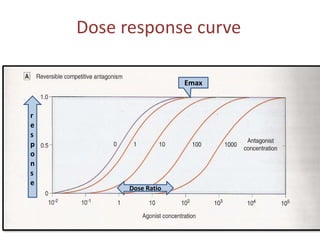
Dose ratio
• Defined as the factor by which the concentration of the
agonist has to be multiplied to produce a response in
the presence of antagonist.
• Higher the dose ratio, more specific is the antagonist.
• Adopt a standard time of exposure to antagonist to rule
out error, as it increases with increase in the exposure
time
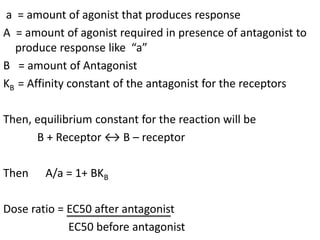
a = amount of agonist that produces response
A = amount of agonist required in presence of antagonist to
produce response like “a”
B = amount of Antagonist
KB = Affinity constant of the antagonist for the receptors
Then, equilibrium constant for the reaction will be
B + Receptor ↔ B – receptor
Then A/a = 1+ BKB
Dose ratio = EC50 after antagonist
EC50 before antagonist
Percentage inhibition
• Antagonism can also be expressed as
• % inhibition =
100- [{height of contraction after exposure to
antagonist/ height of contraction before
exposure to antagonist} x 100]
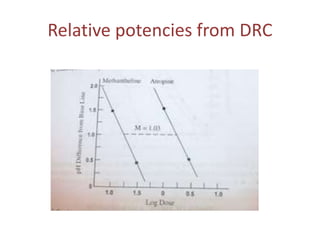
Relative potencies from DRC
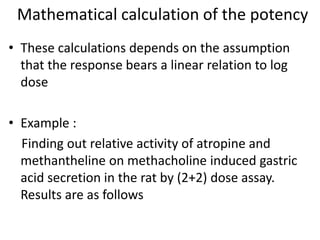
Mathematical calculation of the potency
• These calculations depends on the assumption
that the response bears a linear relation to log
dose
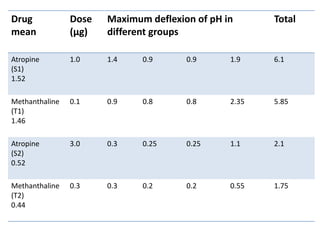
• Example :
Finding out relative activity of atropine and
methantheline on methacholine induced gastric
acid secretion in the rat by (2+2) dose assay.
Results are as follows
Drug
mean
Dose
(µg)
Maximum deflexion of pH in
different groups
Total
Atropine
(S1)
1.52
1.0 1.4 0.9 0.9 1.9 6.1
Methanthaline
(T1)
1.46
0.1 0.9 0.8 0.8 2.35 5.85
Atropine
(S2)
0.52
3.0 0.3 0.25 0.25 1.1 2.1
Methanthaline
(T2)
0.44
0.3 0.3 0.2 0.2 0.55 1.75
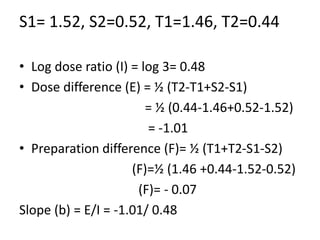
S1= 1.52, S2=0.52, T1=1.46, T2=0.44
• Log dose ratio (I) = log 3= 0.48
• Dose difference (E) = ½ (T2-T1+S2-S1)
= ½ (0.44-1.46+0.52-1.52)
= -1.01
• Preparation difference (F)= ½ (T1+T2-S1-S2)
(F)=½ (1.46 +0.44-1.52-0.52)
(F)= - 0.07
Slope (b) = E/I = -1.01/ 0.48
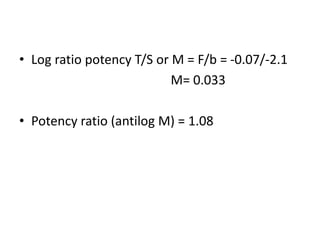
• Log ratio potency T/S or M = F/b = -0.07/-2.1
M= 0.033
• Potency ratio (antilog M) = 1.08
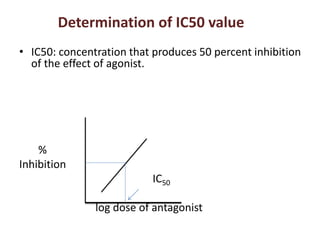
• IC50: concentration that produces 50 percent inhibition
of the effect of agonist.
%
Inhibition
IC50
log dose of antagonist
Determination of IC50 value
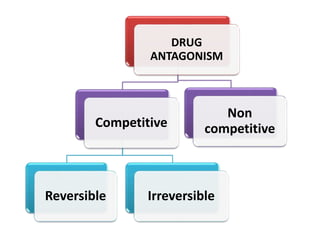
DRUG
ANTAGONISM
Competitive
Reversible Irreversible
Non
competitive
Dose response curve
r
e
s
p
o
n
s
e
Emax
Dose Ratio
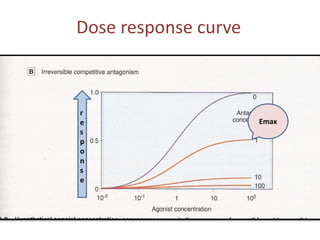
Dose response curve
r
e
s
p
o
n
s
e
Emax
Methods used for determination of drug
antagonism
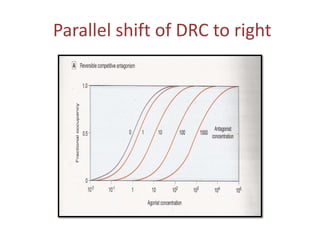
• Parallel shift of DRC to the right
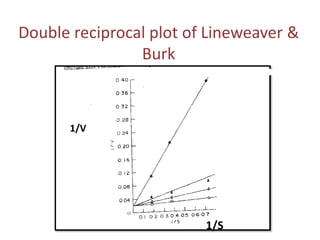
• Double reciprocal plot of Lineweaver and Burk
• Schild plot
• Difference between pA2 and pA10 values
Parallel shift of DRC to right
Double reciprocal plot of Lineweaver &
Burk
1/V
1/S
Schild plot
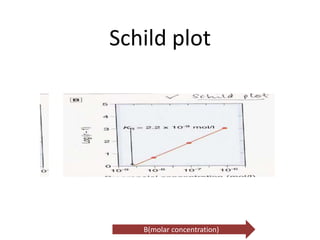
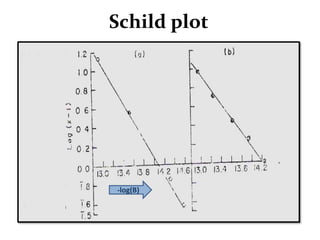
• Most commonly used method for estimating
pA2 value
• Plot log(dose ratio-1) against negative log molar
concentration of the antagonist(B) used(or
directly against B)
• When the slope of the line so obtained is unity,
then the antagonism is competitive.
Schild plot
B(molar concentration)
-log(B)
Schild plot
Schild’s equation
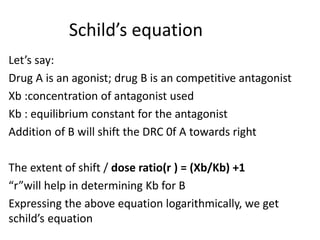
Let’s say:
Drug A is an agonist; drug B is an competitive antagonist
Xb :concentration of antagonist used
Kb : equilibrium constant for the antagonist
Addition of B will shift the DRC 0f A towards right
The extent of shift / dose ratio(r ) = (Xb/Kb) +1
“r”will help in determining Kb for B
Expressing the above equation logarithmically, we get
schild’s equation
Schild’s equation
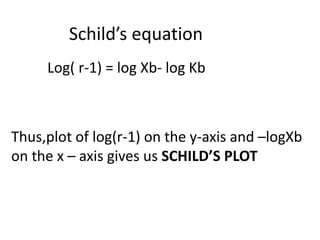
Log( r-1) = log Xb- log Kb
Thus,plot of log(r-1) on the y-axis and –logXb
on the x – axis gives us SCHILD’S PLOT
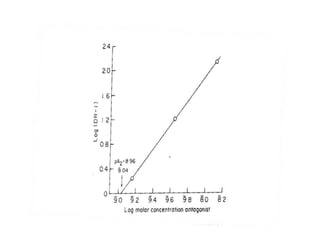
Estimation of Pa2 from Schild’s plot
• pA2 value can be directly calculated from the
Schild’s plot for a particular antagonist.
• Firstly graph is plotted using the required values
for different antagonist concentrations used
• The point at which the line intersects x- axis is the
pA2 value of that antagonist for that particular
receptor
Percentage response
• The response to a particular dose of agoinst
before adding antagonist is taken as 100%
• The response to the same dose in the
presence of antagonist is taken as the
percentage of the normal 100% response
pA2 value
• Measure for the equilibrium dissociation constant of
the antagonist
• Defined as the negative log of molar concentration of
the antagonist which will reduce the effect of double
dose of the agonist drug to that of a single dose
• pAx: x denotes the the number by which the agonist
dose has to be increased to get the effect of single
dose in the presence of antagonist
• X can be 2 or 10( pA2 and pA10)
• Thus, if the presence of a molar concentration
of 10-9.4 mepyramine in the bath reduces the
effect of 2mg histamine on guinea pig ileum to
that produced by 1µg in the absence of
mepyramine, the pA2 of mepyramine-
histamine on guinea pig ileum will be ______
Methods
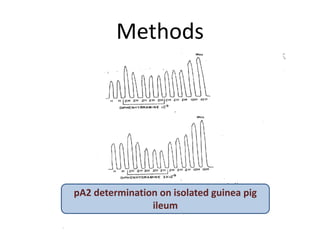
pA2 determination on isolated guinea pig
ileum
Methods
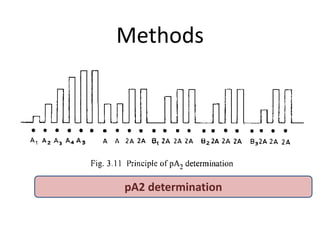
pA2 determination
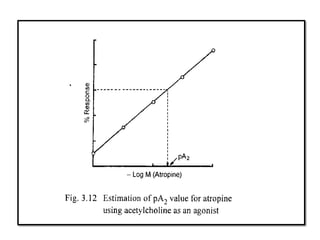
Plotting of pA2 value
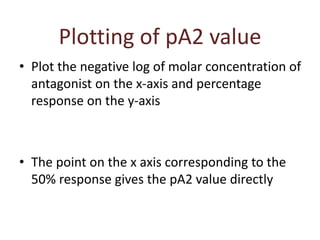
• Plot the negative log of molar concentration of
antagonist on the x-axis and percentage
response on the y-axis
• The point on the x axis corresponding to the
50% response gives the pA2 value directly
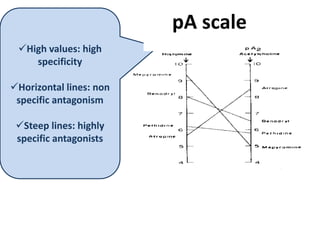
pA scale
High values: high
specificity
Horizontal lines: non
specific antagonism
Steep lines: highly
specific antagonists
Difference between pA2 & pA10 values
• Determine both pA2 and pA10 values for
agonist- antagonist pair on the same tissue
• It the difference between them is approx 0.95
( 0.8 -1.2):Competitive antagonism
• Both the values can be interpolated from
Schild’s plot
Applications of pA2 measurements
• Helps us differentiate between competitive & non
competitive antagonism
• If the same agonist antagonist pair is gives similar
pAx values on different preparation, it suggests that
receptors are identical
• Drugs that act on the same receptor can be
expected to be antagonised by the same
concentration of a competitive antagonist, even
though they themselves may differ considerably in
activity
pD2’ value
• Measures the affinity of either non competitive
or irreversible competitive antagonist for a
specific receptor
• Defined as –log(B) which will decrease the
maximum effect of agonist by 50%
• Higher the pD2 value ,higher the potency
To summarize…..
Pharmacological drug antagonism can be assessed and
measured practically by different methods
Most commonly used methods : pA2 value estimation
and Schild’s plot
Dose ratio is the most important factor which needs to
be determined in antagonism
Refrences
• Medhi B, Prakash A. Practical manual of
experimental and clinical pharmacology.
Jaypee Brothers, Medical Publishers Pvt.
Limited; 2010.
• Ghosh M. Fundamentals of experimental
pharmacology. 2015 ; 118-31
• Pharmacological experiments in isolated
preprations; edinburg university: 1970
• S.K. Kulkarni. Handbook of experimental
pharmacology. Vallabh prakashan;2004:95-7
Pa2 determination

Pa2 determination

  • 1.
  • 2.
    A brief look……. •Origin of pA2 value • Drug antagonism & types • Methods used for determination of drug antagonism • Importance of pA2 values and pA scale • Summary
  • 3.
    Origin of pA2value • Sir Heinz Otto Schild - Quantitative pharmacology • In 1947 - pA scale, to express drug antagonism. • Developed methods for assessing & measuring drug antagonism,like pA2 measure and schild’s plot • Introduced the use of term dose ratio
  • 4.
    Drug Antagonism • Anantagonist is the drug which diminishes or completely abolishes the effect of agonist in it’s presence • For antagonist, efficacy is zero & affinity is one
  • 5.
    Experimental estimation ofdrug antagonism • Antagonism of drug induced contractions are of two types • Preventive : antagonist first added to the bath and then agonist added subsequently • Curative: effect( here contractions) is first produced by the agonist. Antagonist is then added to counter it
  • 6.
    Dose ratio • Definedas the factor by which the concentration of the agonist has to be multiplied to produce a response in the presence of antagonist. • Higher the dose ratio, more specific is the antagonist. • Adopt a standard time of exposure to antagonist to rule out error, as it increases with increase in the exposure time
  • 7.
    a = amountof agonist that produces response A = amount of agonist required in presence of antagonist to produce response like “a” B = amount of Antagonist KB = Affinity constant of the antagonist for the receptors Then, equilibrium constant for the reaction will be B + Receptor ↔ B – receptor Then A/a = 1+ BKB Dose ratio = EC50 after antagonist EC50 before antagonist
  • 8.
    Percentage inhibition • Antagonismcan also be expressed as • % inhibition = 100- [{height of contraction after exposure to antagonist/ height of contraction before exposure to antagonist} x 100]
  • 9.
  • 10.
    Mathematical calculation ofthe potency • These calculations depends on the assumption that the response bears a linear relation to log dose • Example : Finding out relative activity of atropine and methantheline on methacholine induced gastric acid secretion in the rat by (2+2) dose assay. Results are as follows
  • 11.
    Drug mean Dose (µg) Maximum deflexion ofpH in different groups Total Atropine (S1) 1.52 1.0 1.4 0.9 0.9 1.9 6.1 Methanthaline (T1) 1.46 0.1 0.9 0.8 0.8 2.35 5.85 Atropine (S2) 0.52 3.0 0.3 0.25 0.25 1.1 2.1 Methanthaline (T2) 0.44 0.3 0.3 0.2 0.2 0.55 1.75
  • 12.
    S1= 1.52, S2=0.52,T1=1.46, T2=0.44 • Log dose ratio (I) = log 3= 0.48 • Dose difference (E) = ½ (T2-T1+S2-S1) = ½ (0.44-1.46+0.52-1.52) = -1.01 • Preparation difference (F)= ½ (T1+T2-S1-S2) (F)=½ (1.46 +0.44-1.52-0.52) (F)= - 0.07 Slope (b) = E/I = -1.01/ 0.48
  • 13.
    • Log ratiopotency T/S or M = F/b = -0.07/-2.1 M= 0.033 • Potency ratio (antilog M) = 1.08
  • 14.
    • IC50: concentrationthat produces 50 percent inhibition of the effect of agonist. % Inhibition IC50 log dose of antagonist Determination of IC50 value
  • 15.
  • 16.
  • 17.
  • 18.
    Methods used fordetermination of drug antagonism • Parallel shift of DRC to the right • Double reciprocal plot of Lineweaver and Burk • Schild plot • Difference between pA2 and pA10 values
  • 19.
    Parallel shift ofDRC to right
  • 20.
    Double reciprocal plotof Lineweaver & Burk 1/V 1/S
  • 21.
    Schild plot • Mostcommonly used method for estimating pA2 value • Plot log(dose ratio-1) against negative log molar concentration of the antagonist(B) used(or directly against B) • When the slope of the line so obtained is unity, then the antagonism is competitive.
  • 22.
  • 23.
  • 24.
    Schild’s equation Let’s say: DrugA is an agonist; drug B is an competitive antagonist Xb :concentration of antagonist used Kb : equilibrium constant for the antagonist Addition of B will shift the DRC 0f A towards right The extent of shift / dose ratio(r ) = (Xb/Kb) +1 “r”will help in determining Kb for B Expressing the above equation logarithmically, we get schild’s equation
  • 25.
    Schild’s equation Log( r-1)= log Xb- log Kb Thus,plot of log(r-1) on the y-axis and –logXb on the x – axis gives us SCHILD’S PLOT
  • 26.
    Estimation of Pa2from Schild’s plot • pA2 value can be directly calculated from the Schild’s plot for a particular antagonist. • Firstly graph is plotted using the required values for different antagonist concentrations used • The point at which the line intersects x- axis is the pA2 value of that antagonist for that particular receptor
  • 28.
    Percentage response • Theresponse to a particular dose of agoinst before adding antagonist is taken as 100% • The response to the same dose in the presence of antagonist is taken as the percentage of the normal 100% response
  • 29.
    pA2 value • Measurefor the equilibrium dissociation constant of the antagonist • Defined as the negative log of molar concentration of the antagonist which will reduce the effect of double dose of the agonist drug to that of a single dose • pAx: x denotes the the number by which the agonist dose has to be increased to get the effect of single dose in the presence of antagonist • X can be 2 or 10( pA2 and pA10)
  • 30.
    • Thus, ifthe presence of a molar concentration of 10-9.4 mepyramine in the bath reduces the effect of 2mg histamine on guinea pig ileum to that produced by 1µg in the absence of mepyramine, the pA2 of mepyramine- histamine on guinea pig ileum will be ______
  • 31.
    Methods pA2 determination onisolated guinea pig ileum
  • 32.
  • 33.
    Plotting of pA2value • Plot the negative log of molar concentration of antagonist on the x-axis and percentage response on the y-axis • The point on the x axis corresponding to the 50% response gives the pA2 value directly
  • 35.
    pA scale High values:high specificity Horizontal lines: non specific antagonism Steep lines: highly specific antagonists
  • 36.
    Difference between pA2& pA10 values • Determine both pA2 and pA10 values for agonist- antagonist pair on the same tissue • It the difference between them is approx 0.95 ( 0.8 -1.2):Competitive antagonism • Both the values can be interpolated from Schild’s plot
  • 37.
    Applications of pA2measurements • Helps us differentiate between competitive & non competitive antagonism • If the same agonist antagonist pair is gives similar pAx values on different preparation, it suggests that receptors are identical • Drugs that act on the same receptor can be expected to be antagonised by the same concentration of a competitive antagonist, even though they themselves may differ considerably in activity
  • 38.
    pD2’ value • Measuresthe affinity of either non competitive or irreversible competitive antagonist for a specific receptor • Defined as –log(B) which will decrease the maximum effect of agonist by 50% • Higher the pD2 value ,higher the potency
  • 39.
    To summarize….. Pharmacological drugantagonism can be assessed and measured practically by different methods Most commonly used methods : pA2 value estimation and Schild’s plot Dose ratio is the most important factor which needs to be determined in antagonism
  • 40.
    Refrences • Medhi B,Prakash A. Practical manual of experimental and clinical pharmacology. Jaypee Brothers, Medical Publishers Pvt. Limited; 2010. • Ghosh M. Fundamentals of experimental pharmacology. 2015 ; 118-31 • Pharmacological experiments in isolated preprations; edinburg university: 1970 • S.K. Kulkarni. Handbook of experimental pharmacology. Vallabh prakashan;2004:95-7