ANTIDOTES
An antidote is an agent which will remove or
prevent the absorption of a poison, change its
toxic properties, or counteract its physiologic
effects. Antidotes are substances which abolish or
counteract the poison and its harmful effects.
They are generally classified into physical,
chemical and physiological ( pharmacological)
antidotes.
Antidotes
1- Local (e.g. physicomechanical, chemical).
2- Physiological (systemic) e.g. chelators.
Physicomechanical antidotes:- These include
(adsorbents, demulcents, entanglers, dissolvents).
These agents interfere with the ingested poison
through physical means only and do not change its
nature. Demulcents protect the stomach mucosa by
coating it e.g. milk and white egg albumin ( delaying
absorption). Entanglers catch the solid objects e.g.
cotton for pins. Dissolvents dissolve the poison e.g.
ethanol (10%) is used to dissolve phenol.
Adsorbents are used to adsorb the poison, e.g.
activated charcoal and cholestyramin. Activated
charcoal ( 50 g) shaken in ( 400 ml)given orally or
in gastric lavage fluid. Each gram adsorbs ( 100-
1000 mg) of poisons and is useful in all ingested
poisons. Passage of blood through a cartridge
containing charcoal which is better coated with
acrylic hydrogel i.e. haemoperfusion can eliminate
circulating poisons.
Chemical antidotes
• Interfere with poison by chemical means. They
include:- neutralization, precipitation, reduction and
oxidation. Neutralization of weak acids and alkalis is
not reliable because of the bad effects it produces
e.g. exothermic heat emitted increases destructive
effects of corroded mucosa. CO2 formation when
NaHCO3 is used to correct acidosis caused by
salicylates and methanol results in gastric
perforation. Weak acids like vinegar, lemon or
orange juice orally for corrosive alkalis. Weak alkalis
as MgO or soap solution for corrosives.
In precipitation oxalic acid, lead, mercury and
poisonous plants are precipitated by calcium,
magnesium sulphate, skimmed milk and tannic
acid (strong tea) respectively.
Oxidizing agents like potassium permanganate
orally for poisoning by most alkaloids and
specially for strychnine poisoning. Oxygen is the
specific antidote for CO poisoning to provide
adequate tissue oxygenation through saturation
of plasma and hastens the dissociation of CO from
Hb.
• Cyanide and poisonous plants are oxidized by
H2O2 or KMnO4 to non toxic agents.
• Chelators are chelating agents which combine
with metals forming non toxic compounds
that are rapidly excreted in urine. Chelators
can be eye drops, oils and ointments.
Mercuric chloride( divalent) is toxic while
mercurous chloride (monovalent) is not. The
former is reduced to the latter by sodium
formaldehyde sulphoxylate.
Ascorbic acid (vitamin C)1 mg i.v. for treating
methaemoglobinaemia caused by nitrates,
sulphonamide, aniline by reduction.
Sodium thiosusslphate is given orally in iodine
poisoning to reduce it to iodide. It is given i.v. in
cyanide poisoning to form non toxic thiocyanate.
• BAL= British Anti Lewisite is (dimercaprol).
• Mechanism of action:- BAL has 2 (SH) groups
which can attract metals that have great affinity
for (SH) forming non toxic rapidly excreted
compound, i.e. metals bind to (SH) containing
respiratory enzymes leading to its inactivation.
• Metals + SH-containing enzymes(respiratory
enzymes) results in inactive enzymes.
• BAL (2SH) + metals leads to nontoxic rapidly
excreted enzyme.
• The dose is 2.5 mg/Kg/6hours for 2 days. Then
2.5 mg/Kg/12 hours for one week(i.m. or orally).
Uses : - to chelate Lead, Arsenic, Mercury, Gold,
Bismuth.
Disadvantages: - It is not used in iron toxicity as
the Fe-BL complex is toxic.
Haemolysis in G6PD deficient patients. Increased
blood pressure & body temperature.
DMSA (2,3 dimercaprol to succinic acid). It is an
analogue of dimercaprol (BAL). The dose is 10 mg/
Kg /8 hours for 5 days then 10 mg/Kg/12 hours for
two weeks (orally). The uses : - to chelate AS, Hg,
Pb. Advantages: - It is used in treatment of lead
toxicity. It can be used in iron toxicity.
No haemolysis in G6PD deficient patients. Less
toxicity. Has minimal effects on essential
elements.
Other chelators: -
Desferal ( Desferoxamine) is used to treat iron
toxicity. The dose is available as 500 mg ampoules
, 2gm followed by half gm/4hours for two days.
Penicillamine (Cuprimine) is used to treat lead,
mercury, zinc & copper poisoning. The dose is one
capsule (250 mg)/ 6 hours for twenty days on
empty stomach.
EDTA = Ethylene Diamine Tetra Acetic acid has three
types: -
1/ Ca disodium EDTA
2/ Disodium EDTA
3/ Dicobalt EDTA (Kelocyanor).
Ca disodium EDTA combines with metals leading to
nontoxic and rapidly excreted compound ( the metal
replaces Ca). Calcium salt is given to prevent
hypocalcaemia which can occur due to the high affinity
of EDTA to calcium. This leads to calcium loss in the
excreted compound.
The dose is 1 gm in 500 ml glucose 5% twice daily for
five days (i.v. infusion).
The uses: - Calcium disodium EDTA is used in lead
poisoning. Disodium EDTA is used in digitalis poisoning.
Dicobalt EDTA is used in cyanide poisoning.
• When (Ca Na2 EDTA) is used e.g. in digitalis
poisoning, (Ca) is replaced by the poisonous
metal leading to (Ca) loss in the rapidly
excreted compound and to prevent
hypocalcaemia, (Ca) salts are given to the
poisoned patient.
• BAL is not used in iron toxicity because the
Fe-BAL complex is toxic. There are three forms
: oil, ointment & eye drops.
• In G6PD deficient patients haemolysis occurs
with BAL. It raises blood pressure and
temperature. Also BAL is used for poisoning
with mercury, gold and bismuth.
• DMSA(is an analogue of BAL) is used for iron
and lead poisoning. It causes no haemolysis in
G6PD deficient patients. It is less toxic and it
has minimal effects on essential elements.
Physiological (toxicological) antidotes
Antagonists
Atropine: 2 mg/i.v. repeated till signs of full
atropinisation & dilatation of the pupils are
attained for organophosphorus insecticides such as
parathion, malathion, parasympathomimetic
poisoning as physostigmine, pilocorpine &
muscarine. Also 1mg / i.v. for morphine, beta-
blockers, digitalis & acontine poisoning to correct
bradycardia.
Anticonvulsants: Ether inhalation or barbiturates
as pentothal & diazepam.
Digitalis: 1 mg/ i.v. digoxin according to the
condition to antagonize cardiac poisons as
acontine, antimony & arsenic.
Cholinesterase inhibitors: Physostigmine 1.5 mg /
i.v. reverses and controls peripheral effects of
atropine & tricyclic antidepressants.
Antisera: For snake bites, scorpion stings &
botulism. 10 ml of antiserum in 500 ml 5%
glucose i.v. by drip. Sensitivity to horse serum
should be tested first.
Potassium chloride: 1 gm orally for digitalis
toxicity.
Competitive
Narcotic antidotes as nalorphine & naloxone
compete with morphine at target tissues, have a
similar but weaker action than morphine.
Ethyl alcohol: 500ml of 5% ethanol orally or i.v. to
be repeated after 4 hours to reduce the
metabolism of methyl alcohol. Ethanol competes
with the enzyme systems because it is oxidized
more easily to acetaldehyde, acetic acid, carbon
dioxide & water. Methanol is excreted unchanged
instead of changing to its more toxic oxidation
products (formaldehyde & formic acid).
Chelators
Edetates: EDTA & penicillamine (250 – 400 mg /
12 hourly) for copper poisoning.
Desferroxamine in chelation for iron poisoning.
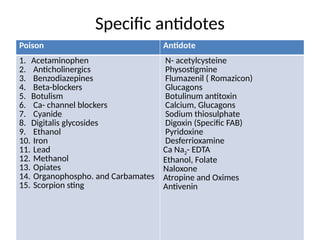
Specific antidotes
Poison Antidote
1. Acetaminophen
2. Anticholinergics
3. Benzodiazepines
4. Beta-blockers
5. Botulism
6. Ca- channel blockers
7. Cyanide
8. Digitalis glycosides
9. Ethanol
10. Iron
11. Lead
12. Methanol
13. Opiates
14. Organophospho. and Carbamates
15. Scorpion sting
N- acetylcysteine
Physostigmine
Flumazenil ( Romazicon)
Glucagons
Botulinum antitoxin
Calcium, Glucagons
Sodium thiosulphate
Digoxin (Specific FAB)
Pyridoxine
Desferrioxamine
Ca Na2- EDTA
Ethanol, Folate
Naloxone
Atropine and Oximes
Antivenin
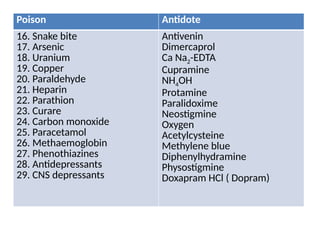
Poison Antidote
16. Snake bite
17. Arsenic
18. Uranium
19. Copper
20. Paraldehyde
21. Heparin
22. Parathion
23. Curare
24. Carbon monoxide
25. Paracetamol
26. Methaemoglobin
27. Phenothiazines
28. Antidepressants
29. CNS depressants
Antivenin
Dimercaprol
Ca Na2-EDTA
Cupramine
NH4OH
Protamine
Paralidoxime
Neostigmine
Oxygen
Acetylcysteine
Methylene blue
Diphenylhydramine
Physostigmine
Doxapram HCl ( Dopram)
Antidotal mechanisms
• Toxicokinetics allow toxicologists to develop antidotes in
order to counteract, lessen or prevent the bad effects of
poisons. Actually, some poisons have no antidotes.
Antidotal mechanisms affect toxicokinetics during the
following phases:-
• 1.Absorption. In heavy metal poisoning, e.g. (Pb)
poisoning, a chelating agent can be used. (CaNa 2EDTA)
the (Ca) and (Na) ions of which have been used to remove
harmful metal ions from the body. The newly formed
stable chelating complex is excreted in the urine and can
not be absorbed from the (GIT).
• 2. Distribution:- To
stop the distribution of certain poisons in the
body, some antidotes could be introduced. For
example (HCN) = Hydrocyanic or prussic acid.
The acid has a powerful action on the tissues
after its rapid absorption and circulation in the
blood plasma. It inhibits the cytochrome
oxidases and thus prevents the tissues using
the oxygen circulating in the blood.
• The saturation of oxyhaemoglobin rises
steadily and at death the blood is bright pink.
Cyanohaemoglobin is not formed in life.
Respiration quickly becomes irregular. The
breath smells distinctly of bitter almonds.
Convulsions or twitching may precede death.
The cause of death is paralysis of central
respiratory and circulatory systems.
Physiological antidotes in cyanide poisoning:-
1. Nitrite-thiosulphate therapy
HbO→ MetHb by sodium nitrite i.v. & amyl nitrite
inhalation.
MetHb + Cyanide-Cytochromeoxidase→ Cyano-
MetHb (toxic) +Cytochromeoxidase get free.
CyanoMetHb + sodium thiosulphate→ Sodium
thiocyanate + MetHb.
MetHb + Vitamin C 1 gm i.v. → HbO.
Side effects:-
Hypotension
MetHb formation (Cyanosis).
2. Hydroxycobalamin (Vitamin B12a )+ Cyanide-
Cytochromeoxidase→ Cyanocobalamin (Vitamin
B12 )+ enzyme get free.
3. Kelocyanor (dicobaltEDTA). Dose is 300 to 600
It chelates cyanide in circulation
but it does not bind to intracellular cyanide.
Supportive measures (ABCs).
GIT decontamination by emesis & gastric lavage.
Local antidote by charcoal & hydrogen peroxide.
Cyanide is oxidized by hydrogen peroxide to non
toxic thiocyanate. Repeat physiological antidotes
after 24-48 hours if the toxicity signs recur. Use ½
the dose.
• Treatment:- Lavage by stomach tube is an
urgent necessity. The use of a mixture of salts
of ferrous and ferric hydroxides forming
Prussian blue or an infusion of sodium
thiosulphate (25%) as a detoxicant should be
performed without an instant’s delay.
Stimulants such as methyl amphetamine
should be given. Respiration must be
sustained by artificial means.
• It is, of course, of no value whatever to give
oxygen, for the tissues are already incapable of
using oxygen owing to the action of the cyanide
on the cell oxidases. The blood is bright red due
to the failure to utilize the oxygen it carries and
the tinge of cyanosis often seen to pulmonary
oedema and respiratory embarrassment. The
stomach is coloured like all other tissues by this
striking tint.
• 3. Metabolism:- e.g.
Ethanol and methanol CH3OH
(Methanol) → HCHO (Formaldehyde) It is
metabolized in the liver by alcohol dehydrogenase
forming formaldehyde which is very toxic because it
may lead to permanent blindness. Ethanol is the
antidote because it stops the metabolism of
methanol. C2H5OH (Ethanol) → CH3CHO
(Acetaldehyde) It is a
competition metabolism.
• 4. Excretion:- In this
phase a complex less toxicant than the parent
poison is formed and easily excreted in urine. For
instance complexes formed with antidotes like:-
a/ CaNa2EDTA reacting
with (Pb, Hg, As, etc.) b/ Dimercprol (BAL) reacts
with heavy metals. (As) ions combine with sulphur
ions in the complex. Irreversible, less toxic, cyclic
complex and easily excreted.
• 5.Competition between antidotes and
receptors:- e.g. a/
(O2 ) for (CO) poisoning. b/
Neostigmine for curari poisoning. c/
Vitamin (K) for coumarine poisoning. d/
Naloxone for morphine poisoning. e/
Potassium salts for thallium poisoning.
Coumarine is a substance sometimes used to
give tobacco a sweet smell.
• 6. Antidote closes receptor:-
The organophosphorus compounds inhibit
acetyl cholinesterase. The inhibition of this
enzyme prevents the analysis of acetyl
choline. A lot of acetyl choline remains at the
nerve endings. Atropine is used to close acetyl
choline receptor and to lessen its physiologic
actions (shocks).
• 7. Antidotes counteract the effect of the
poison:- e.g.
Alcohol and barbiturates are CNS depressants
while caffeine is exciting. 8.
Compensation and repair of the natural
physiologic action of the body:- e.g.
a/ In the treatment of leukaemia mesotrexate,
(folic acid antagonist), is given to the patient.
• Leucovorine (folic acid) is given by mouth, i.m.
or i.v. as an antidote to mesotrexate used to
rescue patients from high dose therapy for
malignant diseases.
b/ Antimetabolites are used in the treatment
of cancer. 5-FU, (Fluor Uracil), is an
antimetabolite cytotoxic agent and it causes a
shortage in thymidine. Thymidine is given to
compensate this shortage.
• c/ 6-mercaptopurine (Puri-Nethol) is used in
the treatment of acute lekaemia in children. It
prevents the synthesis of nucleic acids.
Purines are given for compensation. Purines
are constituents of nucleoproteins from which
uric acid is derived.
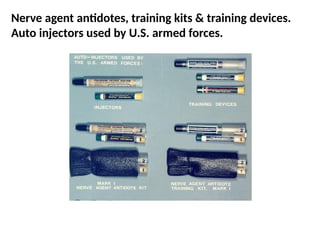
Nerve agent antidotes, training kits & training devices.
Auto injectors used by U.S. armed forces.

Introduction to Antidotes full ppt .pptx

  • 1.
    ANTIDOTES An antidote isan agent which will remove or prevent the absorption of a poison, change its toxic properties, or counteract its physiologic effects. Antidotes are substances which abolish or counteract the poison and its harmful effects. They are generally classified into physical, chemical and physiological ( pharmacological) antidotes.
  • 2.
    Antidotes 1- Local (e.g.physicomechanical, chemical). 2- Physiological (systemic) e.g. chelators. Physicomechanical antidotes:- These include (adsorbents, demulcents, entanglers, dissolvents). These agents interfere with the ingested poison through physical means only and do not change its nature. Demulcents protect the stomach mucosa by coating it e.g. milk and white egg albumin ( delaying absorption). Entanglers catch the solid objects e.g. cotton for pins. Dissolvents dissolve the poison e.g. ethanol (10%) is used to dissolve phenol.
  • 3.
    Adsorbents are usedto adsorb the poison, e.g. activated charcoal and cholestyramin. Activated charcoal ( 50 g) shaken in ( 400 ml)given orally or in gastric lavage fluid. Each gram adsorbs ( 100- 1000 mg) of poisons and is useful in all ingested poisons. Passage of blood through a cartridge containing charcoal which is better coated with acrylic hydrogel i.e. haemoperfusion can eliminate circulating poisons.
  • 4.
    Chemical antidotes • Interferewith poison by chemical means. They include:- neutralization, precipitation, reduction and oxidation. Neutralization of weak acids and alkalis is not reliable because of the bad effects it produces e.g. exothermic heat emitted increases destructive effects of corroded mucosa. CO2 formation when NaHCO3 is used to correct acidosis caused by salicylates and methanol results in gastric perforation. Weak acids like vinegar, lemon or orange juice orally for corrosive alkalis. Weak alkalis as MgO or soap solution for corrosives.
  • 5.
    In precipitation oxalicacid, lead, mercury and poisonous plants are precipitated by calcium, magnesium sulphate, skimmed milk and tannic acid (strong tea) respectively. Oxidizing agents like potassium permanganate orally for poisoning by most alkaloids and specially for strychnine poisoning. Oxygen is the specific antidote for CO poisoning to provide adequate tissue oxygenation through saturation of plasma and hastens the dissociation of CO from Hb.
  • 6.
    • Cyanide andpoisonous plants are oxidized by H2O2 or KMnO4 to non toxic agents. • Chelators are chelating agents which combine with metals forming non toxic compounds that are rapidly excreted in urine. Chelators can be eye drops, oils and ointments.
  • 7.
    Mercuric chloride( divalent)is toxic while mercurous chloride (monovalent) is not. The former is reduced to the latter by sodium formaldehyde sulphoxylate. Ascorbic acid (vitamin C)1 mg i.v. for treating methaemoglobinaemia caused by nitrates, sulphonamide, aniline by reduction. Sodium thiosusslphate is given orally in iodine poisoning to reduce it to iodide. It is given i.v. in cyanide poisoning to form non toxic thiocyanate.
  • 8.
    • BAL= BritishAnti Lewisite is (dimercaprol). • Mechanism of action:- BAL has 2 (SH) groups which can attract metals that have great affinity for (SH) forming non toxic rapidly excreted compound, i.e. metals bind to (SH) containing respiratory enzymes leading to its inactivation. • Metals + SH-containing enzymes(respiratory enzymes) results in inactive enzymes. • BAL (2SH) + metals leads to nontoxic rapidly excreted enzyme. • The dose is 2.5 mg/Kg/6hours for 2 days. Then 2.5 mg/Kg/12 hours for one week(i.m. or orally).
  • 9.
    Uses : -to chelate Lead, Arsenic, Mercury, Gold, Bismuth. Disadvantages: - It is not used in iron toxicity as the Fe-BL complex is toxic. Haemolysis in G6PD deficient patients. Increased blood pressure & body temperature. DMSA (2,3 dimercaprol to succinic acid). It is an analogue of dimercaprol (BAL). The dose is 10 mg/ Kg /8 hours for 5 days then 10 mg/Kg/12 hours for two weeks (orally). The uses : - to chelate AS, Hg, Pb. Advantages: - It is used in treatment of lead toxicity. It can be used in iron toxicity.
  • 10.
    No haemolysis inG6PD deficient patients. Less toxicity. Has minimal effects on essential elements. Other chelators: - Desferal ( Desferoxamine) is used to treat iron toxicity. The dose is available as 500 mg ampoules , 2gm followed by half gm/4hours for two days. Penicillamine (Cuprimine) is used to treat lead, mercury, zinc & copper poisoning. The dose is one capsule (250 mg)/ 6 hours for twenty days on empty stomach.
  • 11.
    EDTA = EthyleneDiamine Tetra Acetic acid has three types: - 1/ Ca disodium EDTA 2/ Disodium EDTA 3/ Dicobalt EDTA (Kelocyanor). Ca disodium EDTA combines with metals leading to nontoxic and rapidly excreted compound ( the metal replaces Ca). Calcium salt is given to prevent hypocalcaemia which can occur due to the high affinity of EDTA to calcium. This leads to calcium loss in the excreted compound. The dose is 1 gm in 500 ml glucose 5% twice daily for five days (i.v. infusion). The uses: - Calcium disodium EDTA is used in lead poisoning. Disodium EDTA is used in digitalis poisoning. Dicobalt EDTA is used in cyanide poisoning.
  • 12.
    • When (CaNa2 EDTA) is used e.g. in digitalis poisoning, (Ca) is replaced by the poisonous metal leading to (Ca) loss in the rapidly excreted compound and to prevent hypocalcaemia, (Ca) salts are given to the poisoned patient. • BAL is not used in iron toxicity because the Fe-BAL complex is toxic. There are three forms : oil, ointment & eye drops.
  • 13.
    • In G6PDdeficient patients haemolysis occurs with BAL. It raises blood pressure and temperature. Also BAL is used for poisoning with mercury, gold and bismuth. • DMSA(is an analogue of BAL) is used for iron and lead poisoning. It causes no haemolysis in G6PD deficient patients. It is less toxic and it has minimal effects on essential elements.
  • 14.
    Physiological (toxicological) antidotes Antagonists Atropine:2 mg/i.v. repeated till signs of full atropinisation & dilatation of the pupils are attained for organophosphorus insecticides such as parathion, malathion, parasympathomimetic poisoning as physostigmine, pilocorpine & muscarine. Also 1mg / i.v. for morphine, beta- blockers, digitalis & acontine poisoning to correct bradycardia. Anticonvulsants: Ether inhalation or barbiturates as pentothal & diazepam.
  • 15.
    Digitalis: 1 mg/i.v. digoxin according to the condition to antagonize cardiac poisons as acontine, antimony & arsenic. Cholinesterase inhibitors: Physostigmine 1.5 mg / i.v. reverses and controls peripheral effects of atropine & tricyclic antidepressants. Antisera: For snake bites, scorpion stings & botulism. 10 ml of antiserum in 500 ml 5% glucose i.v. by drip. Sensitivity to horse serum should be tested first. Potassium chloride: 1 gm orally for digitalis toxicity.
  • 16.
    Competitive Narcotic antidotes asnalorphine & naloxone compete with morphine at target tissues, have a similar but weaker action than morphine. Ethyl alcohol: 500ml of 5% ethanol orally or i.v. to be repeated after 4 hours to reduce the metabolism of methyl alcohol. Ethanol competes with the enzyme systems because it is oxidized more easily to acetaldehyde, acetic acid, carbon dioxide & water. Methanol is excreted unchanged instead of changing to its more toxic oxidation products (formaldehyde & formic acid).
  • 17.
    Chelators Edetates: EDTA &penicillamine (250 – 400 mg / 12 hourly) for copper poisoning. Desferroxamine in chelation for iron poisoning.
  • 18.
    Specific antidotes Poison Antidote 1.Acetaminophen 2. Anticholinergics 3. Benzodiazepines 4. Beta-blockers 5. Botulism 6. Ca- channel blockers 7. Cyanide 8. Digitalis glycosides 9. Ethanol 10. Iron 11. Lead 12. Methanol 13. Opiates 14. Organophospho. and Carbamates 15. Scorpion sting N- acetylcysteine Physostigmine Flumazenil ( Romazicon) Glucagons Botulinum antitoxin Calcium, Glucagons Sodium thiosulphate Digoxin (Specific FAB) Pyridoxine Desferrioxamine Ca Na2- EDTA Ethanol, Folate Naloxone Atropine and Oximes Antivenin
  • 19.
    Poison Antidote 16. Snakebite 17. Arsenic 18. Uranium 19. Copper 20. Paraldehyde 21. Heparin 22. Parathion 23. Curare 24. Carbon monoxide 25. Paracetamol 26. Methaemoglobin 27. Phenothiazines 28. Antidepressants 29. CNS depressants Antivenin Dimercaprol Ca Na2-EDTA Cupramine NH4OH Protamine Paralidoxime Neostigmine Oxygen Acetylcysteine Methylene blue Diphenylhydramine Physostigmine Doxapram HCl ( Dopram)
  • 20.
    Antidotal mechanisms • Toxicokineticsallow toxicologists to develop antidotes in order to counteract, lessen or prevent the bad effects of poisons. Actually, some poisons have no antidotes. Antidotal mechanisms affect toxicokinetics during the following phases:- • 1.Absorption. In heavy metal poisoning, e.g. (Pb) poisoning, a chelating agent can be used. (CaNa 2EDTA) the (Ca) and (Na) ions of which have been used to remove harmful metal ions from the body. The newly formed stable chelating complex is excreted in the urine and can not be absorbed from the (GIT).
  • 21.
    • 2. Distribution:-To stop the distribution of certain poisons in the body, some antidotes could be introduced. For example (HCN) = Hydrocyanic or prussic acid. The acid has a powerful action on the tissues after its rapid absorption and circulation in the blood plasma. It inhibits the cytochrome oxidases and thus prevents the tissues using the oxygen circulating in the blood.
  • 22.
    • The saturationof oxyhaemoglobin rises steadily and at death the blood is bright pink. Cyanohaemoglobin is not formed in life. Respiration quickly becomes irregular. The breath smells distinctly of bitter almonds. Convulsions or twitching may precede death. The cause of death is paralysis of central respiratory and circulatory systems.
  • 23.
    Physiological antidotes incyanide poisoning:- 1. Nitrite-thiosulphate therapy HbO→ MetHb by sodium nitrite i.v. & amyl nitrite inhalation. MetHb + Cyanide-Cytochromeoxidase→ Cyano- MetHb (toxic) +Cytochromeoxidase get free. CyanoMetHb + sodium thiosulphate→ Sodium thiocyanate + MetHb. MetHb + Vitamin C 1 gm i.v. → HbO. Side effects:- Hypotension MetHb formation (Cyanosis).
  • 24.
    2. Hydroxycobalamin (VitaminB12a )+ Cyanide- Cytochromeoxidase→ Cyanocobalamin (Vitamin B12 )+ enzyme get free. 3. Kelocyanor (dicobaltEDTA). Dose is 300 to 600 It chelates cyanide in circulation but it does not bind to intracellular cyanide. Supportive measures (ABCs). GIT decontamination by emesis & gastric lavage. Local antidote by charcoal & hydrogen peroxide. Cyanide is oxidized by hydrogen peroxide to non toxic thiocyanate. Repeat physiological antidotes after 24-48 hours if the toxicity signs recur. Use ½ the dose.
  • 25.
    • Treatment:- Lavageby stomach tube is an urgent necessity. The use of a mixture of salts of ferrous and ferric hydroxides forming Prussian blue or an infusion of sodium thiosulphate (25%) as a detoxicant should be performed without an instant’s delay. Stimulants such as methyl amphetamine should be given. Respiration must be sustained by artificial means.
  • 26.
    • It is,of course, of no value whatever to give oxygen, for the tissues are already incapable of using oxygen owing to the action of the cyanide on the cell oxidases. The blood is bright red due to the failure to utilize the oxygen it carries and the tinge of cyanosis often seen to pulmonary oedema and respiratory embarrassment. The stomach is coloured like all other tissues by this striking tint.
  • 27.
    • 3. Metabolism:-e.g. Ethanol and methanol CH3OH (Methanol) → HCHO (Formaldehyde) It is metabolized in the liver by alcohol dehydrogenase forming formaldehyde which is very toxic because it may lead to permanent blindness. Ethanol is the antidote because it stops the metabolism of methanol. C2H5OH (Ethanol) → CH3CHO (Acetaldehyde) It is a competition metabolism.
  • 28.
    • 4. Excretion:-In this phase a complex less toxicant than the parent poison is formed and easily excreted in urine. For instance complexes formed with antidotes like:- a/ CaNa2EDTA reacting with (Pb, Hg, As, etc.) b/ Dimercprol (BAL) reacts with heavy metals. (As) ions combine with sulphur ions in the complex. Irreversible, less toxic, cyclic complex and easily excreted.
  • 29.
    • 5.Competition betweenantidotes and receptors:- e.g. a/ (O2 ) for (CO) poisoning. b/ Neostigmine for curari poisoning. c/ Vitamin (K) for coumarine poisoning. d/ Naloxone for morphine poisoning. e/ Potassium salts for thallium poisoning. Coumarine is a substance sometimes used to give tobacco a sweet smell.
  • 30.
    • 6. Antidotecloses receptor:- The organophosphorus compounds inhibit acetyl cholinesterase. The inhibition of this enzyme prevents the analysis of acetyl choline. A lot of acetyl choline remains at the nerve endings. Atropine is used to close acetyl choline receptor and to lessen its physiologic actions (shocks).
  • 31.
    • 7. Antidotescounteract the effect of the poison:- e.g. Alcohol and barbiturates are CNS depressants while caffeine is exciting. 8. Compensation and repair of the natural physiologic action of the body:- e.g. a/ In the treatment of leukaemia mesotrexate, (folic acid antagonist), is given to the patient.
  • 32.
    • Leucovorine (folicacid) is given by mouth, i.m. or i.v. as an antidote to mesotrexate used to rescue patients from high dose therapy for malignant diseases. b/ Antimetabolites are used in the treatment of cancer. 5-FU, (Fluor Uracil), is an antimetabolite cytotoxic agent and it causes a shortage in thymidine. Thymidine is given to compensate this shortage.
  • 33.
    • c/ 6-mercaptopurine(Puri-Nethol) is used in the treatment of acute lekaemia in children. It prevents the synthesis of nucleic acids. Purines are given for compensation. Purines are constituents of nucleoproteins from which uric acid is derived.
  • 34.
    Nerve agent antidotes,training kits & training devices. Auto injectors used by U.S. armed forces.