Presented By
Mr. Subodh V. Kamble
M. Pharm (Pharmaceutical Chemistry)
Antidotes In Poisoning
1
Content
 What is Poisoning?
 Antidotes
 Classification of Antidotes
 Heavy Metal Poisoning
 Treatment of Heavy Metal Poisoning
 Cyanide Poisoning
 Treatment of Cyanide Poisoning
2
What is Poisoning?
 Poison:- A substance that is harmful or lethal to a
living organism.
 Poisoning:- Administration of poison is known as
poisoning.
 Poisoning can occurs in various ways.
 Most commonly, poisoning occurs due to heavy metals
present in the environment.
 Many times, the metal are leached from utensils and
cookware's leading to inadvertent poisoning (not
intentional).
 It can also be due to insecticides or pesticides.
 It can be occurs due to excessive use of drug (drug
overdose).
3
Antidotes
 Antidotes are the agents which are used to reverse,
stop or counteract the action of poisons.
 Classification of Antidotes:
Based on mechanism of action antidotes can be
classified as:
1. Physiological Antidote
2. Chemical Antidote
3. Mechanical Antidote
4
Classification
1. Physiological Antidote
It acts by producing the Antagonistic effect (opposite)
to that of poison, or counteract the effect of poison
physiologically.
2. Chemical Antidote
It acts usually by combining with the poison and
thus changes its chemical nature, so the poison
cannot act more.
3. Mechanical Antidote
It act by preventing the absorption of poison in the
body or expelling out the poison by emesis or
elimination through urine.
5
Heavy Metal Poisoning
 The common heavy metals which causes poisoning
are, the salts of arsenic, lead, mercury, iron and
cadmium.
 Heavy metal poisoning occurs due to the overdose
or incomplete metabolism in the body.
 The most commonly widely adopted method is to
use antagonist, which chelate or forms complex with
them.
6
Iron Poisoning
7
 The overdoses of iron preparations can cause serious
problems leading to death particularly young
patients.
 It is important to Keep iron preparations away from
children.
 Treatment:
 Usually treated by gastric lavage, followed by giving
Sodium bicarbonate and sodium dihydrogen phosphate
which converts iron into insoluble iron salts.
 If there is no evidence of kidney damage then
deferoxamine is orally administered to prevent the
absorption of iron.
Treatment of Heavy Metal Poisoning
 The initial treatment is administration of charcoal to
adsorb the heavy metal.
 This is followed by the administration of the
compounds produces emesis. Which eliminates the
possibility of any poison remaining in the stomach,
being absorbed for circulation.
 In case of poison being absorbed in the body
effective organic antidotes are used.
8
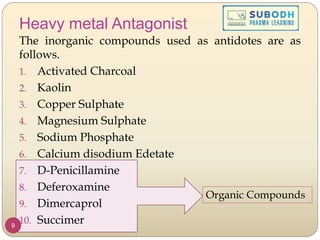
Heavy metal Antagonist
The inorganic compounds used as antidotes are as
follows.
1. Activated Charcoal
2. Kaolin
3. Copper Sulphate
4. Magnesium Sulphate
5. Sodium Phosphate
6. Calcium disodium Edetate
7. D-Penicillamine
8. Deferoxamine
9. Dimercaprol
10. Succimer
Organic Compounds
9
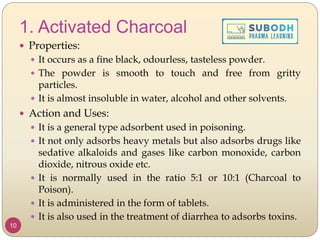
1. Activated Charcoal
 Properties:
 It occurs as a fine black, odourless, tasteless powder.
 The powder is smooth to touch and free from gritty
particles.
 It is almost insoluble in water, alcohol and other solvents.
 Action and Uses:
 It is a general type adsorbent used in poisoning.
 It not only adsorbs heavy metals but also adsorbs drugs like
sedative alkaloids and gases like carbon monoxide, carbon
dioxide, nitrous oxide etc.
 It is normally used in the ratio 5:1 or 10:1 (Charcoal to
Poison).
 It is administered in the form of tablets.
 It is also used in the treatment of diarrhea to adsorbs toxins.
10
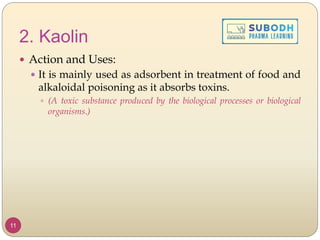
2. Kaolin
 Action and Uses:
 It is mainly used as adsorbent in treatment of food and
alkaloidal poisoning as it absorbs toxins.
 (A toxic substance produced by the biological processes or biological
organisms.)
11
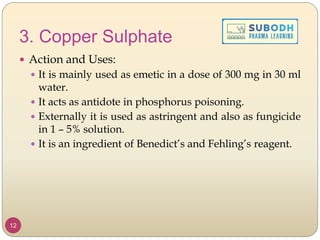
3. Copper Sulphate
 Action and Uses:
 It is mainly used as emetic in a dose of 300 mg in 30 ml
water.
 It acts as antidote in phosphorus poisoning.
 Externally it is used as astringent and also as fungicide
in 1 – 5% solution.
 It is an ingredient of Benedict’s and Fehling’s reagent.
12
4. Magnesium Sulphate
 Besides acting as saline cathartic, it is used in the
treatment of barium and lead poisoning.
 These heavy metals get precipitate as insoluble
sulphates.
13
5. Sodium Phosphate
 Besides acting as Saline Cathartics, it is mainly used
as an antidote for iron poisoning.
 It forms insoluble iron phosphate salt when
administered orally.
14
6. Calcium Disodium Edetate
 It is a universal type of antidote as it forms a chelate
with many metals.
 The compound and its infusion is official in B. P.
1988.
 It is effective in systemic poisoning of heavy metals.
 It is mainly effective in lead poisoning.
 It is given parenterally in 200 mg/ml by
Intramuscular (IM) route.
 It should be used judiciously (in good manner) as it is
a general antidote and shows side effects.
15
7. D-Penicillamine
 It is given in the form of tablets in Copper,
Magnesium and Lead poisoning.
 The usual dose is 500 mg to 1.5 g per day in divided
doses orally.
 It forms complexes with heavy metal and promotes
its elimination through urine.
16
8. Deferoxamine
 Deferoxamine mesylate and its injection is official in
B. P. 1988.
 It is mainly effective against Fe++ ion.
 It is given in 500 mg by IM route in acute poisoning.
 In chronic poisoning it is given in 0.5 to 1 g per day.
17
9. Dimercaprol
 Dimercaprol and its injection is official in B. P. 1988.
 It is given by deep IM route in 1% solution in oil.
 The dose depends upon the nature and amount of
metal poisoning.
 It forms a chelate between sulphadryl – SH group
and metal.
 It is mainly effective against arsenic, gold and
mercury poisoning.
18
10. Succimer
 It is a disulphydryl compound similar in action as of
dimercaprol.
 It is orally active and is relatively nontoxic.
 It is effective in treatment of mercury, arsenic and
lead poisoning.
19
Cyanide Poisoning
 Cyanide poisoning occurs accidently or when it is
taken intentionally for suicidal purpose.
 In cyanide poisoning, cyanide ion combines with
ferric ion of Cytochrome oxidase (an enzyme
responsible for electron transfer reactions).
 This leads to stoppage of cellular respiration and
metabolic reaction.
 Cyanide poisoning is usually fatal (Causing death), if
it is not treated immediately.
20
Treatment of Cyanide Poisoning
 Sodium Nitrite injection
and
 Sodium Thiosulphate injections are given to
counteract the effects of cyanide poison.
21
Sodium Nitrite
 Medicinally it is mainly used as antidote in cyanide
poisoning.
 Sodium Nitrite reacts with ferrous ions (Fe++) of
hemoglobin and converts into ferric ion (Fe+++) of
methaemoglobin.
 The methaemoglobin then combines with serum
cyanide thus reduces the conc. of cyanide ions.
 Other Uses:
 It has hypotensive effect and has relaxant action on
smooth muscles.
 It prevents rusting of surgical instruments and it is also
used as food preservative.
22
Sodium Thiosulphate
 It is specifically used as antidote in cyanide
poisoning.
 Sodium thiosulphate reacts with cyanide ions and
converts into Sodium Thiocyanate, which is less
toxic than cyanide.
 Other Uses:
 It also have antioxidant and cathartic action.
 It is used in photography and analytical laboratory.
23

Antidotes in Poisoning

  • 1.
    Presented By Mr. SubodhV. Kamble M. Pharm (Pharmaceutical Chemistry) Antidotes In Poisoning 1
  • 2.
    Content  What isPoisoning?  Antidotes  Classification of Antidotes  Heavy Metal Poisoning  Treatment of Heavy Metal Poisoning  Cyanide Poisoning  Treatment of Cyanide Poisoning 2
  • 3.
    What is Poisoning? Poison:- A substance that is harmful or lethal to a living organism.  Poisoning:- Administration of poison is known as poisoning.  Poisoning can occurs in various ways.  Most commonly, poisoning occurs due to heavy metals present in the environment.  Many times, the metal are leached from utensils and cookware's leading to inadvertent poisoning (not intentional).  It can also be due to insecticides or pesticides.  It can be occurs due to excessive use of drug (drug overdose). 3
  • 4.
    Antidotes  Antidotes arethe agents which are used to reverse, stop or counteract the action of poisons.  Classification of Antidotes: Based on mechanism of action antidotes can be classified as: 1. Physiological Antidote 2. Chemical Antidote 3. Mechanical Antidote 4
  • 5.
    Classification 1. Physiological Antidote Itacts by producing the Antagonistic effect (opposite) to that of poison, or counteract the effect of poison physiologically. 2. Chemical Antidote It acts usually by combining with the poison and thus changes its chemical nature, so the poison cannot act more. 3. Mechanical Antidote It act by preventing the absorption of poison in the body or expelling out the poison by emesis or elimination through urine. 5
  • 6.
    Heavy Metal Poisoning The common heavy metals which causes poisoning are, the salts of arsenic, lead, mercury, iron and cadmium.  Heavy metal poisoning occurs due to the overdose or incomplete metabolism in the body.  The most commonly widely adopted method is to use antagonist, which chelate or forms complex with them. 6
  • 7.
    Iron Poisoning 7  Theoverdoses of iron preparations can cause serious problems leading to death particularly young patients.  It is important to Keep iron preparations away from children.  Treatment:  Usually treated by gastric lavage, followed by giving Sodium bicarbonate and sodium dihydrogen phosphate which converts iron into insoluble iron salts.  If there is no evidence of kidney damage then deferoxamine is orally administered to prevent the absorption of iron.
  • 8.
    Treatment of HeavyMetal Poisoning  The initial treatment is administration of charcoal to adsorb the heavy metal.  This is followed by the administration of the compounds produces emesis. Which eliminates the possibility of any poison remaining in the stomach, being absorbed for circulation.  In case of poison being absorbed in the body effective organic antidotes are used. 8
  • 9.
    Heavy metal Antagonist Theinorganic compounds used as antidotes are as follows. 1. Activated Charcoal 2. Kaolin 3. Copper Sulphate 4. Magnesium Sulphate 5. Sodium Phosphate 6. Calcium disodium Edetate 7. D-Penicillamine 8. Deferoxamine 9. Dimercaprol 10. Succimer Organic Compounds 9
  • 10.
    1. Activated Charcoal Properties:  It occurs as a fine black, odourless, tasteless powder.  The powder is smooth to touch and free from gritty particles.  It is almost insoluble in water, alcohol and other solvents.  Action and Uses:  It is a general type adsorbent used in poisoning.  It not only adsorbs heavy metals but also adsorbs drugs like sedative alkaloids and gases like carbon monoxide, carbon dioxide, nitrous oxide etc.  It is normally used in the ratio 5:1 or 10:1 (Charcoal to Poison).  It is administered in the form of tablets.  It is also used in the treatment of diarrhea to adsorbs toxins. 10
  • 11.
    2. Kaolin  Actionand Uses:  It is mainly used as adsorbent in treatment of food and alkaloidal poisoning as it absorbs toxins.  (A toxic substance produced by the biological processes or biological organisms.) 11
  • 12.
    3. Copper Sulphate Action and Uses:  It is mainly used as emetic in a dose of 300 mg in 30 ml water.  It acts as antidote in phosphorus poisoning.  Externally it is used as astringent and also as fungicide in 1 – 5% solution.  It is an ingredient of Benedict’s and Fehling’s reagent. 12
  • 13.
    4. Magnesium Sulphate Besides acting as saline cathartic, it is used in the treatment of barium and lead poisoning.  These heavy metals get precipitate as insoluble sulphates. 13
  • 14.
    5. Sodium Phosphate Besides acting as Saline Cathartics, it is mainly used as an antidote for iron poisoning.  It forms insoluble iron phosphate salt when administered orally. 14
  • 15.
    6. Calcium DisodiumEdetate  It is a universal type of antidote as it forms a chelate with many metals.  The compound and its infusion is official in B. P. 1988.  It is effective in systemic poisoning of heavy metals.  It is mainly effective in lead poisoning.  It is given parenterally in 200 mg/ml by Intramuscular (IM) route.  It should be used judiciously (in good manner) as it is a general antidote and shows side effects. 15
  • 16.
    7. D-Penicillamine  Itis given in the form of tablets in Copper, Magnesium and Lead poisoning.  The usual dose is 500 mg to 1.5 g per day in divided doses orally.  It forms complexes with heavy metal and promotes its elimination through urine. 16
  • 17.
    8. Deferoxamine  Deferoxaminemesylate and its injection is official in B. P. 1988.  It is mainly effective against Fe++ ion.  It is given in 500 mg by IM route in acute poisoning.  In chronic poisoning it is given in 0.5 to 1 g per day. 17
  • 18.
    9. Dimercaprol  Dimercaproland its injection is official in B. P. 1988.  It is given by deep IM route in 1% solution in oil.  The dose depends upon the nature and amount of metal poisoning.  It forms a chelate between sulphadryl – SH group and metal.  It is mainly effective against arsenic, gold and mercury poisoning. 18
  • 19.
    10. Succimer  Itis a disulphydryl compound similar in action as of dimercaprol.  It is orally active and is relatively nontoxic.  It is effective in treatment of mercury, arsenic and lead poisoning. 19
  • 20.
    Cyanide Poisoning  Cyanidepoisoning occurs accidently or when it is taken intentionally for suicidal purpose.  In cyanide poisoning, cyanide ion combines with ferric ion of Cytochrome oxidase (an enzyme responsible for electron transfer reactions).  This leads to stoppage of cellular respiration and metabolic reaction.  Cyanide poisoning is usually fatal (Causing death), if it is not treated immediately. 20
  • 21.
    Treatment of CyanidePoisoning  Sodium Nitrite injection and  Sodium Thiosulphate injections are given to counteract the effects of cyanide poison. 21
  • 22.
    Sodium Nitrite  Medicinallyit is mainly used as antidote in cyanide poisoning.  Sodium Nitrite reacts with ferrous ions (Fe++) of hemoglobin and converts into ferric ion (Fe+++) of methaemoglobin.  The methaemoglobin then combines with serum cyanide thus reduces the conc. of cyanide ions.  Other Uses:  It has hypotensive effect and has relaxant action on smooth muscles.  It prevents rusting of surgical instruments and it is also used as food preservative. 22
  • 23.
    Sodium Thiosulphate  Itis specifically used as antidote in cyanide poisoning.  Sodium thiosulphate reacts with cyanide ions and converts into Sodium Thiocyanate, which is less toxic than cyanide.  Other Uses:  It also have antioxidant and cathartic action.  It is used in photography and analytical laboratory. 23