ANTIDIABETIC
AGENTS
By Sara Sami
Yuzuncu Yil University
2015
Aims of management
• To achieve near normal glycaemia
- Short term- to prevent symptoms of hyper &
hypo
- Long term- to prevent complications
• Good quality of life, near normal life
expectancy
Insulin
Human Insulin :
• Do not contain measurable amounts of
proinsulin or contaminants.
• Diminished antibody
• Less allergic reactions
• Less lipodystrophy
• Preferred in gestational diabetes
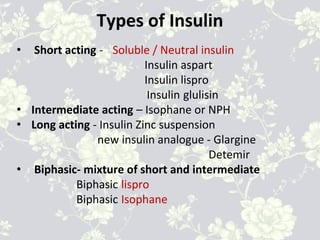
Types of Insulin
• Short acting - Soluble / Neutral insulin
Insulin aspart
Insulin lispro
Insulin glulisin
• Intermediate acting – Isophane or NPH
• Long acting - Insulin Zinc suspension
new insulin analogue - Glargine
Detemir
• Biphasic- mixture of short and intermediate
Biphasic lispro
Biphasic Isophane
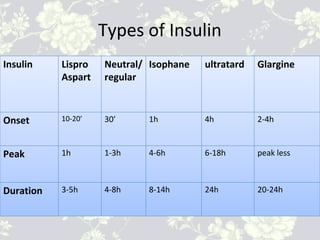
Types of Insulin
Insulin Lispro
Aspart
Neutral/
regular
Isophane ultratard Glargine
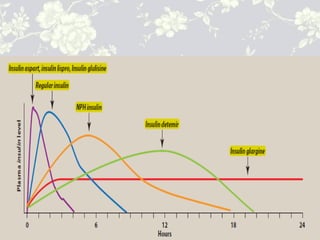
Onset 10-20′ 30′ 1h 4h 2-4h
Peak 1h 1-3h 4-6h 6-18h peak less
Duration 3-5h 4-8h 8-14h 24h 20-24h
Soluble insulin / neutral /clear
• Names - Human actrapid/ Humulin S
• Species- Bovine, porcine, human
• Following s/c injection
Onset of action – 30 min
Peak- 1-3 hours
Duration- 4-8 hours
• Only insulin suitable for intravenous route –plasma
half life < 5 min, required continuous infusion
• Used in diabetes Ketoacidosis
Sites of injections - Subcutaneous
• Thighs
• Upper buttocks
• Abdomen
• Arms
Important to rotate the site
Rate of absorption may be significantly different
– faster from arm and abdomen than from
thigh and buttock
Routes of Administration
• Subcutaneous for long term regular use
• Intravenous infusion in acute conditions- diabetes
Ketoacidosis, Perioperative period, Hyperosmolar
Nonketotic state ONLY NEUTRAL/ CLEAR INSULIN
CAN BE USED
• Continuous subcutaneous insulin infusion via pump –
neutral
• Intraperitoneal – Peritoneal dialysis patients
• Inhaled insulin- experimental
Side effect of insulin
• Hypoglycaemia
• Weight gain- anabolic hormone
• Lipohypertrophy- injection to same site
• Insulin oedema
• Transient deterioration in retinopathy
• Insulin neuritis – actively regenerating
neurone, uncommon
• Postural hypotension
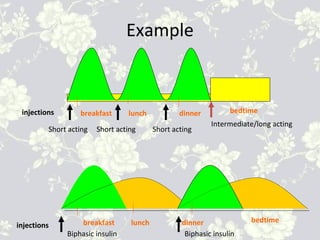
Example
injections
Short acting Short acting Short acting
Intermediate/long acting
breakfast lunch dinner
breakfast lunch dinner bedtime
bedtime
injections
Biphasic insulin Biphasic insulin
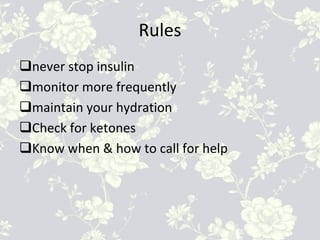
Rules
qnever stop insulin
qmonitor more frequently
qmaintain your hydration
qCheck for ketones
qKnow when & how to call for help
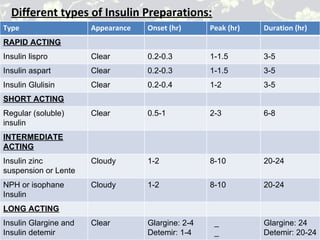
Different types of Insulin Preparations:
Type Appearance Onset (hr) Peak (hr) Duration (hr)
RAPID ACTING
Insulin lispro Clear 0.2-0.3 1-1.5 3-5
Insulin aspart Clear 0.2-0.3 1-1.5 3-5
Insulin Glulisin Clear 0.2-0.4 1-2 3-5
SHORT ACTING
Regular (soluble)
insulin
Clear 0.5-1 2-3 6-8
INTERMEDIATE
ACTING
Insulin zinc
suspension or Lente
Cloudy 1-2 8-10 20-24
NPH or isophane
Insulin
Cloudy 1-2 8-10 20-24
LONG ACTING
Insulin Glargine and
Insulin detemir
Clear Glargine: 2-4
Detemir: 1-4
_
_
Glargine: 24
Detemir: 20-24
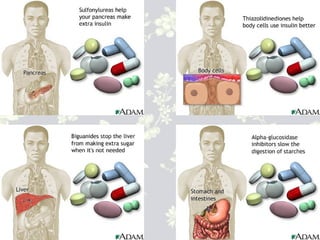
Oral Medications to Treat Type 2
Diabetes
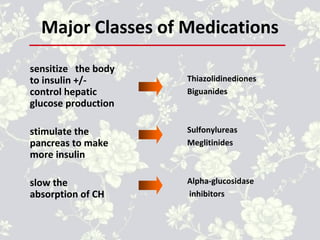
Major Classes of Medications
sensitize the body
to insulin +/-
control hepatic
glucose production
stimulate the
pancreas to make
more insulin
slow the
absorption of CH
Thiazolidinediones
Biguanides
Sulfonylureas
Meglitinides
Alpha-glucosidase
inhibitors
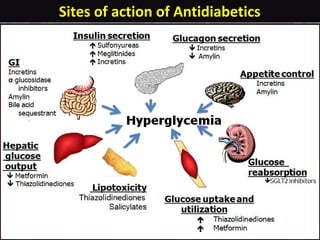
Sites of action of Antidiabetics
Thiazolidinediones
• ↓ insulin resistance by making muscle and adipose
cells more sensitive to insulin. They also suppress
hepatic glucose production.
• Efficacy
• Enhance glucose and lipid metabolism through
action on Peroxisome Proliferator Activated
Receptor (PPAR–γ)
• by increasing the GLUT 4 glucose transporters
–↓ fasting plasma glucose ~1.9-2.2 mmol/L
–6 weeks for maximum effect
• Other Effects
– Weight gain, oedema
– Hypoglycemia (if taken with insulin or agents that
stimulate insulin release)
– Improves HDL cholesterol and plasma triglycerides ;
usually LDL neutral
• Medications in this Class: pioglitazone (Actos),
rosiglitazone (Avandia), troglitazone (Rezulin) - taken
off market due to liver toxicity]
Biguanides
• Biguanides ↓ hepatic glucose production and increase insulin-
mediated peripheral glucose uptake.
• Efficacy
– Decrease fasting plasma glucose 60-70 mg/dl (3.3-3.9 mmol/L)
• Other Effects
– Diarrhea and abdominal discomfort
– Lactic acidosis if improperly prescribed
– Cause small decrease in LDL cholesterol level and triglycerides
– No specific effect on blood pressure
– No weight gain, with possible modest weight loss
– Contraindicated in patients with impaired renal function
– Medications in this Class: metformin (Glucophage), metformin
hydrochloride extended release (Glucophage XR)
Metformin (Glucophage) :
• It does not cause hypoglycemia.
• It produces a significant ↓ TG and LDL,
and ↑HDL.
• There is a serious concern about lactic
acidosis especially in patients with kidney
disease.
Sulfonylureas
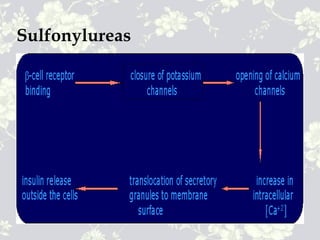
• Sulfonylureas increase endogenous insulin secretion
• Efficacy
– Decrease fasting plasma glucose 3.3-3.9 mmol/L
• Other Effects
– Hypoglycemia
– Weight gain
– No specific effect on plasma lipids or blood pressure
– Generally the least expensive class of medication
• Medications in this Class:
– First generation : chlorpropamide , tolazamide, acetohexamide ,
tolbutamide
– Second generation : glyburide , glipizide
– Third generation : Glimiperide
Sulfonylureas
Sulfonylureas Adverse effects :
• Hypoglycemia
• Cholestatic jaundice
• Weight gain
• Cross placenta – fetal hypoglycemia.
• Chlorpropamide : It can cause water
retention by ↑ release of ADH (SIADH)
• Disulfiram-like reaction with alcohol.
Meglitinides
• stimulate insulin secretion (rapidly and for a short duration) in the
presence of glucose.
• Efficacy
– ↓ peak postprandial glucose
– ↓ plasma glucose 3.3-3.9 mmol/L
• Other Effects
– Hypoglycemia (may be less than with sulfonylureas if patient
has a variable eating schedule)
– Weight gain
– No significant effect on plasma lipid levels
– Safe at higher levels of serum Cr than sulfonylureas
• Medications in this Class: repaglinide , nateglinide
Alpha-glucosidase Inhibitors
• Alpha-glucosidase inhibitors block the enzymes that digest starches
in the small intestine
• It reduces absorption of glucose after meals
• Efficacy
– ↓ peak postprandial glucose 2.2-2.8 mmol/L
– ↓ fasting plasma glucose 1.4-1.7 mmol/L
• Other Effects
– Flatulence or abdominal discomfort
– No specific effect on lipids or blood pressure
– No weight gain
– Contraindicated in patients with inflammatory bowel disease or
cirrhosis
• Medications in this Class: acarbose , miglitol
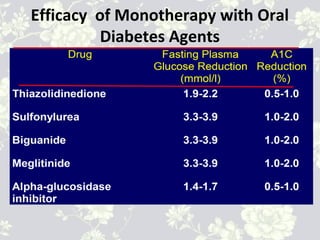
Efficacy of Monotherapy with Oral
Diabetes Agents
Anti-diabetic drugs
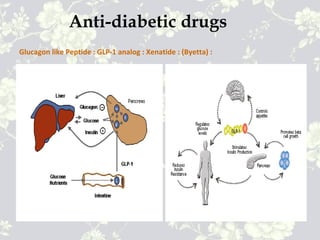
Glucagon like Peptide : GLP-1 analog :
Xenatide : (Byetta) :
• GLP is an incretin released from the small
intestine which increase the glucose
dependent insulin secretion.
• Xenatide suppress glucagon release and
reduce appetite
• It is administered by SC injection.
Anti-diabetic drugs
Glucagon like Peptide : GLP-1 analog : Xenatide : (Byetta) :
Anti-diabetic drugs
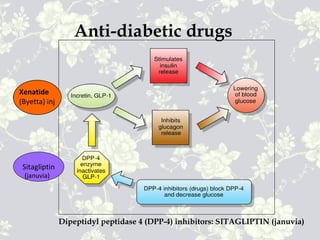
Dipeptidyl peptidase 4 (DPP-4) inhibitors: SITAGLIPTIN (januvia)
Xenatide
(Byetta) inj
Sitagliptin
(januvia)
Anti-diabetic drugs
• Sitagliptin (Januvia) is an oral anti-
diabetic drug.
• It inhibit the dipeptidyl peptidase 4 (DPP-
4), an enzyme which inactivates the
incretins GLP-1 and GIP, that are released
in response to a meal.
• It potentiates the secretion of insulin and
suppress the release of glucagon by the
pancreas.
Endocrine pancreas
Glucagon :
• It has positive inotropic action and
chronotropic action on the heart.
• It acts by stimulation of glucagon
receptors and not through beta 1
receptors.
• This is the basis for using glucagon in
beta blocker overdose.
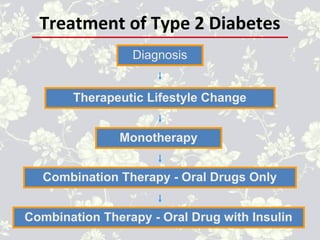
Treatment of Type 2 Diabetes
Diagnosis
Therapeutic Lifestyle Change
Combination Therapy - Oral Drug with Insulin
Combination Therapy - Oral Drugs Only
Monotherapy
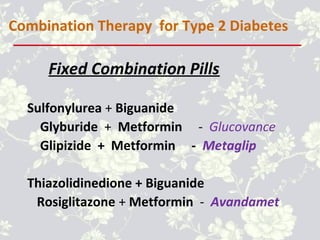
Sulfonylurea + Biguanide
Glyburide + Metformin - Glucovance
Glipizide + Metformin - Metaglip
Thiazolidinedione + Biguanide
Rosiglitazone + Metformin - Avandamet
Fixed Combination Pills
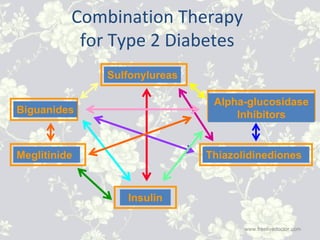
Combination Therapy for Type 2 Diabetes
Combination Therapy
for Type 2 Diabetes
Biguanides
Insulin
Sulfonylureas
Alpha-glucosidase
Inhibitors
Meglitinide Thiazolidinediones
www.freelivedoctor.com
Special circumstances
• Intercurrent illness
• Peri-operative period
• Pregnancy
• Childhood and adolescents
• Others- travelling across time zones
Exercise
Alcohol
Driving
THANK YOU FOR
WASHING

Antidiabetic agent

  • 1.
  • 2.
    Aims of management •To achieve near normal glycaemia - Short term- to prevent symptoms of hyper & hypo - Long term- to prevent complications • Good quality of life, near normal life expectancy
  • 3.
    Insulin Human Insulin : •Do not contain measurable amounts of proinsulin or contaminants. • Diminished antibody • Less allergic reactions • Less lipodystrophy • Preferred in gestational diabetes
  • 4.
    Types of Insulin •Short acting - Soluble / Neutral insulin Insulin aspart Insulin lispro Insulin glulisin • Intermediate acting – Isophane or NPH • Long acting - Insulin Zinc suspension new insulin analogue - Glargine Detemir • Biphasic- mixture of short and intermediate Biphasic lispro Biphasic Isophane
  • 5.
    Types of Insulin InsulinLispro Aspart Neutral/ regular Isophane ultratard Glargine Onset 10-20′ 30′ 1h 4h 2-4h Peak 1h 1-3h 4-6h 6-18h peak less Duration 3-5h 4-8h 8-14h 24h 20-24h
  • 6.
    Soluble insulin /neutral /clear • Names - Human actrapid/ Humulin S • Species- Bovine, porcine, human • Following s/c injection Onset of action – 30 min Peak- 1-3 hours Duration- 4-8 hours • Only insulin suitable for intravenous route –plasma half life < 5 min, required continuous infusion • Used in diabetes Ketoacidosis
  • 7.
    Sites of injections- Subcutaneous • Thighs • Upper buttocks • Abdomen • Arms Important to rotate the site Rate of absorption may be significantly different – faster from arm and abdomen than from thigh and buttock
  • 8.
    Routes of Administration •Subcutaneous for long term regular use • Intravenous infusion in acute conditions- diabetes Ketoacidosis, Perioperative period, Hyperosmolar Nonketotic state ONLY NEUTRAL/ CLEAR INSULIN CAN BE USED • Continuous subcutaneous insulin infusion via pump – neutral • Intraperitoneal – Peritoneal dialysis patients • Inhaled insulin- experimental
  • 9.
    Side effect ofinsulin • Hypoglycaemia • Weight gain- anabolic hormone • Lipohypertrophy- injection to same site • Insulin oedema • Transient deterioration in retinopathy • Insulin neuritis – actively regenerating neurone, uncommon • Postural hypotension
  • 10.
    Example injections Short acting Shortacting Short acting Intermediate/long acting breakfast lunch dinner breakfast lunch dinner bedtime bedtime injections Biphasic insulin Biphasic insulin
  • 11.
    Rules qnever stop insulin qmonitormore frequently qmaintain your hydration qCheck for ketones qKnow when & how to call for help
  • 12.
    Different types ofInsulin Preparations: Type Appearance Onset (hr) Peak (hr) Duration (hr) RAPID ACTING Insulin lispro Clear 0.2-0.3 1-1.5 3-5 Insulin aspart Clear 0.2-0.3 1-1.5 3-5 Insulin Glulisin Clear 0.2-0.4 1-2 3-5 SHORT ACTING Regular (soluble) insulin Clear 0.5-1 2-3 6-8 INTERMEDIATE ACTING Insulin zinc suspension or Lente Cloudy 1-2 8-10 20-24 NPH or isophane Insulin Cloudy 1-2 8-10 20-24 LONG ACTING Insulin Glargine and Insulin detemir Clear Glargine: 2-4 Detemir: 1-4 _ _ Glargine: 24 Detemir: 20-24
  • 14.
    Oral Medications toTreat Type 2 Diabetes
  • 15.
    Major Classes ofMedications sensitize the body to insulin +/- control hepatic glucose production stimulate the pancreas to make more insulin slow the absorption of CH Thiazolidinediones Biguanides Sulfonylureas Meglitinides Alpha-glucosidase inhibitors
  • 16.
    Sites of actionof Antidiabetics
  • 17.
    Thiazolidinediones • ↓ insulinresistance by making muscle and adipose cells more sensitive to insulin. They also suppress hepatic glucose production. • Efficacy • Enhance glucose and lipid metabolism through action on Peroxisome Proliferator Activated Receptor (PPAR–γ) • by increasing the GLUT 4 glucose transporters –↓ fasting plasma glucose ~1.9-2.2 mmol/L –6 weeks for maximum effect
  • 18.
    • Other Effects –Weight gain, oedema – Hypoglycemia (if taken with insulin or agents that stimulate insulin release) – Improves HDL cholesterol and plasma triglycerides ; usually LDL neutral • Medications in this Class: pioglitazone (Actos), rosiglitazone (Avandia), troglitazone (Rezulin) - taken off market due to liver toxicity]
  • 19.
    Biguanides • Biguanides ↓hepatic glucose production and increase insulin- mediated peripheral glucose uptake. • Efficacy – Decrease fasting plasma glucose 60-70 mg/dl (3.3-3.9 mmol/L) • Other Effects – Diarrhea and abdominal discomfort – Lactic acidosis if improperly prescribed – Cause small decrease in LDL cholesterol level and triglycerides – No specific effect on blood pressure – No weight gain, with possible modest weight loss – Contraindicated in patients with impaired renal function – Medications in this Class: metformin (Glucophage), metformin hydrochloride extended release (Glucophage XR)
  • 20.
    Metformin (Glucophage) : •It does not cause hypoglycemia. • It produces a significant ↓ TG and LDL, and ↑HDL. • There is a serious concern about lactic acidosis especially in patients with kidney disease.
  • 21.
    Sulfonylureas • Sulfonylureas increaseendogenous insulin secretion • Efficacy – Decrease fasting plasma glucose 3.3-3.9 mmol/L • Other Effects – Hypoglycemia – Weight gain – No specific effect on plasma lipids or blood pressure – Generally the least expensive class of medication • Medications in this Class: – First generation : chlorpropamide , tolazamide, acetohexamide , tolbutamide – Second generation : glyburide , glipizide – Third generation : Glimiperide
  • 22.
  • 23.
    Sulfonylureas Adverse effects: • Hypoglycemia • Cholestatic jaundice • Weight gain • Cross placenta – fetal hypoglycemia. • Chlorpropamide : It can cause water retention by ↑ release of ADH (SIADH) • Disulfiram-like reaction with alcohol.
  • 24.
    Meglitinides • stimulate insulinsecretion (rapidly and for a short duration) in the presence of glucose. • Efficacy – ↓ peak postprandial glucose – ↓ plasma glucose 3.3-3.9 mmol/L • Other Effects – Hypoglycemia (may be less than with sulfonylureas if patient has a variable eating schedule) – Weight gain – No significant effect on plasma lipid levels – Safe at higher levels of serum Cr than sulfonylureas • Medications in this Class: repaglinide , nateglinide
  • 25.
    Alpha-glucosidase Inhibitors • Alpha-glucosidaseinhibitors block the enzymes that digest starches in the small intestine • It reduces absorption of glucose after meals • Efficacy – ↓ peak postprandial glucose 2.2-2.8 mmol/L – ↓ fasting plasma glucose 1.4-1.7 mmol/L • Other Effects – Flatulence or abdominal discomfort – No specific effect on lipids or blood pressure – No weight gain – Contraindicated in patients with inflammatory bowel disease or cirrhosis • Medications in this Class: acarbose , miglitol
  • 26.
    Efficacy of Monotherapywith Oral Diabetes Agents
  • 28.
    Anti-diabetic drugs Glucagon likePeptide : GLP-1 analog : Xenatide : (Byetta) : • GLP is an incretin released from the small intestine which increase the glucose dependent insulin secretion. • Xenatide suppress glucagon release and reduce appetite • It is administered by SC injection.
  • 29.
    Anti-diabetic drugs Glucagon likePeptide : GLP-1 analog : Xenatide : (Byetta) :
  • 30.
    Anti-diabetic drugs Dipeptidyl peptidase4 (DPP-4) inhibitors: SITAGLIPTIN (januvia) Xenatide (Byetta) inj Sitagliptin (januvia)
  • 31.
    Anti-diabetic drugs • Sitagliptin(Januvia) is an oral anti- diabetic drug. • It inhibit the dipeptidyl peptidase 4 (DPP- 4), an enzyme which inactivates the incretins GLP-1 and GIP, that are released in response to a meal. • It potentiates the secretion of insulin and suppress the release of glucagon by the pancreas.
  • 32.
    Endocrine pancreas Glucagon : •It has positive inotropic action and chronotropic action on the heart. • It acts by stimulation of glucagon receptors and not through beta 1 receptors. • This is the basis for using glucagon in beta blocker overdose.
  • 33.
    Treatment of Type2 Diabetes Diagnosis Therapeutic Lifestyle Change Combination Therapy - Oral Drug with Insulin Combination Therapy - Oral Drugs Only Monotherapy
  • 34.
    Sulfonylurea + Biguanide Glyburide+ Metformin - Glucovance Glipizide + Metformin - Metaglip Thiazolidinedione + Biguanide Rosiglitazone + Metformin - Avandamet Fixed Combination Pills Combination Therapy for Type 2 Diabetes
  • 35.
    Combination Therapy for Type2 Diabetes Biguanides Insulin Sulfonylureas Alpha-glucosidase Inhibitors Meglitinide Thiazolidinediones www.freelivedoctor.com
  • 36.
    Special circumstances • Intercurrentillness • Peri-operative period • Pregnancy • Childhood and adolescents • Others- travelling across time zones Exercise Alcohol Driving
  • 37.