The Receptors Of Adrenergic
By Dr. Sara Sami
Yuzuncu Yil University
2015
Adrenergic Receptors
• These are mainly 2 types
(α) Alfa
(β) Beta
(D) De
These are again subdivided into various types
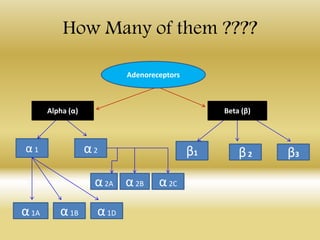
How Many of them ????
Alpha (α) Beta (β)
Adenoreceptors
α1
β3β2β1α2
α2B α2Cα2A
α1A α1B α1D
Adrenergic Receptors
• Adrenergic receptors (or adrenoceptors) are a class of
G-protein coupled receptors that are the target of
catecholamines
• Adrenergic receptors specifically bind their endogenous ligands
– catecholamines (adrenaline and noradrenline)
– Increase or decrease of 2nd messengers cAMP or IP3/DAG
• Many cells possess these receptors, and the binding of an
agonist will generally cause the cell to respond in a flight-fight
manner.
– For instance, the heart will start beating quicker and the
pupils will dilate
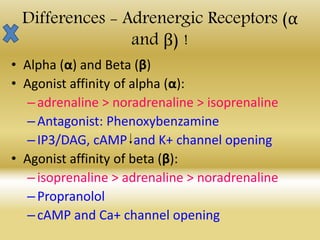
Differences - Adrenergic Receptors (α
and β) !
• Alpha (α) and Beta (β)
• Agonist affinity of alpha (α):
–adrenaline > noradrenaline > isoprenaline
–Antagonist: Phenoxybenzamine
–IP3/DAG, cAMP and K+ channel opening
• Agonist affinity of beta (β):
–isoprenaline > adrenaline > noradrenaline
–Propranolol
–cAMP and Ca+ channel opening
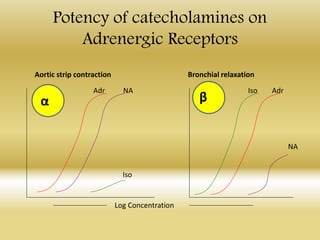
Potency of catecholamines on
Adrenergic Receptors
Adr NA
Iso
Iso Adr
NA
Log Concentration
Aortic strip contraction Bronchial relaxation
α β
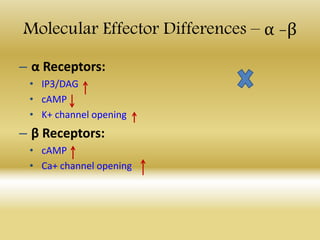
Molecular Effector Differences – α -β
– α Receptors:
• IP3/DAG
• cAMP
• K+ channel opening
– β Receptors:
• cAMP
• Ca+ channel opening
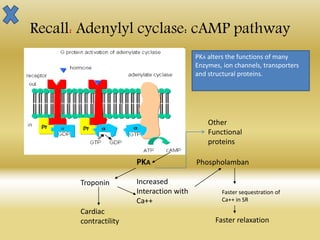
Recall: Adenylyl cyclase: cAMP pathway
PKA Phospholamban
Increased
Interaction with
Ca++
Faster relaxation
Troponin
Cardiac
contractility
Other
Functional
proteins
PKA alters the functions of many
Enzymes, ion channels, transporters
and structural proteins.
Faster sequestration of
Ca++ in SR
PKc
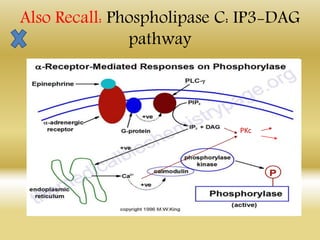
Also Recall: Phospholipase C: IP3-DAG
pathway
Beta receptors
• All β receptors activate adenylate cyclase, raising the intracellular
cAMP concentration
• Type β1:
– These are present in heart tissue, and cause an increased heart
rate by acting on the cardiac pacemaker cells
• Type β2:
– These are in the vessels of skeletal muscle, and cause
vasodilatation, which allows more blood to flow to the muscles,
and reduce total peripheral resistance
– Beta-2 receptors are also present in bronchial smooth muscle, and
cause bronchodilatation when activated
– Stimulated by adrenaline, but not noradrenaline
– Bronchodilator salbutamol work by binding to and stimulating the
β2 receptors
• Type β3:
– Beta-3 receptors are present in adipose tissue and are thought to
have a role in the regulation of lipid metabolism
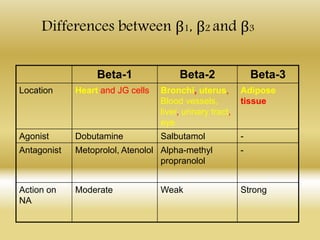
Differences between β1, β2 and β3
Beta-1 Beta-2 Beta-3
Location Heart and JG cells Bronchi, uterus,
Blood vessels,
liver, urinary tract,
eye
Adipose
tissue
Agonist Dobutamine Salbutamol -
Antagonist Metoprolol, Atenolol Alpha-methyl
propranolol
-
Action on
NA
Moderate Weak Strong
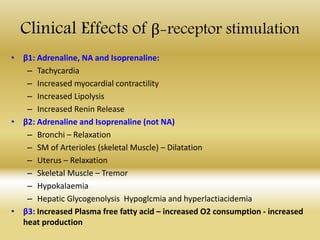
Clinical Effects of β-receptor stimulation
• β1: Adrenaline, NA and Isoprenaline:
– Tachycardia
– Increased myocardial contractility
– Increased Lipolysis
– Increased Renin Release
• β2: Adrenaline and Isoprenaline (not NA)
– Bronchi – Relaxation
– SM of Arterioles (skeletal Muscle) – Dilatation
– Uterus – Relaxation
– Skeletal Muscle – Tremor
– Hypokalaemia
– Hepatic Glycogenolysis Hypoglcmia and hyperlactiacidemia
• β3: Increased Plasma free fatty acid – increased O2 consumption - increased
heat production
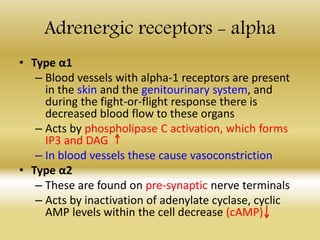
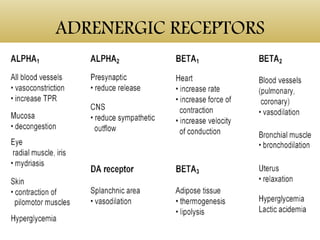
Adrenergic receptors - alpha
• Type α1
– Blood vessels with alpha-1 receptors are present
in the skin and the genitourinary system, and
during the fight-or-flight response there is
decreased blood flow to these organs
– Acts by phospholipase C activation, which forms
IP3 and DAG
– In blood vessels these cause vasoconstriction
• Type α2
– These are found on pre-synaptic nerve terminals
– Acts by inactivation of adenylate cyclase, cyclic
AMP levels within the cell decrease (cAMP)
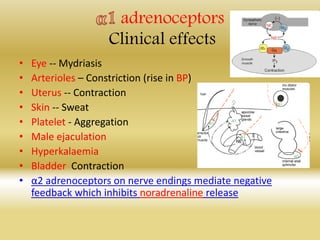
adrenoceptors
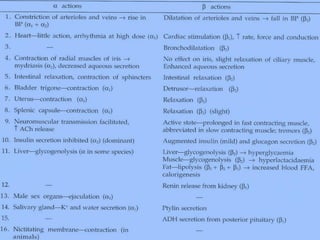
Clinical effects
• Eye -- Mydriasis
• Arterioles – Constriction (rise in BP)
• Uterus -- Contraction
• Skin -- Sweat
• Platelet - Aggregation
• Male ejaculation
• Hyperkalaemia
• Bladder Contraction
• α2 adrenoceptors on nerve endings mediate negative
feedback which inhibits noradrenaline release
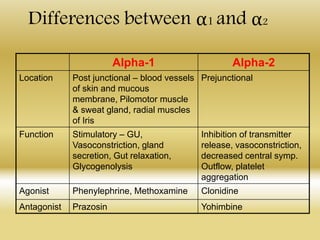
Differences between α1 and α2
Alpha-1 Alpha-2
Location Post junctional – blood vessels
of skin and mucous
membrane, Pilomotor muscle
& sweat gland, radial muscles
of Iris
Prejunctional
Function Stimulatory – GU,
Vasoconstriction, gland
secretion, Gut relaxation,
Glycogenolysis
Inhibition of transmitter
release, vasoconstriction,
decreased central symp.
Outflow, platelet
aggregation
Agonist Phenylephrine, Methoxamine Clonidine
Antagonist Prazosin Yohimbine
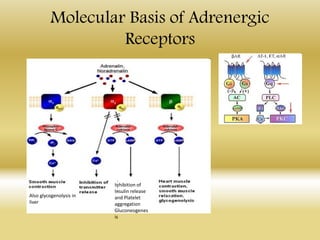
Molecular Basis of Adrenergic
Receptors
Also glycogenolysis in
liver
Inhibition of
Insulin release
and Platelet
aggregation
Gluconeogenes
is
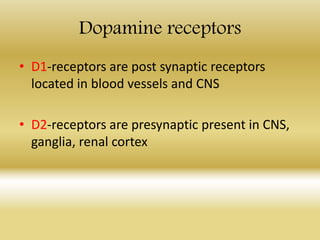
Dopamine receptors
• D1-receptors are post synaptic receptors
located in blood vessels and CNS
• D2-receptors are presynaptic present in CNS,
ganglia, renal cortex
ADRENERGIC RECEPTORS
Adrenal antagonist (1)

Adrenal antagonist (1)

  • 1.
    The Receptors OfAdrenergic By Dr. Sara Sami Yuzuncu Yil University 2015
  • 2.
    Adrenergic Receptors • Theseare mainly 2 types (α) Alfa (β) Beta (D) De These are again subdivided into various types
  • 3.
    How Many ofthem ???? Alpha (α) Beta (β) Adenoreceptors α1 β3β2β1α2 α2B α2Cα2A α1A α1B α1D
  • 4.
    Adrenergic Receptors • Adrenergicreceptors (or adrenoceptors) are a class of G-protein coupled receptors that are the target of catecholamines • Adrenergic receptors specifically bind their endogenous ligands – catecholamines (adrenaline and noradrenline) – Increase or decrease of 2nd messengers cAMP or IP3/DAG • Many cells possess these receptors, and the binding of an agonist will generally cause the cell to respond in a flight-fight manner. – For instance, the heart will start beating quicker and the pupils will dilate
  • 5.
    Differences - AdrenergicReceptors (α and β) ! • Alpha (α) and Beta (β) • Agonist affinity of alpha (α): –adrenaline > noradrenaline > isoprenaline –Antagonist: Phenoxybenzamine –IP3/DAG, cAMP and K+ channel opening • Agonist affinity of beta (β): –isoprenaline > adrenaline > noradrenaline –Propranolol –cAMP and Ca+ channel opening
  • 6.
    Potency of catecholamineson Adrenergic Receptors Adr NA Iso Iso Adr NA Log Concentration Aortic strip contraction Bronchial relaxation α β
  • 7.
    Molecular Effector Differences– α -β – α Receptors: • IP3/DAG • cAMP • K+ channel opening – β Receptors: • cAMP • Ca+ channel opening
  • 8.
    Recall: Adenylyl cyclase:cAMP pathway PKA Phospholamban Increased Interaction with Ca++ Faster relaxation Troponin Cardiac contractility Other Functional proteins PKA alters the functions of many Enzymes, ion channels, transporters and structural proteins. Faster sequestration of Ca++ in SR
  • 9.
  • 10.
    Beta receptors • Allβ receptors activate adenylate cyclase, raising the intracellular cAMP concentration • Type β1: – These are present in heart tissue, and cause an increased heart rate by acting on the cardiac pacemaker cells • Type β2: – These are in the vessels of skeletal muscle, and cause vasodilatation, which allows more blood to flow to the muscles, and reduce total peripheral resistance – Beta-2 receptors are also present in bronchial smooth muscle, and cause bronchodilatation when activated – Stimulated by adrenaline, but not noradrenaline – Bronchodilator salbutamol work by binding to and stimulating the β2 receptors • Type β3: – Beta-3 receptors are present in adipose tissue and are thought to have a role in the regulation of lipid metabolism
  • 11.
    Differences between β1,β2 and β3 Beta-1 Beta-2 Beta-3 Location Heart and JG cells Bronchi, uterus, Blood vessels, liver, urinary tract, eye Adipose tissue Agonist Dobutamine Salbutamol - Antagonist Metoprolol, Atenolol Alpha-methyl propranolol - Action on NA Moderate Weak Strong
  • 12.
    Clinical Effects ofβ-receptor stimulation • β1: Adrenaline, NA and Isoprenaline: – Tachycardia – Increased myocardial contractility – Increased Lipolysis – Increased Renin Release • β2: Adrenaline and Isoprenaline (not NA) – Bronchi – Relaxation – SM of Arterioles (skeletal Muscle) – Dilatation – Uterus – Relaxation – Skeletal Muscle – Tremor – Hypokalaemia – Hepatic Glycogenolysis Hypoglcmia and hyperlactiacidemia • β3: Increased Plasma free fatty acid – increased O2 consumption - increased heat production
  • 13.
    Adrenergic receptors -alpha • Type α1 – Blood vessels with alpha-1 receptors are present in the skin and the genitourinary system, and during the fight-or-flight response there is decreased blood flow to these organs – Acts by phospholipase C activation, which forms IP3 and DAG – In blood vessels these cause vasoconstriction • Type α2 – These are found on pre-synaptic nerve terminals – Acts by inactivation of adenylate cyclase, cyclic AMP levels within the cell decrease (cAMP)
  • 14.
    adrenoceptors Clinical effects • Eye-- Mydriasis • Arterioles – Constriction (rise in BP) • Uterus -- Contraction • Skin -- Sweat • Platelet - Aggregation • Male ejaculation • Hyperkalaemia • Bladder Contraction • α2 adrenoceptors on nerve endings mediate negative feedback which inhibits noradrenaline release
  • 15.
    Differences between α1and α2 Alpha-1 Alpha-2 Location Post junctional – blood vessels of skin and mucous membrane, Pilomotor muscle & sweat gland, radial muscles of Iris Prejunctional Function Stimulatory – GU, Vasoconstriction, gland secretion, Gut relaxation, Glycogenolysis Inhibition of transmitter release, vasoconstriction, decreased central symp. Outflow, platelet aggregation Agonist Phenylephrine, Methoxamine Clonidine Antagonist Prazosin Yohimbine
  • 16.
    Molecular Basis ofAdrenergic Receptors Also glycogenolysis in liver Inhibition of Insulin release and Platelet aggregation Gluconeogenes is
  • 17.
    Dopamine receptors • D1-receptorsare post synaptic receptors located in blood vessels and CNS • D2-receptors are presynaptic present in CNS, ganglia, renal cortex
  • 18.