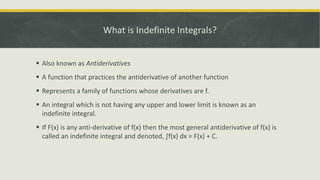
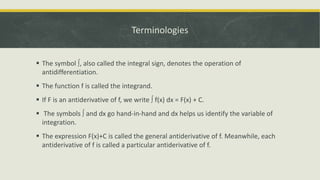
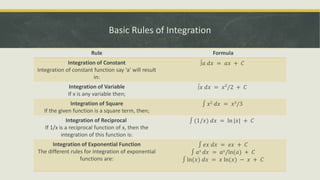
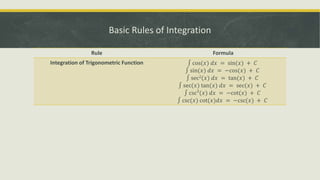
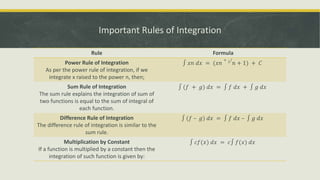
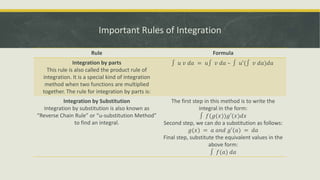
An indefinite integral, also known as an antiderivative, represents a family of functions whose derivatives are equal to a given function f(x). It is denoted by the integral sign followed by the integrand and dx, such as ∫f(x) dx, and represents all functions F(x) whose derivative is f(x) plus an arbitrary constant C. Some basic rules for evaluating indefinite integrals include integrating constants, variables, squares, reciprocals, and exponential, trigonometric, and other standard functions. Techniques like integration by parts, substitution, and applying trigonometric identities can be used to evaluate more complex indefinite integrals.