History of Chemotherapy
Antimicrobial chemotherapy
Presented by:
Bushra Arif (11)
Farah Arooj (4)
Chemotherapy
Chemotherapy is defined as
“treatment of disease by means of chemicals
that have a specific toxic effect upon the
disease producing microorganisms or that
selectively destroy cancerous tissue”
According to American Cancer Society
“the use of medicines or drugs to treat cancer”
Chemotherapeutic agents
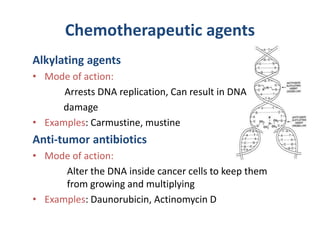
Alkylating agents
• Mode of action:
Arrests DNA replication, Can result in DNA
damage
• Examples: Carmustine, mustine
Anti-tumor antibiotics
• Mode of action:
Alter the DNA inside cancer cells to keep them
from growing and multiplying
• Examples: Daunorubicin, Actinomycin D
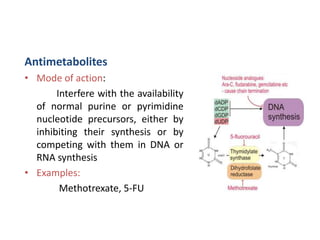
Antimetabolites
• Mode of action:
Interfere with the availability
of normal purine or pyrimidine
nucleotide precursors, either by
inhibiting their synthesis or by
competing with them in DNA or
RNA synthesis
• Examples:
Methotrexate, 5-FU
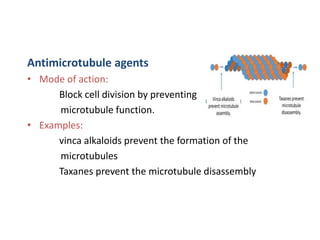
Antimicrotubule agents
• Mode of action:
Block cell division by preventing
microtubule function.
• Examples:
vinca alkaloids prevent the formation of the
microtubules
Taxanes prevent the microtubule disassembly
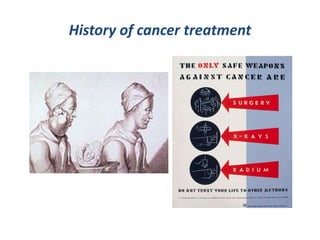
History of cancer treatment
The Early Period of Cancer Drug
Development(1900-1950)
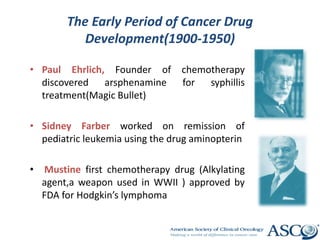
• Paul Ehrlich, Founder of chemotherapy
discovered arsphenamine for syphillis
treatment(Magic Bullet)
• Sidney Farber worked on remission of
pediatric leukemia using the drug aminopterin
• Mustine first chemotherapy drug (Alkylating
agent,a weapon used in WWII ) approved by
FDA for Hodgkin’s lymphoma
The 1950’s
• 5-fluorouracil becomes mainstay of
chemotherapy for colorectal cancer
• NCI demonstrated “combination
chemotherapy” for remission of acute
leukemia
The 1960’s
• First effective chemotherapy was found for men with
advanced testicular cancer( Actinomycin D, Methotrexate,
chlorambucil)
• FDA approved two “microtubule drugs” vinblastine and
vincristine for leukemia
• Central nervous system was treated with radiation and
intrathecal therapy helps achieve first long term cure for
the common childhood leukemia
The 1970’s-Golden era
• Regarded as the age of Adjuvant chemotherapy
• High-dose methotrexate /Leucovorin rescue therapy
results in significant tumor shrinkage ( almost 75% of cases)
• First promising chemotherapy drug carmustine (cross blood-
brain barrier) was reported for glioma
• Doxorubicin was reported active against advanced breast
cancer and FDA approved it for combination chemotherapy
• Doxorubicin was found effective for liver cancer
• Tamoxifen received initial FDA approval for breast cancer
but for women having tumor of estrogen and progesteron
• FDA approved the first chemotherapy drug Cisplatin for
bladder cancer
• First effective combination chemotherapy regimen for
ovarian cancer was developed but had more side
effects(methotrexate, vinblastine, doxorubicin, and
cisplatin)
The 1980’s
• Combination chemotherapy was reported to improve
outcomes for stomach cancer and bladder cancer
• 5-fluorouracil Chemotherapy plus radiation were
investigated to be effective for patients of Pancreatic Cancer
• Hormone therapy drugs introduced slower Prostate Cancer
• Neo- Adjuvant chemotherapy was demonstrated to avoid
amputation in children with bone cancer
• FDA approved carboplatin for ovarian cancer
The 1990’s
•New chemotherapy Topotecan (Hycamptin) drug for
advanced ovarian cancer
•Gemcitabine was found to modestly extend survival, relieve
symptoms with advanced pancreatic cancer
•New chemo-radiation therapy offers alternative to surgery
for advanced disease
•Surgery was found to cure some patients with advanced
colorectal cancer
• Oral chemotherapy drug, capecitabine, approved for
advanced breast cancer
• New oral chemotherapy drug, temozolomide, increases
glioma survival
• FDA approved liposomal doxorubicin for advanced ovarian
cancer
Early 21st Century
• New class of drugs aromatase inhibitors were introduced
• Direct chemotherapy approach increased the survival of
cancerous patients
• Addition of an arsenic compound found to improve survival
for rare form of leukemia
• Taxane therapy improves survival for several types of
advanced head and neck cancers
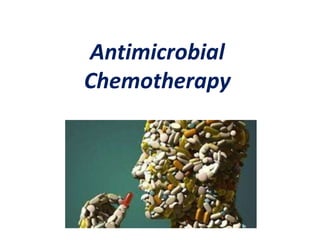
Antimicrobial
Chemotherapy
Introduction
• Clinical application of antimicrobial agents to treat infectious
diseases e.g. influenza, cholera, TB.
• The antimicrobial agents may be extracted from natural
substances or can be produced synthetically.
• Drugs are given in particular doses according to type and
severity of infection.
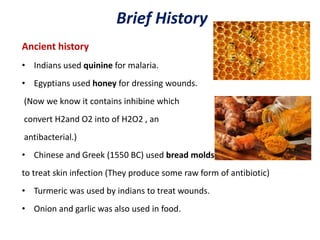
Brief History
Ancient history
• Indians used quinine for malaria.
• Egyptians used honey for dressing wounds.
(Now we know it contains inhibine which
convert H2and O2 into of H2O2 , an
antibacterial.)
• Chinese and Greek (1550 BC) used bread molds
to treat skin infection (They produce some raw form of antibiotic)
• Turmeric was used by indians to treat wounds.
• Onion and garlic was also used in food.
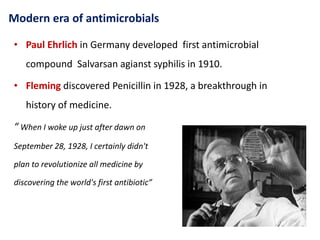
Modern era of antimicrobials
• Paul Ehrlich in Germany developed first antimicrobial
compound Salvarsan agianst syphilis in 1910.
• Fleming discovered Penicillin in 1928, a breakthrough in
history of medicine.
“ When I woke up just after dawn on
September 28, 1928, I certainly didn't
plan to revolutionize all medicine by
discovering the world's first antibiotic”
• In 1935, German biochemist Gerhard Domagk developed the
first sulfonamide, a synthetic and the first commercially
available drug In name of Prontosil.
Selective toxicity
• Antimicrobials are based on concept of selective
toxicity.
• Ability of a drug to injure a target cell or organism
without injuring other cells or organisms that are in
intimate contact .
Reasons of selective toxicity
1- Drug accumulates in microbe more than in human cells.
2- Drug is targeted against particular feature of microbe not
present in host.
• E.g penicillin inhibits peptidoglycan synthesis in the cell wall.
Humans don’t have a cell wall nor peptidoglycan
• Streptomycin target bacterial protein synthesis because
bacterial ribosomes (70S ) are different from the ribosomes
(80S) of humans and other eukaryotic organisms.
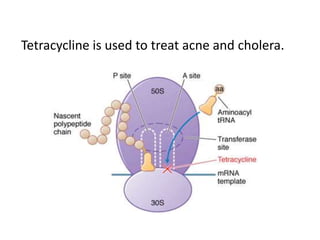
Tetracycline is used to treat acne and cholera.
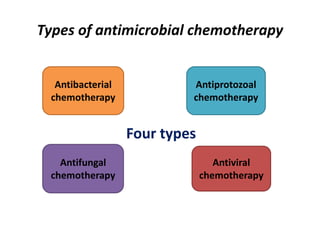
Types of antimicrobial chemotherapy
Antibacterial
chemotherapy
Antifungal
chemotherapy
Antiviral
chemotherapy
Antiprotozoal
chemotherapy
Four types
Antibacterial drugs
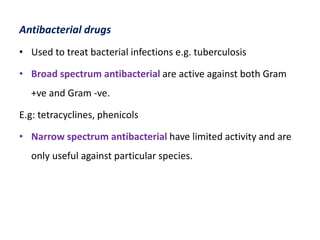
• Used to treat bacterial infections e.g. tuberculosis
• Broad spectrum antibacterial are active against both Gram
+ve and Gram -ve.
E.g: tetracyclines, phenicols
• Narrow spectrum antibacterial have limited activity and are
only useful against particular species.
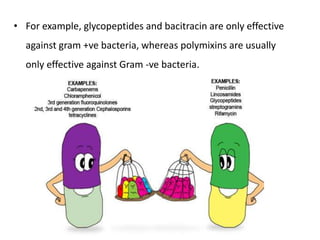
• For example, glycopeptides and bacitracin are only effective
against gram +ve bacteria, whereas polymixins are usually
only effective against Gram -ve bacteria.
• Antiviral drugs
To stop development of virus in host. E.g. HIV, influenza, herpes
simplex
Acyclovir, amantadine
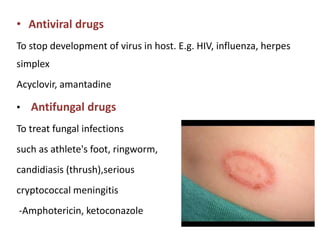
• Antifungal drugs
To treat fungal infections
such as athlete's foot, ringworm,
candidiasis (thrush),serious
cryptococcal meningitis
-Amphotericin, ketoconazole
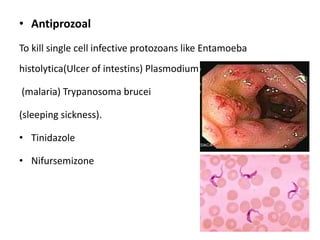
• Antiprozoal
To kill single cell infective protozoans like Entamoeba
histolytica(Ulcer of intestins) Plasmodium
(malaria) Trypanosoma brucei
(sleeping sickness).
• Tinidazole
• Nifursemizone
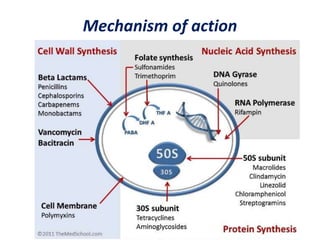
Mechanism of action
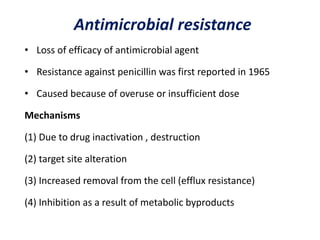
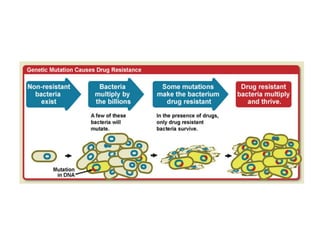
Antimicrobial resistance
• Loss of efficacy of antimicrobial agent
• Resistance against penicillin was first reported in 1965
• Caused because of overuse or insufficient dose
Mechanisms
(1) Due to drug inactivation , destruction
(2) target site alteration
(3) Increased removal from the cell (efflux resistance)
(4) Inhibition as a result of metabolic byproducts
Antimicrobial chemotherapy

Antimicrobial chemotherapy

  • 1.
    History of Chemotherapy Antimicrobialchemotherapy Presented by: Bushra Arif (11) Farah Arooj (4)
  • 2.
    Chemotherapy Chemotherapy is definedas “treatment of disease by means of chemicals that have a specific toxic effect upon the disease producing microorganisms or that selectively destroy cancerous tissue” According to American Cancer Society “the use of medicines or drugs to treat cancer”
  • 3.
    Chemotherapeutic agents Alkylating agents •Mode of action: Arrests DNA replication, Can result in DNA damage • Examples: Carmustine, mustine Anti-tumor antibiotics • Mode of action: Alter the DNA inside cancer cells to keep them from growing and multiplying • Examples: Daunorubicin, Actinomycin D
  • 4.
    Antimetabolites • Mode ofaction: Interfere with the availability of normal purine or pyrimidine nucleotide precursors, either by inhibiting their synthesis or by competing with them in DNA or RNA synthesis • Examples: Methotrexate, 5-FU
  • 5.
    Antimicrotubule agents • Modeof action: Block cell division by preventing microtubule function. • Examples: vinca alkaloids prevent the formation of the microtubules Taxanes prevent the microtubule disassembly
  • 6.
  • 7.
    The Early Periodof Cancer Drug Development(1900-1950) • Paul Ehrlich, Founder of chemotherapy discovered arsphenamine for syphillis treatment(Magic Bullet) • Sidney Farber worked on remission of pediatric leukemia using the drug aminopterin • Mustine first chemotherapy drug (Alkylating agent,a weapon used in WWII ) approved by FDA for Hodgkin’s lymphoma
  • 8.
    The 1950’s • 5-fluorouracilbecomes mainstay of chemotherapy for colorectal cancer • NCI demonstrated “combination chemotherapy” for remission of acute leukemia
  • 9.
    The 1960’s • Firsteffective chemotherapy was found for men with advanced testicular cancer( Actinomycin D, Methotrexate, chlorambucil) • FDA approved two “microtubule drugs” vinblastine and vincristine for leukemia • Central nervous system was treated with radiation and intrathecal therapy helps achieve first long term cure for the common childhood leukemia
  • 10.
    The 1970’s-Golden era •Regarded as the age of Adjuvant chemotherapy • High-dose methotrexate /Leucovorin rescue therapy results in significant tumor shrinkage ( almost 75% of cases) • First promising chemotherapy drug carmustine (cross blood- brain barrier) was reported for glioma • Doxorubicin was reported active against advanced breast cancer and FDA approved it for combination chemotherapy
  • 11.
    • Doxorubicin wasfound effective for liver cancer • Tamoxifen received initial FDA approval for breast cancer but for women having tumor of estrogen and progesteron • FDA approved the first chemotherapy drug Cisplatin for bladder cancer • First effective combination chemotherapy regimen for ovarian cancer was developed but had more side effects(methotrexate, vinblastine, doxorubicin, and cisplatin)
  • 12.
    The 1980’s • Combinationchemotherapy was reported to improve outcomes for stomach cancer and bladder cancer • 5-fluorouracil Chemotherapy plus radiation were investigated to be effective for patients of Pancreatic Cancer • Hormone therapy drugs introduced slower Prostate Cancer • Neo- Adjuvant chemotherapy was demonstrated to avoid amputation in children with bone cancer • FDA approved carboplatin for ovarian cancer
  • 13.
    The 1990’s •New chemotherapyTopotecan (Hycamptin) drug for advanced ovarian cancer •Gemcitabine was found to modestly extend survival, relieve symptoms with advanced pancreatic cancer •New chemo-radiation therapy offers alternative to surgery for advanced disease •Surgery was found to cure some patients with advanced colorectal cancer
  • 14.
    • Oral chemotherapydrug, capecitabine, approved for advanced breast cancer • New oral chemotherapy drug, temozolomide, increases glioma survival • FDA approved liposomal doxorubicin for advanced ovarian cancer
  • 15.
    Early 21st Century •New class of drugs aromatase inhibitors were introduced • Direct chemotherapy approach increased the survival of cancerous patients • Addition of an arsenic compound found to improve survival for rare form of leukemia • Taxane therapy improves survival for several types of advanced head and neck cancers
  • 16.
  • 17.
    Introduction • Clinical applicationof antimicrobial agents to treat infectious diseases e.g. influenza, cholera, TB. • The antimicrobial agents may be extracted from natural substances or can be produced synthetically. • Drugs are given in particular doses according to type and severity of infection.
  • 18.
    Brief History Ancient history •Indians used quinine for malaria. • Egyptians used honey for dressing wounds. (Now we know it contains inhibine which convert H2and O2 into of H2O2 , an antibacterial.) • Chinese and Greek (1550 BC) used bread molds to treat skin infection (They produce some raw form of antibiotic) • Turmeric was used by indians to treat wounds. • Onion and garlic was also used in food.
  • 19.
    Modern era ofantimicrobials • Paul Ehrlich in Germany developed first antimicrobial compound Salvarsan agianst syphilis in 1910. • Fleming discovered Penicillin in 1928, a breakthrough in history of medicine. “ When I woke up just after dawn on September 28, 1928, I certainly didn't plan to revolutionize all medicine by discovering the world's first antibiotic”
  • 20.
    • In 1935,German biochemist Gerhard Domagk developed the first sulfonamide, a synthetic and the first commercially available drug In name of Prontosil.
  • 21.
    Selective toxicity • Antimicrobialsare based on concept of selective toxicity. • Ability of a drug to injure a target cell or organism without injuring other cells or organisms that are in intimate contact .
  • 22.
    Reasons of selectivetoxicity 1- Drug accumulates in microbe more than in human cells. 2- Drug is targeted against particular feature of microbe not present in host. • E.g penicillin inhibits peptidoglycan synthesis in the cell wall. Humans don’t have a cell wall nor peptidoglycan • Streptomycin target bacterial protein synthesis because bacterial ribosomes (70S ) are different from the ribosomes (80S) of humans and other eukaryotic organisms.
  • 23.
    Tetracycline is usedto treat acne and cholera.
  • 24.
    Types of antimicrobialchemotherapy Antibacterial chemotherapy Antifungal chemotherapy Antiviral chemotherapy Antiprotozoal chemotherapy Four types
  • 25.
    Antibacterial drugs • Usedto treat bacterial infections e.g. tuberculosis • Broad spectrum antibacterial are active against both Gram +ve and Gram -ve. E.g: tetracyclines, phenicols • Narrow spectrum antibacterial have limited activity and are only useful against particular species.
  • 26.
    • For example,glycopeptides and bacitracin are only effective against gram +ve bacteria, whereas polymixins are usually only effective against Gram -ve bacteria.
  • 27.
    • Antiviral drugs Tostop development of virus in host. E.g. HIV, influenza, herpes simplex Acyclovir, amantadine • Antifungal drugs To treat fungal infections such as athlete's foot, ringworm, candidiasis (thrush),serious cryptococcal meningitis -Amphotericin, ketoconazole
  • 28.
    • Antiprozoal To killsingle cell infective protozoans like Entamoeba histolytica(Ulcer of intestins) Plasmodium (malaria) Trypanosoma brucei (sleeping sickness). • Tinidazole • Nifursemizone
  • 29.
  • 30.
    Antimicrobial resistance • Lossof efficacy of antimicrobial agent • Resistance against penicillin was first reported in 1965 • Caused because of overuse or insufficient dose Mechanisms (1) Due to drug inactivation , destruction (2) target site alteration (3) Increased removal from the cell (efflux resistance) (4) Inhibition as a result of metabolic byproducts

Editor's Notes

  • #3 Originally chemotherapy referred to treatment of disease with drugs or chemical • but by mid 1950’s the term was only being used primarily in reference to drugs which were used to treat cancer.
  • #7 Tumor cured in 1689 via surgery Poster in 1938 for cancer treatment
  • #8 Syphilis  a sexually transmitted infection caused by the bacteriumTreponema pallidum subspecies pallidum. Magic Bullet: Ehrlich postulated that it would be possible to find chemicals that were selectively toxic for parasites but not toxic to humans leukemia a malignant progressive disease in which the bone marrow and other blood-forming organs produce increased numbers of immature or abnormal leucocytes. These suppress the production of normal blood cells, leading to anaemia and other symptoms Hodgkin’s lymphoma: cancer originates from a specific type of white blood cells called lymphocytes
  • #10 Vinblastine is a vinca alkaloid and a chemical analogue of vincristine. It bindstubulin, thereby inhibiting the assembly of microtubules. Vinblastine treatment causes M phase specific cell cycle arrest by disrupting microtubule assembly and proper formation of the mitotic spindle and the kinetochore, each of which are necessary for the separation of chromosomes during anaphase of mitosis
  • #11 Adjuvant (meaning “in addition to”) chemotherapy refers to medicines administered after surgery for the treatment of cancer. Adjuvant chemotherapy is designed to prevent recurrence of the disease, particularly distant recurrence. Your doctors may recommend chemotherapy if your breast cancer is invasive, has unfavorable prognostic factors, is a certain size, or has spread to nearby lymph nodes. High-dose methotrexate/Leucovorin rescue therapy is based on the assumption of differences in the transport system for folate compounds between normal and malignant proliferating cells. Thus, under normal conditions, methotrexate (MTX) and Leucovorin (citrovorum factor, CF) in low doses can enter the cells by an active transport system, whereas in some malignancies - such as osteosarcoma - these substances only penetrate through the cell membrane by passive diffusion if they are given in very high doses. Therefore, after high-dose MTX treatment, the cytotoxic effect of the folate antagonist is compensated for by rescue with Leucovorin in low doses only in the normal cell system. The consequence of this kind of treatment is a selective antitumor effect
  • #12 course of therapy
  • #28 systemic infections such as