Ocular AAnnttii--aalllleerrggyy DDrruuggss 
RRaajjuu KKaaiittii 
OOppttoommeettrriisstt 
DDhhuulliikkhheell HHoossppiittaall,, KKaatthhmmaanndduu UUnniivveerrssiittyy HHoossppiittaall
๏ฌ Release of histamine, prostaglandins, leukotriene and other 
less well-defined mediators from the mast cell during an 
allergic reaction can cause a variety of uncomfortable 
symptoms and sometimes life threatening complications. 
๏ฌ Type 1 hypersensitivity reactions/anaphylactic/immediate or 
IgE mediated reactions 
๏ฌ First antigen exposure-IgE antibodies produced and attach 
to mast cells 
๏ฌ Second exposure to the same-Degranulation of mast cells 
๏ฌ Release of large quantities of inflammatory mediators 
including histamine
๏‚ง Histamine activates H1 receptors on blood vessels-vasodilation- 
Leakage of fluid-swelling of tissues-Redness, swelling and 
itching 
๏‚ง In Hay fever, allergic conjunctivitis, vernal conjunctivitis, atopic 
conjunctivitis, GPC, asthma, bee stings, toxin sensitivities 
Treatments: 
๏‚ง Based on the symptoms, severity & characteristics. 
๏‚ง Begins with eliminating & avoiding the allergen. 
๏‚ง Lubricating drops may wash away the allergen. 
๏‚ง Drug intervention required.
Main classes of anti-allergy drugs 
1. Ocular Decongestants 
2. Antihistamines 
3. Mast Cell Stabilizers 
4. NSAIDS 
5. Corticosteroids 
6. Other โ€œsideโ€ ingredients 
1.Ocular Decongestants 
๏ฌ Cost effective choice for mild allergies 
๏ฌ Use with cold compresses 
๏ฌ Artificial tears necessary 
๏ฌ Local vasoconstrictor, temporarily reduces redness 
๏ฌ Does not treat โ€œitchingโ€ 
๏ฌ Four alpha-agonists available
Ocular Decongestants 
๏ฌ Phenylephrine 0.12% and 0.125% 
๏ฌ Naphazoline (0.012%, 0.05%, 0.1%) 
๏ฌ Tetrahydrozoline(0.05%) Imidazole derivatives 
๏ฌ Oxymetazoline(0.025%) 
๏ฌ All constrict superficial conjunctival vessels within minutes 
๏ฌ Prolonged and excessive use causes rebound conjunctival 
hyperemia
HHiissttaammiinnee RReecceeppttoorrss 
Based on the chemical structure of antihistamine that bind to the receptor 
& on the type of histamine antagonist. 
๏‚ง 3 types: 
๏‚ง H1, H2 & H3 
๏‚ง H1 receptors located mainly on neuronal tissues and results in itching. 
๏‚ง H2 receptors associated with vascular tissue & results in redness. 
๏‚ง H3 receptors not clinically significant. 
๏‚ง In ocular therapy, mainly H1 antihistamines are applicable. 
๏‚ง H1 antihistamines prevent histamine-H1 receptor interaction 
๏‚ง Thus providing symptomatic relief from histamine activity.
2.Anti-histamines- ocular 
๏‚ง Reduces itching caused from already released histamine from mast cells 
and basophils 
๏‚ง Blocks H1 receptors which control 
๏‚ง Itching 
๏‚ง Capillary dilation 
๏‚ง Increase in capillary permeability 
๏‚ง Almost always combined with ocular decongestant 
๏‚ง Chlorpheniramine (does not work as well topically) 
๏‚ง Drugs available 
๏‚ง Levocabastine HCl ophthalmic suspension .05% (Livostin) 
๏‚ง Emedastine difumarate 0.05% (Emadine) 
๏‚ง All QID dosing for 2 weeks
Levocabastine 
๏‚ง Highly specific H1 receptor antagonist 
๏‚ง 1st antihistamine without a decongestant 
๏‚ง Available as 0.05% suspension. Dosage: 4 times a day 
๏‚ง Emedastine & azelastine are selective H1 receptor antagonists. 
๏‚ง Also inhibit histamine release from mast cells 
๏‚ง Emedastine (0.05% solution) significant reduces itching & redness in 10 
minutes of instillation. 
๏‚ง Dosage: 4 times per day. For patients above 3 years of age.
3.Chronic Care Drugs: Mast cell stabilizers 
โ€ข Stabilizes mast cell membranes and inhibits degranulation of mast cells 
โ€ข Not effective in acute disease 
โ€ข Preventive and maintenance therapy 
โ€ข Must be used regularly for better performance 
โ€ข VERY, VERY safe 
โ€ข First generation (older) 
โ€ข Cromolyn Sodium (Sodium cromoglycate) 4% -BD 
โ€ข Lodoxaminde 0.1%
Chronic Care Drugs: Mast cell stabilizers 
โ€ข Second generation- BD dosing, same efficacy as first generation 
โ€ข Pemirolast potassium 0.1% (Alamast) 
โ€ข Nedocromil sodium 2% (Alocril) 
โ€ข Pearls to remember: 
๏ƒ˜ Drug of choice for 
โ€ข Vernal Disease 
โ€ข GPC 
โ€ข Chronic allergies 
โ€ข Children age 3 and above
Cromolyn Sodium 
โ€ข Traditional view was that it inhibits mast cell degranulation & release of 
mediators of allergic disease by preventing calcium influx. 
โ€ข However the mast cell stabilizers containing Cromolyn may also act via 
other mechanisms. 
โ€ข Recent studies showed that it neither exhibits antihistaminic activity nor 
inhibit the interaction of IgE with corresponding antigen on the mast cell 
surface. 
โ€ข Cromolyn may also prolong the tear breakup time in patients with 
chronic conjunctivitis
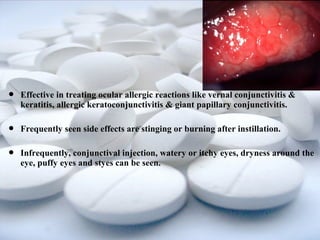
๏ฌ Effective in treating ocular allergic reactions like vernal conjunctivitis & 
keratitis, allergic keratoconjunctivitis & giant papillary conjunctivitis. 
๏ฌ Frequently seen side effects are stinging or burning after instillation. 
๏ฌ Infrequently, conjunctival injection, watery or itchy eyes, dryness around the 
eye, puffy eyes and styes can be seen.
4. Anti-histamines combined with Mast cell 
stabilizers 
๏ƒ˜ Stabilizes mast cell membranes and controls immediate itching 
๏ƒ˜ Used BD 
๏ƒ˜ Very, very successful and effective 
๏ƒ˜ Names are: 
๏ƒ˜ Olopatadine hydrochloride 0.1% (Patanol) 
๏ƒ˜ Ketotifen fumarate 0.025% (Zaditor) 
๏ƒ˜ Azelastine HCl 0.05% (Optivar)
Other drugs for ocular allergies 
๏‚ง 5.NSAIDs 
๏‚ง Ketorolac tromethamine 0.5% (Acular)- First NSAID approved for 
topical ocular use in seasonal allergic reactions 
๏‚ง It affects prostaglandin synthesis by inhibiting the activity of 
cyclooxygenase (responsible for the conversion of arachidonic acid to 
prostaglandin). 
๏‚ง Pharmacokinetic data shows that it penetrates the cornea & reaches 
concentrations that reduces prostaglandin E levels in the aqueous 
humor. 
๏‚ง Plasma level usually below detectable limit in oral administration.
๏‚ง Does not affect IOP, pupillary response or visual acuity. 
๏‚ง Used mainly in acute allergic conjunctivitis 
๏‚ง Dosage: 4 times daily 
๏‚ง Side effects 
๏‚ง Transient stinging & burning occurs frequently 
๏‚ง Allergic reactions & superficial keratitis rarely occurs. 
๏‚ง Contraindications 
๏‚ง In patients wearing contact lenses. 
๏‚ง Patient who have previously exhibited sensitivity to acetylsalicylic acid, 
phenylacetic acid derivatives & other NSAIDs.
6.Corticosteroids 
๏‚งControl of inflammatory and immunologic diseases of eye. 
๏‚งReduction in capillary permeability and cellular exudation. 
๏‚งInhibition of degranulation of mast cells, basophils and neutrophils. 
๏‚งโ€œAddedโ€ ingredients: 
๏‚ง Camphor 
๏‚ง Menthol 
๏‚งDo not underestimate the value of artificial tears and cold 
compresses!
TTHHAANNKK YYOOUU

Antiallergy drugs

  • 1.
    Ocular AAnnttii--aalllleerrggyy DDrruuggss RRaajjuu KKaaiittii OOppttoommeettrriisstt DDhhuulliikkhheell HHoossppiittaall,, KKaatthhmmaanndduu UUnniivveerrssiittyy HHoossppiittaall
  • 2.
    ๏ฌ Release ofhistamine, prostaglandins, leukotriene and other less well-defined mediators from the mast cell during an allergic reaction can cause a variety of uncomfortable symptoms and sometimes life threatening complications. ๏ฌ Type 1 hypersensitivity reactions/anaphylactic/immediate or IgE mediated reactions ๏ฌ First antigen exposure-IgE antibodies produced and attach to mast cells ๏ฌ Second exposure to the same-Degranulation of mast cells ๏ฌ Release of large quantities of inflammatory mediators including histamine
  • 3.
    ๏‚ง Histamine activatesH1 receptors on blood vessels-vasodilation- Leakage of fluid-swelling of tissues-Redness, swelling and itching ๏‚ง In Hay fever, allergic conjunctivitis, vernal conjunctivitis, atopic conjunctivitis, GPC, asthma, bee stings, toxin sensitivities Treatments: ๏‚ง Based on the symptoms, severity & characteristics. ๏‚ง Begins with eliminating & avoiding the allergen. ๏‚ง Lubricating drops may wash away the allergen. ๏‚ง Drug intervention required.
  • 4.
    Main classes ofanti-allergy drugs 1. Ocular Decongestants 2. Antihistamines 3. Mast Cell Stabilizers 4. NSAIDS 5. Corticosteroids 6. Other โ€œsideโ€ ingredients 1.Ocular Decongestants ๏ฌ Cost effective choice for mild allergies ๏ฌ Use with cold compresses ๏ฌ Artificial tears necessary ๏ฌ Local vasoconstrictor, temporarily reduces redness ๏ฌ Does not treat โ€œitchingโ€ ๏ฌ Four alpha-agonists available
  • 5.
    Ocular Decongestants ๏ฌPhenylephrine 0.12% and 0.125% ๏ฌ Naphazoline (0.012%, 0.05%, 0.1%) ๏ฌ Tetrahydrozoline(0.05%) Imidazole derivatives ๏ฌ Oxymetazoline(0.025%) ๏ฌ All constrict superficial conjunctival vessels within minutes ๏ฌ Prolonged and excessive use causes rebound conjunctival hyperemia
  • 6.
    HHiissttaammiinnee RReecceeppttoorrss Basedon the chemical structure of antihistamine that bind to the receptor & on the type of histamine antagonist. ๏‚ง 3 types: ๏‚ง H1, H2 & H3 ๏‚ง H1 receptors located mainly on neuronal tissues and results in itching. ๏‚ง H2 receptors associated with vascular tissue & results in redness. ๏‚ง H3 receptors not clinically significant. ๏‚ง In ocular therapy, mainly H1 antihistamines are applicable. ๏‚ง H1 antihistamines prevent histamine-H1 receptor interaction ๏‚ง Thus providing symptomatic relief from histamine activity.
  • 7.
    2.Anti-histamines- ocular ๏‚งReduces itching caused from already released histamine from mast cells and basophils ๏‚ง Blocks H1 receptors which control ๏‚ง Itching ๏‚ง Capillary dilation ๏‚ง Increase in capillary permeability ๏‚ง Almost always combined with ocular decongestant ๏‚ง Chlorpheniramine (does not work as well topically) ๏‚ง Drugs available ๏‚ง Levocabastine HCl ophthalmic suspension .05% (Livostin) ๏‚ง Emedastine difumarate 0.05% (Emadine) ๏‚ง All QID dosing for 2 weeks
  • 8.
    Levocabastine ๏‚ง Highlyspecific H1 receptor antagonist ๏‚ง 1st antihistamine without a decongestant ๏‚ง Available as 0.05% suspension. Dosage: 4 times a day ๏‚ง Emedastine & azelastine are selective H1 receptor antagonists. ๏‚ง Also inhibit histamine release from mast cells ๏‚ง Emedastine (0.05% solution) significant reduces itching & redness in 10 minutes of instillation. ๏‚ง Dosage: 4 times per day. For patients above 3 years of age.
  • 9.
    3.Chronic Care Drugs:Mast cell stabilizers โ€ข Stabilizes mast cell membranes and inhibits degranulation of mast cells โ€ข Not effective in acute disease โ€ข Preventive and maintenance therapy โ€ข Must be used regularly for better performance โ€ข VERY, VERY safe โ€ข First generation (older) โ€ข Cromolyn Sodium (Sodium cromoglycate) 4% -BD โ€ข Lodoxaminde 0.1%
  • 10.
    Chronic Care Drugs:Mast cell stabilizers โ€ข Second generation- BD dosing, same efficacy as first generation โ€ข Pemirolast potassium 0.1% (Alamast) โ€ข Nedocromil sodium 2% (Alocril) โ€ข Pearls to remember: ๏ƒ˜ Drug of choice for โ€ข Vernal Disease โ€ข GPC โ€ข Chronic allergies โ€ข Children age 3 and above
  • 11.
    Cromolyn Sodium โ€ขTraditional view was that it inhibits mast cell degranulation & release of mediators of allergic disease by preventing calcium influx. โ€ข However the mast cell stabilizers containing Cromolyn may also act via other mechanisms. โ€ข Recent studies showed that it neither exhibits antihistaminic activity nor inhibit the interaction of IgE with corresponding antigen on the mast cell surface. โ€ข Cromolyn may also prolong the tear breakup time in patients with chronic conjunctivitis
  • 12.
    ๏ฌ Effective intreating ocular allergic reactions like vernal conjunctivitis & keratitis, allergic keratoconjunctivitis & giant papillary conjunctivitis. ๏ฌ Frequently seen side effects are stinging or burning after instillation. ๏ฌ Infrequently, conjunctival injection, watery or itchy eyes, dryness around the eye, puffy eyes and styes can be seen.
  • 13.
    4. Anti-histamines combinedwith Mast cell stabilizers ๏ƒ˜ Stabilizes mast cell membranes and controls immediate itching ๏ƒ˜ Used BD ๏ƒ˜ Very, very successful and effective ๏ƒ˜ Names are: ๏ƒ˜ Olopatadine hydrochloride 0.1% (Patanol) ๏ƒ˜ Ketotifen fumarate 0.025% (Zaditor) ๏ƒ˜ Azelastine HCl 0.05% (Optivar)
  • 14.
    Other drugs forocular allergies ๏‚ง 5.NSAIDs ๏‚ง Ketorolac tromethamine 0.5% (Acular)- First NSAID approved for topical ocular use in seasonal allergic reactions ๏‚ง It affects prostaglandin synthesis by inhibiting the activity of cyclooxygenase (responsible for the conversion of arachidonic acid to prostaglandin). ๏‚ง Pharmacokinetic data shows that it penetrates the cornea & reaches concentrations that reduces prostaglandin E levels in the aqueous humor. ๏‚ง Plasma level usually below detectable limit in oral administration.
  • 15.
    ๏‚ง Does notaffect IOP, pupillary response or visual acuity. ๏‚ง Used mainly in acute allergic conjunctivitis ๏‚ง Dosage: 4 times daily ๏‚ง Side effects ๏‚ง Transient stinging & burning occurs frequently ๏‚ง Allergic reactions & superficial keratitis rarely occurs. ๏‚ง Contraindications ๏‚ง In patients wearing contact lenses. ๏‚ง Patient who have previously exhibited sensitivity to acetylsalicylic acid, phenylacetic acid derivatives & other NSAIDs.
  • 16.
    6.Corticosteroids ๏‚งControl ofinflammatory and immunologic diseases of eye. ๏‚งReduction in capillary permeability and cellular exudation. ๏‚งInhibition of degranulation of mast cells, basophils and neutrophils. ๏‚งโ€œAddedโ€ ingredients: ๏‚ง Camphor ๏‚ง Menthol ๏‚งDo not underestimate the value of artificial tears and cold compresses!
  • 17.

Editor's Notes

  • #6ย Rebound conjunctival hyperemia: eye becomes more red and congested as the drug effect subsides. Alpha agonists can precipitate susceptible patients to acute angle closure atacks.