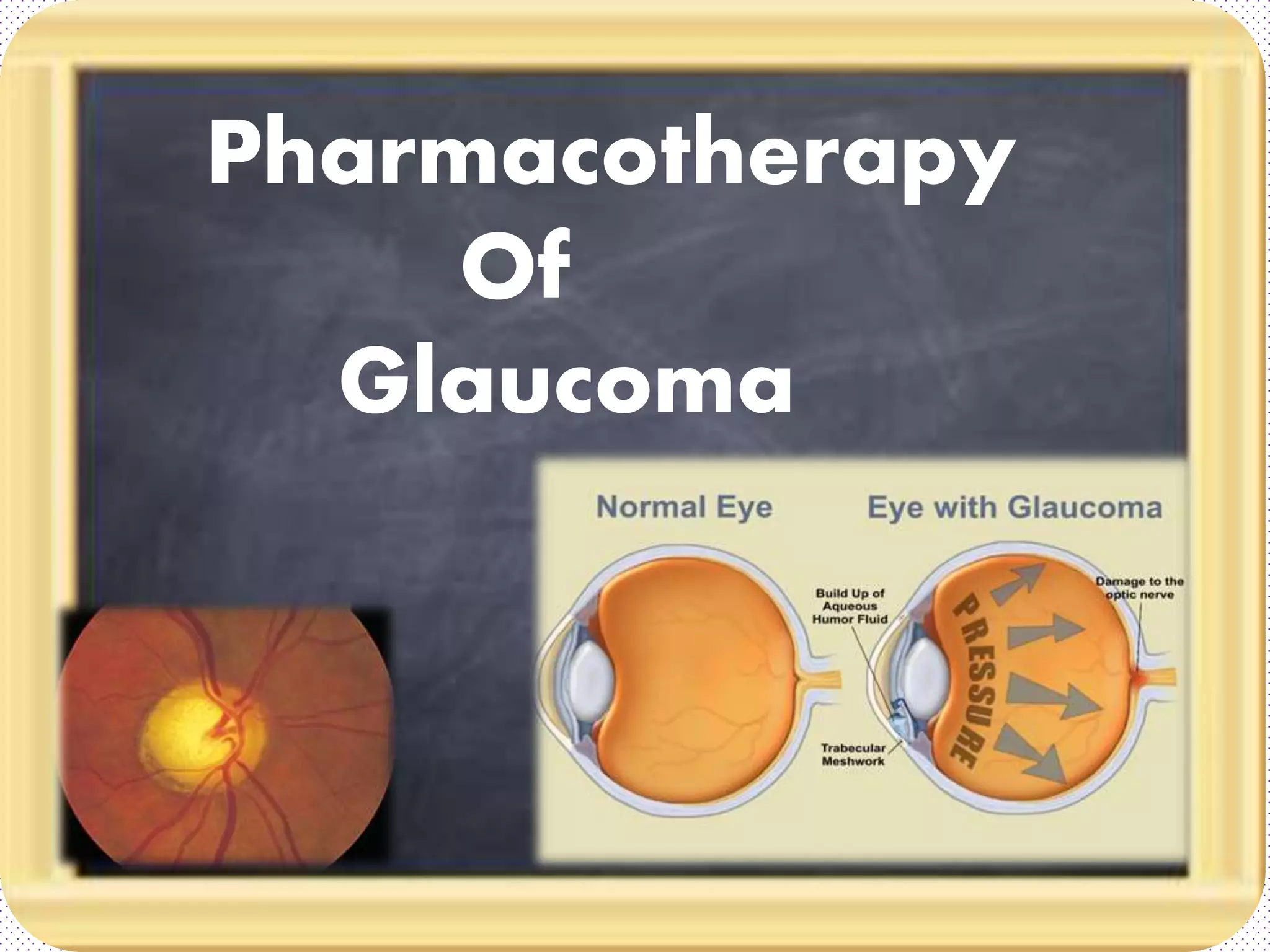

Pharmacotherapy
Of
Glaucoma
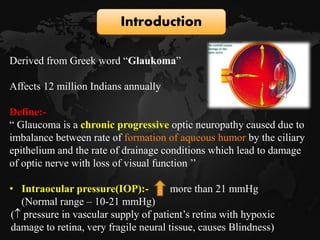
Derived from Greek word “Glaukoma”
Affects 12 million Indians annually
Define:-
“ Glaucoma is a chronic progressive optic neuropathy caused due to
imbalance between rate of formation of aqueous humor by the ciliary
epithelium and the rate of drainage conditions which lead to damage
of optic nerve with loss of visual function ’’
• Intraocular pressure(IOP):- more than 21 mmHg
(Normal range – 10-21 mmHg)
( pressure in vascular supply of patient’s retina with hypoxic
damage to retina, very fragile neural tissue, causes Blindness)
Introduction
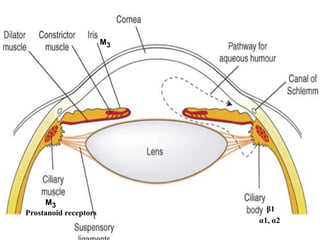
M3
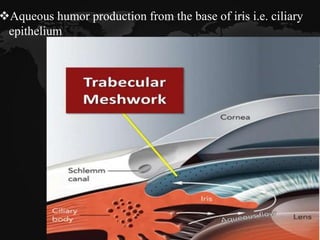
Aqueous humor production from the base of iris i.e. ciliary
epithelium
Derived from Greek word “Glaukoma”
Affects 12 million Indians annually
Define:-
“ Glaucoma is a chronic progressive optic neuropathy caused due to
imbalance between rate of formation of aqueous humor by the ciliary
epithelium and the rate of drainage conditions which lead to damage
of optic nerve with loss of visual function ’’
• Intraocular pressure(IOP):- more than 21 mmHg
(Normal range – 10-21 mmHg)
( pressure in vascular supply of patient’s retina with hypoxic
damage to retina, very fragile neural tissue, causes Blindness)
Introduction
β1
M3
M3
α1, α2
Prostanoid receptors
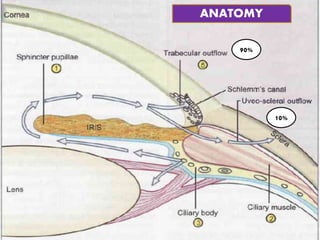
ANATOMY
90%
10%
Drainage of aqueous humor occurs by 2 routes:-
(1)Conventional route through the trabecular network
into the canal of Schlemm, it drains about 90%.
(2) Uveo-scleral pathway through the ciliary body
into the suprachoroidal space, it drains about 10%
-:Risk Factors:-
Age- above 40-45yr.
Family history of Glaucoma
Physical injuries-Eye trauma
Disease condition-
 Diabetes mellitus,
 Cataract,
 Cardiovascular disease,
 Hypothyroidism,
 Sleep apnoea,
 Sickle cell anaemia,
 Leukaemia
Drug induced-corticosteroid use, anti-histaminic drug
Emotional stress
Thin cornea
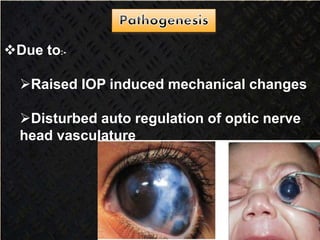
Due to:-
Raised IOP induced mechanical changes
Disturbed auto regulation of optic nerve
head vasculature
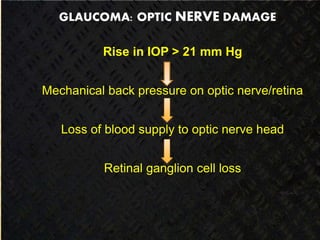
GLAUCOMA: OPTIC NERVE DAMAGE
Rise in IOP > 21 mm Hg
Mechanical back pressure on optic nerve/retina
Loss of blood supply to optic nerve head
Retinal ganglion cell loss
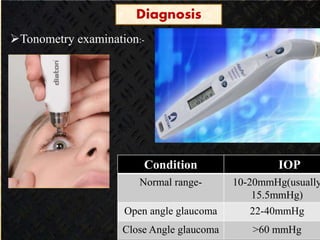
Diagnosis
Tonometry examination:-
Condition IOP
Normal range- 10-20mmHg(usually
15.5mmHg)
Open angle glaucoma 22-40mmHg
Close Angle glaucoma >60 mmHg
Drainage of aqueous humor occurs by 2 routes
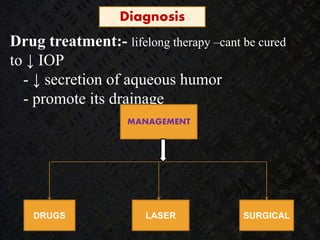
Diagnosis
Drug treatment:- lifelong therapy –cant be cured
to ↓ IOP
- ↓ secretion of aqueous humor
- promote its drainage
MANAGEMENT
DRUGS LASER SURGICAL
Drainage of aqueous humor occurs by 2 routes
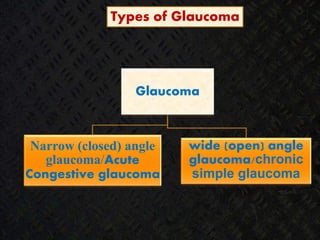
Types of Glaucoma
Glaucoma
Narrow (closed) angle
glaucoma/Acute
Congestive glaucoma
wide (open) angle
glaucoma/chronic
simple glaucoma
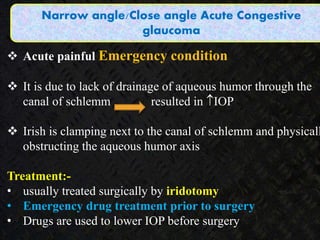
Narrow angle/Close angle Acute Congestive
glaucoma
 Acute painful Emergency condition
 It is due to lack of drainage of aqueous humor through the
canal of schlemm resulted in IOP
 Irish is clamping next to the canal of schlemm and physicall
obstructing the aqueous humor axis
Treatment:-
• usually treated surgically by iridotomy
• Emergency drug treatment prior to surgery
• Drugs are used to lower IOP before surgery
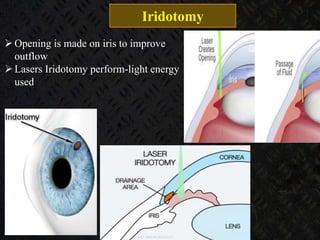
Iridotomy
Opening is made on iris to improve
outflow
Lasers Iridotomy perform-light energy
used
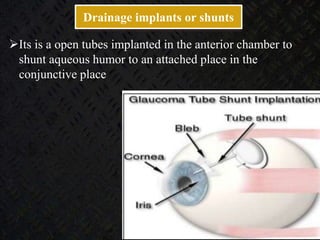
Drainage implants or shunts
Its is a open tubes implanted in the anterior chamber to
shunt aqueous humor to an attached place in the
conjunctive place
Open angle /wide angle/chronic simple)
glaucoma
 Genetically predisposed degenerative condition- mutation in
myocilin gene(GLC1A).
Progressive (painless) visual loss
untreated
Blindness
 Irido-corneal angle is normal but the patency of the trabecula
meshwork is disrupted
 Slow progressive raise of BP & usually chronic and is treated
medically
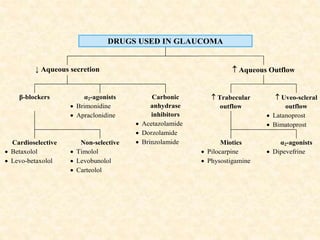
DRUGS USED IN GLAUCOMA
↓ Aqueous secretion  Aqueous Outflow
β-blockers α2-agonists
 Brimonidine
 Apraclonidine
Carbonic
anhydrase
inhibitors
 Acetazolamide
 Dorzolamide
 Brinzolamide
 Trabecular
outflow
 Uveo-scleral
outflow
 Latanoprost
 Bimatoprost
Cardioselective
 Betaxolol
 Levo-betaxolol
Non-selective
 Timolol
 Levobunolol
 Carteolol
Miotics
 Pilocarpine
 Physostigamine
α2-agonists
 Dipevefrine
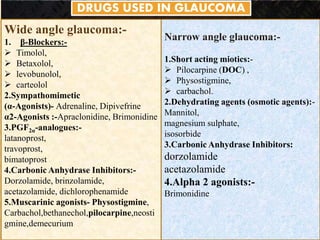
Narrow angle glaucoma:-
1.Short acting miotics:-
 Pilocarpine (DOC) ,
 Physostigmine,
 carbachol.
2.Dehydrating agents (osmotic agents):-
Mannitol,
magnesium sulphate,
isosorbide
3.Carbonic Anhydrase Inhibitors:
dorzolamide
acetazolamide
4.Alpha 2 agonists:-
Brimonidine
Wide angle glaucoma:-
1. β-Blockers:-
 Timolol,
 Betaxolol,
 levobunolol,
 carteolol
2.Sympathomimetic
(α-Agonists)- Adrenaline, Dipivefrine
α2-Agonists :-Apraclonidine, Brimonidine
3.PGF2α-analogues:-
latanoprost,
travoprost,
bimatoprost
4.Carbonic Anhydrase Inhibitors:-
Dorzolamide, brinzolamide,
acetazolamide, dichlorophenamide
5.Muscarinic agonists- Physostigmine,
Carbachol,bethanechol,pilocarpine,neosti
gmine,demecurium
DRUGS USED IN GLAUCOMA
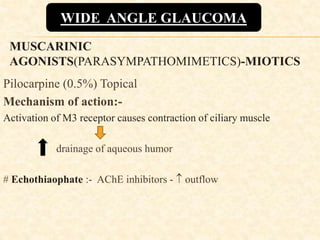
MUSCARINIC
AGONISTS(PARASYMPATHOMIMETICS)-MIOTICS
Pilocarpine (0.5%) Topical
Mechanism of action:-
Activation of M3 receptor causes contraction of ciliary muscle
drainage of aqueous humor
# Echothiaophate :- AChE inhibitors -  outflow
WIDE ANGLE GLAUCOMA
 SE:-
 diminished vision
 headache, brow pain
 spasm of accommodation
Current status:- several drawbacks they are now used
only as the last option
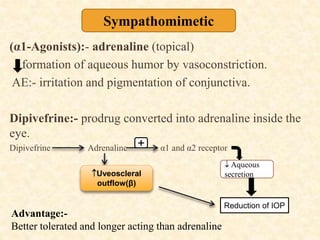
(α1-Agonists):- adrenaline (topical)
formation of aqueous humor by vasoconstriction.
AE:- irritation and pigmentation of conjunctiva.
Dipivefrine:- prodrug converted into adrenaline inside the
eye.
Dipivefrine Adrenaline α1 and α2 receptor
Sympathomimetic
+
 Aqueous
secretion
Reduction of IOP
Advantage:-
Better tolerated and longer acting than adrenaline
Uveoscleral
outflow(β)
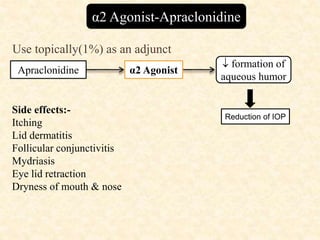
Use topically(1%) as an adjunct
α2 Agonist-Apraclonidine
Reduction of IOP
Side effects:-
Itching
Lid dermatitis
Follicular conjunctivitis
Mydriasis
Eye lid retraction
Dryness of mouth & nose
Apraclonidine α2 Agonist
 formation of
aqueous humor
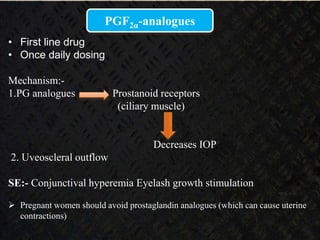
PGF2α-analogues
• First line drug
• Once daily dosing
Mechanism:-
1.PG analogues Prostanoid receptors
(ciliary muscle)
Decreases IOP
2. Uveoscleral outflow
SE:- Conjunctival hyperemia Eyelash growth stimulation
 Pregnant women should avoid prostaglandin analogues (which can cause uterine
contractions)
 Once daily administration in evening
 Potent IOP lowering effect
 Mean IOP reduction(by 25-35%)
Advantage:-
good efficacy
once daily application
absence of systemic complications
PG-analogues have become the first choice drugs in
developed countries
 Non-selective - Timolol maleate
Levobunolol
Metipranolol
Carteolol
 Selective β1-blocker - Betaxolol
-blockers
Drugs:-
Timolol(0.5% topical),
Betaxolol,
carteolol ,
levobunolol,
 (betaxolol, timolol) having neuroprotective action
β-blockers blunt the ganglion cell death in glaucoma .eg-
Levobetaxolol
People with asthma should avoid beta-blockers and
parasympathomimetics (which can cause bronchospasm)
Advantages over miotics:-
no change in pupil size –
no headache
no fluctuations in i.o.p
once / twice daily administration
Mechanism:-
block β-receptors in ciliary body
↓c-AMP aqueous humor
 Integral part of glaucoma management
 2nd line medication
 Work well when added to prostaglandins
 If twice daily dosing required early
morning and then 12 hrs later
Use in clinical practice
BETAXOLOL
 Selective β1 - blocker
 Less likely to cause bronchospasm
 Less likely to cause systemic side effects
 Neuroprotective effect- Ca⁺⁺-channel blocker
effect
1. Topical – Dorzolamide , Brinzolamide
2. Oral – Acetazolamide, Methazolamide
Mechanism:-
These drugs inhibit carbonic anhydrase enzyme
Reduces formation of HCO₃⁻
IOP reduction
Carbonic anhydrase inhibitors
 Malaise, fatigue, nausea, loss of appetite, taste
alteration
 Confusion, drowsiness, hearing dysfunction
 Renal stones & polyuria
 Hyponatremia
 Hypokalemia
 Severe kidney or liver dysfunction
 Adrenal gland failure
 Hyperchloremic alkalosis
 Pregnancy-teratogenic effect
Adverse Effect:-
Contraindication:-
 Short acting miotics:-
pilocarpine (drug of choice) , physostigmine, carbachol.
 Carbonic Anhydrase Inhibitors: given locally as
dorzolamide or orally as acetazolamide
 Alpha 2 agonists as Brimonidine.
 osmotic agents :- Mannitol , Urea
 Mannitol – i.v 1.5-2g/Kg infusion over 30min
 Urea – i.v 1-1.5g/Kg slow infusion
CLOSED ANGLE GLAUCOMA
Note:-
 Avoid mydriatics in closed angle glaucoma.(Q).
 Recently Beta blockers are used with pilocarpine.
Drugs Contraindicated in Glaucoma:
 Antimuscarinic drugs:- atropine, hyoscine, and synthetic
substitutes homatropine, tropicamide, and cyclopentolate.

 Ganglion blockers:-e.g trimethaphan.
 Drugs with atropine- like action: 1st-generation
antihistaminics-
 antiarrhythmic drugs-Disopyramide
 Tricyclic antidepressants-Phenothiazine antipsychotics
 Glucocorticoids: such as cortisol, may also cause cataract.
 Vasodilators: as nitrates and fenoldopam.
 Succinylcholine: depolarizing neuro-muscular blocker.
THANK YOU

Pharmacotherapy of glaucoma

  • 1.
  • 2.
    Derived from Greekword “Glaukoma” Affects 12 million Indians annually Define:- “ Glaucoma is a chronic progressive optic neuropathy caused due to imbalance between rate of formation of aqueous humor by the ciliary epithelium and the rate of drainage conditions which lead to damage of optic nerve with loss of visual function ’’ • Intraocular pressure(IOP):- more than 21 mmHg (Normal range – 10-21 mmHg) ( pressure in vascular supply of patient’s retina with hypoxic damage to retina, very fragile neural tissue, causes Blindness) Introduction M3
  • 3.
    Aqueous humor productionfrom the base of iris i.e. ciliary epithelium
  • 4.
    Derived from Greekword “Glaukoma” Affects 12 million Indians annually Define:- “ Glaucoma is a chronic progressive optic neuropathy caused due to imbalance between rate of formation of aqueous humor by the ciliary epithelium and the rate of drainage conditions which lead to damage of optic nerve with loss of visual function ’’ • Intraocular pressure(IOP):- more than 21 mmHg (Normal range – 10-21 mmHg) ( pressure in vascular supply of patient’s retina with hypoxic damage to retina, very fragile neural tissue, causes Blindness) Introduction β1 M3 M3 α1, α2 Prostanoid receptors
  • 5.
  • 6.
    Drainage of aqueoushumor occurs by 2 routes:- (1)Conventional route through the trabecular network into the canal of Schlemm, it drains about 90%. (2) Uveo-scleral pathway through the ciliary body into the suprachoroidal space, it drains about 10%
  • 7.
    -:Risk Factors:- Age- above40-45yr. Family history of Glaucoma Physical injuries-Eye trauma Disease condition-  Diabetes mellitus,  Cataract,  Cardiovascular disease,  Hypothyroidism,  Sleep apnoea,  Sickle cell anaemia,  Leukaemia Drug induced-corticosteroid use, anti-histaminic drug Emotional stress Thin cornea
  • 8.
    Due to:- Raised IOPinduced mechanical changes Disturbed auto regulation of optic nerve head vasculature
  • 9.
    GLAUCOMA: OPTIC NERVEDAMAGE Rise in IOP > 21 mm Hg Mechanical back pressure on optic nerve/retina Loss of blood supply to optic nerve head Retinal ganglion cell loss
  • 10.
    Diagnosis Tonometry examination:- Condition IOP Normalrange- 10-20mmHg(usually 15.5mmHg) Open angle glaucoma 22-40mmHg Close Angle glaucoma >60 mmHg
  • 11.
    Drainage of aqueoushumor occurs by 2 routes Diagnosis Drug treatment:- lifelong therapy –cant be cured to ↓ IOP - ↓ secretion of aqueous humor - promote its drainage MANAGEMENT DRUGS LASER SURGICAL
  • 12.
    Drainage of aqueoushumor occurs by 2 routes Types of Glaucoma Glaucoma Narrow (closed) angle glaucoma/Acute Congestive glaucoma wide (open) angle glaucoma/chronic simple glaucoma
  • 13.
    Narrow angle/Close angleAcute Congestive glaucoma  Acute painful Emergency condition  It is due to lack of drainage of aqueous humor through the canal of schlemm resulted in IOP  Irish is clamping next to the canal of schlemm and physicall obstructing the aqueous humor axis Treatment:- • usually treated surgically by iridotomy • Emergency drug treatment prior to surgery • Drugs are used to lower IOP before surgery
  • 14.
    Iridotomy Opening is madeon iris to improve outflow Lasers Iridotomy perform-light energy used
  • 15.
    Drainage implants orshunts Its is a open tubes implanted in the anterior chamber to shunt aqueous humor to an attached place in the conjunctive place
  • 16.
    Open angle /wideangle/chronic simple) glaucoma  Genetically predisposed degenerative condition- mutation in myocilin gene(GLC1A). Progressive (painless) visual loss untreated Blindness  Irido-corneal angle is normal but the patency of the trabecula meshwork is disrupted  Slow progressive raise of BP & usually chronic and is treated medically
  • 18.
    DRUGS USED INGLAUCOMA ↓ Aqueous secretion  Aqueous Outflow β-blockers α2-agonists  Brimonidine  Apraclonidine Carbonic anhydrase inhibitors  Acetazolamide  Dorzolamide  Brinzolamide  Trabecular outflow  Uveo-scleral outflow  Latanoprost  Bimatoprost Cardioselective  Betaxolol  Levo-betaxolol Non-selective  Timolol  Levobunolol  Carteolol Miotics  Pilocarpine  Physostigamine α2-agonists  Dipevefrine
  • 19.
    Narrow angle glaucoma:- 1.Shortacting miotics:-  Pilocarpine (DOC) ,  Physostigmine,  carbachol. 2.Dehydrating agents (osmotic agents):- Mannitol, magnesium sulphate, isosorbide 3.Carbonic Anhydrase Inhibitors: dorzolamide acetazolamide 4.Alpha 2 agonists:- Brimonidine Wide angle glaucoma:- 1. β-Blockers:-  Timolol,  Betaxolol,  levobunolol,  carteolol 2.Sympathomimetic (α-Agonists)- Adrenaline, Dipivefrine α2-Agonists :-Apraclonidine, Brimonidine 3.PGF2α-analogues:- latanoprost, travoprost, bimatoprost 4.Carbonic Anhydrase Inhibitors:- Dorzolamide, brinzolamide, acetazolamide, dichlorophenamide 5.Muscarinic agonists- Physostigmine, Carbachol,bethanechol,pilocarpine,neosti gmine,demecurium DRUGS USED IN GLAUCOMA
  • 20.
    MUSCARINIC AGONISTS(PARASYMPATHOMIMETICS)-MIOTICS Pilocarpine (0.5%) Topical Mechanismof action:- Activation of M3 receptor causes contraction of ciliary muscle drainage of aqueous humor # Echothiaophate :- AChE inhibitors -  outflow WIDE ANGLE GLAUCOMA
  • 21.
     SE:-  diminishedvision  headache, brow pain  spasm of accommodation Current status:- several drawbacks they are now used only as the last option
  • 22.
    (α1-Agonists):- adrenaline (topical) formationof aqueous humor by vasoconstriction. AE:- irritation and pigmentation of conjunctiva. Dipivefrine:- prodrug converted into adrenaline inside the eye. Dipivefrine Adrenaline α1 and α2 receptor Sympathomimetic +  Aqueous secretion Reduction of IOP Advantage:- Better tolerated and longer acting than adrenaline Uveoscleral outflow(β)
  • 23.
    Use topically(1%) asan adjunct α2 Agonist-Apraclonidine Reduction of IOP Side effects:- Itching Lid dermatitis Follicular conjunctivitis Mydriasis Eye lid retraction Dryness of mouth & nose Apraclonidine α2 Agonist  formation of aqueous humor
  • 24.
    PGF2α-analogues • First linedrug • Once daily dosing Mechanism:- 1.PG analogues Prostanoid receptors (ciliary muscle) Decreases IOP 2. Uveoscleral outflow SE:- Conjunctival hyperemia Eyelash growth stimulation  Pregnant women should avoid prostaglandin analogues (which can cause uterine contractions)
  • 25.
     Once dailyadministration in evening  Potent IOP lowering effect  Mean IOP reduction(by 25-35%) Advantage:- good efficacy once daily application absence of systemic complications PG-analogues have become the first choice drugs in developed countries
  • 26.
     Non-selective -Timolol maleate Levobunolol Metipranolol Carteolol  Selective β1-blocker - Betaxolol -blockers Drugs:- Timolol(0.5% topical), Betaxolol, carteolol , levobunolol,  (betaxolol, timolol) having neuroprotective action β-blockers blunt the ganglion cell death in glaucoma .eg- Levobetaxolol People with asthma should avoid beta-blockers and parasympathomimetics (which can cause bronchospasm)
  • 27.
    Advantages over miotics:- nochange in pupil size – no headache no fluctuations in i.o.p once / twice daily administration Mechanism:- block β-receptors in ciliary body ↓c-AMP aqueous humor
  • 28.
     Integral partof glaucoma management  2nd line medication  Work well when added to prostaglandins  If twice daily dosing required early morning and then 12 hrs later Use in clinical practice
  • 29.
    BETAXOLOL  Selective β1- blocker  Less likely to cause bronchospasm  Less likely to cause systemic side effects  Neuroprotective effect- Ca⁺⁺-channel blocker effect
  • 30.
    1. Topical –Dorzolamide , Brinzolamide 2. Oral – Acetazolamide, Methazolamide Mechanism:- These drugs inhibit carbonic anhydrase enzyme Reduces formation of HCO₃⁻ IOP reduction Carbonic anhydrase inhibitors
  • 31.
     Malaise, fatigue,nausea, loss of appetite, taste alteration  Confusion, drowsiness, hearing dysfunction  Renal stones & polyuria  Hyponatremia  Hypokalemia  Severe kidney or liver dysfunction  Adrenal gland failure  Hyperchloremic alkalosis  Pregnancy-teratogenic effect Adverse Effect:- Contraindication:-
  • 32.
     Short actingmiotics:- pilocarpine (drug of choice) , physostigmine, carbachol.  Carbonic Anhydrase Inhibitors: given locally as dorzolamide or orally as acetazolamide  Alpha 2 agonists as Brimonidine.  osmotic agents :- Mannitol , Urea  Mannitol – i.v 1.5-2g/Kg infusion over 30min  Urea – i.v 1-1.5g/Kg slow infusion CLOSED ANGLE GLAUCOMA
  • 33.
    Note:-  Avoid mydriaticsin closed angle glaucoma.(Q).  Recently Beta blockers are used with pilocarpine. Drugs Contraindicated in Glaucoma:  Antimuscarinic drugs:- atropine, hyoscine, and synthetic substitutes homatropine, tropicamide, and cyclopentolate.   Ganglion blockers:-e.g trimethaphan.  Drugs with atropine- like action: 1st-generation antihistaminics-  antiarrhythmic drugs-Disopyramide  Tricyclic antidepressants-Phenothiazine antipsychotics  Glucocorticoids: such as cortisol, may also cause cataract.  Vasodilators: as nitrates and fenoldopam.  Succinylcholine: depolarizing neuro-muscular blocker.
  • 34.

Editor's Notes

  • #32 Evening time glacoma ppt more coz evening time puple dialate more