GRACE COLLEGE OF PHARMACY,PALAKKAD
APPROVED BY PCI,GOVERNMENT OF KERALA AFFLIATED TO KERALA UNIVERSITY OF HEALTH SCIENCES
ANTI-TUBERCULAR DRUGS
Prepared by:
Mr. GOKUL J SIDDHARTH
RESEARCH SCHOLAR
gokulsiddu@gmail.com
ANTI-TUBERCULAR DRUGS
•Tuberculosis is a chronic granulomatous disease.
•Infected with mycobacterium tuberculosis.
•Infection is due to inhalation of infected droplet nuclei and lung is the
major organ affected.
Symptoms:
•Low grade fever (99°F) in evening.
•Night sweat.
•Malaise.
•Fatigue.
•Weight loss.
•Blood streaked productive cough.
 Treatment:
Anti-TB drugs can be divided into:
First line drugs:
Drugs have high anti-tubercular efficacy as well as low toxicity; used
routinely.
Second line drugs:
•Low anti-tubercular efficacy or higher toxicity or both .
•Used special circumstances .
•Therapy must contain two or more drugs to avoid resistance(multi drug
therapy).
•The drugs must be taken regularly.
•Drugs must continue for sufficient duration to achieve adequate
therapeutic results.
Newer drugs
•Ciprofloxacin
•Ofloxacin
•Clarithromycin
•Azithromycin
•Rifabutin
First line drugs
• Thiacetazone
• Para-aminosalicyclic acid(PAS)
• Ethionamide
• Cycloserine
• Kanamycin
• Amikacin
• Capreomycin
• Isoniazid
• Rifampin
• Pyrazinamide
• Ethambutol
• Streptomycin
Second line drugs
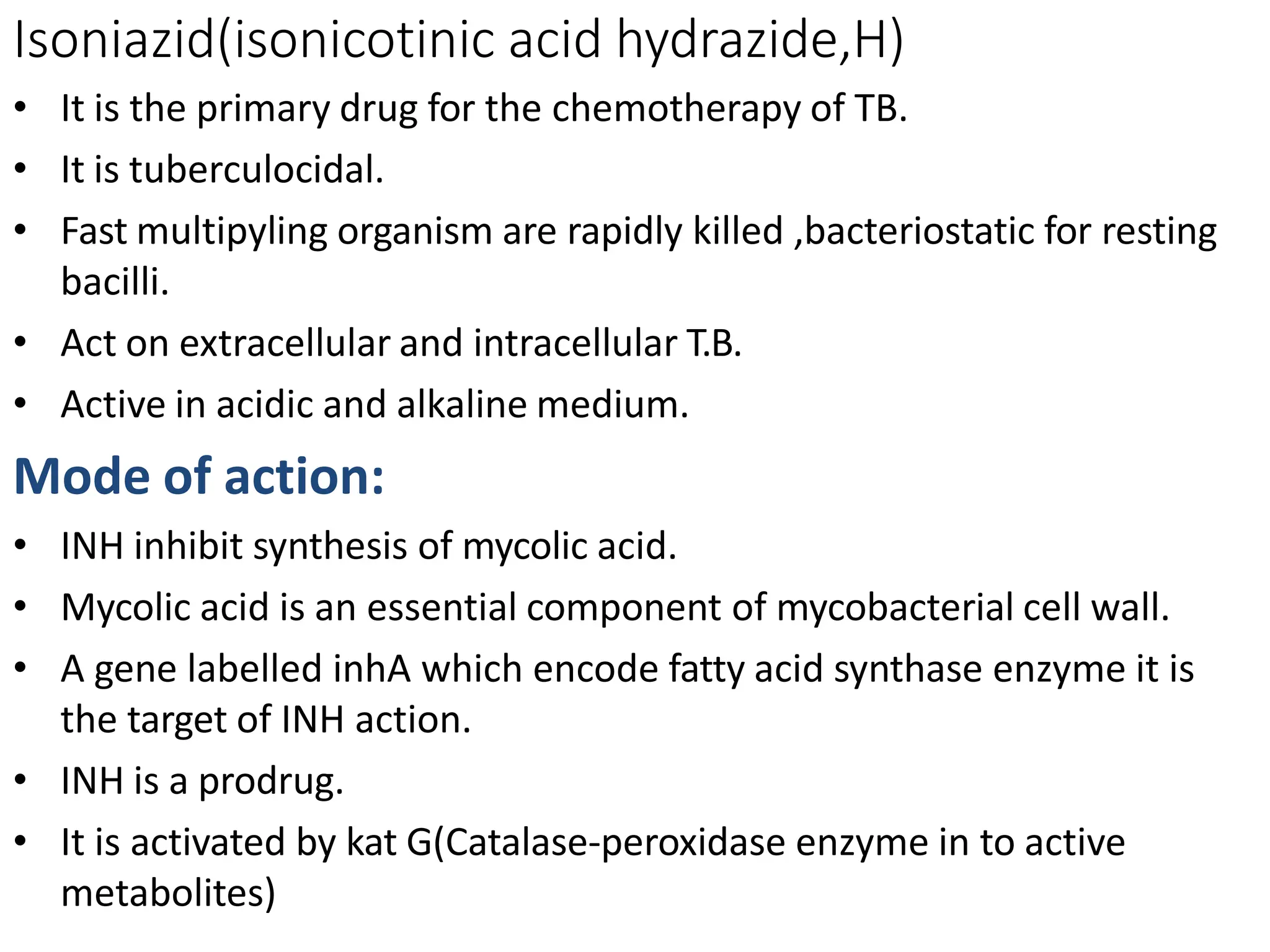
Isoniazid(isonicotinic acid hydrazide,H)
• It is the primary drug for the chemotherapy of TB.
• It is tuberculocidal.
• Fast multipyling organism are rapidly killed ,bacteriostatic for resting
bacilli.
• Act on extracellular and intracellular T.B.
• Active in acidic and alkaline medium.
Mode of action:
• INH inhibit synthesis of mycolic acid.
• Mycolic acid is an essential component of mycobacterial cell wall.
• A gene labelled inhA which encode fatty acid synthase enzyme it is
the target of INH action.
• INH is a prodrug.
• It is activated by kat G(Catalase-peroxidase enzyme in to active
metabolites)
• The active metabolites interact with inhA gene by forming a covalent
bond with acyl carrier protein and beta ketoacyl carrier protein
synthase .
• Which block mycolic acid synthesis and kill the cell.
Resistance:
• Resistance to the drugs produced by reduced penetration into the
bacterium.
• Cross resistance with other anti-TB drugs does not occur.
• The common mechanism of INH is the mutation of kat Ggene
responsible for the activation if INH.
• Mutation of the target gene inhA involved in mycolic acid
biosynthesis.
ADME:
• Orally absorbed and also parentrally.
• Aluminium containing antacid interfere absorption of INH
• Widely distributed-saliva,milk,CSF,meninges,placenta.
• Metabolized in liver-by acetylation(N-acetyltransferase)
• Excreted through urine.
Interaction :
• INH × Aluminum hydroxide= INH absorption.
• INH × Phenytoin /carbamazepine/diazepam/theophylline/warfarin/ =
inhibit the metabolism.
• INH × PAS = Inhibit INH metabolism
Adverse Drug Reaction :
• Peripheral neuritis ,paresthesias,numbness,mental disturbances,
rarely convolutions.
• Rashes, Fever, Jaundice .Anemia, Thrombocytopenia,
Agranulocytosis, Hepatotoxicity
Dose :
• INH Tab
• INH Syrup
300mg/d or 900mg twice weekly.
50-100mg/ml
• INH Inj. 100mg/ml
• RIFAMPIN(RIFAMPICIN)
• It is a semi synthetic derivative of rifamycin.
• It is an antibiotic produced by streptomyces -mediterranei.
• Bactericidl to mycobacterium tuberculosis mycobacterium leprea,
gram +ve, gram-ve bacteria.
• Act both extra and intracellular organism.
• Good sterilizing and resistance preventing action.
Mode Of Action:
• Rifampin bind β- subunit RNApolymerase and inhibit DNA
dependent RNA polymerase enzyme of mycobacteria.
• Suppression of initiation of chain formation in RNA synthesis
• Produce bactericidal effects.
Resistance :
• Resistance produce rapidly.
• It is due to mutation of repoB gene (β-subunit of RNA Polymerase).
• No cross resistance
ADME:
• Well absorbed orally.
• Widely distributed in the body.
• Metabolized in liver by deacetylation.
• Excreted mainly in bile and less in urine.
metabolism of
Interactions:
• Rifampin × warfarin/oral contraceptives/
steroids/theophylline/metaprolol/fluconazole =
precipitant drugs.
Adverse Drug Reaction:
• Hepatitis, jaundice,breathlessness,hemolysis,shock,renal
failure,flushing,Pruritus rash, redness and watering of eyes.
• Flu syndrome: with chills, fever ,headache, malaise and bone pain.
• Abdominal syndrome: nausea, vomiting, abdominal cramps with or
without diarrhoea.
• Urine and secretion may become orange-red-but this is harmless.
Use :
• Leprosy
• Meningococcal and H.influenza.
• Brucellosis (Doxycycline+Rifampin)
• PRAZINAMIDE:
• It is a weak tuberculocidal drugs.
• More active in acidic medium.
• Good sterilizing action.
Mode Of Action:
• Same as INH
• Inhibit mycolic acid synthesis.
Resistance:
• If it is used alone, resistance produce rapidly.
ADME
• Absorbed orally
• Widely distributed
• Good penetration CSF
• Metabolized in liver
• Excreted in urine
• t1/2:6-10hr
Adverse Drug Reaction:
• Hepatotoxicity
• Hyperuricaemia
• Flushing,rashes,fever
• C.T with liver disease patients.
ETHAMBUTOL
• Tuberculostatic drugs
Mode Of Action:
• Ethambutol
• Inhibit arabinosyl transferace.
• Bacteriostatic effect
• It also involved in cell wall synthesis
Resistance:
• Resistance emerge rapidly, when it is used alone
ADME:
• Nausea
• Vomiting
• Rashes
• Fever
• hyperuricemia
STREPTOMYCIN:
• It is a tuberculocidal drugs
• Less effective than INH
• Act only on extracellular bacilli(poor penetration)
• Does not cross CSF
• Poor action in acidic medium
• Given as i.m inj.
Mode Of Action:
• Streptomycin
Bind with 30S Subunit of ribosomal protein
Inhibit bacterial protein synthesis
Resistance:
• Produced rapidly( when it is alone)
Adverse Drug Reaction:
• Ototoxicity
• Nephrotoxicity
THIACETAZONE
• Tuberculostatic,low efficacy drug
• Used in combination with INH
• Orally active
• Excreted in urine
• t1/2-12hr
Adverse Drug Reaction:
• Exfoliative dermatitis
• Steven- johnson syndrome, bone marrow depression.
• Anorexia loose motion abdominal discomfort.
PARA-AMINO SALICYCLIC ACID (PAS)
• It is a bacteriostatic drug.
• Least active drug
• Related to sulfonamides.
• Delay development of resistance
• Used as Na⁺ salt/Ca⁺ salt.
• Mode of action:
ADME:
• Absorbed orally
• Distributed overall except CSF
• Metabolized in liver by acetylation.
• Excreted in urine.
Adverse Drug Reaction:
• Anorexia
• Nausea
• Vomiting
• epigastric pain
• Rashes
• fever liver dysfunction
ETHIONAMIDE
• Similar to INH
• Tuberculostatic drugs
• Moderate efficacy
• Act as both intra and extracellular organisms
• Resistance produce rapidly
• Cross resistance with thiacetazone
ADME:
• Absorbed orally
• Widely distributed includes CSF
• Metabolized in liver
• Excretion by urine
Adverse Drug Reaction:
• Anorexia,nausea,vomiting
• Abdominal upset,aches,pains,hepatitis
Mode Of Action
• Inhibit mycolic acid synthesis
CYCLOSERINE
• Analogue of D-Alanine
• Inhibit bacterial cell wall synthesis
Mode Of Action:
Cycloserine
Inactivating the enzyme Racemize L-Alanine and
link two D-Alanine residues.
• It is a tuberculostatic drugs.
• Inhibit gram+ve bacteria
• Resistance develops slowly
• No cross resistance
ADME:
• Absorbed orally
• Distributed all over the body
• ⅓rd of the dose is metabolized by liver
• Rest dose eliminated in urine
Adverse Drug Reaction:
• Sleepiness
• Head ache
• Tremors
• Psychosis
• convulsion
KANAMYCIN,AMIKACIN,CAPREOMYCIN
• Toxic antibiotic.
• Used as reverse drugs in rare cases not responding to usual therapy.
• Resistance not developed.
Adverse Drug Reaction:
• Ototoxicity, nephrotoxicity
• Electrolyte abnormality
ADME:
• Absorbed orally
• Penetrate meninges
• Excreted by kidney
Mode Of Action:
• Kanamycin:inhibitprotein synthesis by binding to the four nucleotides
of 16srRNA and single amino acid of protein s12
• Amikacin:inbihit protein synthesis by binding to 30s ribosomal
subunit.
Capreomycin:peptide protein synthesis inhibitors obtained from
streptomyces capreolous
• Resistance due to rrs mutation
Newer Drugs:
CIPROFLOXACIN,OFLOXACIN,MOXIFLOXACIN
• These are fluroquinolone and as anti-T.B
•
• Bind to A Subunit of DNA gyrase enzymes.
•
• Prevent binding of substrate to the active site of DNA gyrase
Absence of formation of E-S Complex
• Blockade of unwinding of double stranded DNA with a single
stranded structure
Prevent synthesis of mRNA
Inhibit bacterial protein synthesis
Antibacterial activity
CLARITHROMYCIN,AZITHROMYCIN
• Newer macrolide antibiotic
• Most active against non-tubercular mycobacteria
Mode Of Action:
• macrolide bind to 50S subunit ribosomal subunit.
• Inhibit polypeptide chain elongation and protein synthesis inhibition
Inhibit growth and multiplication of bacteria
Bacteriostatic effect
Adverse Drug Reaction:
• Ototoxicity
RIFABUTIN
• Related to rifampin structure and mechanism of action
• Less active against M.Tuberculosis
• More active against M.Avium complex
• Partial cross resistance occur
Adverse Drug Reaction
GI intolerance, rashes, granulocytopenia,myalgia,uvetis
THE WHO GUIDELINES FOR THE TREATMENT OF TUBERCULOSIS.
The regimen recommended for each patient depend category for each
patient.
The revised national tuberculosis control programme(RNTCP) was
launched in India in1997. under this programme.DOTS( directly
observed treatment short course) chemotherapy is being
implemented. Out of the WHO recommended regimens, the thrice
weekly regimens is followed in DOTS, in DOTS, patients is
administrated drugs under the supervision of the health workers or
other trained person to ensure that drugs are actually consumed. The
therapy must be supervised and monitored by bacteriological
examination dots is the backbone of RNTCP. It is aimed at ensuring
patient compliance thus preventing the emergence of drugs-resistant
tuberculosis.
MULTIDRUG-RESISTANT TUBERCULOSIS (MDR-TB)
It is defined as Resistance to both isoniazide and rifampicin with or
without resistance to any other anti-TB drugs.
TYPE OF PATIENT TB TREATMENT REGIMEN S
GNOSTIC
TEGORY INTENSIVE PHASE CONTINUATION
PHASE
TOTAL DURATION
(MONTHS)
egory 1 New sputum +ve
Seriously ill sputum
Negative , seriously
ill extra pulmonary
Daily
2HRZE
Thrice weekly
2(HRTZE)ȝ
4HR
4(HR)ȝ
6
6
egory 2 sputum +ve
relapse
sputum +ve failure
sputum +ve
treatment after
default
Daily
2HRZES
1HRZE
thrice weekly
2(HRZES)ȝ
1(HRZE)ȝ
5HRE
5(HRE)ȝ
8
8
egory 3 Sputum negative
not seriously ill,
Extra pulmonary
not seriously ill
Daily
2HRZ
thrice weekly
2(HRZ)ȝ
4HR
4(HR)ȝ
6
6
egory 4 chronic or
suspected
MDR-TB cases
Specially des
regimens
igned standardi zed or individu
TREATMENT:
MDRT-TB can be treated by either specially designed standardized
regimens . Drugs susceptibility testing is recommended for the cases
if facilities are available. MDR-TB is treated with 5-6 drugs including
2-3 anti-TB drugs which the patients has not received in the past.
Treatment should be given daily and observed directly .treatment
should be continued for at least 24 months.
To address the problems of MDR-TB,WHO is implementing a strategy
DOTS plus . DOTS plus is designed to treat MDR-TB using second line
anti-TB it is recommended in area where DOTS is fully in place.
TB TREATMENT IN HIV PATIENTS
The diagnostic categories for patient are the same irrespective of HIV
status generally,TB treatment is the same for HIV infected as for non-
HIV infected TB patients
Short-course chemotherapy must be stared immediately once TB is
diagnosed .Rifabutin is preferred over Rifampicin in HIV patients on
antiretroviral drugs as it does not interact with Pls .
TUBERCULOSIS IN PREGNANCY
INH, Rifampicin and ethambutol are considered safe in pregnancy
REFERANCE
KD Tripathi Essential of Medical Pharmacology
7th Edition Page no:765-779
©2013,KD Tripathi

anti tubercular drugs.pptx

  • 1.
    GRACE COLLEGE OFPHARMACY,PALAKKAD APPROVED BY PCI,GOVERNMENT OF KERALA AFFLIATED TO KERALA UNIVERSITY OF HEALTH SCIENCES ANTI-TUBERCULAR DRUGS Prepared by: Mr. GOKUL J SIDDHARTH RESEARCH SCHOLAR gokulsiddu@gmail.com
  • 2.
    ANTI-TUBERCULAR DRUGS •Tuberculosis isa chronic granulomatous disease. •Infected with mycobacterium tuberculosis. •Infection is due to inhalation of infected droplet nuclei and lung is the major organ affected. Symptoms: •Low grade fever (99°F) in evening. •Night sweat. •Malaise. •Fatigue. •Weight loss. •Blood streaked productive cough.
  • 3.
     Treatment: Anti-TB drugscan be divided into: First line drugs: Drugs have high anti-tubercular efficacy as well as low toxicity; used routinely. Second line drugs: •Low anti-tubercular efficacy or higher toxicity or both . •Used special circumstances . •Therapy must contain two or more drugs to avoid resistance(multi drug therapy). •The drugs must be taken regularly. •Drugs must continue for sufficient duration to achieve adequate therapeutic results.
  • 4.
    Newer drugs •Ciprofloxacin •Ofloxacin •Clarithromycin •Azithromycin •Rifabutin First linedrugs • Thiacetazone • Para-aminosalicyclic acid(PAS) • Ethionamide • Cycloserine • Kanamycin • Amikacin • Capreomycin • Isoniazid • Rifampin • Pyrazinamide • Ethambutol • Streptomycin Second line drugs
  • 5.
    Isoniazid(isonicotinic acid hydrazide,H) •It is the primary drug for the chemotherapy of TB. • It is tuberculocidal. • Fast multipyling organism are rapidly killed ,bacteriostatic for resting bacilli. • Act on extracellular and intracellular T.B. • Active in acidic and alkaline medium. Mode of action: • INH inhibit synthesis of mycolic acid. • Mycolic acid is an essential component of mycobacterial cell wall. • A gene labelled inhA which encode fatty acid synthase enzyme it is the target of INH action. • INH is a prodrug. • It is activated by kat G(Catalase-peroxidase enzyme in to active metabolites)
  • 6.
    • The activemetabolites interact with inhA gene by forming a covalent bond with acyl carrier protein and beta ketoacyl carrier protein synthase . • Which block mycolic acid synthesis and kill the cell. Resistance: • Resistance to the drugs produced by reduced penetration into the bacterium. • Cross resistance with other anti-TB drugs does not occur. • The common mechanism of INH is the mutation of kat Ggene responsible for the activation if INH. • Mutation of the target gene inhA involved in mycolic acid biosynthesis. ADME: • Orally absorbed and also parentrally. • Aluminium containing antacid interfere absorption of INH • Widely distributed-saliva,milk,CSF,meninges,placenta.
  • 7.
    • Metabolized inliver-by acetylation(N-acetyltransferase) • Excreted through urine. Interaction : • INH × Aluminum hydroxide= INH absorption. • INH × Phenytoin /carbamazepine/diazepam/theophylline/warfarin/ = inhibit the metabolism. • INH × PAS = Inhibit INH metabolism Adverse Drug Reaction : • Peripheral neuritis ,paresthesias,numbness,mental disturbances, rarely convolutions. • Rashes, Fever, Jaundice .Anemia, Thrombocytopenia, Agranulocytosis, Hepatotoxicity Dose : • INH Tab • INH Syrup 300mg/d or 900mg twice weekly. 50-100mg/ml
  • 8.
    • INH Inj.100mg/ml • RIFAMPIN(RIFAMPICIN) • It is a semi synthetic derivative of rifamycin. • It is an antibiotic produced by streptomyces -mediterranei. • Bactericidl to mycobacterium tuberculosis mycobacterium leprea, gram +ve, gram-ve bacteria. • Act both extra and intracellular organism. • Good sterilizing and resistance preventing action. Mode Of Action: • Rifampin bind β- subunit RNApolymerase and inhibit DNA dependent RNA polymerase enzyme of mycobacteria. • Suppression of initiation of chain formation in RNA synthesis • Produce bactericidal effects.
  • 9.
    Resistance : • Resistanceproduce rapidly. • It is due to mutation of repoB gene (β-subunit of RNA Polymerase). • No cross resistance ADME: • Well absorbed orally. • Widely distributed in the body. • Metabolized in liver by deacetylation. • Excreted mainly in bile and less in urine. metabolism of Interactions: • Rifampin × warfarin/oral contraceptives/ steroids/theophylline/metaprolol/fluconazole = precipitant drugs.
  • 10.
    Adverse Drug Reaction: •Hepatitis, jaundice,breathlessness,hemolysis,shock,renal failure,flushing,Pruritus rash, redness and watering of eyes. • Flu syndrome: with chills, fever ,headache, malaise and bone pain. • Abdominal syndrome: nausea, vomiting, abdominal cramps with or without diarrhoea. • Urine and secretion may become orange-red-but this is harmless. Use : • Leprosy • Meningococcal and H.influenza. • Brucellosis (Doxycycline+Rifampin)
  • 11.
    • PRAZINAMIDE: • Itis a weak tuberculocidal drugs. • More active in acidic medium. • Good sterilizing action. Mode Of Action: • Same as INH • Inhibit mycolic acid synthesis. Resistance: • If it is used alone, resistance produce rapidly. ADME • Absorbed orally • Widely distributed • Good penetration CSF • Metabolized in liver • Excreted in urine • t1/2:6-10hr
  • 12.
    Adverse Drug Reaction: •Hepatotoxicity • Hyperuricaemia • Flushing,rashes,fever • C.T with liver disease patients. ETHAMBUTOL • Tuberculostatic drugs Mode Of Action: • Ethambutol • Inhibit arabinosyl transferace. • Bacteriostatic effect • It also involved in cell wall synthesis
  • 13.
    Resistance: • Resistance emergerapidly, when it is used alone ADME: • Nausea • Vomiting • Rashes • Fever • hyperuricemia
  • 14.
    STREPTOMYCIN: • It isa tuberculocidal drugs • Less effective than INH • Act only on extracellular bacilli(poor penetration) • Does not cross CSF • Poor action in acidic medium • Given as i.m inj. Mode Of Action: • Streptomycin Bind with 30S Subunit of ribosomal protein Inhibit bacterial protein synthesis
  • 15.
    Resistance: • Produced rapidly(when it is alone) Adverse Drug Reaction: • Ototoxicity • Nephrotoxicity THIACETAZONE • Tuberculostatic,low efficacy drug • Used in combination with INH • Orally active • Excreted in urine • t1/2-12hr Adverse Drug Reaction: • Exfoliative dermatitis • Steven- johnson syndrome, bone marrow depression. • Anorexia loose motion abdominal discomfort.
  • 16.
    PARA-AMINO SALICYCLIC ACID(PAS) • It is a bacteriostatic drug. • Least active drug • Related to sulfonamides. • Delay development of resistance • Used as Na⁺ salt/Ca⁺ salt.
  • 17.
    • Mode ofaction:
  • 18.
    ADME: • Absorbed orally •Distributed overall except CSF • Metabolized in liver by acetylation. • Excreted in urine. Adverse Drug Reaction: • Anorexia • Nausea • Vomiting • epigastric pain • Rashes • fever liver dysfunction
  • 19.
    ETHIONAMIDE • Similar toINH • Tuberculostatic drugs • Moderate efficacy • Act as both intra and extracellular organisms • Resistance produce rapidly • Cross resistance with thiacetazone ADME: • Absorbed orally • Widely distributed includes CSF • Metabolized in liver • Excretion by urine Adverse Drug Reaction: • Anorexia,nausea,vomiting • Abdominal upset,aches,pains,hepatitis
  • 20.
    Mode Of Action •Inhibit mycolic acid synthesis CYCLOSERINE • Analogue of D-Alanine • Inhibit bacterial cell wall synthesis Mode Of Action: Cycloserine Inactivating the enzyme Racemize L-Alanine and link two D-Alanine residues. • It is a tuberculostatic drugs. • Inhibit gram+ve bacteria • Resistance develops slowly • No cross resistance
  • 21.
    ADME: • Absorbed orally •Distributed all over the body • ⅓rd of the dose is metabolized by liver • Rest dose eliminated in urine Adverse Drug Reaction: • Sleepiness • Head ache • Tremors • Psychosis • convulsion
  • 22.
    KANAMYCIN,AMIKACIN,CAPREOMYCIN • Toxic antibiotic. •Used as reverse drugs in rare cases not responding to usual therapy. • Resistance not developed. Adverse Drug Reaction: • Ototoxicity, nephrotoxicity • Electrolyte abnormality ADME: • Absorbed orally • Penetrate meninges • Excreted by kidney Mode Of Action: • Kanamycin:inhibitprotein synthesis by binding to the four nucleotides of 16srRNA and single amino acid of protein s12 • Amikacin:inbihit protein synthesis by binding to 30s ribosomal subunit.
  • 23.
    Capreomycin:peptide protein synthesisinhibitors obtained from streptomyces capreolous • Resistance due to rrs mutation Newer Drugs: CIPROFLOXACIN,OFLOXACIN,MOXIFLOXACIN • These are fluroquinolone and as anti-T.B • • Bind to A Subunit of DNA gyrase enzymes. • • Prevent binding of substrate to the active site of DNA gyrase Absence of formation of E-S Complex
  • 24.
    • Blockade ofunwinding of double stranded DNA with a single stranded structure Prevent synthesis of mRNA Inhibit bacterial protein synthesis Antibacterial activity CLARITHROMYCIN,AZITHROMYCIN • Newer macrolide antibiotic • Most active against non-tubercular mycobacteria Mode Of Action: • macrolide bind to 50S subunit ribosomal subunit.
  • 25.
    • Inhibit polypeptidechain elongation and protein synthesis inhibition Inhibit growth and multiplication of bacteria Bacteriostatic effect Adverse Drug Reaction: • Ototoxicity RIFABUTIN • Related to rifampin structure and mechanism of action • Less active against M.Tuberculosis • More active against M.Avium complex • Partial cross resistance occur Adverse Drug Reaction GI intolerance, rashes, granulocytopenia,myalgia,uvetis
  • 26.
    THE WHO GUIDELINESFOR THE TREATMENT OF TUBERCULOSIS. The regimen recommended for each patient depend category for each patient. The revised national tuberculosis control programme(RNTCP) was launched in India in1997. under this programme.DOTS( directly observed treatment short course) chemotherapy is being implemented. Out of the WHO recommended regimens, the thrice weekly regimens is followed in DOTS, in DOTS, patients is administrated drugs under the supervision of the health workers or other trained person to ensure that drugs are actually consumed. The therapy must be supervised and monitored by bacteriological examination dots is the backbone of RNTCP. It is aimed at ensuring patient compliance thus preventing the emergence of drugs-resistant tuberculosis. MULTIDRUG-RESISTANT TUBERCULOSIS (MDR-TB) It is defined as Resistance to both isoniazide and rifampicin with or without resistance to any other anti-TB drugs.
  • 27.
    TYPE OF PATIENTTB TREATMENT REGIMEN S GNOSTIC TEGORY INTENSIVE PHASE CONTINUATION PHASE TOTAL DURATION (MONTHS) egory 1 New sputum +ve Seriously ill sputum Negative , seriously ill extra pulmonary Daily 2HRZE Thrice weekly 2(HRTZE)ȝ 4HR 4(HR)ȝ 6 6 egory 2 sputum +ve relapse sputum +ve failure sputum +ve treatment after default Daily 2HRZES 1HRZE thrice weekly 2(HRZES)ȝ 1(HRZE)ȝ 5HRE 5(HRE)ȝ 8 8 egory 3 Sputum negative not seriously ill, Extra pulmonary not seriously ill Daily 2HRZ thrice weekly 2(HRZ)ȝ 4HR 4(HR)ȝ 6 6 egory 4 chronic or suspected MDR-TB cases Specially des regimens igned standardi zed or individu
  • 28.
    TREATMENT: MDRT-TB can betreated by either specially designed standardized regimens . Drugs susceptibility testing is recommended for the cases if facilities are available. MDR-TB is treated with 5-6 drugs including 2-3 anti-TB drugs which the patients has not received in the past. Treatment should be given daily and observed directly .treatment should be continued for at least 24 months. To address the problems of MDR-TB,WHO is implementing a strategy DOTS plus . DOTS plus is designed to treat MDR-TB using second line anti-TB it is recommended in area where DOTS is fully in place. TB TREATMENT IN HIV PATIENTS The diagnostic categories for patient are the same irrespective of HIV status generally,TB treatment is the same for HIV infected as for non- HIV infected TB patients Short-course chemotherapy must be stared immediately once TB is diagnosed .Rifabutin is preferred over Rifampicin in HIV patients on antiretroviral drugs as it does not interact with Pls .
  • 29.
    TUBERCULOSIS IN PREGNANCY INH,Rifampicin and ethambutol are considered safe in pregnancy
  • 30.
    REFERANCE KD Tripathi Essentialof Medical Pharmacology 7th Edition Page no:765-779 ©2013,KD Tripathi