By
PRIYANKA NAMDEO
Assistant Professor
Department of Pharmacology
Anthelmintic Drugs
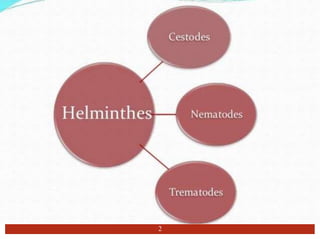
2
Introduction:
Types of Common Helminthes
Taenia solium(Pork),
1. Gastrointestinal worms
A- TAPE WORMS (CESTODES)
⚫ Taenia saginata (Beef)
Diphylobothrium latum (Fish)
⚫ Humans infected by eating raw or under cooked meat containing
larvae or encysted in infected animal muscles.
3
1. Worms live in hosts GIT.
2.Worms or larvae live in other tissues of hostsꞌ body like muscles ,
viscera , meninges , lungs, subcutaneous tissues.
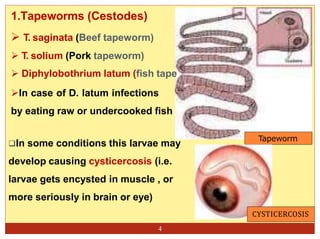
Tapeworm
1.Tapeworms (Cestodes)
 T. saginata (Beef tapeworm)
 T. solium (Pork tapeworm)
 Diphylobothrium latum (fish tape
In case of D. latum infections
by eating raw or undercooked fish
In some conditions this larvae may
develop causing cysticercosis (i.e.
larvae gets encysted in muscle , or
more seriously in brain or eye)
CYSTICERCOSIS
4
2/16/2015
Dr. Nehal Afifi 5
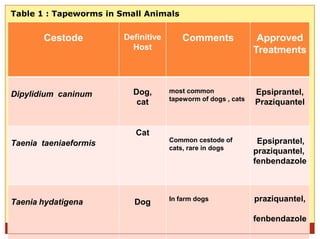
Table 1 : Tapeworms in Small Animals
Cestode Definitive
Host
Comments Approved
Treatments
Dipylidium caninum Dog,
cat
most common
tapeworm of dogs , cats
Epsiprantel,
Praziquantel
Taenia taeniaeformis
Cat
Common cestode of
cats, rare in dogs
Epsiprantel,
praziquantel,
fenbendazole
Taenia hydatigena Dog In farm dogs praziquantel,
fenbendazole
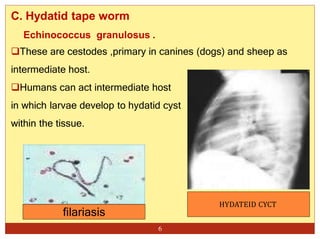
C. Hydatid tape worm
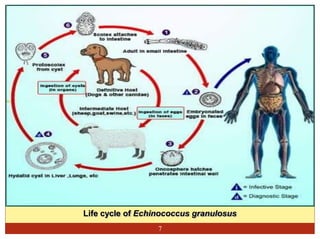
Echinococcus granulosus .
These are cestodes ,primary in canines (dogs) and sheep as
intermediate host.
Humans can act intermediate host
in which larvae develop to hydatid cyst
within the tissue.
HYDATEID CYCT
6
filariasis
Life cycle of Echinococcus granulosus
7
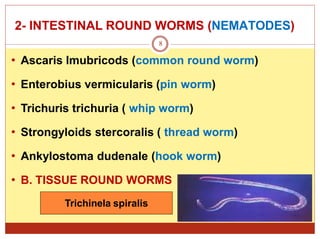
2- INTESTINAL ROUND WORMS (NEMATODES)
• Ascaris lmubricods (common round worm)
• Enterobius vermicularis (pin worm)
• Trichuris trichuria ( whip worm)
• Strongyloids stercoralis ( thread worm)
• Ankylostoma dudenale (hook worm)
• B. TISSUE ROUND WORMS
8
Trichinela spiralis
9
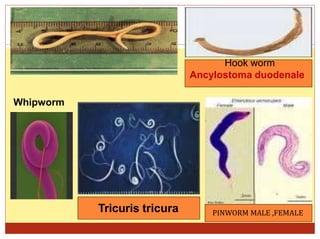
Ascaris lumbricoids (Comm R.W.) Hook worm
Ancylostoma duodenale
Tricuris tricura
Whipworm
PINWORM MALE ,FEMALE
3- TREMATODES
(Schisotomes, FLUKES)
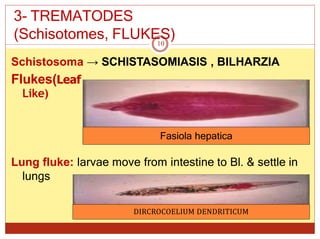
Schistosoma → SCHISTASOMIASIS , BILHARZIA
Flukes(Leaf
Like)
Lung fluke: larvae move from intestine to Bl. & settle in
lungs
10
Fasiola hepatica
DIRCROCOELIUM DENDRITICUM
2/16/2015
Dr. Nehal Afifi 11
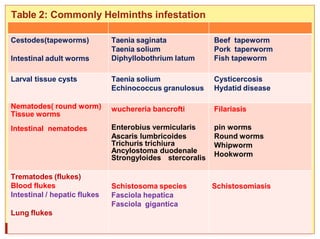
Table 2: Commonly Helminths infestation
Cestodes(tapeworms)
Intestinal adult worms
Taenia saginata
Taenia solium
Diphyllobothrium latum
Beef tapeworm
Pork taperworm
Fish tapeworm
Larval tissue cysts Taenia solium
Echinococcus granulosus
Cysticercosis
Hydatid disease
Nematodes( round worm)
Tissue worms
Intestinal nematodes
wuchereria bancrofti
Enterobius vermicularis
Ascaris lumbricoides
Trichuris trichiura
Ancylostoma duodenale
Strongyloides stercoralis
Filariasis
pin worms
Round worms
Whipworm
Hookworm
Trematodes (flukes)
Blood flukes
Intestinal / hepatic flukes
Lung flukes
Schistosoma species
Fasciola hepatica
Fasciola gigantica
Schistosomiasis
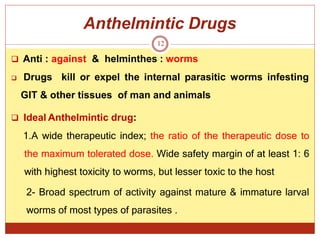
Anthelmintic Drugs
12
 Anti : against & helminthes : worms
 Drugs kill or expel the internal parasitic worms infesting
GIT & other tissues of man and animals
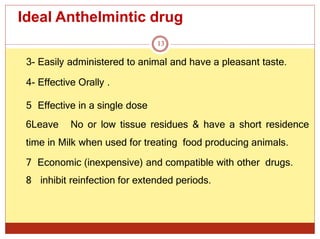
 Ideal Anthelmintic drug:
1.A wide therapeutic index; the ratio of the therapeutic dose to
the maximum tolerated dose. Wide safety margin of at least 1: 6
with highest toxicity to worms, but lesser toxic to the host
2- Broad spectrum of activity against mature & immature larval
worms of most types of parasites .
Ideal Anthelmintic drug
13
3- Easily administered to animal and have a pleasant taste.
4- Effective Orally .
5 Effective in a single dose
6Leave No or low tissue residues & have a short residence
time in Milk when used for treating food producing animals.
7 Economic (inexpensive) and compatible with other drugs.
8 inhibit reinfection for extended periods.
14
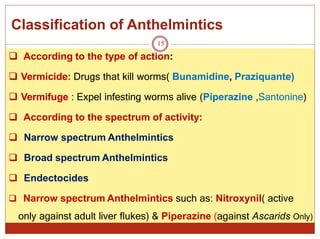
Classification of Anthelmintics
15
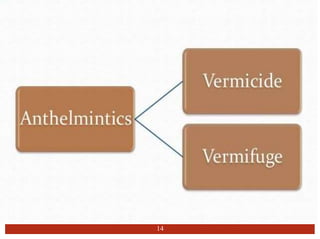
 According to the type of action:
 Vermicide: Drugs that kill worms( Bunamidine, Praziquante)
 Vermifuge : Expel infesting worms alive (Piperazine ,Santonine)
 According to the spectrum of activity:
 Narrow spectrum Anthelmintics
 Broad spectrum Anthelmintics
 Endectocides
 Narrow spectrum Anthelmintics such as: Nitroxynil( active
only against adult liver flukes) & Piperazine (against Ascarids Only)
16
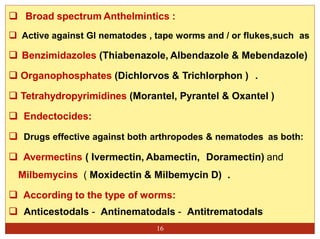
 Broad spectrum Anthelmintics :
 Active against GI nematodes , tape worms and / or flukes,such as
 Benzimidazoles (Thiabenazole, Albendazole & Mebendazole)
 Organophosphates (Dichlorvos & Trichlorphon ) .
 Tetrahydropyrimidines (Morantel, Pyrantel & Oxantel )
 Endectocides:
 Drugs effective against both arthropodes & nematodes as both:
 Avermectins ( Ivermectin, Abamectin, Doramectin) and
Milbemycins ( Moxidectin & Milbemycin D) .
 According to the type of worms:
 Anticestodals - Antinematodals - Antitrematodals
General MOA of Anthelmintics
17
⚫ Inhibiting energy production in the parasite by:
⚫ Inhibiting activity of fumarate reductase enz. in parasite(Albendazole,
⚫ Inhibiting mitochondrial phosphorylation process in parasite(Rafoxanide
⚫ Inhibiting process of glycolysis in parasite as Clorsulon, Phenothiazin
⚫ Causing muscular paralysis of the worm by:
⚫ Inhibiting cholinergic nerves of worm as nicotine sulphate.
⚫ Acting as GABA agonist so cause paralysis of worm as Piperazine.
⚫ Muscle hyperpolarization & paralysis of worm as Levamisole.
⚫ Other mechanism: Disruption of tegument (outer skin) as Bunamidine.
Anticestodal drugs
⚫ Drugs kill or expel tape worms (Cestodes) infesting man & animals.
⚫ Classification of Anticestodals:
⚫ I- Organic of plant origin:
 Arecoline:
 Alkaloid from Areca nut seeds given orally as vermifuge.
 Effective against Taenia species infesting dogs and cats.
 MOA: by inducing muscular paralysis of worms so lose their
attachment with intestinal mucosa & increase intestinal motility of
host ( as a neuromuscular purgative) → expel detached worms alive
 Kamala powder:
 A red powder act as vermifuge due to its irritant effect so expels
worms alive.
 Given orally and effective against cestodes infesting poultry
II- Synthetic drugs:
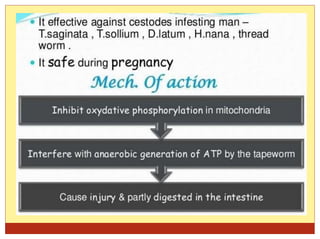
Niclosamide (Mansonil®)
19
 A salicylanilide derivative
 Vermicide drug for treatment of tape worm infestation in dogs & cats ,
Beef tape worm, pork tape worm and fish tape worm.
 has also activity against intestinal flukes as paramphistomes in ruminants
 Not effective against cysticercosis or hydatic disease.
 MOA: Adult worm killed by inhibiting the mitochondrial phosphorylation
process thus inhibiting energy production in worms.
 Pharmacokinetic: Niclosamide poorly absorbed & very rapidly excreted
 has a 5 to 7 folds safety margin
 Given in a single dose on empty stomach & a purgative use after 2 hrs
2- Bunamidine:
⚫ Used as Effective remedy for tape worms infesting dogs & cats.
⚫ MOA: act as vermicide by disruption of the tegument (outer skin) of
worms and kill the worms.
⚫ Used for a long time as effective ttt for Echinococcus in pets
⚫ Adverse Effects: Diarrhea & vomition . sudden death in dogs may happen
as drug cause myocardial sensitization to catecholamine.
3- Dichlorophen:
A narrow spectrum anthelmintic against Taenia & Dipylidium speices in
dogs, but ineffective against Echinococcus.
 MOA: as taenicide by inhibiting phosphorylation process in mitochondria
of worms so inhibit energy production.
4- Prazequentel
22
 A broad Spectrum ( Novel Anthelmintic)
 Actives against Cestodes – Schistosomes -Trematodes
 Effective against all adult Cestodes & their larval forms in dogs & cats
 A potent schistosomicide with a high activity against Bl. flukes causing
bilharziasis in man.
 Active on Trematodes as the lung and gut flukes in animals, but not
effective against liver flukes
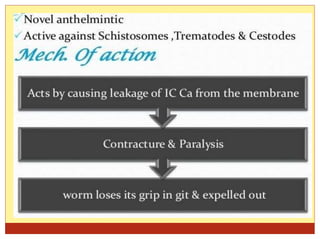
 MO A : Act as vermicide by 1- interfering with ionic balance due to
leakage of IC Ca. from membrane causing rapid muscular contraction
2. causing vacuolation → disruption of worm tegument & death. .
 kinetics: Praziquantel given orally or (S/C) . Rapidly absorbed &
metabolized
 its safety margin reaches 1:40 of the recommended dose.
2/16/2015
Dr. Nehal Afifi 24
5- Epsiprantel
⚫ A very potent, safe and novel tape worm remedy.
⚫ Given orally for treatment of cestodes of dogs & cats.
⚫ Safer than praziquantel as its safety margin is 1: 90
⚫ Not active against schistosomes.
⚫ MOA: anticestodal in a similar manner of praziquantel
6- Nitroscanate:
⚫ Like dichlorophen, but more safer ( safety margin 1: 40)
⚫ A broad spectrum anthelmintic against cestodes & nematodes of
dogs but not used for cats.
MOA: Taenicide by inhibiting phosphorylation process in mitochondr
of worms so inhibit energy production.
Antinematodal drugs
25
⚫ Drugs kill or expel round worms (nematodes) infesting man & animals
⚫ Classification of Antinematodals:
⚫ I- Organic of plant origin:
⚫ 1- Nicotine sulphate:
⚫ Alkaloid obtained from Nicotiana tobacco plant
⚫ Used orally as a drench as nicotine sulphate salt
⚫ Acts as a vermifuge for Ascaris &Trichostrongylus worms of ruminants.
⚫ MOA: By causing inhibition of the cholinergic nerves of worms leading
to muscular paralysis and expelling of worms.
2- Santonine:
⚫ A pale yellow powder obtained from Artemisia plant
⚫ Santonine given orally to expel Ascarids worms of dogs & pigs .
⚫ Acts as a vermifuge due its irritant effect on worms .
⚫ A purgative given after it for rapid expelling of worms.
⚫3- Chenopodium oil:
⚫ A pale yellow volatile oil obtained from American wormseed plant.
⚫ Oil contain a mixture of volatile subs. & active principle (Ascaridol).
⚫ Ascaridol acts as a vermifuge by causing muscular paralysis of
worms and expel them outside
⚫ The oil active against Strongylus worms in horses & Ascardis
worms in pigs, dogs and cats.
⚫ Oil given orally in soft gelatinous capsules.
II- Synthetic drugs:
1- Benzimidazoles
 Benzimidazoles ( Albendazloe, Thiabendazloe, Triclabendazole ,
Mebendazole, Oxfendazole , Fenbendazole & Flubendazole ).
⚫ A good activity against GIT nematodes & lung worms +their larvae.
⚫ The recent drugs Mebendazole & Oxfendazole are highly effective
against both nematodes & cestodes(broad spectrum ) .
⚫ Albendazole active against adult liver flukes, cestodes & GIT
nematodes larvae (broad spectrum ,vermicide, oral anthelmintic)
⚫ On contrast, Tricalbendazole is highly active against liver flukes
(fasciolicide), but has no activity against nematodes & cestodes
27
 MOA:Benzimidazoles act as vermicide by inhibiting energy production
via inhibition of the activity of fumarate reductase enz.
 Benzim. are very safe anthelmintics ; a wide safety margin from 1: 20
for albendazole to 1: 100 for fenbendazole (very safe).
 Cambendazole ,Oxfendazole & Parbendazole have embryotoxic &
teratogenic effects → not given to pregnant animals.
 Albendazole leave tissue residues therefore 10 days from the last
dosing of sheep and 14 days from the last dosing of cattle must be
elapsed before slaughtering animals.
 Cows producing milk for human should Not treated with Albendazole.
 Fenbendazole withdrawal time= 14 days for meat & 3 d. for milk
 Triclab. withdrawal time = 28 days & Not use to animals providing milk.
Clinical uses of Albendazole
29
 Albendazole is the drug of choice for treatment of intestinal round
worms as Ascaris , hook worm (Ankylostoma ) thread worm
(Strongyloids) , pin worms (Enterobius) & whip worm (Trichuris
trichuria) infestations, as a single dose repeated after 3 weeks .
Albendazole is the main drug for Hydatid disease (dog tapeworm)
twice / day for 1 month & repeat after 2-3wks if required up to 3
courses.
Used for treatment of tissue round worm (Trichnella spiralis)
for 3 days .
2- Tetrahydropyrimidine derivatives
(Morantel, Pyrantel & Oxantel)
30
⚫ Morantel effective against GIT nematodes, but not against lung
worms in ruminants.
⚫ Used as a drench or "protect bolus" to provide prolonged
protection for 90 days ( slowly released).
⚫ Pyrantel pamoate:
⚫ A broad specturm anthelmintic , highly effective against adult &
larval nematodes of horse and dogs.
⚫ Not active against lung worms and whipworms.
⚫ Oxantel : Narrow spectrum ( only active against whipworm) dogs
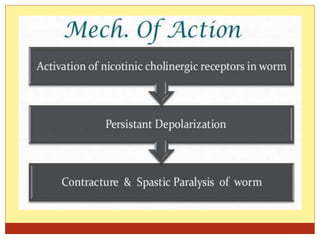
⚫ MOA: Pyrantel is a depolrazing neuromuscular blocking agent
cause release of acetylcholine & inhibition of cholinesterase enz.
leading to muscular paralysis & death (Vermicide).
Pyrantel Clinical uses :
32
 Pyrantel is very safe remedy for horses and dogs
 Pyrantel Given to pregnant or lactating animals.
 Pyrantel given orally with or without food.
For Pin worm, Ascariasis & Hookworm as a single dose and
repeated after 2 wks.
Morantel is a very safe remedy and no withdrawal period is
required for the bolus, but a withdrawal period of 3 days is
required for the drench.
3- Levamisole & Tetramisole
 Levamisole: Effective against mature & immature larval GI round
and lung worms both orally & parenterally in ruminants & poultry.
 Used with limited success against heartworm microfilaria in dogs.
 Very rapid action & expel worms within 24 hrs.
 Rapid absorbed from GIT- Metabolized by liver- Half life 3-4hr
 Levamisole acts also as an immunostimulant drug
 Neither embryotoxic nor teratogenic if given to pregnant animals
worms causing
⚫ MOA: NN agonist stimulate nicotinic ganglia in
muscular paralysis & death of the worms(vermicide).
⚫ Interfere with carbohydrate metabolism.
33
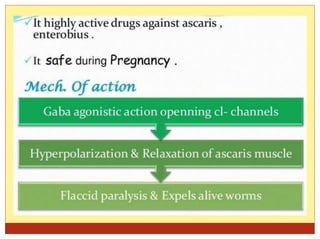
4- Piperazine
34
⚫ Commonly used antinematodal drug against only Ascaris and
Oxyuris worms in man and animals.
⚫ Not recommended for other helminthes infestation.
⚫ Administered as citrate or phosphate salts and given orally as a
drench or added to drinking water for poultry.
⚫ MOA: act as vermifuge by its GABA agonist effect so it prevents
neural transmission in the worm causing muscular paralysis and
expelling of the worms alive.
⚫ A very safe drug for man and animals during pregnancy
⚫ Moderate oral absorption & excreted unchanged in urine.
5- Diethyl Carbamazine (DEC)
36
⚫ A highly soluble piperazine derivative → rapidly absorbed &
distributed throughout the body.
⚫ Drug of choice for treatment of Filariasis .
⚫ Highly selective effect on microfilaria.
⚫ Enhances cell mediated immunity
⚫ Used for control of heartworm larvae in dogs.
⚫ Safe for use in pregnant & young animals(Not teratogenic).
⚫ MOA: DEC disrupt the microtubules & inhibit microtubules
polymerization in microfilaria.
⚫ MOA: 1- DEC Immobilize microfilaria & alter their membrane
structure displacing them from tissues & making them susceptible
to destruction by host defense mechanism.
⚫ 2.Alternation of microfilaria membrane → phagocytosed by fixed
tissue monocytes.
⚫ 3.Affect muscular activity and cause hyper polarization due to
piperazine moiety.
⚫ The drug should be given after meals.
6- Ivermectin ( Ivomec® )
38
⚫ One of Avermectins that commonly used in vet. Med.
⚫ Highly effective against all nematodes in animals & arthropods as
mange mites, lice & ticks (endectocide).
⚫ has no activity against cestodes and flukes.
⚫ Given S/C at very low doses (o.2mg /kg for cattle, horse & sheep)
⚫ MOA: act as vermicide causing paralysis of worms by intensifying
the action of the inhibitory transmitter GABA at neuromuscular
junction → paralysis and death of the worms.
2/16/2015
39
IVERMECTIN Pharmacokinetics
⚫ Rapidly absorbed & widely distributed .
⚫ Does not cross BBB
⚫ Half- life 2-3 days & Excretion mainly in feces.
⚫ Very safe remedy for ruminants, with withdrawal period = 28 days
⚫ Not used in dairy cows providing milk for human consumption.
⚫ Contraindication:
⚫ Pregnancy.
⚫ Concurrent use with other drugs that enhance GABA
e.g Barbiturates, valproaic acid & bnezodiazepines.
7- Organophosphate compounds
40
⚫ Organophosphates as diclorvos, haloxon, & trichlorphon.
⚫ Effective against GI nematodes infesting animals.
⚫ MOA: Organophosphates inhibit the acetylcholinestrase of the
worms leading to their paralysis and death.
⚫ Nowadays, they are less commonly used because of their high
toxicity to the host.
III– Antitrematodal drugs (Antiflukes)
41
⚫ Drugs kill liver flukes (Fasciola hepatica & gigantica), rumen &
abomasums flukes (Paramphestomes) & Bl. flukes (Schistosomes)
infesting man and animals.
⚫ Classification:
⚫ I- Old fasciolicides:
⚫ 1-Carbon tetrachloride (Ccl 4):
⚫ Used for treating haemonchosis in ruminants, strongylosis in
horses, ancylostomiasis in dogs, fascioliasis in sheep & cattle.
⚫ Ccl 4 given either orally (as drench or in capsules) or (I/M).
⚫ Only kills adult flukes & not effective against immature flukes →
repeated after 3-4 weeks .
⚫ MOA: Ccl 4 acts as fasciolicide by inhibiting the metabolic enzyms
present in mature flukes.
⚫ Toxic symptoms of Ccl4 : drowsiness, muscular incoordination
or convulsion, diarrhea and hypocalcaemia.
⚫ To reduce its toxic effects, premedication of animals with calcium
salts as calcium borogluconate (I/V) should be done.
⚫ 2- Hexachloroethane (C2cl 6):
⚫ Effective for treating liver fascioliasis in cattle, sheep & goats.
⚫ MOA: kills the mature flukes by inhibiting the metabolic enzymes
present in the mature worms only.
⚫ The dose of C2cl 6 should repeated after 3 weeks(immature not aff
⚫ C2cl 6 is less toxic than Ccl 4.
⚫ Toxic Symptomes in cattle loss of appetite & mild diarrhea.
II- Modern fasciolicides:
43
⚫ (A) Substituted phenols as:
⚫ 1- Nitroxynil:
⚫ Used for treating fascioliasis in cattle and sheep.
⚫ Nitroxynil only active by S/C injection & Not given orally due to rumen
microflora cause reduction of nitro group → loss anthelmintic activity
⚫ Effective against adult liver flukes & Bl. sucking nematodes.
⚫ A withdrawal period of 30 days before slaughtering the animal.
⚫ Should not dosed to cows producing milk for human consumption.
⚫ 2- Diamphenethide:
⚫ Active against mature & immature liver flukes in sheep, inactive in cattle.
⚫ MOA: fasciolicide by causing rupture of fluke tegument →muscular parals
⚫ Must not dosed to sheep producing milk for human consumption.
⚫ Has a 7 days withdrawal period for meat and its safety margin is 1:4.
(B) Salicylanilide derivatives:
1- Rafoxanide 3- Oxyclozanide
⚫1- Rafoxanide:
⚫ Active against mature & immature liver flukes in both cattle & sheep
as well as blood sucking nematodes.
⚫ MOA: Rafoxanide acts as fasciolicide by inhibiting the process of
phosphorylation in mitochondria of worms .
⚫ Given orally or by S/C injection & has a safety margin of 1: 6.
⚫ Rapidly absorbed, but slowly excreted →28 days withdrawal period
required for meat.
⚫ Rafoxanide not used for cows producing milk .
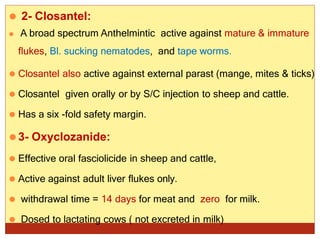
2- Closantel
44
⚫ 2- Closantel:
⚫ A broad spectrum Anthelmintic active against mature & immature
flukes, Bl. sucking nematodes, and tape worms.
⚫ Closantel also active against external parast (mange, mites & ticks)
⚫ Closantel given orally or by S/C injection to sheep and cattle.
⚫ Has a six -fold safety margin.
⚫3- Oxyclozanide:
⚫ Effective oral fasciolicide in sheep and cattle,
⚫ Active against adult liver flukes only.
⚫ withdrawal time = 14 days for meat and zero for milk.
⚫ Dosed to lactating cows ( not excreted in milk)
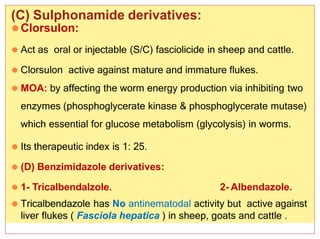
(C) Sulphonamide derivatives:
46
Dr. Nehal Afifi 2/16/2015
⚫Clorsulon:
⚫ Act as oral or injectable (S/C) fasciolicide in sheep and cattle.
⚫ Clorsulon active against mature and immature flukes.
⚫ MOA: by affecting the worm energy production via inhibiting two
enzymes (phosphoglycerate kinase & phosphoglycerate mutase)
which essential for glucose metabolism (glycolysis) in worms.
⚫ Its therapeutic index is 1: 25.
⚫ (D) Benzimidazole derivatives:
⚫ 1- Tricalbendalzole. 2- Albendazole.
⚫ Tricalbendazole has No antinematodal activity but active against
liver flukes ( Fasciola hepatica ) in sheep, goats and cattle .
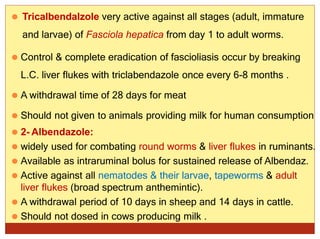
⚫ Tricalbendalzole very active against all stages (adult, immature
and larvae) of Fasciola hepatica from day 1 to adult worms.
⚫ Control & complete eradication of fascioliasis occur by breaking
L.C. liver flukes with triclabendazole once every 6-8 months .
⚫ A withdrawal time of 28 days for meat
⚫ Should not given to animals providing milk for human consumption
⚫ 2- Albendazole:
⚫ widely used for combating round worms & liver flukes in ruminants.
⚫ Available as intraruminal bolus for sustained release of Albendaz.
⚫ Active against all nematodes & their larvae, tapeworms & adult
liver flukes (broad spectrum anthemintic).
⚫ A withdrawal period of 10 days in sheep and 14 days in cattle.
⚫ Should not dosed in cows producing milk .
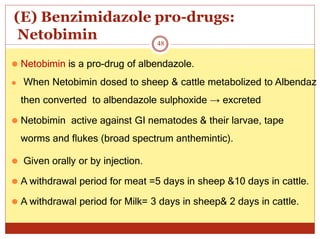
(E) Benzimidazole pro-drugs:
Netobimin
⚫ Netobimin is a pro-drug of albendazole.
⚫ When Netobimin dosed to sheep & cattle metabolized to Albendaz
then converted to albendazole sulphoxide → excreted
⚫ Netobimin active against GI nematodes & their larvae, tape
worms and flukes (broad spectrum anthemintic).
⚫ Given orally or by injection.
⚫ A withdrawal period for meat =5 days in sheep &10 days in cattle.
⚫ A withdrawal period for Milk= 3 days in sheep& 2 days in cattle.
48
49 Drugs
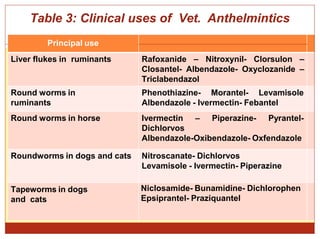
Table 3: Clinical uses of Vet. Anthelmintics
Principal use
Liver flukes in ruminants Rafoxanide – Nitroxynil- Clorsulon –
Closantel- Albendazole- Oxyclozanide –
Triclabendazol
Round worms in
ruminants
Phenothiazine- Morantel- Levamisole
Albendazole - Ivermectin- Febantel
Round worms in horse Ivermectin – Piperazine- Pyrantel-
Dichlorvos
Albendazole-Oxibendazole- Oxfendazole
Roundworms in dogs and cats Nitroscanate- Dichlorvos
Levamisole - Ivermectin- Piperazine
Tapeworms in dogs
and cats
Niclosamide- Bunamidine- Dichlorophen
Epsiprantel- Praziquantel
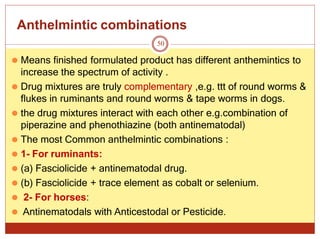
Anthelmintic combinations
50
⚫ Means finished formulated product has different anthemintics to
increase the spectrum of activity .
⚫ Drug mixtures are truly complementary ,e.g. ttt of round worms &
flukes in ruminants and round worms & tape worms in dogs.
⚫ the drug mixtures interact with each other e.g.combination of
piperazine and phenothiazine (both antinematodal)
⚫ The most Common anthelmintic combinations :
⚫ 1- For ruminants:
⚫ (a) Fasciolicide + antinematodal drug.
⚫ (b) Fasciolicide + trace element as cobalt or selenium.
⚫ 2- For horses:
⚫ Antinematodals with Anticestodal or Pesticide.
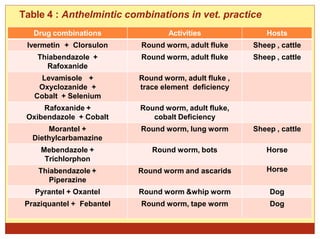
Drug combinations Activities Hosts
Ivermetin + Clorsulon Round worm, adult fluke Sheep , cattle
Thiabendazole +
Rafoxanide
Round worm, adult fluke Sheep , cattle
Levamisole +
Oxyclozanide +
Cobalt + Selenium
Round worm, adult fluke ,
trace element deficiency
Rafoxanide +
Oxibendazole + Cobalt
Round worm, adult fluke,
cobalt Deficiency
Morantel +
Diethylcarbamazine
Round worm, lung worm Sheep , cattle
Mebendazole +
Trichlorphon
Round worm, bots Horse
Thiabendazole +
Piperazine
Round worm and ascarids Horse
Pyrantel + Oxantel Round worm &whip worm Dog
Praziquantel + Febantel Round worm, tape worm Dog
Table 4 : Anthelmintic combinations in vet. practice

Anthelmintic drugs.pptx

  • 1.
    By PRIYANKA NAMDEO Assistant Professor Departmentof Pharmacology Anthelmintic Drugs
  • 2.
  • 3.
    Introduction: Types of CommonHelminthes Taenia solium(Pork), 1. Gastrointestinal worms A- TAPE WORMS (CESTODES) ⚫ Taenia saginata (Beef) Diphylobothrium latum (Fish) ⚫ Humans infected by eating raw or under cooked meat containing larvae or encysted in infected animal muscles. 3 1. Worms live in hosts GIT. 2.Worms or larvae live in other tissues of hostsꞌ body like muscles , viscera , meninges , lungs, subcutaneous tissues.
  • 4.
    Tapeworm 1.Tapeworms (Cestodes)  T.saginata (Beef tapeworm)  T. solium (Pork tapeworm)  Diphylobothrium latum (fish tape In case of D. latum infections by eating raw or undercooked fish In some conditions this larvae may develop causing cysticercosis (i.e. larvae gets encysted in muscle , or more seriously in brain or eye) CYSTICERCOSIS 4
  • 5.
    2/16/2015 Dr. Nehal Afifi5 Table 1 : Tapeworms in Small Animals Cestode Definitive Host Comments Approved Treatments Dipylidium caninum Dog, cat most common tapeworm of dogs , cats Epsiprantel, Praziquantel Taenia taeniaeformis Cat Common cestode of cats, rare in dogs Epsiprantel, praziquantel, fenbendazole Taenia hydatigena Dog In farm dogs praziquantel, fenbendazole
  • 6.
    C. Hydatid tapeworm Echinococcus granulosus . These are cestodes ,primary in canines (dogs) and sheep as intermediate host. Humans can act intermediate host in which larvae develop to hydatid cyst within the tissue. HYDATEID CYCT 6 filariasis
  • 7.
    Life cycle ofEchinococcus granulosus 7
  • 8.
    2- INTESTINAL ROUNDWORMS (NEMATODES) • Ascaris lmubricods (common round worm) • Enterobius vermicularis (pin worm) • Trichuris trichuria ( whip worm) • Strongyloids stercoralis ( thread worm) • Ankylostoma dudenale (hook worm) • B. TISSUE ROUND WORMS 8 Trichinela spiralis
  • 9.
    9 Ascaris lumbricoids (CommR.W.) Hook worm Ancylostoma duodenale Tricuris tricura Whipworm PINWORM MALE ,FEMALE
  • 10.
    3- TREMATODES (Schisotomes, FLUKES) Schistosoma→ SCHISTASOMIASIS , BILHARZIA Flukes(Leaf Like) Lung fluke: larvae move from intestine to Bl. & settle in lungs 10 Fasiola hepatica DIRCROCOELIUM DENDRITICUM
  • 11.
    2/16/2015 Dr. Nehal Afifi11 Table 2: Commonly Helminths infestation Cestodes(tapeworms) Intestinal adult worms Taenia saginata Taenia solium Diphyllobothrium latum Beef tapeworm Pork taperworm Fish tapeworm Larval tissue cysts Taenia solium Echinococcus granulosus Cysticercosis Hydatid disease Nematodes( round worm) Tissue worms Intestinal nematodes wuchereria bancrofti Enterobius vermicularis Ascaris lumbricoides Trichuris trichiura Ancylostoma duodenale Strongyloides stercoralis Filariasis pin worms Round worms Whipworm Hookworm Trematodes (flukes) Blood flukes Intestinal / hepatic flukes Lung flukes Schistosoma species Fasciola hepatica Fasciola gigantica Schistosomiasis
  • 12.
    Anthelmintic Drugs 12  Anti: against & helminthes : worms  Drugs kill or expel the internal parasitic worms infesting GIT & other tissues of man and animals  Ideal Anthelmintic drug: 1.A wide therapeutic index; the ratio of the therapeutic dose to the maximum tolerated dose. Wide safety margin of at least 1: 6 with highest toxicity to worms, but lesser toxic to the host 2- Broad spectrum of activity against mature & immature larval worms of most types of parasites .
  • 13.
    Ideal Anthelmintic drug 13 3-Easily administered to animal and have a pleasant taste. 4- Effective Orally . 5 Effective in a single dose 6Leave No or low tissue residues & have a short residence time in Milk when used for treating food producing animals. 7 Economic (inexpensive) and compatible with other drugs. 8 inhibit reinfection for extended periods.
  • 14.
  • 15.
    Classification of Anthelmintics 15 According to the type of action:  Vermicide: Drugs that kill worms( Bunamidine, Praziquante)  Vermifuge : Expel infesting worms alive (Piperazine ,Santonine)  According to the spectrum of activity:  Narrow spectrum Anthelmintics  Broad spectrum Anthelmintics  Endectocides  Narrow spectrum Anthelmintics such as: Nitroxynil( active only against adult liver flukes) & Piperazine (against Ascarids Only)
  • 16.
    16  Broad spectrumAnthelmintics :  Active against GI nematodes , tape worms and / or flukes,such as  Benzimidazoles (Thiabenazole, Albendazole & Mebendazole)  Organophosphates (Dichlorvos & Trichlorphon ) .  Tetrahydropyrimidines (Morantel, Pyrantel & Oxantel )  Endectocides:  Drugs effective against both arthropodes & nematodes as both:  Avermectins ( Ivermectin, Abamectin, Doramectin) and Milbemycins ( Moxidectin & Milbemycin D) .  According to the type of worms:  Anticestodals - Antinematodals - Antitrematodals
  • 17.
    General MOA ofAnthelmintics 17 ⚫ Inhibiting energy production in the parasite by: ⚫ Inhibiting activity of fumarate reductase enz. in parasite(Albendazole, ⚫ Inhibiting mitochondrial phosphorylation process in parasite(Rafoxanide ⚫ Inhibiting process of glycolysis in parasite as Clorsulon, Phenothiazin ⚫ Causing muscular paralysis of the worm by: ⚫ Inhibiting cholinergic nerves of worm as nicotine sulphate. ⚫ Acting as GABA agonist so cause paralysis of worm as Piperazine. ⚫ Muscle hyperpolarization & paralysis of worm as Levamisole. ⚫ Other mechanism: Disruption of tegument (outer skin) as Bunamidine.
  • 18.
    Anticestodal drugs ⚫ Drugskill or expel tape worms (Cestodes) infesting man & animals. ⚫ Classification of Anticestodals: ⚫ I- Organic of plant origin:  Arecoline:  Alkaloid from Areca nut seeds given orally as vermifuge.  Effective against Taenia species infesting dogs and cats.  MOA: by inducing muscular paralysis of worms so lose their attachment with intestinal mucosa & increase intestinal motility of host ( as a neuromuscular purgative) → expel detached worms alive  Kamala powder:  A red powder act as vermifuge due to its irritant effect so expels worms alive.  Given orally and effective against cestodes infesting poultry
  • 19.
    II- Synthetic drugs: Niclosamide(Mansonil®) 19  A salicylanilide derivative  Vermicide drug for treatment of tape worm infestation in dogs & cats , Beef tape worm, pork tape worm and fish tape worm.  has also activity against intestinal flukes as paramphistomes in ruminants  Not effective against cysticercosis or hydatic disease.  MOA: Adult worm killed by inhibiting the mitochondrial phosphorylation process thus inhibiting energy production in worms.  Pharmacokinetic: Niclosamide poorly absorbed & very rapidly excreted  has a 5 to 7 folds safety margin  Given in a single dose on empty stomach & a purgative use after 2 hrs
  • 21.
    2- Bunamidine: ⚫ Usedas Effective remedy for tape worms infesting dogs & cats. ⚫ MOA: act as vermicide by disruption of the tegument (outer skin) of worms and kill the worms. ⚫ Used for a long time as effective ttt for Echinococcus in pets ⚫ Adverse Effects: Diarrhea & vomition . sudden death in dogs may happen as drug cause myocardial sensitization to catecholamine. 3- Dichlorophen: A narrow spectrum anthelmintic against Taenia & Dipylidium speices in dogs, but ineffective against Echinococcus.  MOA: as taenicide by inhibiting phosphorylation process in mitochondria of worms so inhibit energy production.
  • 22.
    4- Prazequentel 22  Abroad Spectrum ( Novel Anthelmintic)  Actives against Cestodes – Schistosomes -Trematodes  Effective against all adult Cestodes & their larval forms in dogs & cats  A potent schistosomicide with a high activity against Bl. flukes causing bilharziasis in man.  Active on Trematodes as the lung and gut flukes in animals, but not effective against liver flukes  MO A : Act as vermicide by 1- interfering with ionic balance due to leakage of IC Ca. from membrane causing rapid muscular contraction 2. causing vacuolation → disruption of worm tegument & death. .  kinetics: Praziquantel given orally or (S/C) . Rapidly absorbed & metabolized  its safety margin reaches 1:40 of the recommended dose.
  • 24.
    2/16/2015 Dr. Nehal Afifi24 5- Epsiprantel ⚫ A very potent, safe and novel tape worm remedy. ⚫ Given orally for treatment of cestodes of dogs & cats. ⚫ Safer than praziquantel as its safety margin is 1: 90 ⚫ Not active against schistosomes. ⚫ MOA: anticestodal in a similar manner of praziquantel 6- Nitroscanate: ⚫ Like dichlorophen, but more safer ( safety margin 1: 40) ⚫ A broad spectrum anthelmintic against cestodes & nematodes of dogs but not used for cats. MOA: Taenicide by inhibiting phosphorylation process in mitochondr of worms so inhibit energy production.
  • 25.
    Antinematodal drugs 25 ⚫ Drugskill or expel round worms (nematodes) infesting man & animals ⚫ Classification of Antinematodals: ⚫ I- Organic of plant origin: ⚫ 1- Nicotine sulphate: ⚫ Alkaloid obtained from Nicotiana tobacco plant ⚫ Used orally as a drench as nicotine sulphate salt ⚫ Acts as a vermifuge for Ascaris &Trichostrongylus worms of ruminants. ⚫ MOA: By causing inhibition of the cholinergic nerves of worms leading to muscular paralysis and expelling of worms.
  • 26.
    2- Santonine: ⚫ Apale yellow powder obtained from Artemisia plant ⚫ Santonine given orally to expel Ascarids worms of dogs & pigs . ⚫ Acts as a vermifuge due its irritant effect on worms . ⚫ A purgative given after it for rapid expelling of worms. ⚫3- Chenopodium oil: ⚫ A pale yellow volatile oil obtained from American wormseed plant. ⚫ Oil contain a mixture of volatile subs. & active principle (Ascaridol). ⚫ Ascaridol acts as a vermifuge by causing muscular paralysis of worms and expel them outside ⚫ The oil active against Strongylus worms in horses & Ascardis worms in pigs, dogs and cats. ⚫ Oil given orally in soft gelatinous capsules.
  • 27.
    II- Synthetic drugs: 1-Benzimidazoles  Benzimidazoles ( Albendazloe, Thiabendazloe, Triclabendazole , Mebendazole, Oxfendazole , Fenbendazole & Flubendazole ). ⚫ A good activity against GIT nematodes & lung worms +their larvae. ⚫ The recent drugs Mebendazole & Oxfendazole are highly effective against both nematodes & cestodes(broad spectrum ) . ⚫ Albendazole active against adult liver flukes, cestodes & GIT nematodes larvae (broad spectrum ,vermicide, oral anthelmintic) ⚫ On contrast, Tricalbendazole is highly active against liver flukes (fasciolicide), but has no activity against nematodes & cestodes 27
  • 28.
     MOA:Benzimidazoles actas vermicide by inhibiting energy production via inhibition of the activity of fumarate reductase enz.  Benzim. are very safe anthelmintics ; a wide safety margin from 1: 20 for albendazole to 1: 100 for fenbendazole (very safe).  Cambendazole ,Oxfendazole & Parbendazole have embryotoxic & teratogenic effects → not given to pregnant animals.  Albendazole leave tissue residues therefore 10 days from the last dosing of sheep and 14 days from the last dosing of cattle must be elapsed before slaughtering animals.  Cows producing milk for human should Not treated with Albendazole.  Fenbendazole withdrawal time= 14 days for meat & 3 d. for milk  Triclab. withdrawal time = 28 days & Not use to animals providing milk.
  • 29.
    Clinical uses ofAlbendazole 29  Albendazole is the drug of choice for treatment of intestinal round worms as Ascaris , hook worm (Ankylostoma ) thread worm (Strongyloids) , pin worms (Enterobius) & whip worm (Trichuris trichuria) infestations, as a single dose repeated after 3 weeks . Albendazole is the main drug for Hydatid disease (dog tapeworm) twice / day for 1 month & repeat after 2-3wks if required up to 3 courses. Used for treatment of tissue round worm (Trichnella spiralis) for 3 days .
  • 30.
    2- Tetrahydropyrimidine derivatives (Morantel,Pyrantel & Oxantel) 30 ⚫ Morantel effective against GIT nematodes, but not against lung worms in ruminants. ⚫ Used as a drench or "protect bolus" to provide prolonged protection for 90 days ( slowly released). ⚫ Pyrantel pamoate: ⚫ A broad specturm anthelmintic , highly effective against adult & larval nematodes of horse and dogs. ⚫ Not active against lung worms and whipworms. ⚫ Oxantel : Narrow spectrum ( only active against whipworm) dogs ⚫ MOA: Pyrantel is a depolrazing neuromuscular blocking agent cause release of acetylcholine & inhibition of cholinesterase enz. leading to muscular paralysis & death (Vermicide).
  • 32.
    Pyrantel Clinical uses: 32  Pyrantel is very safe remedy for horses and dogs  Pyrantel Given to pregnant or lactating animals.  Pyrantel given orally with or without food. For Pin worm, Ascariasis & Hookworm as a single dose and repeated after 2 wks. Morantel is a very safe remedy and no withdrawal period is required for the bolus, but a withdrawal period of 3 days is required for the drench.
  • 33.
    3- Levamisole &Tetramisole  Levamisole: Effective against mature & immature larval GI round and lung worms both orally & parenterally in ruminants & poultry.  Used with limited success against heartworm microfilaria in dogs.  Very rapid action & expel worms within 24 hrs.  Rapid absorbed from GIT- Metabolized by liver- Half life 3-4hr  Levamisole acts also as an immunostimulant drug  Neither embryotoxic nor teratogenic if given to pregnant animals worms causing ⚫ MOA: NN agonist stimulate nicotinic ganglia in muscular paralysis & death of the worms(vermicide). ⚫ Interfere with carbohydrate metabolism. 33
  • 34.
    4- Piperazine 34 ⚫ Commonlyused antinematodal drug against only Ascaris and Oxyuris worms in man and animals. ⚫ Not recommended for other helminthes infestation. ⚫ Administered as citrate or phosphate salts and given orally as a drench or added to drinking water for poultry. ⚫ MOA: act as vermifuge by its GABA agonist effect so it prevents neural transmission in the worm causing muscular paralysis and expelling of the worms alive. ⚫ A very safe drug for man and animals during pregnancy ⚫ Moderate oral absorption & excreted unchanged in urine.
  • 36.
    5- Diethyl Carbamazine(DEC) 36 ⚫ A highly soluble piperazine derivative → rapidly absorbed & distributed throughout the body. ⚫ Drug of choice for treatment of Filariasis . ⚫ Highly selective effect on microfilaria. ⚫ Enhances cell mediated immunity ⚫ Used for control of heartworm larvae in dogs. ⚫ Safe for use in pregnant & young animals(Not teratogenic). ⚫ MOA: DEC disrupt the microtubules & inhibit microtubules polymerization in microfilaria.
  • 37.
    ⚫ MOA: 1-DEC Immobilize microfilaria & alter their membrane structure displacing them from tissues & making them susceptible to destruction by host defense mechanism. ⚫ 2.Alternation of microfilaria membrane → phagocytosed by fixed tissue monocytes. ⚫ 3.Affect muscular activity and cause hyper polarization due to piperazine moiety. ⚫ The drug should be given after meals.
  • 38.
    6- Ivermectin (Ivomec® ) 38 ⚫ One of Avermectins that commonly used in vet. Med. ⚫ Highly effective against all nematodes in animals & arthropods as mange mites, lice & ticks (endectocide). ⚫ has no activity against cestodes and flukes. ⚫ Given S/C at very low doses (o.2mg /kg for cattle, horse & sheep) ⚫ MOA: act as vermicide causing paralysis of worms by intensifying the action of the inhibitory transmitter GABA at neuromuscular junction → paralysis and death of the worms.
  • 39.
    2/16/2015 39 IVERMECTIN Pharmacokinetics ⚫ Rapidlyabsorbed & widely distributed . ⚫ Does not cross BBB ⚫ Half- life 2-3 days & Excretion mainly in feces. ⚫ Very safe remedy for ruminants, with withdrawal period = 28 days ⚫ Not used in dairy cows providing milk for human consumption. ⚫ Contraindication: ⚫ Pregnancy. ⚫ Concurrent use with other drugs that enhance GABA e.g Barbiturates, valproaic acid & bnezodiazepines.
  • 40.
    7- Organophosphate compounds 40 ⚫Organophosphates as diclorvos, haloxon, & trichlorphon. ⚫ Effective against GI nematodes infesting animals. ⚫ MOA: Organophosphates inhibit the acetylcholinestrase of the worms leading to their paralysis and death. ⚫ Nowadays, they are less commonly used because of their high toxicity to the host.
  • 41.
    III– Antitrematodal drugs(Antiflukes) 41 ⚫ Drugs kill liver flukes (Fasciola hepatica & gigantica), rumen & abomasums flukes (Paramphestomes) & Bl. flukes (Schistosomes) infesting man and animals. ⚫ Classification: ⚫ I- Old fasciolicides: ⚫ 1-Carbon tetrachloride (Ccl 4): ⚫ Used for treating haemonchosis in ruminants, strongylosis in horses, ancylostomiasis in dogs, fascioliasis in sheep & cattle. ⚫ Ccl 4 given either orally (as drench or in capsules) or (I/M). ⚫ Only kills adult flukes & not effective against immature flukes → repeated after 3-4 weeks . ⚫ MOA: Ccl 4 acts as fasciolicide by inhibiting the metabolic enzyms present in mature flukes.
  • 42.
    ⚫ Toxic symptomsof Ccl4 : drowsiness, muscular incoordination or convulsion, diarrhea and hypocalcaemia. ⚫ To reduce its toxic effects, premedication of animals with calcium salts as calcium borogluconate (I/V) should be done. ⚫ 2- Hexachloroethane (C2cl 6): ⚫ Effective for treating liver fascioliasis in cattle, sheep & goats. ⚫ MOA: kills the mature flukes by inhibiting the metabolic enzymes present in the mature worms only. ⚫ The dose of C2cl 6 should repeated after 3 weeks(immature not aff ⚫ C2cl 6 is less toxic than Ccl 4. ⚫ Toxic Symptomes in cattle loss of appetite & mild diarrhea.
  • 43.
    II- Modern fasciolicides: 43 ⚫(A) Substituted phenols as: ⚫ 1- Nitroxynil: ⚫ Used for treating fascioliasis in cattle and sheep. ⚫ Nitroxynil only active by S/C injection & Not given orally due to rumen microflora cause reduction of nitro group → loss anthelmintic activity ⚫ Effective against adult liver flukes & Bl. sucking nematodes. ⚫ A withdrawal period of 30 days before slaughtering the animal. ⚫ Should not dosed to cows producing milk for human consumption. ⚫ 2- Diamphenethide: ⚫ Active against mature & immature liver flukes in sheep, inactive in cattle. ⚫ MOA: fasciolicide by causing rupture of fluke tegument →muscular parals ⚫ Must not dosed to sheep producing milk for human consumption. ⚫ Has a 7 days withdrawal period for meat and its safety margin is 1:4.
  • 44.
    (B) Salicylanilide derivatives: 1-Rafoxanide 3- Oxyclozanide ⚫1- Rafoxanide: ⚫ Active against mature & immature liver flukes in both cattle & sheep as well as blood sucking nematodes. ⚫ MOA: Rafoxanide acts as fasciolicide by inhibiting the process of phosphorylation in mitochondria of worms . ⚫ Given orally or by S/C injection & has a safety margin of 1: 6. ⚫ Rapidly absorbed, but slowly excreted →28 days withdrawal period required for meat. ⚫ Rafoxanide not used for cows producing milk . 2- Closantel 44
  • 45.
    ⚫ 2- Closantel: ⚫A broad spectrum Anthelmintic active against mature & immature flukes, Bl. sucking nematodes, and tape worms. ⚫ Closantel also active against external parast (mange, mites & ticks) ⚫ Closantel given orally or by S/C injection to sheep and cattle. ⚫ Has a six -fold safety margin. ⚫3- Oxyclozanide: ⚫ Effective oral fasciolicide in sheep and cattle, ⚫ Active against adult liver flukes only. ⚫ withdrawal time = 14 days for meat and zero for milk. ⚫ Dosed to lactating cows ( not excreted in milk)
  • 46.
    (C) Sulphonamide derivatives: 46 Dr.Nehal Afifi 2/16/2015 ⚫Clorsulon: ⚫ Act as oral or injectable (S/C) fasciolicide in sheep and cattle. ⚫ Clorsulon active against mature and immature flukes. ⚫ MOA: by affecting the worm energy production via inhibiting two enzymes (phosphoglycerate kinase & phosphoglycerate mutase) which essential for glucose metabolism (glycolysis) in worms. ⚫ Its therapeutic index is 1: 25. ⚫ (D) Benzimidazole derivatives: ⚫ 1- Tricalbendalzole. 2- Albendazole. ⚫ Tricalbendazole has No antinematodal activity but active against liver flukes ( Fasciola hepatica ) in sheep, goats and cattle .
  • 47.
    ⚫ Tricalbendalzole veryactive against all stages (adult, immature and larvae) of Fasciola hepatica from day 1 to adult worms. ⚫ Control & complete eradication of fascioliasis occur by breaking L.C. liver flukes with triclabendazole once every 6-8 months . ⚫ A withdrawal time of 28 days for meat ⚫ Should not given to animals providing milk for human consumption ⚫ 2- Albendazole: ⚫ widely used for combating round worms & liver flukes in ruminants. ⚫ Available as intraruminal bolus for sustained release of Albendaz. ⚫ Active against all nematodes & their larvae, tapeworms & adult liver flukes (broad spectrum anthemintic). ⚫ A withdrawal period of 10 days in sheep and 14 days in cattle. ⚫ Should not dosed in cows producing milk .
  • 48.
    (E) Benzimidazole pro-drugs: Netobimin ⚫Netobimin is a pro-drug of albendazole. ⚫ When Netobimin dosed to sheep & cattle metabolized to Albendaz then converted to albendazole sulphoxide → excreted ⚫ Netobimin active against GI nematodes & their larvae, tape worms and flukes (broad spectrum anthemintic). ⚫ Given orally or by injection. ⚫ A withdrawal period for meat =5 days in sheep &10 days in cattle. ⚫ A withdrawal period for Milk= 3 days in sheep& 2 days in cattle. 48
  • 49.
    49 Drugs Table 3:Clinical uses of Vet. Anthelmintics Principal use Liver flukes in ruminants Rafoxanide – Nitroxynil- Clorsulon – Closantel- Albendazole- Oxyclozanide – Triclabendazol Round worms in ruminants Phenothiazine- Morantel- Levamisole Albendazole - Ivermectin- Febantel Round worms in horse Ivermectin – Piperazine- Pyrantel- Dichlorvos Albendazole-Oxibendazole- Oxfendazole Roundworms in dogs and cats Nitroscanate- Dichlorvos Levamisole - Ivermectin- Piperazine Tapeworms in dogs and cats Niclosamide- Bunamidine- Dichlorophen Epsiprantel- Praziquantel
  • 50.
    Anthelmintic combinations 50 ⚫ Meansfinished formulated product has different anthemintics to increase the spectrum of activity . ⚫ Drug mixtures are truly complementary ,e.g. ttt of round worms & flukes in ruminants and round worms & tape worms in dogs. ⚫ the drug mixtures interact with each other e.g.combination of piperazine and phenothiazine (both antinematodal) ⚫ The most Common anthelmintic combinations : ⚫ 1- For ruminants: ⚫ (a) Fasciolicide + antinematodal drug. ⚫ (b) Fasciolicide + trace element as cobalt or selenium. ⚫ 2- For horses: ⚫ Antinematodals with Anticestodal or Pesticide.
  • 51.
    Drug combinations ActivitiesHosts Ivermetin + Clorsulon Round worm, adult fluke Sheep , cattle Thiabendazole + Rafoxanide Round worm, adult fluke Sheep , cattle Levamisole + Oxyclozanide + Cobalt + Selenium Round worm, adult fluke , trace element deficiency Rafoxanide + Oxibendazole + Cobalt Round worm, adult fluke, cobalt Deficiency Morantel + Diethylcarbamazine Round worm, lung worm Sheep , cattle Mebendazole + Trichlorphon Round worm, bots Horse Thiabendazole + Piperazine Round worm and ascarids Horse Pyrantel + Oxantel Round worm &whip worm Dog Praziquantel + Febantel Round worm, tape worm Dog Table 4 : Anthelmintic combinations in vet. practice