Antihelmintics
Presented to:


Dr. S.N. Manjula. M.Pharm, Ph.D.


Professor & Head


Department of Pharmacology


JSS College of Pharmacy, Mysuru


Presented by:


Naveen Reddy .P 1st M.Pharm


Department of Pharmacology


JSS College of Pharmacy, Mysuru
Drugs used in the treatment of Helminthiasis
1
2
Anthelmintic Drugs


• Infections with helminths, or parasitic worms, a
ff
ect more than two billion people
worldwide.


• Anthelmintics are drugs that either kill (vermicide) or expel (vermifuge) infesting
helminths. Helminthiasis is prevalent globally (1/3rd of world's population harbours
them).


• Helminthiasis is more common in developing countries with poorer personal and
environmental hygiene.


• In the human body, g.i.t. is the abode of many helminths, but some also live in
tissues, or their larvae migrate into tissues.


• They harm the host by depriving him of food, causing blood loss, injury to organs,
intestinal or lymphatic obstruction and by secreting toxins.


• Helminthiasis is rarely fatal, but is a major cause of ill health.
INTRODUCTION
3
EPIDEMIOLOGY
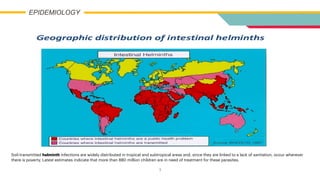
Soil-transmitted helminth infections are widely distributed in tropical and subtropical areas and, since they are linked to a lack of sanitation, occur wherever
there is poverty. Latest estimates indicate that more than 880 million children are in need of treatment for these parasites.
IMMUNITY
4
Helminth The helminths are macroscopic, multicellular organisms, having their
own digestive, excretory, reproductive and nervous system.


Helminthiasis


– A disease in which part of the body is infested with one or more intestinal
parasitic worms such as roundworm, tapeworms or
f
lukes.


– The worms usually infest the intestine but sometimes. they may invade the other
organs.
HELMINTH
5
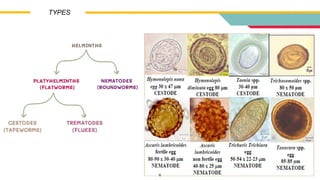
TYPES
6
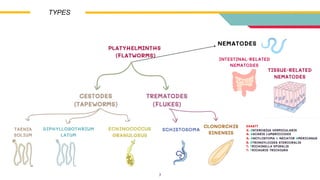
TYPES
7
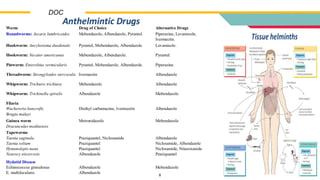
DOC
8
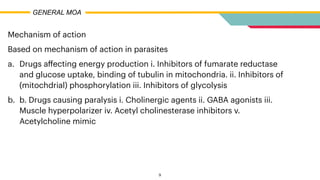
Mechanism of action


Based on mechanism of action in parasites


a. Drugs a
ff
ecting energy production i. Inhibitors of fumarate reductase
and glucose uptake, binding of tubulin in mitochondria. ii. Inhibitors of
(mitochdrial) phosphorylation iii. Inhibitors of glycolysis


b. b. Drugs causing paralysis i. Cholinergic agents ii. GABA agonists iii.
Muscle hyperpolarizer iv. Acetyl cholinesterase inhibitors v.
Acetylcholine mimic
GENERAL MOA
9
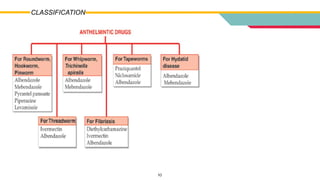
CLASSIFICATION
10
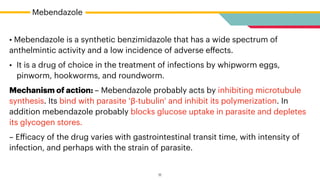
• Mebendazole is a synthetic benzimidazole that has a wide spectrum of
anthelmintic activity and a low incidence of adverse e
ff
ects.


• It is a drug of choice in the treatment of infections by whipworm eggs,
pinworm, hookworms, and roundworm.


Mechanism of action: – Mebendazole probably acts by inhibiting microtubule
synthesis. Its bind with parasite ‘β-tubulin’ and inhibit its polymerization. In
addition mebendazole probably blocks glucose uptake in parasite and depletes
its glycogen stores.


– E
ff
icacy of the drug varies with gastrointestinal transit time, with intensity of
infection, and perhaps with the strain of parasite.
Mebendazole
11
12
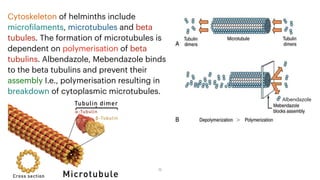
Cytoskeleton of helminths include
micro
f
ilaments, microtubules and beta
tubules. The formation of microtubules is
dependent on polymerisation of beta
tubulins. Albendazole, Mebendazole binds
to the beta tubulins and prevent their
assembly I.e., polymerisation resulting in
breakdown of cytoplasmic microtubules.
Albendazole
Mebendazole
• Pharmacokinetics: – Absorption of mebendazole from intestines is minimal. –
Less than 10% of orally administered mebendazole is absorbed. The absorbed
drug is protein-bound (> 90%), rapidly converted to inactive metabolites
(primarily during its
f
irst pass in the liver), and has a half-life of 2
-
6 hours. – 75 –
90% of oral dose passed in the faeces.


• Dose: – 100 mg chewable tablet. – 100 mg/5ml suspension. – 100 mg tablet. –
Mebendazole is one of the preferred drugs for treatment of multiple infestations
and is more e
ff
ective than albendazole in trichuriasis.
13
• Adverse e
ff
ects:


– Well tolerated even by patient in poor health.


– Mild nausea, vomiting, diarrhea, and abdominal pain have been reported
infrequently. Rare side e
ff
ects, usually with high-dose therapy, are
hypersensitivity reactions (rash, urticaria), agranulocytosis, alopecia, and
elevation of liver enzymes.


– Mebendazole is teratogenic in animals and therefore contraindicated in
pregnancy.


– It should be used with caution in children younger than 2 years of age because
of limited experience and rare reports of convulsions in this age group.
Mebendazole
14
• Albendazole, a broad-spectrum oral anthelmintic of Benzimidazoles group


• It is the drug of choice for treatment of hydatid disease and cysticercosis. It is
also used in the treatment of pinworm and hookworm, round worm, whip worm,
and thread worm infections.


• One dose treatment is e
ff
ective against round worm, pin worm and hook worm
infections which are comparable to 3 days treatment with mebendazole. Three
days treatment is necessary for tapeworms including H. nana. It has weak
micro
f
ilaricidal action.


• MOA is similar to mebendazole.
Albendazole
15
• Clinical Uses:


– Against intestinal nematodes and cestodes as well as against liver
f
lukes (Trematodes).


– Albendazole is administered on an empty stomach when used against intraluminal parasites
but with a fatty meal when used against tissue parasites.


– DOC for Ascariasis, trichuriasis, hookworm and pinworm infections: 400 mg oral/ adult and
children older than 2 years of age (repeated for 2
-
3 days for heavy ascaris infections and in 2
weeks for pinworm infection).


– Hydatid disease: Adjunct to surgical removal or aspiration of cysts. 400 mg twice daily with
meals for one month or longer. Daily therapy for up to 6 months has been well tolerated.


– Neurocysticercosis: Corticosteroids are given with the anthelmintic drug to decrease
in
f
lammation caused by dying organisms. Albendazole is given in a dosage of 400 mg twice a
day for up to 21 days.


– Albendazole + DEC or Ivermectin is a synergistic combination for treating or controlling
lymphatic
f
ilariasis.
Albendazole
16
• Pharmacokinetics:


– Albendazole is erratically absorbed after oral administration, but absorption is enhanced by a
high-fat meal.


– Its metabolized in liver and primarily excreted in urine.


– t½ = approx. 8.5 hours.


Adverse e
ff
ects: (>3mon)


– Mild and transient epigastric distress, diarrhea, headache, nausea, dizziness, lassitude, and
insomnia can occur.


– In long-term use for hydatid disease, albendazole is well tolerated, but it can cause abdominal
distress, headaches, fever, fatigue, alopecia.


– Use in pregnant women is contraindicated. It should be given with caution to patients with
hepatic or renal disease.
Albendazole
17
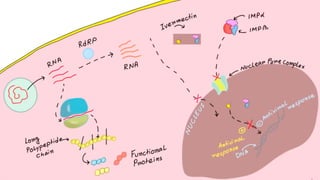
• It is a semi synthetic macrolytic lactone and is a mixture of avermectin B1a and
B1b are obtained from “streptomycin avermitilis”.


Mechanism of action:


• Ivermectin targets the parasite’s and activates nematode speci
f
ic glutamate-
gated chloride channel receptors. Chloride in
f
lux is enhanced, and
hyperpolarization occurs, resulting in paralysis and expulsion of the Paralysed
worm.


• The drug is given orally. It does not cross the blood-brain barrier and has no
pharmacologic e
ff
ects in the CNS. However, it is contraindicated in patients
with meningitis, because their blood-brain barrier is more permeable, making
CNS e
ff
ects possible.


Ivermectin
18
Pharmacokinetics:


• Absorbed from GIT, Wide distribution in the body and excreted in the faeces.


• Dose: 10
-
15 mg oral dose with 400 mg of albendazole. Given annually for 5
-
6
years for
f
ilariasis.
Clinical Uses:


• Is the drug of choice for the treatment of onchocerciasis (river blindness) 6 mon,
age >5y, 150mg/kg oral dose with 400 mg of albendazole, Given annually for 5
-
6
years for
f
ilariasis. strongyloids, Scabies 200mg/kg 2 days.
Adverse e
ff
ects: Fever, Pruritis, hypertension, tachycardia.
Ivermectin
20
Ivermectin
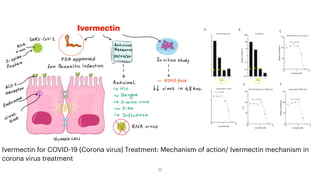
Ivermectin for COVID
-
19 (Corona virus) Treatment: Mechanism of action/ Ivermectin mechanism in
corona virus treatment
21
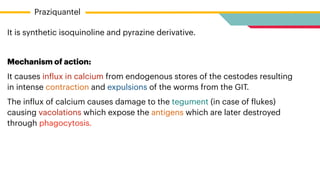
It is synthetic isoquinoline and pyrazine derivative.


Mechanism of action:


It causes in
f
lux in calcium from endogenous stores of the cestodes resulting
in intense contraction and expulsions of the worms from the GIT.


The in
f
lux of calcium causes damage to the tegument (in case of
f
lukes)
causing vacolations which expose the antigens which are later destroyed
through phagocytosis.


Praziquantel
Pharmacokinetics: Readily absorbed orally signi
f
icant
f
irst Pass metabolism in
the liver.


Clinical Uses: DOC for Schistosomiasis (20mg/kg orally BD), In treatment of
tapeworm infestations (10mg/kg orally), in neurocysticercosis.


Adverse e
ff
ects:


(CNS) Headache, dizziness and drowsiness, (GIT) Nausea, Vomiting & abdominal
pain (dermatological) Pruritis, urticaria, skin rashes with eosinophilia.
Praziquantel
Diethyl carbamazine citrate (DEC)


• DEC developed in 1948, and its is the
f
irst drug for
f
ilariasis.


• It is a synthetic piperazine derivative.


(DEC)
24
Mechanism of action:


(i) it alters the micro
f
ilarial membrane surface characteristics so that they are
subsequently phagocytosed by tissue
f
ixed monocytes.


(ii) It also hyper polarises the worms musculature so that these are expelled.


(iii) It also blocks the production of prostaglandins, resulting in capillary
vasoconstriction and impairment of the passage of micro
f
ilariae.
Pharmacokinetics:


• DEC absorbed after oral ingestion, well distributed, metabolized in liver and
excreted in urine. Excretion is faster in acidic urine. Plasma t½ is around 4
-
12
hours.


• Dose adjustments are needed in renal impairment.


Clinical Use: Doc for the treatment of Lymphatic
f
ilariasis,, Chemoprophylaxis
of loiasis (Loa loa) and
f
ilariasis, common regimen 2mg/kg TDS 2
-
3 weeks,
tropical eosinophilia 2mg/kg TDS 7days.


ADR: ADR is common but not serious. Nausea, vomiting, loss of appetite,
headache, general weakness and dizziness.
(DEC)
25
Piperazine


• Piperazine causes hyperpolarization of Ascaris muscle by GABA agonist action
(opening of chloride channels relaxation and decresses responsiveness to
contractile action of Ach).


• Orally active and partly metabolized in liver and excreted in urine.


• ADR: Its safe and well tolerated. Dizziness and excitement occur at high doses.
Toxic dose produce convulsion and death, due to respiratory failure.


• Contraindicated in renal insu
ff
iciency and epileptics), but safe in pregnant.
Piperazine
26
Pyrantel pamoate


• Pyrantel pamoate, along with mebendazole is e
ff
ective in the treatment of
infections caused by roundworms, pinworms and hookworms.


• Pyrantel causes activation of nicotinic cholinergic receptors in the worms
resulting in persistent depolarization, slowly developing contracture and
spastic paralysis.


• Its poorly absorbed orally and exerts its e
ff
ects in the intestinal tract.


• Adverse e
ff
ects : Adverse e
ff
ects are mild and include nausea, vomiting, and
diarrhea.
Pyrantel .p
27
• Thiabendazole e
ff
ective against threadworm, cutaneous larva migrans, and
early stage of trichinosis.


• PK: insoluble in water but readily available for oral absorption. It is
hydroxylated in the liver and excreted in urine.


• MOA: Same as mebendazole. Thiabendazole has antiin
f
lammatory, analgesic
and antipyretic actions. These may contribute to its e
ff
ect in cutaneous larva
migrans and other in
f
lammatory conditions produced by larvae or worms in
tissues.


• ADR: Nausea, vomiting, loss of appetite, headache, giddiness are most
common
Thiab..zole
28
29
•Pharmacology for medical graduates Third edition by Tara V Shanbhag.


•Goodman & Gilman’s The Pharmacological Basis of THERAPEUTICS


•Essentials of Medical Pharmacology [7th Edition] by KD Tripathi


•Rang and Dale 8th Edition By H.P.Rang, J.M. Ritter
REFERENCES
Thank You

Antihelmintics

  • 1.
    Antihelmintics Presented to: Dr. S.N.Manjula. M.Pharm, Ph.D. Professor & Head Department of Pharmacology JSS College of Pharmacy, Mysuru Presented by: Naveen Reddy .P 1st M.Pharm Department of Pharmacology JSS College of Pharmacy, Mysuru Drugs used in the treatment of Helminthiasis 1
  • 2.
    2 Anthelmintic Drugs • Infectionswith helminths, or parasitic worms, a ff ect more than two billion people worldwide. • Anthelmintics are drugs that either kill (vermicide) or expel (vermifuge) infesting helminths. Helminthiasis is prevalent globally (1/3rd of world's population harbours them). • Helminthiasis is more common in developing countries with poorer personal and environmental hygiene. • In the human body, g.i.t. is the abode of many helminths, but some also live in tissues, or their larvae migrate into tissues. • They harm the host by depriving him of food, causing blood loss, injury to organs, intestinal or lymphatic obstruction and by secreting toxins. • Helminthiasis is rarely fatal, but is a major cause of ill health. INTRODUCTION
  • 3.
    3 EPIDEMIOLOGY Soil-transmitted helminth infectionsare widely distributed in tropical and subtropical areas and, since they are linked to a lack of sanitation, occur wherever there is poverty. Latest estimates indicate that more than 880 million children are in need of treatment for these parasites.
  • 4.
  • 5.
    Helminth The helminthsare macroscopic, multicellular organisms, having their own digestive, excretory, reproductive and nervous system. Helminthiasis – A disease in which part of the body is infested with one or more intestinal parasitic worms such as roundworm, tapeworms or f lukes. – The worms usually infest the intestine but sometimes. they may invade the other organs. HELMINTH 5
  • 6.
  • 7.
  • 8.
  • 9.
    Mechanism of action Basedon mechanism of action in parasites a. Drugs a ff ecting energy production i. Inhibitors of fumarate reductase and glucose uptake, binding of tubulin in mitochondria. ii. Inhibitors of (mitochdrial) phosphorylation iii. Inhibitors of glycolysis b. b. Drugs causing paralysis i. Cholinergic agents ii. GABA agonists iii. Muscle hyperpolarizer iv. Acetyl cholinesterase inhibitors v. Acetylcholine mimic GENERAL MOA 9
  • 10.
  • 11.
    • Mebendazole isa synthetic benzimidazole that has a wide spectrum of anthelmintic activity and a low incidence of adverse e ff ects. • It is a drug of choice in the treatment of infections by whipworm eggs, pinworm, hookworms, and roundworm. Mechanism of action: – Mebendazole probably acts by inhibiting microtubule synthesis. Its bind with parasite ‘β-tubulin’ and inhibit its polymerization. In addition mebendazole probably blocks glucose uptake in parasite and depletes its glycogen stores. – E ff icacy of the drug varies with gastrointestinal transit time, with intensity of infection, and perhaps with the strain of parasite. Mebendazole 11
  • 12.
    12 Cytoskeleton of helminthsinclude micro f ilaments, microtubules and beta tubules. The formation of microtubules is dependent on polymerisation of beta tubulins. Albendazole, Mebendazole binds to the beta tubulins and prevent their assembly I.e., polymerisation resulting in breakdown of cytoplasmic microtubules. Albendazole
  • 13.
    Mebendazole • Pharmacokinetics: –Absorption of mebendazole from intestines is minimal. – Less than 10% of orally administered mebendazole is absorbed. The absorbed drug is protein-bound (> 90%), rapidly converted to inactive metabolites (primarily during its f irst pass in the liver), and has a half-life of 2 - 6 hours. – 75 – 90% of oral dose passed in the faeces. • Dose: – 100 mg chewable tablet. – 100 mg/5ml suspension. – 100 mg tablet. – Mebendazole is one of the preferred drugs for treatment of multiple infestations and is more e ff ective than albendazole in trichuriasis. 13
  • 14.
    • Adverse e ff ects: –Well tolerated even by patient in poor health. – Mild nausea, vomiting, diarrhea, and abdominal pain have been reported infrequently. Rare side e ff ects, usually with high-dose therapy, are hypersensitivity reactions (rash, urticaria), agranulocytosis, alopecia, and elevation of liver enzymes. – Mebendazole is teratogenic in animals and therefore contraindicated in pregnancy. – It should be used with caution in children younger than 2 years of age because of limited experience and rare reports of convulsions in this age group. Mebendazole 14
  • 15.
    • Albendazole, abroad-spectrum oral anthelmintic of Benzimidazoles group • It is the drug of choice for treatment of hydatid disease and cysticercosis. It is also used in the treatment of pinworm and hookworm, round worm, whip worm, and thread worm infections. • One dose treatment is e ff ective against round worm, pin worm and hook worm infections which are comparable to 3 days treatment with mebendazole. Three days treatment is necessary for tapeworms including H. nana. It has weak micro f ilaricidal action. • MOA is similar to mebendazole. Albendazole 15
  • 16.
    • Clinical Uses: –Against intestinal nematodes and cestodes as well as against liver f lukes (Trematodes). – Albendazole is administered on an empty stomach when used against intraluminal parasites but with a fatty meal when used against tissue parasites. – DOC for Ascariasis, trichuriasis, hookworm and pinworm infections: 400 mg oral/ adult and children older than 2 years of age (repeated for 2 - 3 days for heavy ascaris infections and in 2 weeks for pinworm infection). – Hydatid disease: Adjunct to surgical removal or aspiration of cysts. 400 mg twice daily with meals for one month or longer. Daily therapy for up to 6 months has been well tolerated. – Neurocysticercosis: Corticosteroids are given with the anthelmintic drug to decrease in f lammation caused by dying organisms. Albendazole is given in a dosage of 400 mg twice a day for up to 21 days. – Albendazole + DEC or Ivermectin is a synergistic combination for treating or controlling lymphatic f ilariasis. Albendazole 16
  • 17.
    • Pharmacokinetics: – Albendazoleis erratically absorbed after oral administration, but absorption is enhanced by a high-fat meal. – Its metabolized in liver and primarily excreted in urine. – t½ = approx. 8.5 hours. Adverse e ff ects: (>3mon) – Mild and transient epigastric distress, diarrhea, headache, nausea, dizziness, lassitude, and insomnia can occur. – In long-term use for hydatid disease, albendazole is well tolerated, but it can cause abdominal distress, headaches, fever, fatigue, alopecia. – Use in pregnant women is contraindicated. It should be given with caution to patients with hepatic or renal disease. Albendazole 17
  • 18.
    • It isa semi synthetic macrolytic lactone and is a mixture of avermectin B1a and B1b are obtained from “streptomycin avermitilis”. Mechanism of action: • Ivermectin targets the parasite’s and activates nematode speci f ic glutamate- gated chloride channel receptors. Chloride in f lux is enhanced, and hyperpolarization occurs, resulting in paralysis and expulsion of the Paralysed worm. • The drug is given orally. It does not cross the blood-brain barrier and has no pharmacologic e ff ects in the CNS. However, it is contraindicated in patients with meningitis, because their blood-brain barrier is more permeable, making CNS e ff ects possible. Ivermectin 18
  • 19.
    Pharmacokinetics: • Absorbed fromGIT, Wide distribution in the body and excreted in the faeces. • Dose: 10 - 15 mg oral dose with 400 mg of albendazole. Given annually for 5 - 6 years for f ilariasis. Clinical Uses: • Is the drug of choice for the treatment of onchocerciasis (river blindness) 6 mon, age >5y, 150mg/kg oral dose with 400 mg of albendazole, Given annually for 5 - 6 years for f ilariasis. strongyloids, Scabies 200mg/kg 2 days. Adverse e ff ects: Fever, Pruritis, hypertension, tachycardia. Ivermectin
  • 20.
    20 Ivermectin Ivermectin for COVID - 19(Corona virus) Treatment: Mechanism of action/ Ivermectin mechanism in corona virus treatment
  • 21.
  • 22.
    It is syntheticisoquinoline and pyrazine derivative. Mechanism of action: It causes in f lux in calcium from endogenous stores of the cestodes resulting in intense contraction and expulsions of the worms from the GIT. The in f lux of calcium causes damage to the tegument (in case of f lukes) causing vacolations which expose the antigens which are later destroyed through phagocytosis. Praziquantel
  • 23.
    Pharmacokinetics: Readily absorbedorally signi f icant f irst Pass metabolism in the liver. Clinical Uses: DOC for Schistosomiasis (20mg/kg orally BD), In treatment of tapeworm infestations (10mg/kg orally), in neurocysticercosis. Adverse e ff ects: (CNS) Headache, dizziness and drowsiness, (GIT) Nausea, Vomiting & abdominal pain (dermatological) Pruritis, urticaria, skin rashes with eosinophilia. Praziquantel
  • 24.
    Diethyl carbamazine citrate(DEC) • DEC developed in 1948, and its is the f irst drug for f ilariasis. • It is a synthetic piperazine derivative. (DEC) 24 Mechanism of action: (i) it alters the micro f ilarial membrane surface characteristics so that they are subsequently phagocytosed by tissue f ixed monocytes. (ii) It also hyper polarises the worms musculature so that these are expelled. (iii) It also blocks the production of prostaglandins, resulting in capillary vasoconstriction and impairment of the passage of micro f ilariae.
  • 25.
    Pharmacokinetics: • DEC absorbedafter oral ingestion, well distributed, metabolized in liver and excreted in urine. Excretion is faster in acidic urine. Plasma t½ is around 4 - 12 hours. • Dose adjustments are needed in renal impairment. Clinical Use: Doc for the treatment of Lymphatic f ilariasis,, Chemoprophylaxis of loiasis (Loa loa) and f ilariasis, common regimen 2mg/kg TDS 2 - 3 weeks, tropical eosinophilia 2mg/kg TDS 7days. ADR: ADR is common but not serious. Nausea, vomiting, loss of appetite, headache, general weakness and dizziness. (DEC) 25
  • 26.
    Piperazine • Piperazine causeshyperpolarization of Ascaris muscle by GABA agonist action (opening of chloride channels relaxation and decresses responsiveness to contractile action of Ach). • Orally active and partly metabolized in liver and excreted in urine. • ADR: Its safe and well tolerated. Dizziness and excitement occur at high doses. Toxic dose produce convulsion and death, due to respiratory failure. • Contraindicated in renal insu ff iciency and epileptics), but safe in pregnant. Piperazine 26
  • 27.
    Pyrantel pamoate • Pyrantelpamoate, along with mebendazole is e ff ective in the treatment of infections caused by roundworms, pinworms and hookworms. • Pyrantel causes activation of nicotinic cholinergic receptors in the worms resulting in persistent depolarization, slowly developing contracture and spastic paralysis. • Its poorly absorbed orally and exerts its e ff ects in the intestinal tract. • Adverse e ff ects : Adverse e ff ects are mild and include nausea, vomiting, and diarrhea. Pyrantel .p 27
  • 28.
    • Thiabendazole e ff ectiveagainst threadworm, cutaneous larva migrans, and early stage of trichinosis. • PK: insoluble in water but readily available for oral absorption. It is hydroxylated in the liver and excreted in urine. • MOA: Same as mebendazole. Thiabendazole has antiin f lammatory, analgesic and antipyretic actions. These may contribute to its e ff ect in cutaneous larva migrans and other in f lammatory conditions produced by larvae or worms in tissues. • ADR: Nausea, vomiting, loss of appetite, headache, giddiness are most common Thiab..zole 28
  • 29.
    29 •Pharmacology for medicalgraduates Third edition by Tara V Shanbhag. •Goodman & Gilman’s The Pharmacological Basis of THERAPEUTICS •Essentials of Medical Pharmacology [7th Edition] by KD Tripathi •Rang and Dale 8th Edition By H.P.Rang, J.M. Ritter REFERENCES Thank You