Anti-helminthic drugs
By
Dr. ALKA BANSAL
Associate Professor, Deptt. of Pharmacology, SMSMC,
Jaipur
Introduction
Helminths are macroscopic pathogenic organisms which cause
disease of intestine and/ or tissues in human.
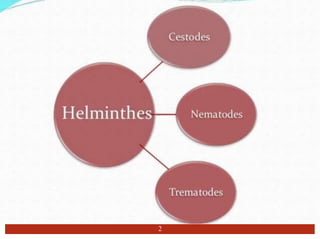
Trematodes and cestodes together are called flatworms or
platyhelminths.Nematodes are also called roundworms.
2
2/16/2015Dr. Nehal Afifi 11
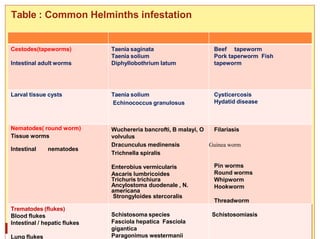
Table : Common Helminths infestation
Cestodes(tapeworms)
Intestinal adult worms
Taenia saginata
Taenia solium
Diphyllobothrium latum
Beef tapeworm
Pork taperworm Fish
tapeworm
Larval tissue cysts Taenia solium
Echinococcus granulosus
Cysticercosis
Hydatid disease
Nematodes( round worm)
Tissue worms
Intestinal nematodes
Wuchereria bancrofti, B malayi, O
volvulus
Dracunculus medinensis
Trichnella spiralis
Enterobius vermicularis
Ascaris lumbricoides
Trichuris trichiura
Ancylostoma duodenale , N.
americana
Strongyloides stercoralis
Filariasis
Guinea worm
Pin worms
Round worms
Whipworm
Hookworm
Threadworm
Trematodes (flukes)
Blood flukes
Intestinal / hepatic flukes
Lung flukes
Schistosoma species
Fasciola hepatica Fasciola
gigantica
Paragonimus westermanii
Schistosomiasis
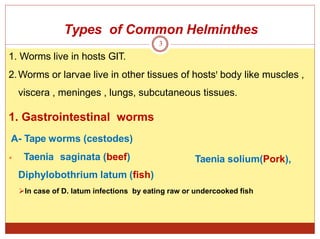
Types of Common Helminthes
Taenia solium(Pork),
1. Gastrointestinal worms
A- Tape worms (cestodes)
 Taenia saginata (beef)
Diphylobothrium latum (fish)
3
1. Worms live in hosts GIT.
2.Worms or larvae live in other tissues of hostsꞌ body like muscles ,
viscera , meninges , lungs, subcutaneous tissues.
In case of D. latum infections by eating raw or undercooked fish
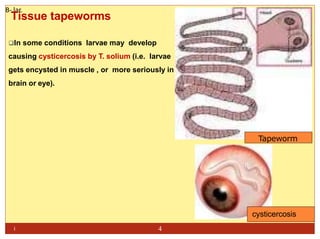
B- lar.
Tapeworm
Tissue tapeworms
In some conditions larvae may develop
causing cysticercosis by T. solium (i.e. larvae
gets encysted in muscle , or more seriously in
brain or eye).
cysticercosis
4i
-
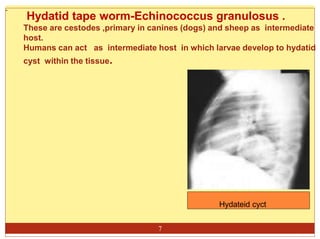
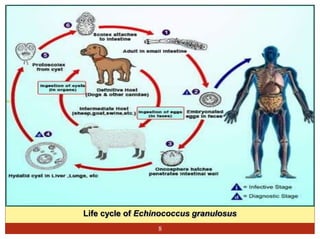
Hydatid tape worm-Echinococcus granulosus .
These are cestodes ,primary in canines (dogs) and sheep as intermediate
host.
Humans can act as intermediate host in which larvae develop to hydatid
cyst within the tissue.
Hydateid cyct
7
Life cycle of Echinococcus granulosus
8
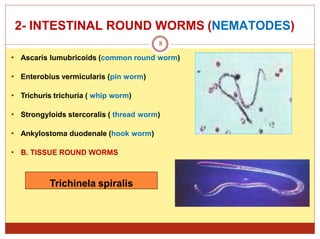
2- INTESTINAL ROUND WORMS (NEMATODES)
• Ascaris lumubricoids (common round worm)
• Enterobius vermicularis (pin worm)
• Trichuris trichuria ( whip worm)
• Strongyloids stercoralis ( thread worm)
• Ankylostoma duodenale (hook worm)
• B. TISSUE ROUND WORMS
8
Trichinela spiralis
9
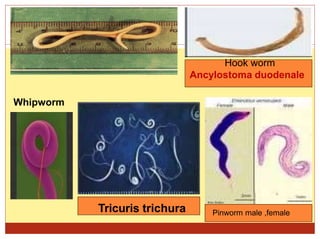
Ascaris lumbricoids (Comm R.W.) Hook worm
Ancylostoma duodenale
Tricuris trichura
Whipworm
Pinworm male ,female
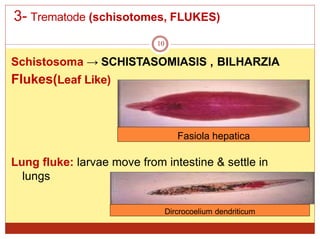
3- Trematode (schisotomes, FLUKES)
Schistosoma → SCHISTASOMIASIS , BILHARZIA
Flukes(Leaf Like)
Lung fluke: larvae move from intestine & settle in
lungs
10
Fasiola hepatica
Dircrocoelium dendriticum
Anthelmintic Drugs
i
12
 Anti : against & helminthes : worms
 Drugs kill or expel the internal parasitic worms infesting
GIT & other tissues of man and animals.
 Helminths harm by depriving of food, causing blood loss,
injury to organs, intestinal or lymphatic obstruction and by
secreting toxins.
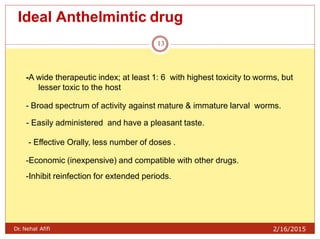
Ideal Anthelmintic drug
Dr. Nehal Afifi 2/16/2015
13
-A wide therapeutic index; at least 1: 6 with highest toxicity to worms, but
lesser toxic to the host
- Broad spectrum of activity against mature & immature larval worms.
- Easily administered and have a pleasant taste.
- Effective Orally, less number of doses .
-Economic (inexpensive) and compatible with other drugs.
-Inhibit reinfection for extended periods.
2/16/2015Dr. Nehal Afifi 14
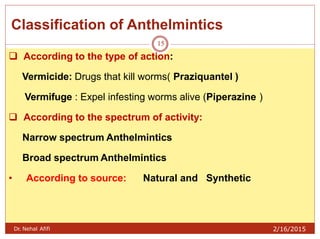
Classification of Anthelmintics
2/16/2015Dr. Nehal Afifi
15
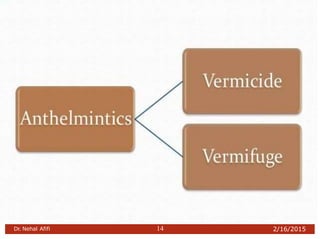
 According to the type of action:
Vermicide: Drugs that kill worms( Praziquantel )
Vermifuge : Expel infesting worms alive (Piperazine )
 According to the spectrum of activity:
Narrow spectrum Anthelmintics
Broad spectrum Anthelmintics
• According to source: Natural and Synthetic
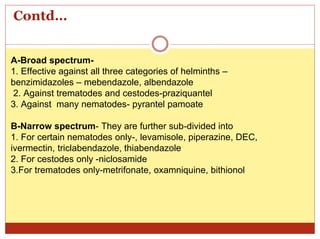
Contd…
A-Broad spectrum-
1. Effective against all three categories of helminths –
benzimidazoles – mebendazole, albendazole
2. Against trematodes and cestodes-praziquantel
3. Against many nematodes- pyrantel pamoate
B-Narrow spectrum- They are further sub-divided into
1. For certain nematodes only-, levamisole, piperazine, DEC,
ivermectin, triclabendazole, thiabendazole
2. For cestodes only -niclosamide
3.For trematodes only-metrifonate, oxamniquine, bithionol
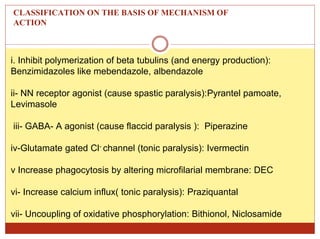
CLASSIFICATION ON THE BASIS OF MECHANISM OF
ACTION
i. Inhibit polymerization of beta tubulins (and energy production):
Benzimidazoles like mebendazole, albendazole
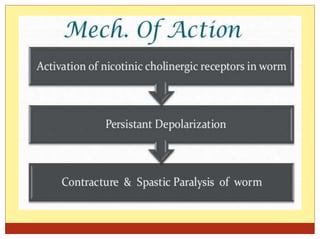
ii- NN receptor agonist (cause spastic paralysis):Pyrantel pamoate,
Levimasole
iii- GABA- A agonist (cause flaccid paralysis ): Piperazine
iv-Glutamate gated Cl- channel (tonic paralysis): Ivermectin
v Increase phagocytosis by altering microfilarial membrane: DEC
vi- Increase calcium influx( tonic paralysis): Praziquantal
vii- Uncoupling of oxidative phosphorylation: Bithionol, Niclosamide
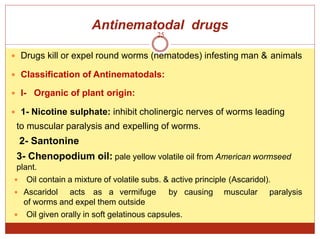
Antinematodal drugs
25
 Drugs kill or expel round worms (nematodes) infesting man & animals
 Classification of Antinematodals:
 I- Organic of plant origin:
 1- Nicotine sulphate: inhibit cholinergic nerves of worms leading
to muscular paralysis and expelling of worms.
2- Santonine
3- Chenopodium oil: pale yellow volatile oil from American wormseed
plant.
 Oil contain a mixture of volatile subs. & active principle (Ascaridol).
 Ascaridol acts as a vermifuge by causing muscular paralysis
of worms and expel them outside
 Oil given orally in soft gelatinous capsules.
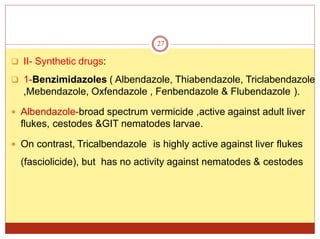
 II- Synthetic drugs:
 1-Benzimidazoles ( Albendazole, Thiabendazole, Triclabendazole
,Mebendazole, Oxfendazole , Fenbendazole & Flubendazole ).
 Albendazole-broad spectrum vermicide ,active against adult liver
flukes, cestodes &GIT nematodes larvae.
 On contrast, Tricalbendazole is highly active against liver flukes
(fasciolicide), but has no activity against nematodes & cestodes
27
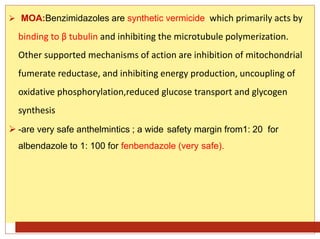
 MOA:Benzimidazoles are synthetic vermicide which primarily acts by
binding to β tubulin and inhibiting the microtubule polymerization.
Other supported mechanisms of action are inhibition of mitochondrial
fumerate reductase, and inhibiting energy production, uncoupling of
oxidative phosphorylation,reduced glucose transport and glycogen
synthesis
 -are very safe anthelmintics ; a wide safety margin from1: 20 for
albendazole to 1: 100 for fenbendazole (very safe).
Albendazole
Drugs of choice in
1. Ascaris, necator, enterobius, ancyclostoma in single dose of
400mg. It is taken for three days for heavy infestation. Dose is
reduced to 200mg in children less than two years. In enterobius
second dose is given two weeks apart.
2. For Tapeworms ,Strongyloides,- 400mg OD for three days.
3. For Trichinella 400mg BD for three days but not effective on larva
migrated to muscles.
4. For Cutaneus larva migrans caused by Ancylostoma braziliense
and Ancylostoma caninum- 400mg OD for 3-5 days .
5. In Visceral larva migrans by Toxocara canis and catti-400mg BD
for 28 days
6. Neurocysticercosis caused by T. solium cercarie reaching the
brain -400mg BD for 3 to 28 days. (Steroids and anticonvulsants
are added to suppress the inflammation and to check the
convulsions. Albendazole is preferred over praziquantel for its
better penetration, high cure rate, shorter duration of action and is
cheaper).
7.Hydatid disease by Echinococcus granulosis, alveolar
echinococcosis by E. multilocularis-400mg BD for28 days.
8. Alternative and equally effective drug for-trichuriasis, enterobius
in 400mg single dose.
9. Clonorchicsinensis (liver fluke) - 400mg BD for 7 days.
Prophylaxis-
9. Filariasis – 400 mg albendazole yearly added to DEC/ Ivermectin
as adjuvant for mass prophylaxis as recommended by WHO.
10. Other uses of albendazole are T vaginalis, G lamblia,
microsporidial species (enterocytozoonbieneusi , encephalitozoon
intestinalis) which cause intestinal infection in AIDS.
Mebendazole
Drug of choice in Trichuriasis and multiple infestations by
roundworm-100 mg BD for three consecutive days.
Alternative to Albendazole in-
2. Pin worm- 100 mg single dose for 2years and above,repeated
after 2-3 weeks if required. Maintain proper hygiene and treat all
contacts simultaneously.
3. Ascaris / hookworm-100 mg BD for three days or 500 mg single
dose (less effective)
4. Trichinella spiralis -200mg BD for four days.
5. Hydatid - 200-400 mg BD or TDS for three to four weeks.
Alternative to metronidazole in guinea worm infection
Triclabendazole- liver fluke
Thiabendazole-additional anti-inflammatory, analgesic, antipyretic
properties. It can be applied locally for cutaneous larva migrans
and trichinella two to three times daily for 5 days
PK &A/e - benzimidazoles
- Well absorbed and tolerated even by patients with poor health.
Albenda produces active sulfoxide moiety so potent &prolonged
action
Taken with fatty food especially for neurocysticercosis and hydatid
disease.
- include nausea, vomiting, abdominal pain diarrhea.
-incidences of starvation of ascaris and its migration leading
expulsion from mouth and nose have been reported eith
mebendazole.
Contraindication :Pregnancy
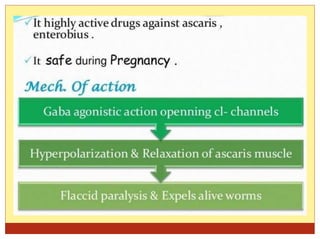
2- Tetrahydropyrimidine derivatives ( Pyrantel , Oxantel,
Morantel)
30
Pyrantel pamoate:
 A broad specturm anthelmintic , highly effective against adult &
larval nematodes .
 Not active against lung worms and whipworms.
 Oxantel : Narrow spectrum
 MOA: Pyrantel is a depolarizing neuromuscular blocking agent ;
cause release of acetylcholine & inhibition of cholinesterase enz.
leading to muscular paralysis & death (Vermicide).
 Morantel in ruminants used as a drench or "protect bolus"
to provide prolonged protection for 90 days ( slowly released).
32
Pyrantel Clinical uses :
For Pin worm, Ascariasis & ancyclostoma as a single dose of
10mg/kg and repeated after 2 wks.
Three days course for Necator & strongyloides
-Pyrantel given orally with or without food.
No fasting , purging required.
-
A/E
-mild nausea, vomiting, diarrhoea, abdominal pain.
-Contraindicated in pregnancy and in children less than 2 years.
DI- Not given with piperazine as both have opposite mechanism of
action. While pyrantel causes spastic paralysis, piperazine causes
flaccid paralysis.
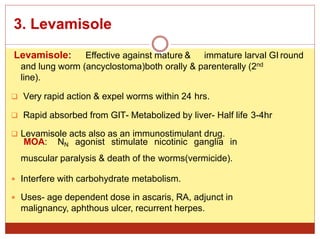
3. Levamisole
Levamisole: Effective against mature & immature larval GI round
and lung worm (ancyclostoma)both orally & parenterally (2nd
line).
 Very rapid action & expel worms within 24 hrs.
 Rapid absorbed from GIT- Metabolized by liver- Half life 3-4hr
 Levamisole acts also as an immunostimulant drug.
MOA: NN agonist stimulate nicotinic ganglia in
muscular paralysis & death of the worms(vermicide).
 Interfere with carbohydrate metabolism.
 Uses- age dependent dose in ascaris, RA, adjunct in
malignancy, aphthous ulcer, recurrent herpes.
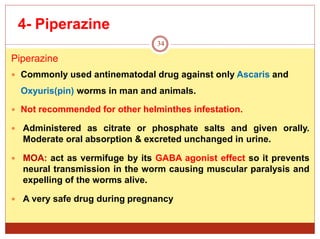
4- Piperazine
34
Piperazine
 Commonly used antinematodal drug against only Ascaris and
Oxyuris(pin) worms in man and animals.
 Not recommended for other helminthes infestation.
 Administered as citrate or phosphate salts and given orally.
Moderate oral absorption & excreted unchanged in urine.
 MOA: act as vermifuge by its GABA agonist effect so it prevents
neural transmission in the worm causing muscular paralysis and
expelling of the worms alive.
 A very safe drug during pregnancy
5- Diethyl Carbamazine (DEC)
36
 A highly soluble piperazine derivative → rapidly absorbed &
distributed throughout the body.
 Drug of choice for treatment of Filariasis .
 Highly selective effect on microfilaria. Adult of O.volvulus is
not killed.
 Enhances cell mediated immunity
 Safe for use in pregnant & young.
 MOA: DEC disrupt the microtubules & inhibit microtubules
polymerization in microfilaria.
 MOA: 1- DEC Immobilize microfilaria & alter their membrane structure
displacing them from tissues & making them susceptible to destruction by host
defense mechanism.
 2.Alternation of microfilaria membrane → phagocytosed by fixed tissue
monocytes.
 3.Affect muscular activity and cause hyper polarization due to piperazine
moiety.
 The drug should be given after meals.
 Uses: filariasis 2mg/kg TDS for 12 days to 21 days.
 tropical pulmonary eosinophilia
 A/e- febrile reaction; minimizedby low dose, antihistaminics, steroids
6- Ivermectin (endectocide)
38
Endectocides are drugs effective against both arthropodes &
nematode both.
One of Avermectins that is highly effective against nematodes, mites, lice & ticks .
 has no activity against cestodes and flukes.
 Given orally or S/C at very low doses (o.2mg /kg)
 MOA: act as vermicide causing paralysis of worms by
 i)special glutamate gated Cl- channels(absent in flukes, tapeworms)
 ii) intensifying the action of the inhibitory transmitter GABA at neuromuscular
junction → paralysis and death of the worms.
IVERMECTIN Pharmacokinetics
 Rapidly absorbed & widely distributed .
 Does not cross BBB
 Half- life 2-3 days & Excretion mainly in feces.
Uses: DOC for onchocerciasis (river blindness) and strongyloidosis
(single dose) . Scabies, pediculosis given orally. With 400 mg
albendazole annually for filariasis prophylaxis.
A/e- mild pruritus, giddiness, nausea , abdominal pain, due to
degradation products of Mf.
Contraindication: Pregnancy.
 Concurrent use with other drugs that enhance GABA
e.g Barbiturates, valproaic acid & benzodiazepines.
Anticestodal drugs
 Drugs kill or expel tape worms (Cestodes) infesting man & animals.
 Classification of Anticestodals:
 I- Organic of plant origin:
1.Arecoline:orally as vermifuge,Effective against Taenia species
infesting dogs and cats.
 MOA: by inducing muscular paralysis of worms so lose their
attachment with intestinal mucosa & increase intestinal motility of
host ( as a neuromuscular purgative) → expel detached worms alive
2.Kamala powder: A red powder act as vermifuge due to its irritant
effect so expels worms alive.
 Given orally and effective against cestodes infesting poultry
Niclosamide
19
 A salicylanilide derivative
 Vermicide drug for treatment of tape worm infestation.
 Not effective against cysticercosis or hydatic disease.
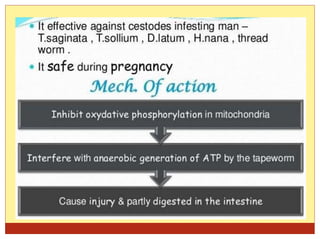
 MOA: Adult worm killed by inhibiting the mitochondrial phosphorylation
process thus inhibiting energy production in worms.
 Pharmacokinetic: Niclosamide poorly absorbed & very rapidly excreted
 has a 5 to 7 folds safety margin
 Given in a single dose on empty stomach & a purgative use after 2 hrs
because partial digestion may release eggs in t. solium which can then
cause visceral cysticercosis.
Prazequantel
22
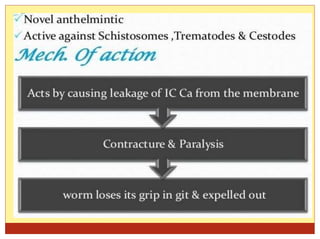
 A broad Spectrum ( Novel Anthelmintic)
 Actives against Cestodes – Schistosomes -Trematodes
 Effective against all adult, juvenile Cestodes & their larval forms in
dogs & cats
 A potent schistosomicide with a high activity against Bl. flukes causing
bilharziasis in man.
 MO A :Act as vermicide by 1- interfering with ionic balance due to
leakage of IC Ca. from membrane causing rapid muscular contraction
2. causing vacuolation → disruption of worm tegument & death. .
 kinetics: Praziquantel given orally or (S/C) . Rapidly absorbed &
metabolized
 safety margin reaches 1:40 of the recommended dose.
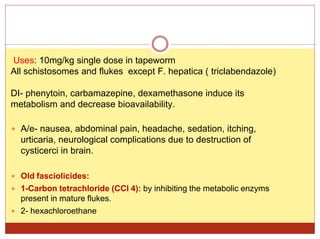
Uses: 10mg/kg single dose in tapeworm
All schistosomes and flukes except F. hepatica ( triclabendazole)
DI- phenytoin, carbamazepine, dexamethasone induce its
metabolism and decrease bioavailability.
 A/e- nausea, abdominal pain, headache, sedation, itching,
urticaria, neurological complications due to destruction of
cysticerci in brain.
 Old fasciolicides:
 1-Carbon tetrachloride (CCl 4): by inhibiting the metabolic enzyms
present in mature flukes.
 2- hexachloroethane
Important
i
41
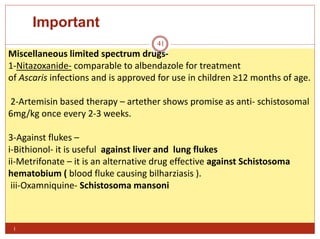
Miscellaneous limited spectrum drugs-
1-Nitazoxanide- comparable to albendazole for treatment
of Ascaris infections and is approved for use in children ≥12 months of age.
2-Artemisin based therapy – artether shows promise as anti- schistosomal
6mg/kg once every 2-3 weeks.
3-Against flukes –
i-Bithionol- it is useful against liver and lung flukes
ii-Metrifonate – it is an alternative drug effective against Schistosoma
hematobium ( blood fluke causing bilharziasis ).
iii-Oxamniquine- Schistosoma mansoni
Summary-
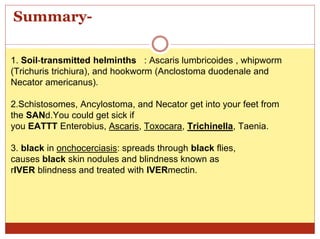
1. Soil-transmitted helminths : Ascaris lumbricoides , whipworm
(Trichuris trichiura), and hookworm (Anclostoma duodenale and
Necator americanus).
2.Schistosomes, Ancylostoma, and Necator get into your feet from
the SANd.You could get sick if
you EATTT Enterobius, Ascaris, Toxocara, Trichinella, Taenia.
3. black in onchocerciasis: spreads through black flies,
causes black skin nodules and blindness known as
rIVER blindness and treated with IVERmectin.
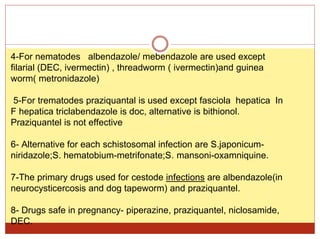
4-For nematodes albendazole/ mebendazole are used except
filarial (DEC, ivermectin) , threadworm ( ivermectin)and guinea
worm( metronidazole)
5-For trematodes praziquantal is used except fasciola hepatica In
F hepatica triclabendazole is doc, alternative is bithionol.
Praziquantel is not effective
6- Alternative for each schistosomal infection are S.japonicum-
niridazole;S. hematobium-metrifonate;S. mansoni-oxamniquine.
7-The primary drugs used for cestode infections are albendazole(in
neurocysticercosis and dog tapeworm) and praziquantel.
8- Drugs safe in pregnancy- piperazine, praziquantel, niclosamide,
DEC.
Q&A
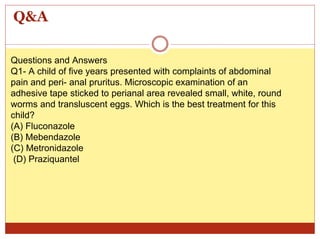
Questions and Answers
Q1- A child of five years presented with complaints of abdominal
pain and peri- anal pruritus. Microscopic examination of an
adhesive tape sticked to perianal area revealed small, white, round
worms and transluscent eggs. Which is the best treatment for this
child?
(A) Fluconazole
(B) Mebendazole
(C) Metronidazole
(D) Praziquantel
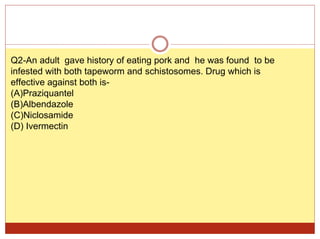
Q2-An adult gave history of eating pork and he was found to be
infested with both tapeworm and schistosomes. Drug which is
effective against both is-
(A)Praziquantel
(B)Albendazole
(C)Niclosamide
(D) Ivermectin
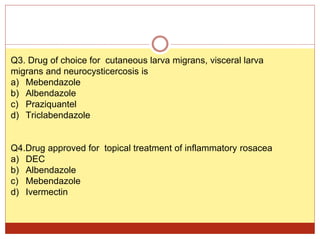
Q3. Drug of choice for cutaneous larva migrans, visceral larva
migrans and neurocysticercosis is
a) Mebendazole
b) Albendazole
c) Praziquantel
d) Triclabendazole
Q4.Drug approved for topical treatment of inflammatory rosacea
a) DEC
b) Albendazole
c) Mebendazole
d) Ivermectin
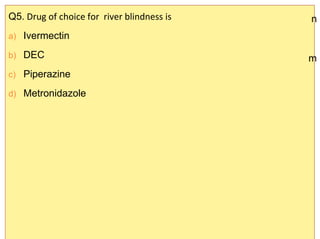
Q5. Drug of choice for river blindness is
a) Ivermectin
b) DEC
c) Piperazine
d) Metronidazole
n
m
Anti helminthes - 25-7-20

Anti helminthes - 25-7-20

  • 1.
    Anti-helminthic drugs By Dr. ALKABANSAL Associate Professor, Deptt. of Pharmacology, SMSMC, Jaipur
  • 2.
    Introduction Helminths are macroscopicpathogenic organisms which cause disease of intestine and/ or tissues in human. Trematodes and cestodes together are called flatworms or platyhelminths.Nematodes are also called roundworms.
  • 3.
  • 4.
    2/16/2015Dr. Nehal Afifi11 Table : Common Helminths infestation Cestodes(tapeworms) Intestinal adult worms Taenia saginata Taenia solium Diphyllobothrium latum Beef tapeworm Pork taperworm Fish tapeworm Larval tissue cysts Taenia solium Echinococcus granulosus Cysticercosis Hydatid disease Nematodes( round worm) Tissue worms Intestinal nematodes Wuchereria bancrofti, B malayi, O volvulus Dracunculus medinensis Trichnella spiralis Enterobius vermicularis Ascaris lumbricoides Trichuris trichiura Ancylostoma duodenale , N. americana Strongyloides stercoralis Filariasis Guinea worm Pin worms Round worms Whipworm Hookworm Threadworm Trematodes (flukes) Blood flukes Intestinal / hepatic flukes Lung flukes Schistosoma species Fasciola hepatica Fasciola gigantica Paragonimus westermanii Schistosomiasis
  • 5.
    Types of CommonHelminthes Taenia solium(Pork), 1. Gastrointestinal worms A- Tape worms (cestodes)  Taenia saginata (beef) Diphylobothrium latum (fish) 3 1. Worms live in hosts GIT. 2.Worms or larvae live in other tissues of hostsꞌ body like muscles , viscera , meninges , lungs, subcutaneous tissues. In case of D. latum infections by eating raw or undercooked fish
  • 6.
    B- lar. Tapeworm Tissue tapeworms Insome conditions larvae may develop causing cysticercosis by T. solium (i.e. larvae gets encysted in muscle , or more seriously in brain or eye). cysticercosis 4i
  • 7.
    - Hydatid tape worm-Echinococcusgranulosus . These are cestodes ,primary in canines (dogs) and sheep as intermediate host. Humans can act as intermediate host in which larvae develop to hydatid cyst within the tissue. Hydateid cyct 7
  • 8.
    Life cycle ofEchinococcus granulosus 8
  • 9.
    2- INTESTINAL ROUNDWORMS (NEMATODES) • Ascaris lumubricoids (common round worm) • Enterobius vermicularis (pin worm) • Trichuris trichuria ( whip worm) • Strongyloids stercoralis ( thread worm) • Ankylostoma duodenale (hook worm) • B. TISSUE ROUND WORMS 8 Trichinela spiralis
  • 10.
    9 Ascaris lumbricoids (CommR.W.) Hook worm Ancylostoma duodenale Tricuris trichura Whipworm Pinworm male ,female
  • 11.
    3- Trematode (schisotomes,FLUKES) Schistosoma → SCHISTASOMIASIS , BILHARZIA Flukes(Leaf Like) Lung fluke: larvae move from intestine & settle in lungs 10 Fasiola hepatica Dircrocoelium dendriticum
  • 12.
    Anthelmintic Drugs i 12  Anti: against & helminthes : worms  Drugs kill or expel the internal parasitic worms infesting GIT & other tissues of man and animals.  Helminths harm by depriving of food, causing blood loss, injury to organs, intestinal or lymphatic obstruction and by secreting toxins.
  • 13.
    Ideal Anthelmintic drug Dr.Nehal Afifi 2/16/2015 13 -A wide therapeutic index; at least 1: 6 with highest toxicity to worms, but lesser toxic to the host - Broad spectrum of activity against mature & immature larval worms. - Easily administered and have a pleasant taste. - Effective Orally, less number of doses . -Economic (inexpensive) and compatible with other drugs. -Inhibit reinfection for extended periods.
  • 14.
  • 15.
    Classification of Anthelmintics 2/16/2015Dr.Nehal Afifi 15  According to the type of action: Vermicide: Drugs that kill worms( Praziquantel ) Vermifuge : Expel infesting worms alive (Piperazine )  According to the spectrum of activity: Narrow spectrum Anthelmintics Broad spectrum Anthelmintics • According to source: Natural and Synthetic
  • 16.
    Contd… A-Broad spectrum- 1. Effectiveagainst all three categories of helminths – benzimidazoles – mebendazole, albendazole 2. Against trematodes and cestodes-praziquantel 3. Against many nematodes- pyrantel pamoate B-Narrow spectrum- They are further sub-divided into 1. For certain nematodes only-, levamisole, piperazine, DEC, ivermectin, triclabendazole, thiabendazole 2. For cestodes only -niclosamide 3.For trematodes only-metrifonate, oxamniquine, bithionol
  • 17.
    CLASSIFICATION ON THEBASIS OF MECHANISM OF ACTION i. Inhibit polymerization of beta tubulins (and energy production): Benzimidazoles like mebendazole, albendazole ii- NN receptor agonist (cause spastic paralysis):Pyrantel pamoate, Levimasole iii- GABA- A agonist (cause flaccid paralysis ): Piperazine iv-Glutamate gated Cl- channel (tonic paralysis): Ivermectin v Increase phagocytosis by altering microfilarial membrane: DEC vi- Increase calcium influx( tonic paralysis): Praziquantal vii- Uncoupling of oxidative phosphorylation: Bithionol, Niclosamide
  • 18.
    Antinematodal drugs 25  Drugskill or expel round worms (nematodes) infesting man & animals  Classification of Antinematodals:  I- Organic of plant origin:  1- Nicotine sulphate: inhibit cholinergic nerves of worms leading to muscular paralysis and expelling of worms. 2- Santonine 3- Chenopodium oil: pale yellow volatile oil from American wormseed plant.  Oil contain a mixture of volatile subs. & active principle (Ascaridol).  Ascaridol acts as a vermifuge by causing muscular paralysis of worms and expel them outside  Oil given orally in soft gelatinous capsules.
  • 19.
     II- Syntheticdrugs:  1-Benzimidazoles ( Albendazole, Thiabendazole, Triclabendazole ,Mebendazole, Oxfendazole , Fenbendazole & Flubendazole ).  Albendazole-broad spectrum vermicide ,active against adult liver flukes, cestodes &GIT nematodes larvae.  On contrast, Tricalbendazole is highly active against liver flukes (fasciolicide), but has no activity against nematodes & cestodes 27
  • 20.
     MOA:Benzimidazoles aresynthetic vermicide which primarily acts by binding to β tubulin and inhibiting the microtubule polymerization. Other supported mechanisms of action are inhibition of mitochondrial fumerate reductase, and inhibiting energy production, uncoupling of oxidative phosphorylation,reduced glucose transport and glycogen synthesis  -are very safe anthelmintics ; a wide safety margin from1: 20 for albendazole to 1: 100 for fenbendazole (very safe).
  • 21.
    Albendazole Drugs of choicein 1. Ascaris, necator, enterobius, ancyclostoma in single dose of 400mg. It is taken for three days for heavy infestation. Dose is reduced to 200mg in children less than two years. In enterobius second dose is given two weeks apart. 2. For Tapeworms ,Strongyloides,- 400mg OD for three days. 3. For Trichinella 400mg BD for three days but not effective on larva migrated to muscles. 4. For Cutaneus larva migrans caused by Ancylostoma braziliense and Ancylostoma caninum- 400mg OD for 3-5 days . 5. In Visceral larva migrans by Toxocara canis and catti-400mg BD for 28 days
  • 22.
    6. Neurocysticercosis causedby T. solium cercarie reaching the brain -400mg BD for 3 to 28 days. (Steroids and anticonvulsants are added to suppress the inflammation and to check the convulsions. Albendazole is preferred over praziquantel for its better penetration, high cure rate, shorter duration of action and is cheaper). 7.Hydatid disease by Echinococcus granulosis, alveolar echinococcosis by E. multilocularis-400mg BD for28 days. 8. Alternative and equally effective drug for-trichuriasis, enterobius in 400mg single dose. 9. Clonorchicsinensis (liver fluke) - 400mg BD for 7 days.
  • 23.
    Prophylaxis- 9. Filariasis –400 mg albendazole yearly added to DEC/ Ivermectin as adjuvant for mass prophylaxis as recommended by WHO. 10. Other uses of albendazole are T vaginalis, G lamblia, microsporidial species (enterocytozoonbieneusi , encephalitozoon intestinalis) which cause intestinal infection in AIDS.
  • 24.
    Mebendazole Drug of choicein Trichuriasis and multiple infestations by roundworm-100 mg BD for three consecutive days. Alternative to Albendazole in- 2. Pin worm- 100 mg single dose for 2years and above,repeated after 2-3 weeks if required. Maintain proper hygiene and treat all contacts simultaneously. 3. Ascaris / hookworm-100 mg BD for three days or 500 mg single dose (less effective) 4. Trichinella spiralis -200mg BD for four days. 5. Hydatid - 200-400 mg BD or TDS for three to four weeks. Alternative to metronidazole in guinea worm infection
  • 25.
    Triclabendazole- liver fluke Thiabendazole-additionalanti-inflammatory, analgesic, antipyretic properties. It can be applied locally for cutaneous larva migrans and trichinella two to three times daily for 5 days
  • 26.
    PK &A/e -benzimidazoles - Well absorbed and tolerated even by patients with poor health. Albenda produces active sulfoxide moiety so potent &prolonged action Taken with fatty food especially for neurocysticercosis and hydatid disease. - include nausea, vomiting, abdominal pain diarrhea. -incidences of starvation of ascaris and its migration leading expulsion from mouth and nose have been reported eith mebendazole. Contraindication :Pregnancy
  • 27.
    2- Tetrahydropyrimidine derivatives( Pyrantel , Oxantel, Morantel) 30 Pyrantel pamoate:  A broad specturm anthelmintic , highly effective against adult & larval nematodes .  Not active against lung worms and whipworms.  Oxantel : Narrow spectrum  MOA: Pyrantel is a depolarizing neuromuscular blocking agent ; cause release of acetylcholine & inhibition of cholinesterase enz. leading to muscular paralysis & death (Vermicide).  Morantel in ruminants used as a drench or "protect bolus" to provide prolonged protection for 90 days ( slowly released).
  • 29.
    32 Pyrantel Clinical uses: For Pin worm, Ascariasis & ancyclostoma as a single dose of 10mg/kg and repeated after 2 wks. Three days course for Necator & strongyloides -Pyrantel given orally with or without food. No fasting , purging required. -
  • 30.
    A/E -mild nausea, vomiting,diarrhoea, abdominal pain. -Contraindicated in pregnancy and in children less than 2 years. DI- Not given with piperazine as both have opposite mechanism of action. While pyrantel causes spastic paralysis, piperazine causes flaccid paralysis.
  • 31.
    3. Levamisole Levamisole: Effectiveagainst mature & immature larval GI round and lung worm (ancyclostoma)both orally & parenterally (2nd line).  Very rapid action & expel worms within 24 hrs.  Rapid absorbed from GIT- Metabolized by liver- Half life 3-4hr  Levamisole acts also as an immunostimulant drug. MOA: NN agonist stimulate nicotinic ganglia in muscular paralysis & death of the worms(vermicide).  Interfere with carbohydrate metabolism.  Uses- age dependent dose in ascaris, RA, adjunct in malignancy, aphthous ulcer, recurrent herpes.
  • 32.
    4- Piperazine 34 Piperazine  Commonlyused antinematodal drug against only Ascaris and Oxyuris(pin) worms in man and animals.  Not recommended for other helminthes infestation.  Administered as citrate or phosphate salts and given orally. Moderate oral absorption & excreted unchanged in urine.  MOA: act as vermifuge by its GABA agonist effect so it prevents neural transmission in the worm causing muscular paralysis and expelling of the worms alive.  A very safe drug during pregnancy
  • 34.
    5- Diethyl Carbamazine(DEC) 36  A highly soluble piperazine derivative → rapidly absorbed & distributed throughout the body.  Drug of choice for treatment of Filariasis .  Highly selective effect on microfilaria. Adult of O.volvulus is not killed.  Enhances cell mediated immunity  Safe for use in pregnant & young.  MOA: DEC disrupt the microtubules & inhibit microtubules polymerization in microfilaria.
  • 35.
     MOA: 1-DEC Immobilize microfilaria & alter their membrane structure displacing them from tissues & making them susceptible to destruction by host defense mechanism.  2.Alternation of microfilaria membrane → phagocytosed by fixed tissue monocytes.  3.Affect muscular activity and cause hyper polarization due to piperazine moiety.  The drug should be given after meals.  Uses: filariasis 2mg/kg TDS for 12 days to 21 days.  tropical pulmonary eosinophilia  A/e- febrile reaction; minimizedby low dose, antihistaminics, steroids
  • 36.
    6- Ivermectin (endectocide) 38 Endectocidesare drugs effective against both arthropodes & nematode both. One of Avermectins that is highly effective against nematodes, mites, lice & ticks .  has no activity against cestodes and flukes.  Given orally or S/C at very low doses (o.2mg /kg)  MOA: act as vermicide causing paralysis of worms by  i)special glutamate gated Cl- channels(absent in flukes, tapeworms)  ii) intensifying the action of the inhibitory transmitter GABA at neuromuscular junction → paralysis and death of the worms.
  • 37.
    IVERMECTIN Pharmacokinetics  Rapidlyabsorbed & widely distributed .  Does not cross BBB  Half- life 2-3 days & Excretion mainly in feces. Uses: DOC for onchocerciasis (river blindness) and strongyloidosis (single dose) . Scabies, pediculosis given orally. With 400 mg albendazole annually for filariasis prophylaxis. A/e- mild pruritus, giddiness, nausea , abdominal pain, due to degradation products of Mf. Contraindication: Pregnancy.  Concurrent use with other drugs that enhance GABA e.g Barbiturates, valproaic acid & benzodiazepines.
  • 38.
    Anticestodal drugs  Drugskill or expel tape worms (Cestodes) infesting man & animals.  Classification of Anticestodals:  I- Organic of plant origin: 1.Arecoline:orally as vermifuge,Effective against Taenia species infesting dogs and cats.  MOA: by inducing muscular paralysis of worms so lose their attachment with intestinal mucosa & increase intestinal motility of host ( as a neuromuscular purgative) → expel detached worms alive 2.Kamala powder: A red powder act as vermifuge due to its irritant effect so expels worms alive.  Given orally and effective against cestodes infesting poultry
  • 39.
    Niclosamide 19  A salicylanilidederivative  Vermicide drug for treatment of tape worm infestation.  Not effective against cysticercosis or hydatic disease.  MOA: Adult worm killed by inhibiting the mitochondrial phosphorylation process thus inhibiting energy production in worms.  Pharmacokinetic: Niclosamide poorly absorbed & very rapidly excreted  has a 5 to 7 folds safety margin  Given in a single dose on empty stomach & a purgative use after 2 hrs because partial digestion may release eggs in t. solium which can then cause visceral cysticercosis.
  • 41.
    Prazequantel 22  A broadSpectrum ( Novel Anthelmintic)  Actives against Cestodes – Schistosomes -Trematodes  Effective against all adult, juvenile Cestodes & their larval forms in dogs & cats  A potent schistosomicide with a high activity against Bl. flukes causing bilharziasis in man.  MO A :Act as vermicide by 1- interfering with ionic balance due to leakage of IC Ca. from membrane causing rapid muscular contraction 2. causing vacuolation → disruption of worm tegument & death. .  kinetics: Praziquantel given orally or (S/C) . Rapidly absorbed & metabolized  safety margin reaches 1:40 of the recommended dose.
  • 42.
    Uses: 10mg/kg singledose in tapeworm All schistosomes and flukes except F. hepatica ( triclabendazole) DI- phenytoin, carbamazepine, dexamethasone induce its metabolism and decrease bioavailability.  A/e- nausea, abdominal pain, headache, sedation, itching, urticaria, neurological complications due to destruction of cysticerci in brain.  Old fasciolicides:  1-Carbon tetrachloride (CCl 4): by inhibiting the metabolic enzyms present in mature flukes.  2- hexachloroethane
  • 44.
    Important i 41 Miscellaneous limited spectrumdrugs- 1-Nitazoxanide- comparable to albendazole for treatment of Ascaris infections and is approved for use in children ≥12 months of age. 2-Artemisin based therapy – artether shows promise as anti- schistosomal 6mg/kg once every 2-3 weeks. 3-Against flukes – i-Bithionol- it is useful against liver and lung flukes ii-Metrifonate – it is an alternative drug effective against Schistosoma hematobium ( blood fluke causing bilharziasis ). iii-Oxamniquine- Schistosoma mansoni
  • 45.
    Summary- 1. Soil-transmitted helminths: Ascaris lumbricoides , whipworm (Trichuris trichiura), and hookworm (Anclostoma duodenale and Necator americanus). 2.Schistosomes, Ancylostoma, and Necator get into your feet from the SANd.You could get sick if you EATTT Enterobius, Ascaris, Toxocara, Trichinella, Taenia. 3. black in onchocerciasis: spreads through black flies, causes black skin nodules and blindness known as rIVER blindness and treated with IVERmectin.
  • 46.
    4-For nematodes albendazole/mebendazole are used except filarial (DEC, ivermectin) , threadworm ( ivermectin)and guinea worm( metronidazole) 5-For trematodes praziquantal is used except fasciola hepatica In F hepatica triclabendazole is doc, alternative is bithionol. Praziquantel is not effective 6- Alternative for each schistosomal infection are S.japonicum- niridazole;S. hematobium-metrifonate;S. mansoni-oxamniquine. 7-The primary drugs used for cestode infections are albendazole(in neurocysticercosis and dog tapeworm) and praziquantel. 8- Drugs safe in pregnancy- piperazine, praziquantel, niclosamide, DEC.
  • 47.
    Q&A Questions and Answers Q1-A child of five years presented with complaints of abdominal pain and peri- anal pruritus. Microscopic examination of an adhesive tape sticked to perianal area revealed small, white, round worms and transluscent eggs. Which is the best treatment for this child? (A) Fluconazole (B) Mebendazole (C) Metronidazole (D) Praziquantel
  • 48.
    Q2-An adult gavehistory of eating pork and he was found to be infested with both tapeworm and schistosomes. Drug which is effective against both is- (A)Praziquantel (B)Albendazole (C)Niclosamide (D) Ivermectin
  • 49.
    Q3. Drug ofchoice for cutaneous larva migrans, visceral larva migrans and neurocysticercosis is a) Mebendazole b) Albendazole c) Praziquantel d) Triclabendazole Q4.Drug approved for topical treatment of inflammatory rosacea a) DEC b) Albendazole c) Mebendazole d) Ivermectin
  • 50.
    Q5. Drug ofchoice for river blindness is a) Ivermectin b) DEC c) Piperazine d) Metronidazole n m