Antacids
Dr. Pravin Prasad
MBBS, MD Clinical Pharmacology
Assistant Professor, Department of Clinical Pharmacology
Maharajgunj Medical Campus, TU
10 March 2020 (27 Falgun 2076), Tuesday
By the end of this discussion, BDS 1st year
students will be able to:
• Discuss the rationale of having gastric acid in the stomach
• Enlist the problems due to increased gastric acid secretion
• Classify the drugs used as antacids
• Understand the differences among drugs used as antacids
• Explain the basis of combination of antacids
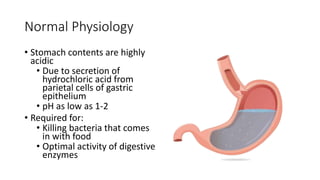
Normal Physiology
• Stomach contents are highly
acidic
• Due to secretion of
hydrochloric acid from
parietal cells of gastric
epithelium
• pH as low as 1-2
• Required for:
• Killing bacteria that comes
in with food
• Optimal activity of digestive
enzymes
Factors increasing gastric acid secretion
• Alcohol consumption
• Eating certain foods
• Spicy food
• Oily food
• Emotional stress:
• Anxiety
• Stress
• Smoking
• Certain Drugs, i.e. Aspirin
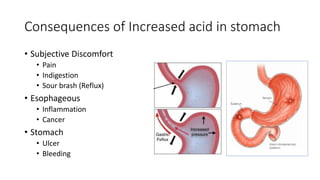
Consequences of Increased acid in stomach
• Subjective Discomfort
• Pain
• Indigestion
• Sour brash (Reflux)
• Esophageous
• Inflammation
• Cancer
• Stomach
• Ulcer
• Bleeding
Introduction
• Basic substances which neutralize gastric acid and raise pH of
gastric contents
• Includes:
• Aluminum Hydroxide, Magnesium Carbonate, And
Magnesium Trisilicate
• Are Available As Tablets And Liquids
• May be combined with:
• Simethicone: reduces flatulence
• Alginates: protects the lining of the esophagus (gullet) from
stomach acid
• Sodium Alginate And Alginic Acid
Antacids: Classification
• Systemic:
• Sodium bicarbonate
• Sodium citrate
• Non-systemic:
• Magnesium hydroxide
• Mag. Trisilicate
• Aluminium hydroxide gel
• Magaldrate
• Calcium carbonate
Antacids: Mechanism of Action
• Neutralises the gastric acid
• Acid Neutralising Capacity: number of mEq of 1N HCl that are brought to pH
3.5 in 15 min (or 60 min in some tests) by a unit dose of the antacid
preparation
• Leads to:
• Decrease in pain
• Allow the ulcers to heal
• Decreases the activity of pepsin
• Secreted as an inactive form, gets activated in pH < 4
• May lead to rebound acidity
Systemic antacids
• Sodium bicarbonate
• water soluble, acts instantaneously, but the duration of action is short
• Potent neutralizer (1 g → 12 mEq HCl), pH may rise above 7
• Disadvantages:
• Absorbed systemically: large doses will induce alkalosis.
• Produces CO2 in stomach → distention, discomfort, belching, risk of ulcer perforation
• Acid rebound occurs, but is usually short lasting
• Increases Na+ load: may worsen edema and CHF
• Uses:
• Casual treatment of heartburn
• Alkalinize urine and to treat acidosis
• Sodium citrate
• 1 g neutralizes 10 mEq HCl
• CO2 is not evolved
Non systemic antacids
• Insoluble and poorly absorbed basic compounds react in stomach to
form the corresponding chloride salt
• Chloride salt again reacts with the intestinal bicarbonate so that
HCO3¯ is not spared for absorption—no acid-base disturbance occurs
• However, small amounts that are absorbed have the same alkalinizing
effect as NaHCO3
Non systemic antacids
• Mag. Hydroxide:
• low water solubility: its aqueous suspension (milk of magnesia) has
low concentration of OH¯ ions and thus low alkalinity
• Reacts with HCl promptly and is an efficacious antacid (1 g → 30 mEq
HCl)
• Rebound acidity is mild and brief
Non systemic antacids
• Magnesium trisilicate
• Low solubility and reactivity
• 1 g can react with 10 mEq acid, but in clinical use only about 1 mEq is
neutralized
• About 5% of administered Mg is absorbed systemically—may cause problem if
renal function is inadequate
• All Mg salts have a laxative action by generating osmotically active MgCl2 in
the stomach and through Mg2+ ion induced cholecystokinin release
Non systemic antacids
• Aluminium hydroxide gel
• bland, weak and slowly reacting antacid
• Little acid neutralization obtained at conventional doses
• The Al3+ ions relax smooth muscle: delays gastric emptying (constipation)
• Binds phosphate in the intestine and prevents its absorption—
hypophosphatemia occurs on regular use leading to:
• osteomalacia
• Be used as therapeutically in hyperphosphatemia and phosphate stones.
• Small amount of Al3+ that is absorbed is excreted by kidney
• Aluminium toxicity (encephalopathy, osteoporosis) in renal failure
Non systemic antacids
• Magaldrate
• hydrated complex of hydroxymagnesium aluminate that initially reacts rapidly
with acid and releases alum. hydrox. which then reacts more slowly
• The freshly released alum. hydrox. is in the unpolymerized more reactive
form
• Thus, magaldrate cannot be equated to a physical mixture of mag. and alum.
Hydroxides
• It is a good antacid with prompt and sustained neutralizing action. Its ANC is
estimated to be 28 mEq HCl/g
Non systemic antacids
• Calcium carbonate
• Potent and rapidly acting acid neutralizer (1 g → 20 mEq HCl)
• ANC of commercial preparations is less and variable due to differing particle size and
crystal structure
• Though it liberates CO2 in the stomach at a slower rate than NaHCO3, it can cause
distention and discomfort
• Ca2+ ions are partly absorbed
• Increase HCl production directly by parietal cells as well as by releasing gastrin
• Mild constipation or rarely loose motions
• Can be dangerous in renal insufficiency
Antacid combinations
• Fast (Mag. hydrox.) and slow (Alum. hydrox.) acting components yield
prompt as well as sustained effect
• Mag. salts are laxative, while alum. salts are constipating:
combination may annul each other’s action and bowel movement
may be least affected
• Gastric emptying is least affected; while alum. salts tend to delay it,
mag./cal. salts tend to hasten it
• Dose of individual components is reduced; systemic toxicity
(dependent on fractional absorption) is minimized.
Conclusion
• Strong gastric acid is responsible for killing of micro-organisms
present with the food and for activation of pepsin enzyme
• Increased gastric acid secretion may present as subjective discomfort
to cancer of related organs
• Antacids can be both systemic and non-systemic
• Antacids differ and are compared in terms of acid neutralising
capacity
• Problems of one antacid can be minimised by using another antacid
Questions??
• Thank you..

Antacids

  • 1.
    Antacids Dr. Pravin Prasad MBBS,MD Clinical Pharmacology Assistant Professor, Department of Clinical Pharmacology Maharajgunj Medical Campus, TU 10 March 2020 (27 Falgun 2076), Tuesday
  • 2.
    By the endof this discussion, BDS 1st year students will be able to: • Discuss the rationale of having gastric acid in the stomach • Enlist the problems due to increased gastric acid secretion • Classify the drugs used as antacids • Understand the differences among drugs used as antacids • Explain the basis of combination of antacids
  • 3.
    Normal Physiology • Stomachcontents are highly acidic • Due to secretion of hydrochloric acid from parietal cells of gastric epithelium • pH as low as 1-2 • Required for: • Killing bacteria that comes in with food • Optimal activity of digestive enzymes
  • 4.
    Factors increasing gastricacid secretion • Alcohol consumption • Eating certain foods • Spicy food • Oily food • Emotional stress: • Anxiety • Stress • Smoking • Certain Drugs, i.e. Aspirin
  • 5.
    Consequences of Increasedacid in stomach • Subjective Discomfort • Pain • Indigestion • Sour brash (Reflux) • Esophageous • Inflammation • Cancer • Stomach • Ulcer • Bleeding
  • 6.
    Introduction • Basic substanceswhich neutralize gastric acid and raise pH of gastric contents • Includes: • Aluminum Hydroxide, Magnesium Carbonate, And Magnesium Trisilicate • Are Available As Tablets And Liquids • May be combined with: • Simethicone: reduces flatulence • Alginates: protects the lining of the esophagus (gullet) from stomach acid • Sodium Alginate And Alginic Acid
  • 7.
    Antacids: Classification • Systemic: •Sodium bicarbonate • Sodium citrate • Non-systemic: • Magnesium hydroxide • Mag. Trisilicate • Aluminium hydroxide gel • Magaldrate • Calcium carbonate
  • 8.
    Antacids: Mechanism ofAction • Neutralises the gastric acid • Acid Neutralising Capacity: number of mEq of 1N HCl that are brought to pH 3.5 in 15 min (or 60 min in some tests) by a unit dose of the antacid preparation • Leads to: • Decrease in pain • Allow the ulcers to heal • Decreases the activity of pepsin • Secreted as an inactive form, gets activated in pH < 4 • May lead to rebound acidity
  • 9.
    Systemic antacids • Sodiumbicarbonate • water soluble, acts instantaneously, but the duration of action is short • Potent neutralizer (1 g → 12 mEq HCl), pH may rise above 7 • Disadvantages: • Absorbed systemically: large doses will induce alkalosis. • Produces CO2 in stomach → distention, discomfort, belching, risk of ulcer perforation • Acid rebound occurs, but is usually short lasting • Increases Na+ load: may worsen edema and CHF • Uses: • Casual treatment of heartburn • Alkalinize urine and to treat acidosis • Sodium citrate • 1 g neutralizes 10 mEq HCl • CO2 is not evolved
  • 10.
    Non systemic antacids •Insoluble and poorly absorbed basic compounds react in stomach to form the corresponding chloride salt • Chloride salt again reacts with the intestinal bicarbonate so that HCO3¯ is not spared for absorption—no acid-base disturbance occurs • However, small amounts that are absorbed have the same alkalinizing effect as NaHCO3
  • 11.
    Non systemic antacids •Mag. Hydroxide: • low water solubility: its aqueous suspension (milk of magnesia) has low concentration of OH¯ ions and thus low alkalinity • Reacts with HCl promptly and is an efficacious antacid (1 g → 30 mEq HCl) • Rebound acidity is mild and brief
  • 12.
    Non systemic antacids •Magnesium trisilicate • Low solubility and reactivity • 1 g can react with 10 mEq acid, but in clinical use only about 1 mEq is neutralized • About 5% of administered Mg is absorbed systemically—may cause problem if renal function is inadequate • All Mg salts have a laxative action by generating osmotically active MgCl2 in the stomach and through Mg2+ ion induced cholecystokinin release
  • 13.
    Non systemic antacids •Aluminium hydroxide gel • bland, weak and slowly reacting antacid • Little acid neutralization obtained at conventional doses • The Al3+ ions relax smooth muscle: delays gastric emptying (constipation) • Binds phosphate in the intestine and prevents its absorption— hypophosphatemia occurs on regular use leading to: • osteomalacia • Be used as therapeutically in hyperphosphatemia and phosphate stones. • Small amount of Al3+ that is absorbed is excreted by kidney • Aluminium toxicity (encephalopathy, osteoporosis) in renal failure
  • 14.
    Non systemic antacids •Magaldrate • hydrated complex of hydroxymagnesium aluminate that initially reacts rapidly with acid and releases alum. hydrox. which then reacts more slowly • The freshly released alum. hydrox. is in the unpolymerized more reactive form • Thus, magaldrate cannot be equated to a physical mixture of mag. and alum. Hydroxides • It is a good antacid with prompt and sustained neutralizing action. Its ANC is estimated to be 28 mEq HCl/g
  • 15.
    Non systemic antacids •Calcium carbonate • Potent and rapidly acting acid neutralizer (1 g → 20 mEq HCl) • ANC of commercial preparations is less and variable due to differing particle size and crystal structure • Though it liberates CO2 in the stomach at a slower rate than NaHCO3, it can cause distention and discomfort • Ca2+ ions are partly absorbed • Increase HCl production directly by parietal cells as well as by releasing gastrin • Mild constipation or rarely loose motions • Can be dangerous in renal insufficiency
  • 16.
    Antacid combinations • Fast(Mag. hydrox.) and slow (Alum. hydrox.) acting components yield prompt as well as sustained effect • Mag. salts are laxative, while alum. salts are constipating: combination may annul each other’s action and bowel movement may be least affected • Gastric emptying is least affected; while alum. salts tend to delay it, mag./cal. salts tend to hasten it • Dose of individual components is reduced; systemic toxicity (dependent on fractional absorption) is minimized.
  • 17.
    Conclusion • Strong gastricacid is responsible for killing of micro-organisms present with the food and for activation of pepsin enzyme • Increased gastric acid secretion may present as subjective discomfort to cancer of related organs • Antacids can be both systemic and non-systemic • Antacids differ and are compared in terms of acid neutralising capacity • Problems of one antacid can be minimised by using another antacid
  • 18.

Editor's Notes

  • #14 On keeping it slowly polymerizes to variable extents into still less reactive forms. Thus, the ANC of a preparation gradually declines on storage Also, the product from different manufacturers may have differing ANCs; usually it varies from 1–2.5 mEq/g. Thus, 5 ml of its suspension may neutralize just 1 mEq HCl. As such, little worthwhile acid neutralization is obtained at conventional doses.
  • #16 The greatest drawback of CaCO3 as an antacid is that Ca2+ ions diffuse into the gastric mucosa—increase HCl production directly by parietal cells as well as by releasing gastrin. Acid rebound occurs. Mild constipation or rarely loose motions may be produced. The absorbed calcium can be dangerous in renal insufficiency.