GUNJAN SHARMA
Assistant Professor
Pragati College,
Choubey Colony
Raipur (CG)
INTRODUCTION
Microteaching is a teacher training
and faculty development technique
whereby the teacher reviews a
recording of a teaching session, in
order to get constructive feedback
from students. Microteaching was
invented in the year 1961 at Stanford
University by Dwight W. Allen.
MEANING OF MICROTEACHING
• Teaching of a small unit of content to the small group
of students (6-10 number) in a small amount of
time(5-10 min.)
• To train inexperience student-teachers for acquiring
teaching skills.
• To improve the skills of experience teachers.
DEFINITION
Allen D.W. (1966): Micro-teaching is a scaled down
teaching encounter size and class time.
Passi, B.K. (1976): The most important point in
microteaching is that teaching is practiced in
terms of definable, observable, measurable and
controllable teaching skills.
Brent & Thomson, 1966: Microteaching is a
technique aiming to prepare teacher candidates
to the real classroom setting.
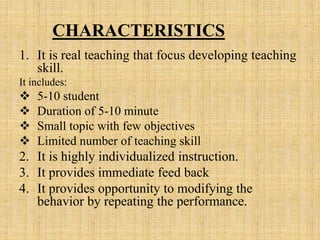
CHARACTERISTICS
1. It is real teaching that focus developing teaching
skill.
It includes:
 5-10 student
 Duration of 5-10 minute
 Small topic with few objectives
 Limited number of teaching skill
2. It is highly individualized instruction.
3. It provides immediate feed back
4. It provides opportunity to modifying the
behavior by repeating the performance.
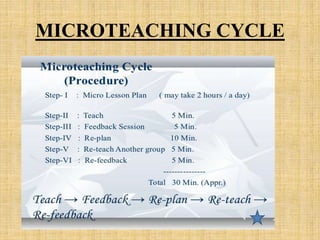
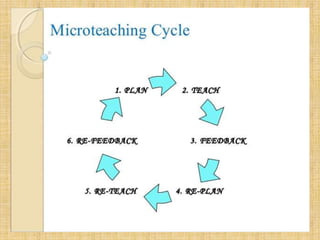
MICROTEACHING CYCLE
1. Writing instructional objectives
2. Introducing a lesson
3. Fluencing in questioning
4. Probing question
5. Explaining
6. Illustrating with example
7. Stimulus variation
8. Reinforcement of learning
9. Nonverbal clues
10.Increasing student participation
11.Using blackboard
12.Achieving closure
13.Recognizing attending behavior
TEACHING SKILLS:
ADVANTAGES
 Modification of teacher behaviour
Knowledge of teaching skills
Developing teaching skills
Developing teaching efficiency
Improving teaching practice
Individualised training
Regulating teaching practice
Real teaching
Reducing complexities
Focus on teaching
Continuous reinforcement
DISADVANTAGES
•It is skill oriented; Content not emphasized.
•A large number of trainees cannot be given the
opportunity for re-teaching and re-planning.
•It is very time consuming technique.
•It requires special classroom setting.
•It covers only a few specific skills.
•It deviates from normal classroom teaching.
•It may raise administrative problem while arranging
micro lessons
Microteaching involves presentation of micro
lesson
Audience..Small group of peers.
Feedback given by peers role playing as students
Participants learn about strengths & weakness in
themselves as teachers.
Plan strategies for improvement in performance.
SUMMARY:
Micro- teaching

Micro- teaching

  • 1.
    GUNJAN SHARMA Assistant Professor PragatiCollege, Choubey Colony Raipur (CG)
  • 2.
    INTRODUCTION Microteaching is ateacher training and faculty development technique whereby the teacher reviews a recording of a teaching session, in order to get constructive feedback from students. Microteaching was invented in the year 1961 at Stanford University by Dwight W. Allen.
  • 3.
    MEANING OF MICROTEACHING •Teaching of a small unit of content to the small group of students (6-10 number) in a small amount of time(5-10 min.) • To train inexperience student-teachers for acquiring teaching skills. • To improve the skills of experience teachers.
  • 4.
    DEFINITION Allen D.W. (1966):Micro-teaching is a scaled down teaching encounter size and class time. Passi, B.K. (1976): The most important point in microteaching is that teaching is practiced in terms of definable, observable, measurable and controllable teaching skills. Brent & Thomson, 1966: Microteaching is a technique aiming to prepare teacher candidates to the real classroom setting.
  • 5.
    CHARACTERISTICS 1. It isreal teaching that focus developing teaching skill. It includes:  5-10 student  Duration of 5-10 minute  Small topic with few objectives  Limited number of teaching skill 2. It is highly individualized instruction. 3. It provides immediate feed back 4. It provides opportunity to modifying the behavior by repeating the performance.
  • 6.
  • 9.
    1. Writing instructionalobjectives 2. Introducing a lesson 3. Fluencing in questioning 4. Probing question 5. Explaining 6. Illustrating with example 7. Stimulus variation 8. Reinforcement of learning 9. Nonverbal clues 10.Increasing student participation 11.Using blackboard 12.Achieving closure 13.Recognizing attending behavior TEACHING SKILLS:
  • 10.
    ADVANTAGES  Modification ofteacher behaviour Knowledge of teaching skills Developing teaching skills Developing teaching efficiency Improving teaching practice Individualised training Regulating teaching practice Real teaching Reducing complexities Focus on teaching Continuous reinforcement
  • 11.
    DISADVANTAGES •It is skilloriented; Content not emphasized. •A large number of trainees cannot be given the opportunity for re-teaching and re-planning. •It is very time consuming technique. •It requires special classroom setting. •It covers only a few specific skills. •It deviates from normal classroom teaching. •It may raise administrative problem while arranging micro lessons
  • 12.
    Microteaching involves presentationof micro lesson Audience..Small group of peers. Feedback given by peers role playing as students Participants learn about strengths & weakness in themselves as teachers. Plan strategies for improvement in performance. SUMMARY: